
[nextpage title=”Introduction:”]
This is it, D-Day, the end of the NDA for the NVIDIA RTX 5080 Founders Edition graphics cards announced at CES 2025. We’ve already had the opportunity to bring you a review of the NVIDIA RTX 5090 Founders Edition on January 23. Tomorrow at 3pm we’ll be bringing you the three custom models we’ve received: the ROG Astral RTX 5080 OC Edition, the PNY RTX 5080 and the AORUS RTX 5080 Master.
You’ll finally find out where the performance of this new NVIDIA RTX 5080 Founders Edition stands in relation to the previous generation and the potential of DLSS 4 on this model. This new card will be available on January 30 on the NVIDIA website at the rather attractive price of 1179 euros. This is the MSRP price, but as you might expect, the vast majority of custom cards will be more expensive. Just to take you back a little further, the MSRP for the RTX 4080 FE at launch was 1469 euros, and for the RTX 4080 Super FE it was 1109 euros.

So today we’re going to focus on the performance of this new-generation RTX 5080 model, which on paper looks promising and could be of interest to many gamers with ageing graphics cards. We haven’t made an unboxing video for this model, as the card has identical packaging to the RTX 5090 Founders Edition and a common design. You can watch the RTX 5090 unboxing video here. Thank you to NVIDIA France for providing us with a copy of this RTX 5080 Founders Edition model.
[nextpage title=”The NVIDIA RTX 5080 Founders Edition:”]
Architecture :
As a reminder, the cards in the “Founders Edition” series are unique models offered by NVIDIA. The main advantage of these cards is that they are offered at a “locked-in” price, which will not change in the coming weeks or months, unless the price goes down. NVIDIA ‘s partners will also be offering their own models. Visually, NVIDIA has radically changed its design, moving to a 2-slot wide card that will be SFF-Ready. We’ll be coming back to this new design in more detail later in this article.
This NVIDIA RTX 5080 benefits from the Blackwell architecture and retains a 4 nanometre engraving finesse, but switches to the TSMC N4P process, enabling greater transistor density and improved energy efficiency. This architecture features new 5th generation Tensor Cores and 4th generation Ray Tracing Cores. The 5th generation Tensor Cores will provide support for the FP4 (Floating Point 4 bits) format, which will double the computation performance of neural models while halving the memory footprint. We’ll be coming back to this development during our tests, in particular with the UL Procyon software that we’ve been using for several weeks now.
Of course, DLSS 4 support cannot be overlooked. This new RTX 5080 is equipped with 10,752 CUDA Cores, compared with 21,760 for the RTX 5090 version.


There’s also something new on the memory front, with 16GB of GDDR7 memory (30 Gbps). As for the TDP, it’s announced at 360 watts. But let’s move on to the new packaging for this series.
The Founders Edition bundle:
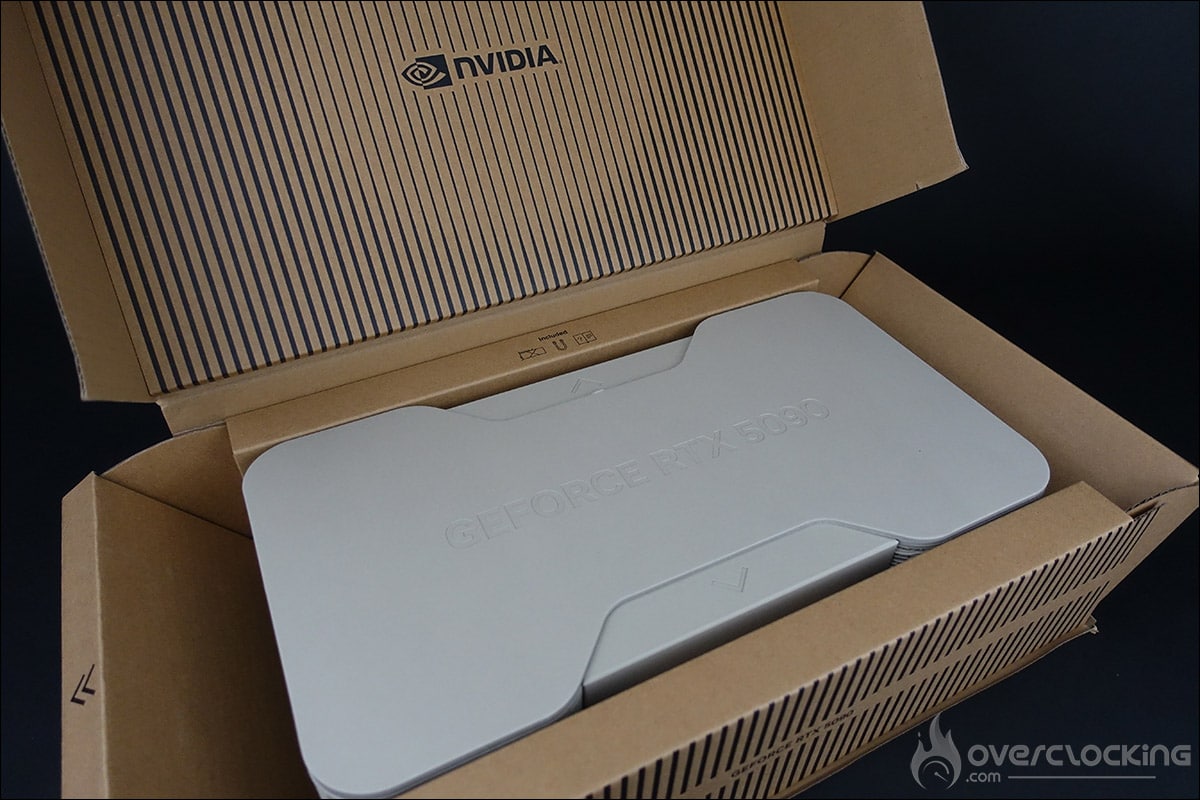
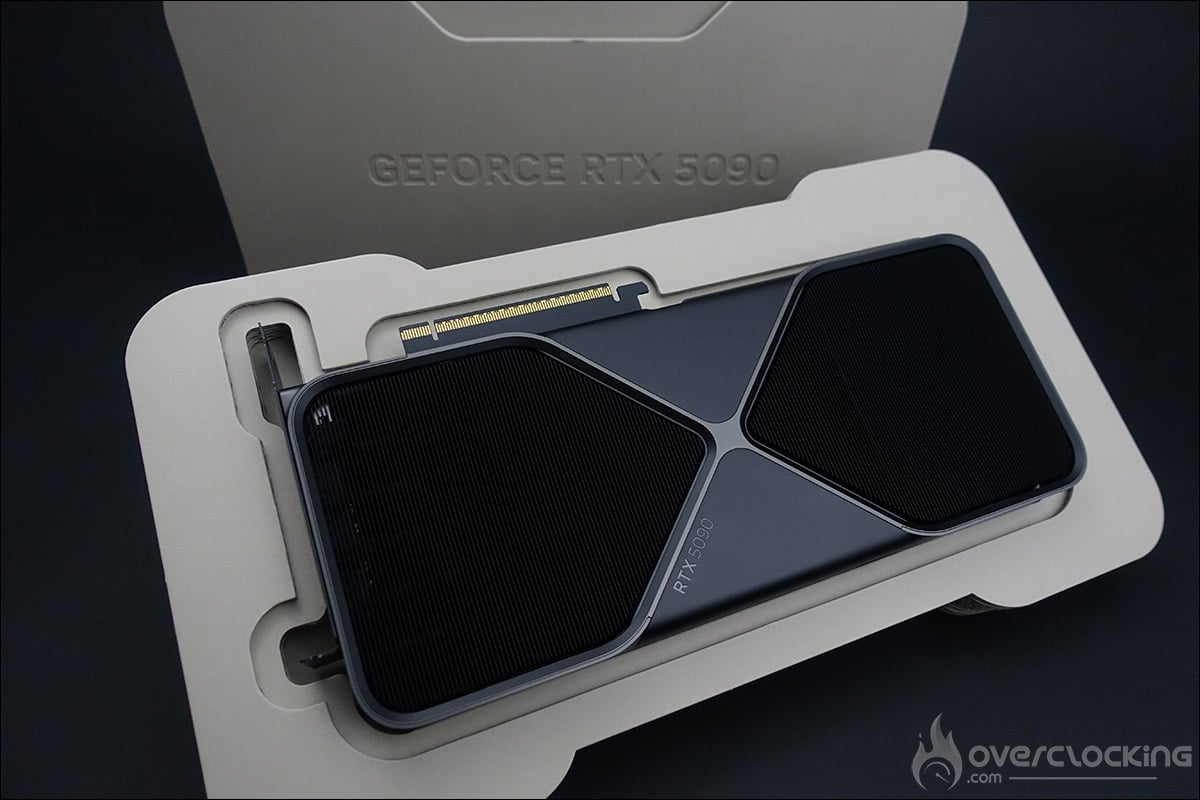
The first thing that strikes you is the size of the box, which is more imposing in terms of dimensions when compared to previous generation cards. Despite this, NVIDIA says it has halved the packaging of this NVIDIA RTX 5080 Founders Edition compared to the ADA Lovelace cards, because there’s a little surprise. As with the previous generation, the card arrives in a cardboard box, but here, this cardboard box is actually the packaging for our RTX 5080 FE, whereas with the RTX 4000s, the cardboard box was merely a protective layer before we discovered the graphics card’s ‘real box’ (click here to remember). We’ve taken a large proportion of the photos of the RTX 5090 Founders Edition, as the two are perfectly identical apart from a lighter grey colour for the RTX 5080 FE.
Ecologically, the first good point for the greens, and you’ll see that this isn’t the only effort made, since there’s no plastic and the whole thing is made from paper fibres. The cardboard tab that seals the box reveals the following annotation: ” Inspired by Gamers. Enhanced by AI. Built by NVIDIA “. It says it all: gamers, artificial intelligence and NVIDIA.
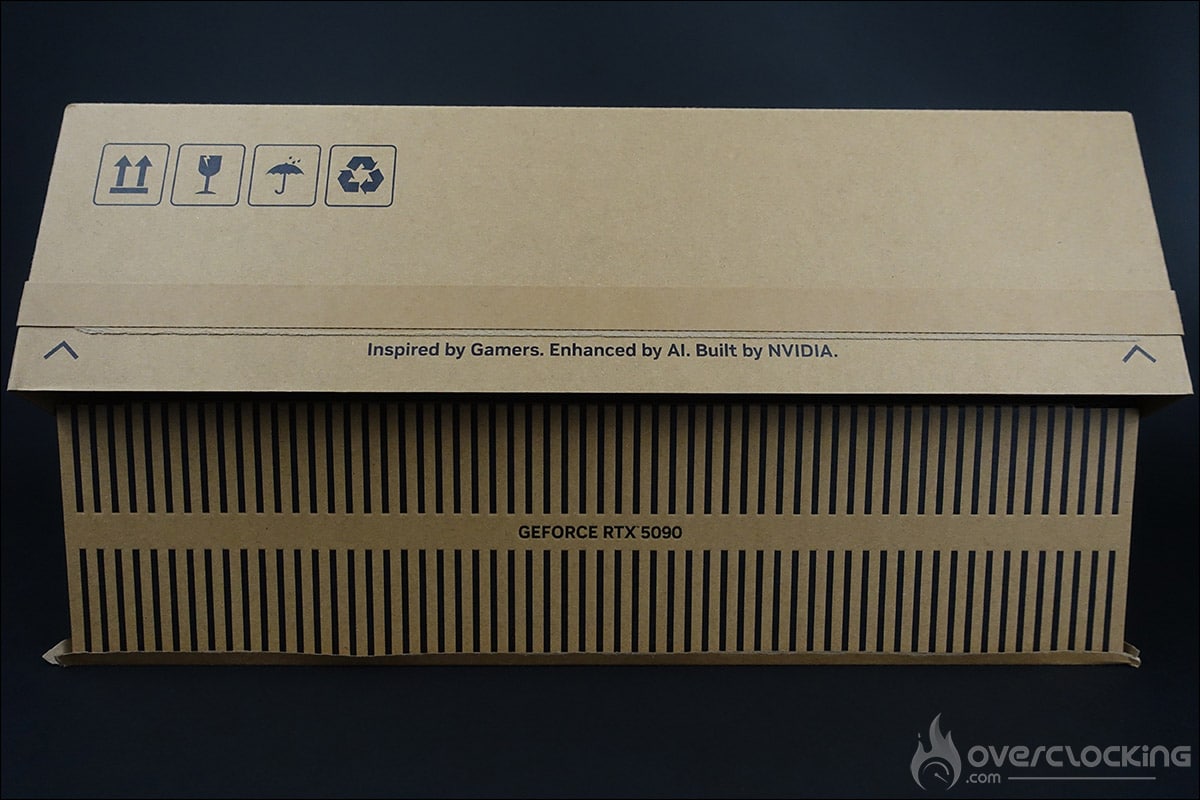
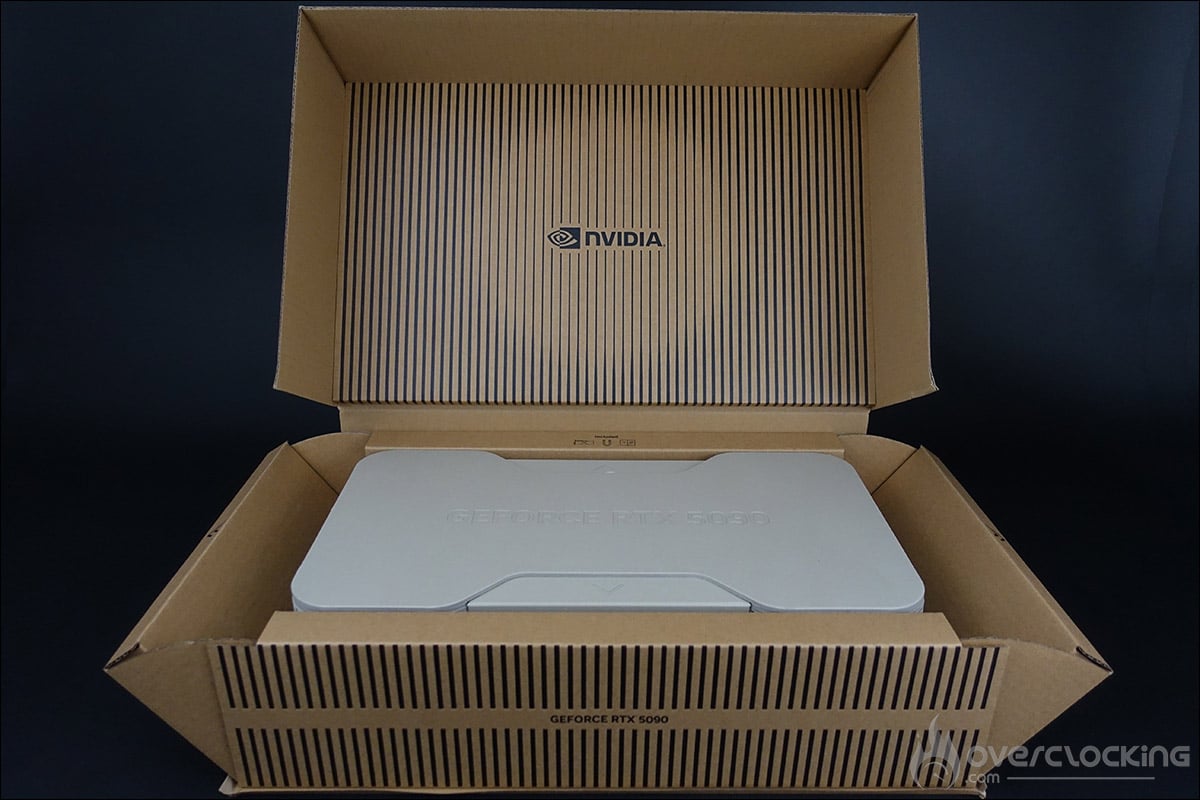
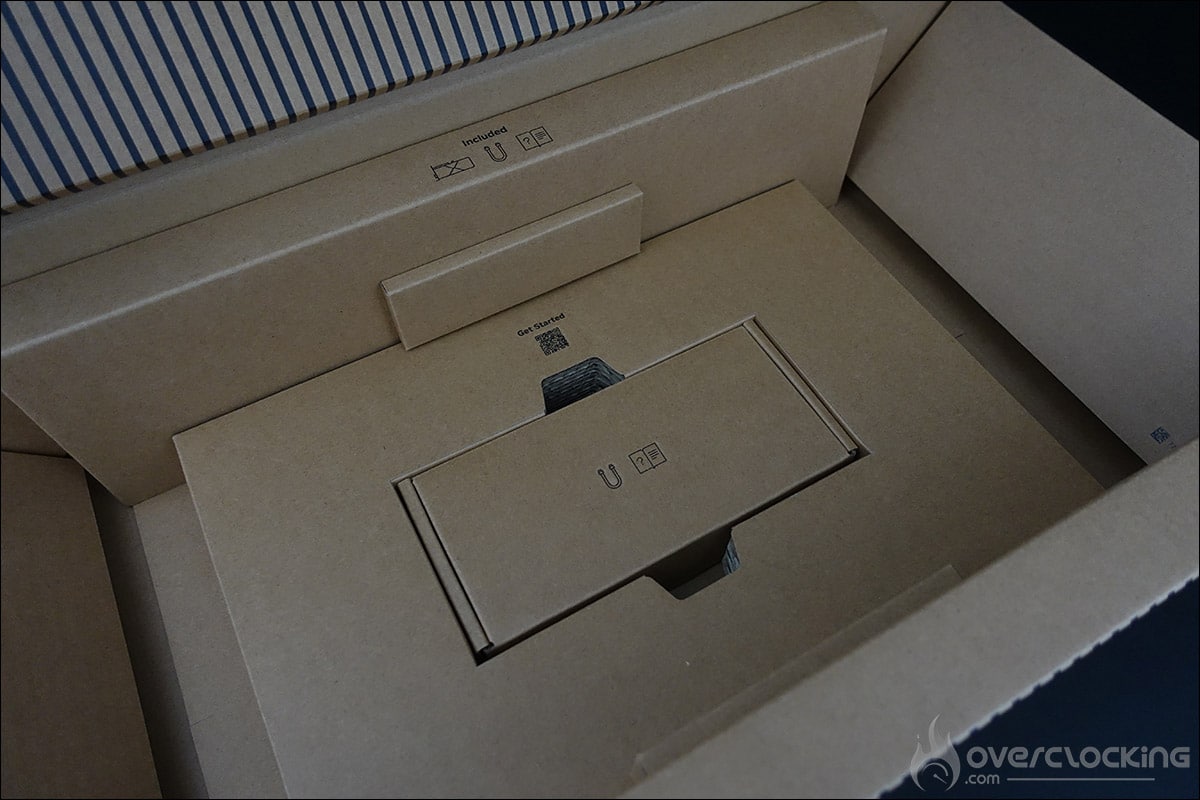
So what does this new box have in store for us? As usual, NVIDIA has taken great care with the packaging, offering a cardboard box in which to hide our copy of the NVIDIA RTX 5080 Founders Edition. It’s always very exciting to discover the new packaging offered by NVIDIA for the arrival of a new generation. The box opens at the front and conceals a second cardboard box in the centre, the top of which is engraved with the words “GeForce RTX 5080”.
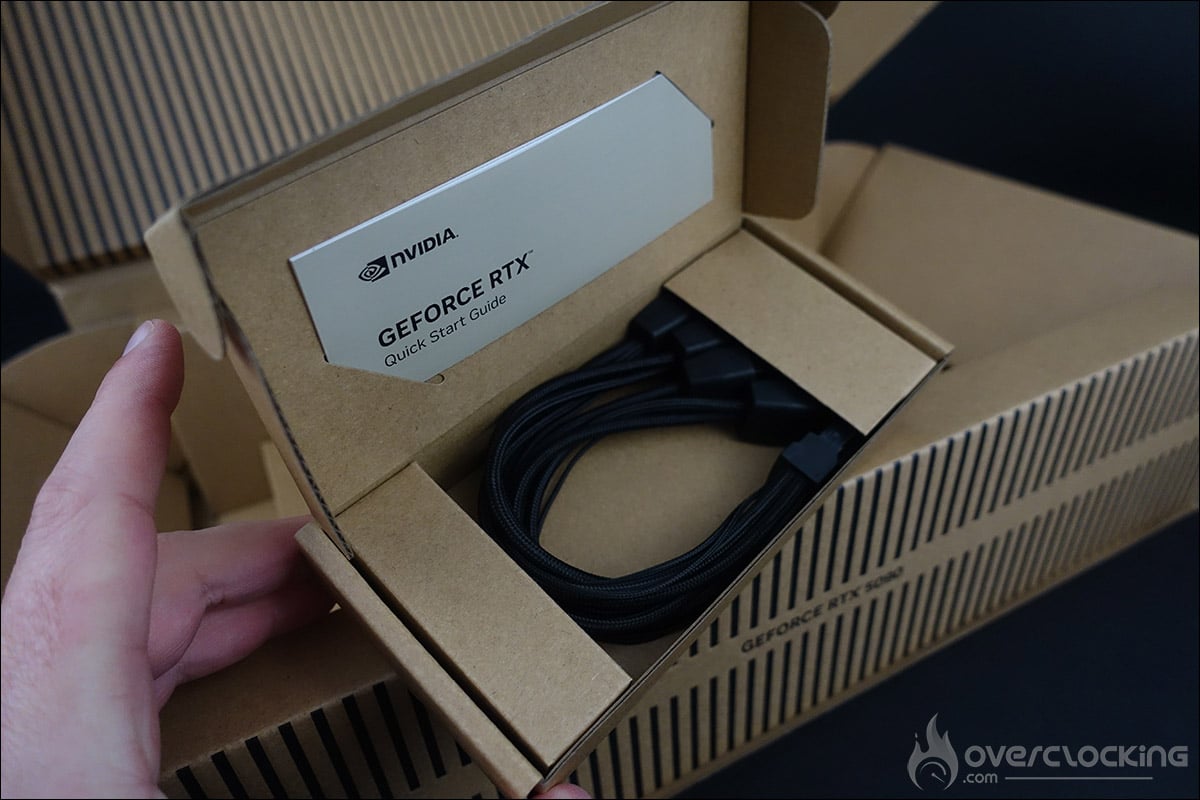
When this is removed, a small box is revealed, containing the card’s power adapter and a quick-start guide. Note that the adapter is a 3 x PCIe 8-pin model to be compatible with your power supply, if you don’t have the 12V-2×6 connector. NVIDIA recommends a minimum power supply of 850 watts.
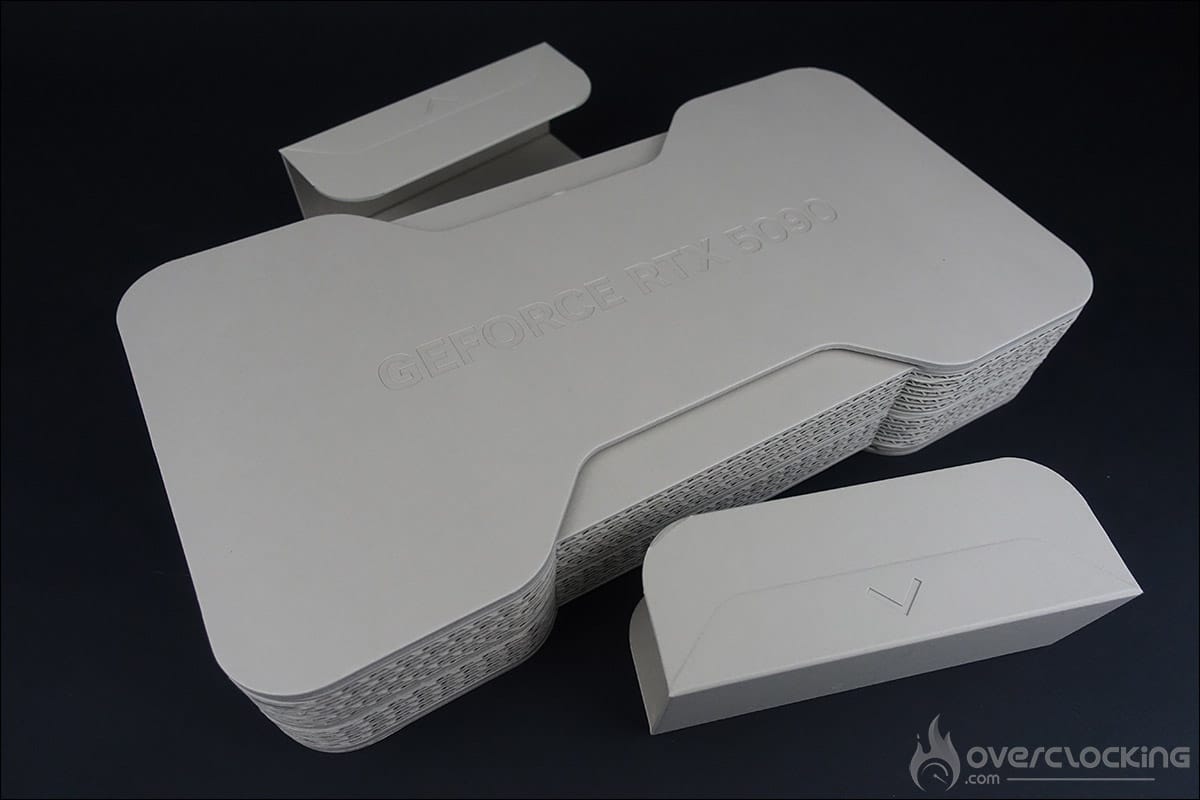
To access and discover our NVIDIA RTX 5080 Founders Edition, all you have to do is slide out the top and bottom cardboard boxes, which hold the two sides of the box together. NVIDIA is therefore playing the eco-responsible card with the packaging of this Founders Edition, and we can only agree!
NVIDIA RTX 5080 Founders Edition:
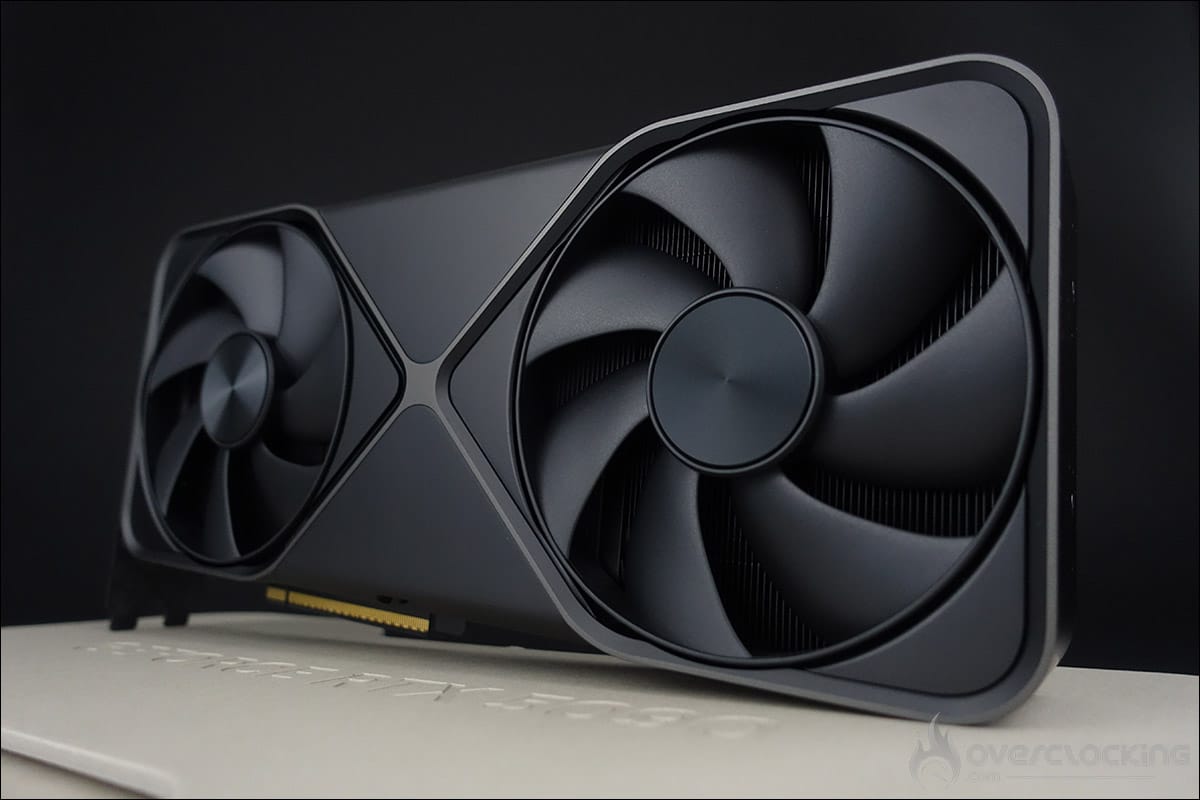
The card is 304 mm long, 137 mm high and 2 slots (40 mm) thick, which means it can be labelled SFF-Ready. This means it can be inserted into a case compatible with the Small Form Factor for anyone who decides to design a compact configuration.
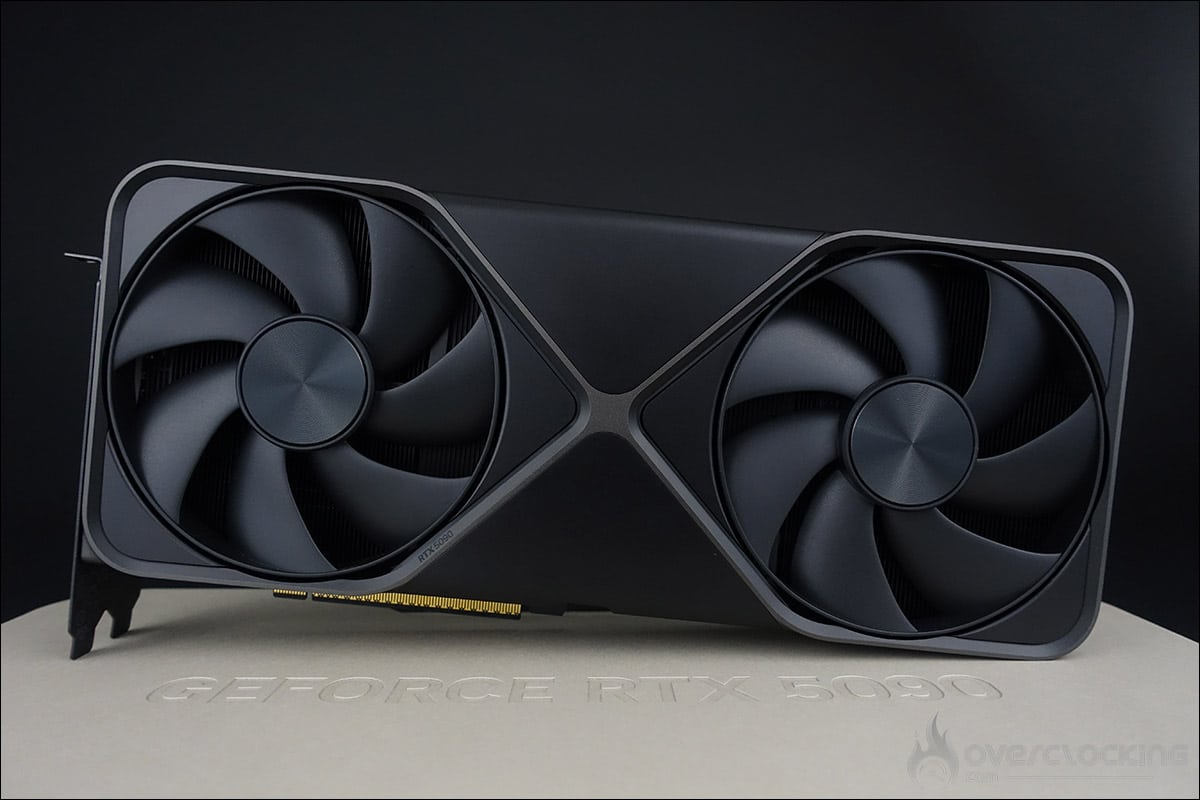
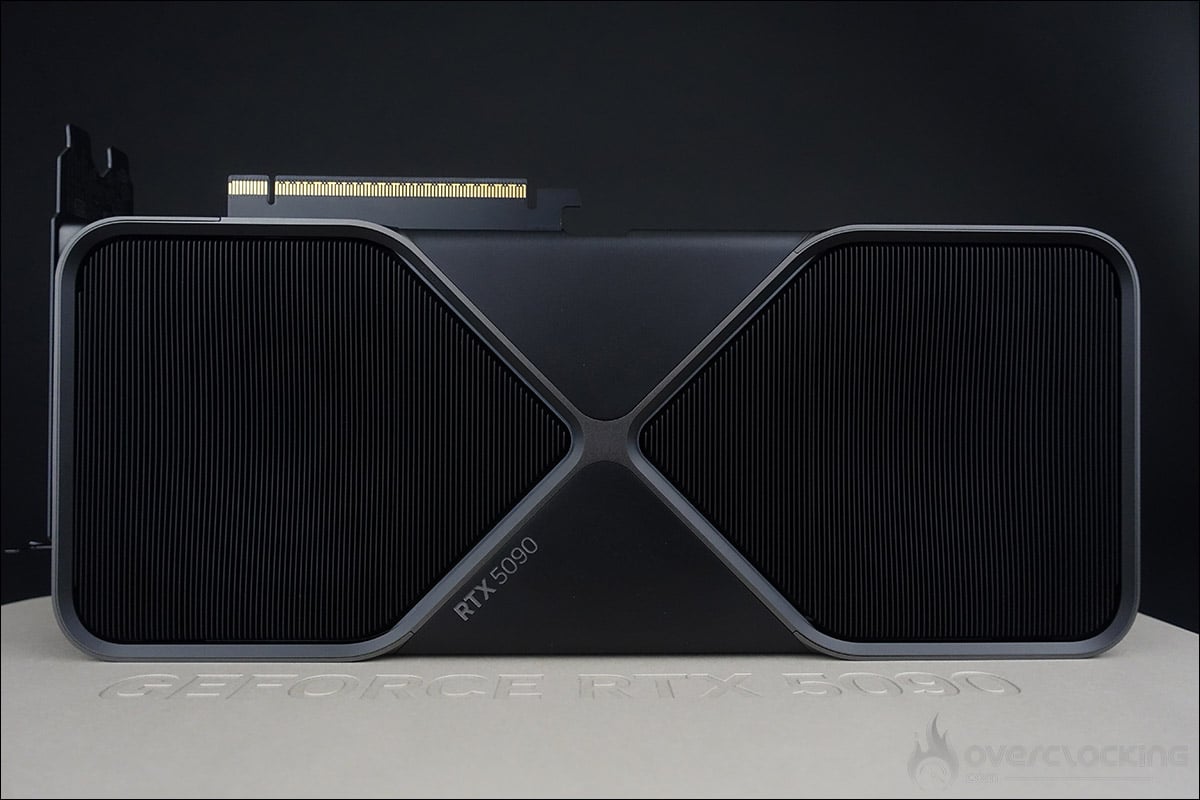
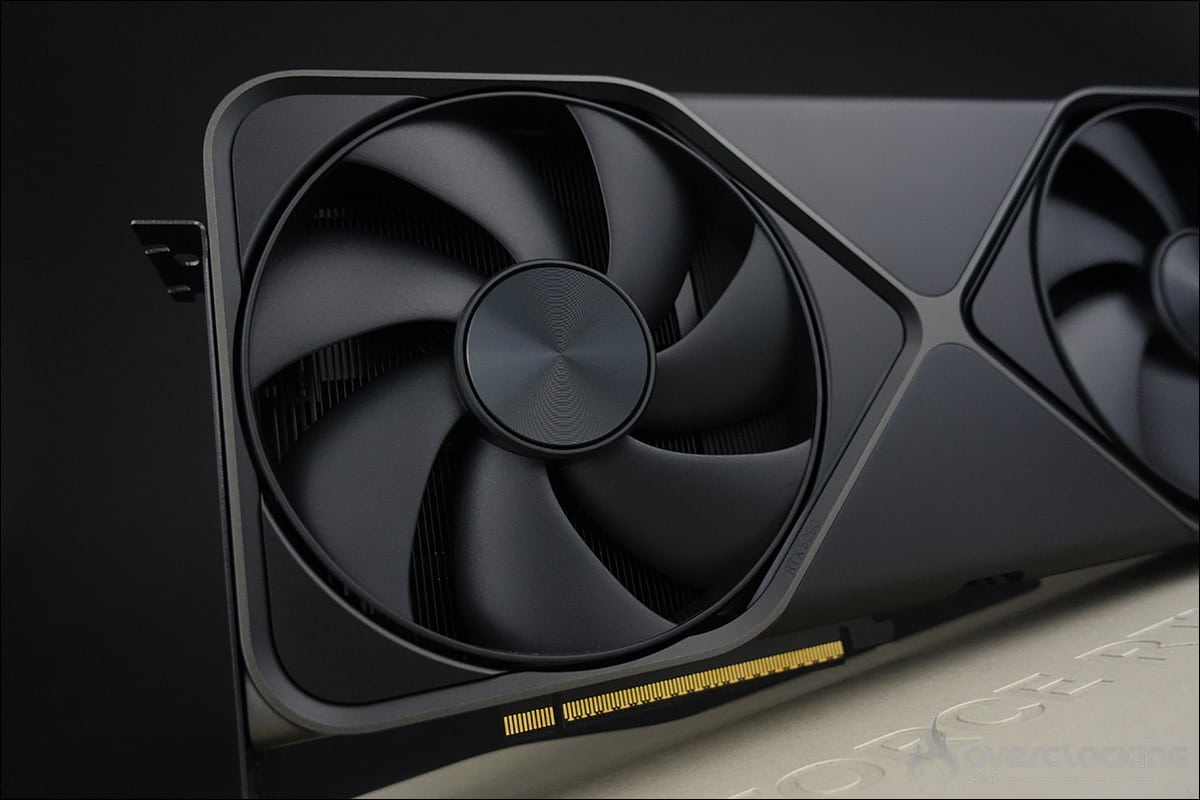
During the press presentation, NVIDIA talked about its new cooling system, which allows our NVIDIA RTX 5080 Founders Edition to be only two slots thick while still being able to dissipate 360 watts, which is, let’s face it, a technical feat. There are two 115 mm fans that draw in cool air from the bottom of your case, which is then evacuated by the fans at the top.
As we already hinted at in this brief, the internal design is made up of three elements: the PCB with the graphics chip, memory chips and power stages, a PCB with the PCIe Gen5 connector and finally a PCB in charge of the video ports linked by a flexible cable to the central PCB.
NVIDIA also took the opportunity to look back at the first generations of Founders Edition boards to show how the cooling system has evolved. And so we come to our RTX 5080 Founders Edition, which benefits from what we call dual-flow cooling. The two fans blow the air directly through the radiator.
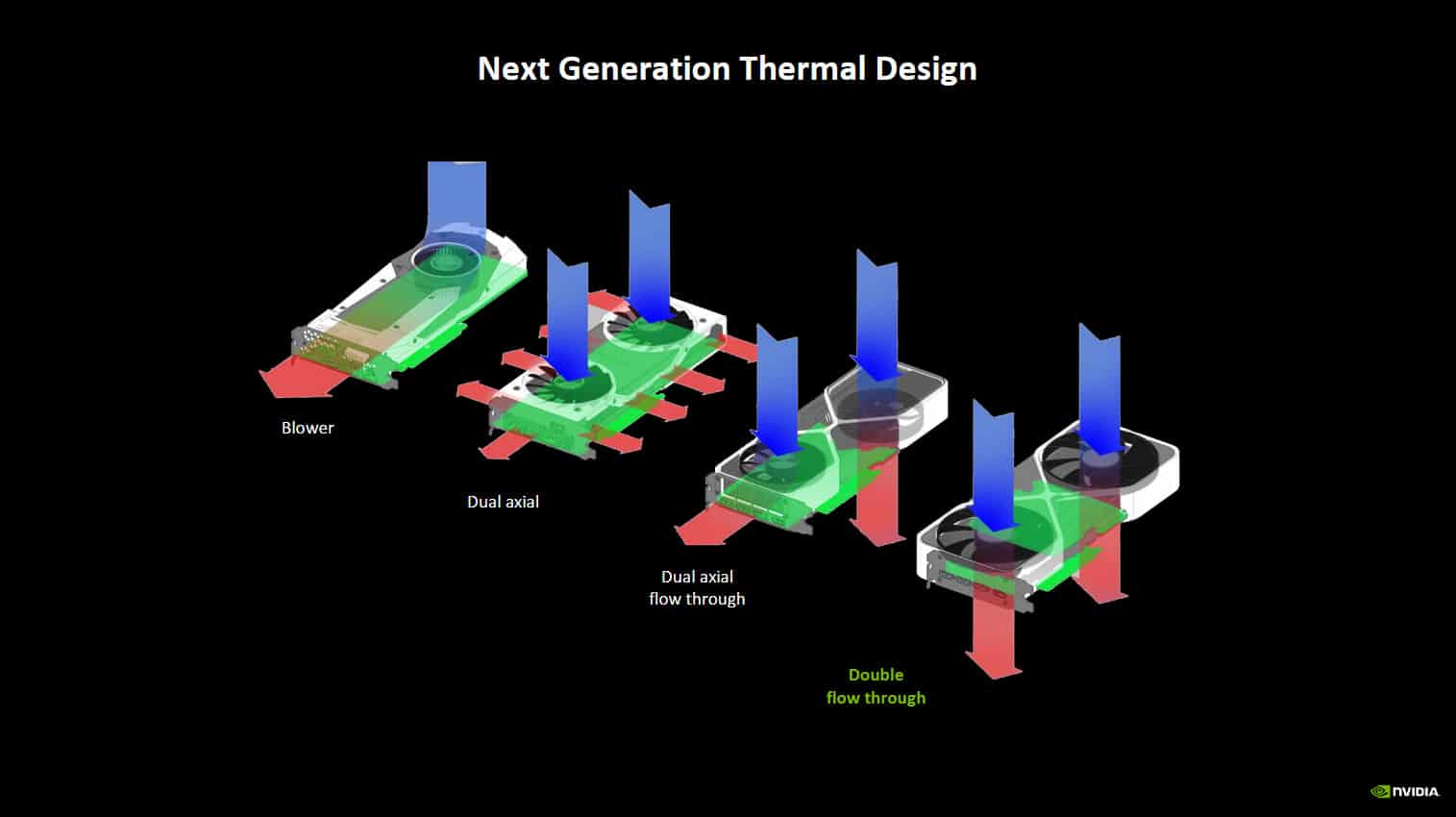
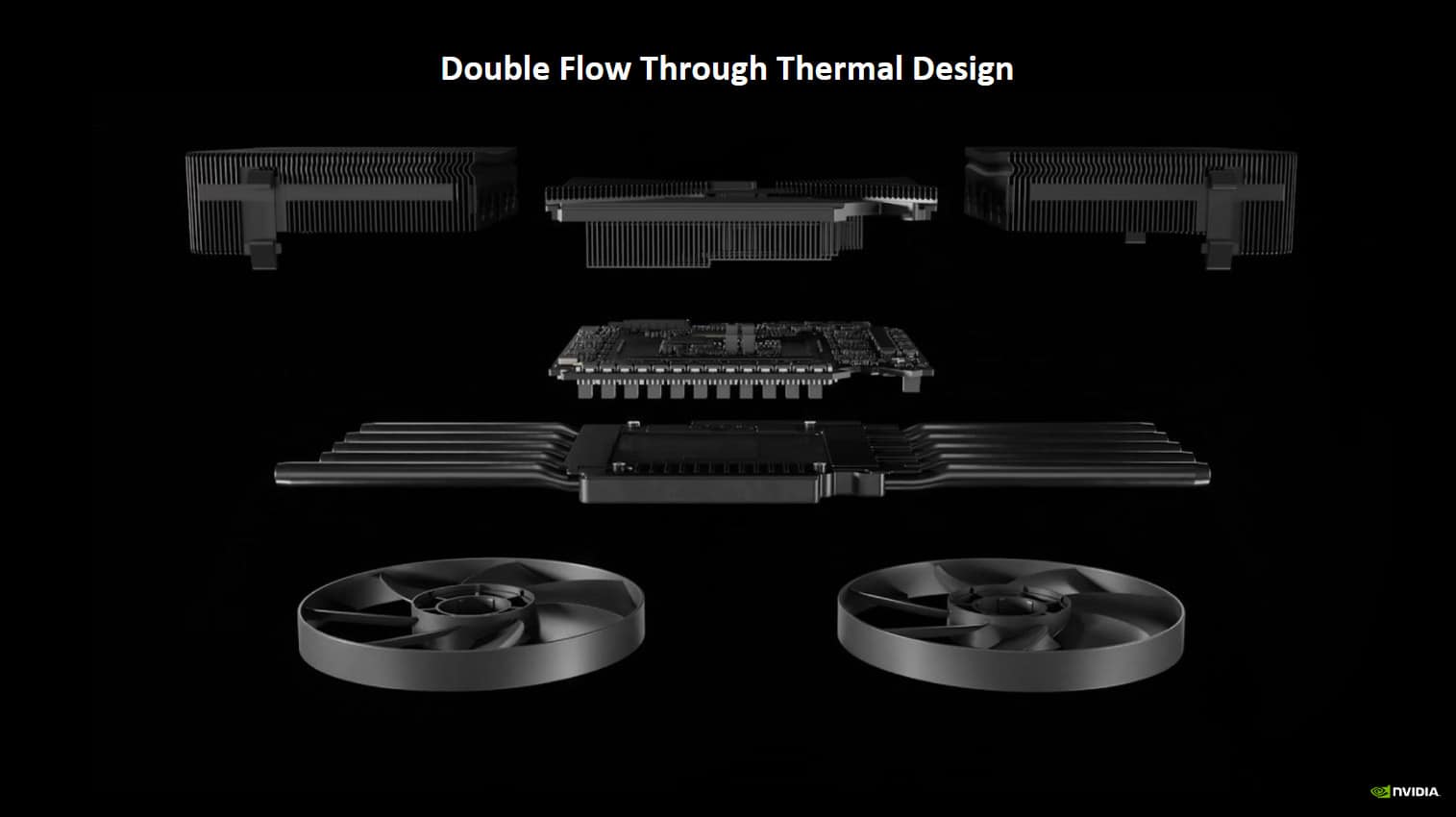
What’s important to understand is that the two fans blow on the radiator through which the heat pipes pass, which are inserted into the steam chamber responsible for dissipating the heat from the central PCB components. It’s not possible to see this in our photos, but as der8auer noticed, the fins of the radiator gradually curve to optimise the airflow. As for the thermal paste, it has been replaced by liquid metal, which offers better heat exchange and saves a few degrees compared to traditional thermal paste. This new cooling system has therefore been completely redesigned, and must have required many hours of testing.
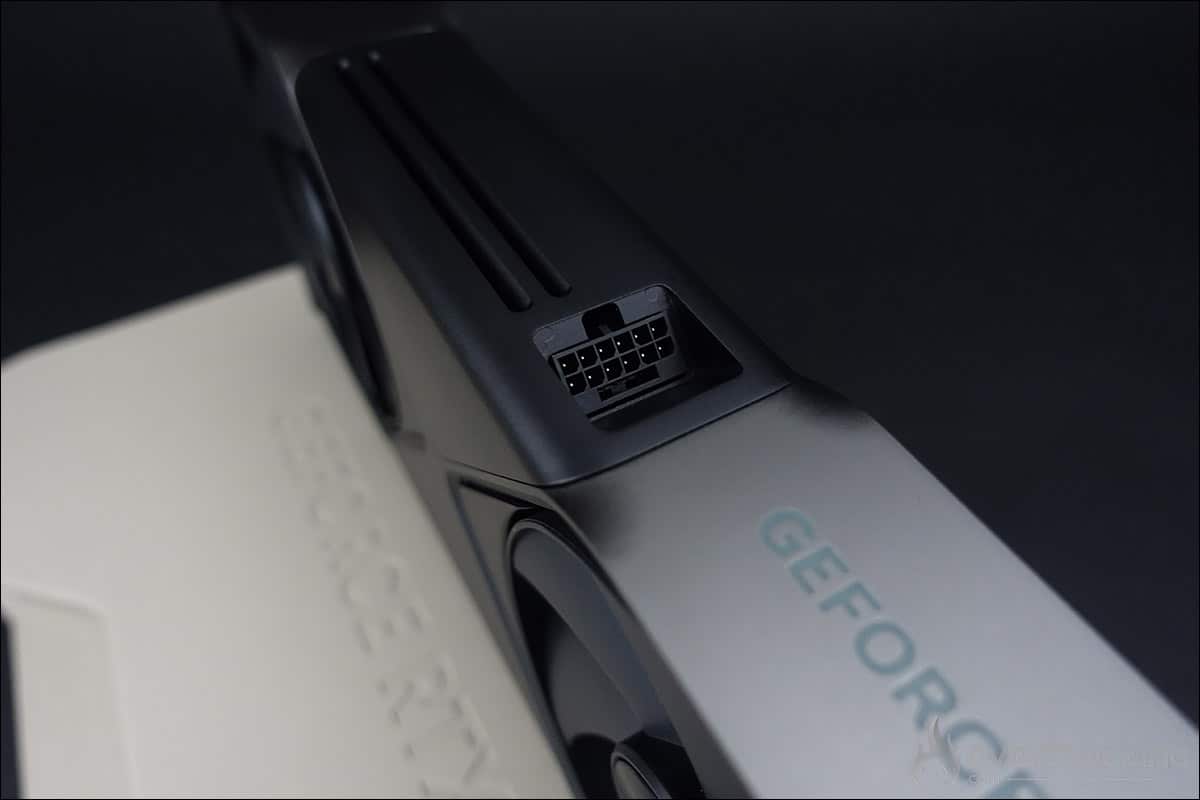
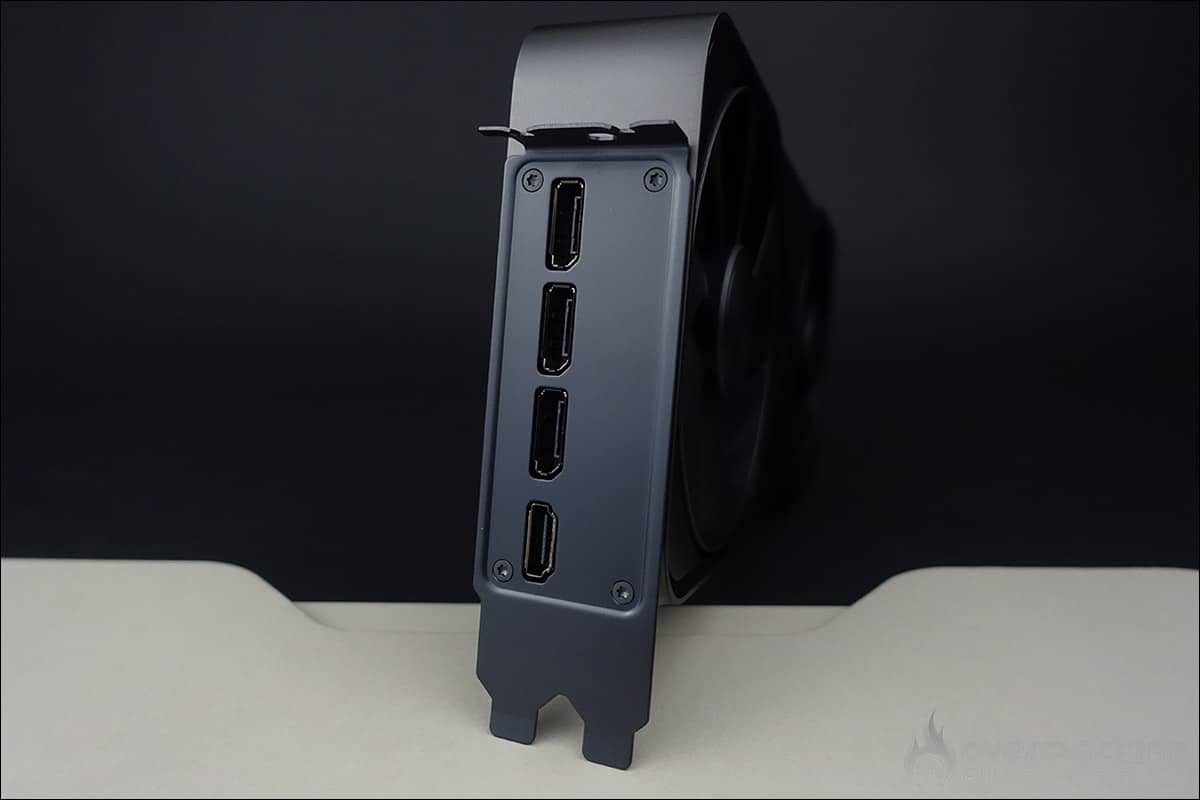
Finally, to power the card, there is a single 12V-2×6 connector, but you can use the 3 x PCIe 8-pin adapter supplied in the bundle by NVIDIA. Note that its position has changed compared to the previous generation. Aesthetically, it will be more difficult to hide the power cable. As for video, you’ll get three DisplayPort 2.1b with UHBR20 and one HDMI 2.1b. NVIDIA has even gone so far as to offer a bracket in matt grey, rather than metallic.
[nextpage title=”Full of new technologies:”]
DLSS4: what’s new?
With the announcement of its new range of graphics cards, the GeForce RTX 5090, RTX 5080, RTX 5070 Ti and RTX 5070, it was also an opportunity for the Greens to announce the arrival of DLSS 4, the fourth generation of Deep Learning Super Sampling combined with Multi Frame Generation (MFG). As a reminder, the Blackwell architecture features new 5th generation Tensor Cores and 4th generation Ray Tracing Cores. It is these hardware innovations from Blackwell and DLSS that will enable MFG, which would have been technically impossible on the previous generation ADA Lovelace.
According to NVIDIA, Multi Frame Generation will deliver up to 8 times better performance in games such as Cyberpunk 2077 compared with raw image rendering. Up to 15 of the 16 pixels per frame are generated by the AI. It will also be possible to reach 240 FPS in 4K ray tracing, and to use path tracing in compatible games.

So what will this new generation bring compared with the previous one? The main difference lies in Frame Generation. Whereas with the RTX 4000, DLSS 3 was able to insert an additional frame between two native frames, DLSS 4 will be able to insert up to three, hence the addition of the term Multi FG. This means you can choose to generate a single image (x2) for the RTX 40 and RTX 50 series, two images (x3) for the RTX 50 series or three images (x4) for the RTX 50 series.


The AI will generate up to three images, which will increase the number of FPS, resulting in smoother gameplay and lower memory consumption thanks to the RTX Neural Shaders , which can be used to compress textures. This new AI model is 40% faster, uses 30% less VRAM and only needs to run once per rendered image to generate multiple images. The only downside is that these AI-created images will add latency due to the creation process, but NVIDIA will be introducing Reflex 2, which we’ll come back to later in this article.
One thing is certain, NVIDIA is reaping the benefits of having jumped on the AI bandwagon very quickly and is now benefiting from its many years of research in the face of the competition. It’s important to realise that it’s no longer possible to increase raw performance by 25-30% with each generation of graphics cards – it’s the same problem faced by processors, for example. So it was NVIDIA’s choice to integrate AI into its cards in order to offer upscaling.

DLSS 4 is only compatible with this new generation of RTX 5000, but the other accompanying technologies will have a positive impact on previous generations. The RTX 5000 and 4000 will also benefit from the improved Frame Generation, with a gain of between 5 and 10% according to NVIDIA, and with lower memory consumption.
As soon as the RTX 5000s arrive, i.e. at the end of January, on the 30th to be precise, 75 games and applications will be compatible with DLSS 4 at launch, including Alan Wake 2, Cyberpunk 2077, Indiana Jones and the Great Circle, and Star Wars Outlaws.
The new ‘Transformer’:
DLSS 4 features an updated architecture for DLSS Ray Reconstruction, DLSS Super Resolution and DLAA. Previously, DLSS used convolutional neural networks (CNNs) to generate new pixels, and this has now been replaced by the new Transformer. This should offer greater stability, fewer ghost images, more detail on moving objects and smoother edges.

This could translate into the possibility of using a Performance mode for the DLSS, which would no longer be visually average, but could approach the Balanced/Quality mode on the previous-generation CNN model. Of course, this will have to be tested and compared in terms of image quality between the RTX 4000 and RTX 5000. It will also be relevant to compare the different DLSS modes in terms of image quality.


The new Transformer will offer improved image quality in Ray Reconstruction, such as the image on the left in Alan Wake 2 with the chain-link fence. The image on the right shows the improvement in detail between the CNN model and this new generation model.
Reflex 2 technology:
As we said earlier, Multi Frame Generation will allow you to increase the number of FPS, but will add latency because of the creation process. NVIDIA will therefore be offering its version 2 for Reflex. It’s especially in competitive games that these few milliseconds will really make a difference.


NVIDIA Reflex 2 will combine Reflex Low Latency mode with Frame Warp technology and will be compatible with all RTXs. The idea, of course, is to reduce latency, i.e. the time that elapses between the moment you click your mouse button and its appearance on the screen, by displaying a predictive image that is as close as possible to reality. Reflex 2 will be available in the coming weeks.
Override DLSS or the replacement for DLSS :
NVIDIA’s latest application, NVIDIA App, will allow games that have not yet been updated to the latest DLSS models and features to enable support via a DLSS override. The version of the app we will be testing is a press version, and the DLSS replacement options are available in the Graphics > Program Settings screen under Driver Settings.

We will of course be testing Override DLSS during this test to see how easy it is to use. We’ve made an initial assessment of these new technologies, even if we haven’t gone into detail about everything the new NVIDIA RTX 5080 Founders Edition has to offer. You should know that it has three 9th-generation encoders and a new 6th-generation decoder. The three encoders should logically accelerate rendering speed.
[nextpage title=”Technical specifications:”]
A quick trip to GPU-Z to check that the information read is correct. As you can see, this is not yet entirely the case. A new version of GPU-Z will almost certainly be posted on January 30, the day the RTX 5090 and RTX 5080 are launched. In the meantime, we can still learn a few things from our copy of the NVIDIA RTX 5080 Founders Edition.
In terms of frequency, GPU-Z has announced a base frequency of 2295 MHz and a boost frequency of 2617 MHz for this NVIDIA RTX 5080 Founders Edition. The card has 16 GB of GDDR7 memory (480 GB/s) on a 256-bit bus. This model has the frequencies imposed by NVIDIA, but custom boards can offer factory overclocking depending on their cooling system. That’s what we’ll be looking at tomorrow, when we test our three examples.
Don’t forget that the GPU frequency could be higher during benchmarks, depending on the quality of your chip and the cooling system used.

In fact, we carried out a test using 3DMark Time Spy to observe the GPU boost frequency. We can see that it reaches the maximum frequency of 2865 MHz at certain times. The memory frequency remains unchanged, which is perfectly normal. GPU-Z reports a maximum TDP of 93.7%, which means we still have some way to go to reach 100%.

As far as temperatures are concerned, it climbs to 65.3°C and the memory to 68°C. At the time of this first test, it was 19°C in the lab. We’ll have to check the temperatures during our more in-depth tests. The fans are far from running at maximum speed and the card is fairly silent. As a reminder, we’re on a bench and not inside a case. Let’s get testing!
[nextpage title=”The test configuration: “]
As we said in the introduction, we’ve updated all our graphics using the latest drivers from NVIDIA, AMD and, of course, INTEL. We also took the opportunity to slightly modify our test configuration and add some new games to our protocol. So here we go again, with a new series of tests and graphics on this slightly modified configuration:
- Motherboard: ROG Maximus Z790 APEX Encore
- Processor : Intel Alder Lake i9-14900K delid
- Cooling system: EK-Nucleus AIO CR360 Direct Die D-RGB – 1700
- Memory: 48 GB Corsair Dominator Titanium 8000 MT/s CL38
- Graphics card: NVIDIA RTX 5080 FE, NVIDIA RTX 5090 FE, ASUS RTX 4090 TUF OC, NVIDIA RTX 4080 Super FE, NVIDIA RTX 4080 FE, AMD RX 7900 XTX and AMD RX 7900 XT
- SSD: Western Digital Black SN750 2 TB EKWB radiator
- Power supply: Corsair AX1600i
- Operating system: Windows 11 64-bit 24H2 (26100.2894)

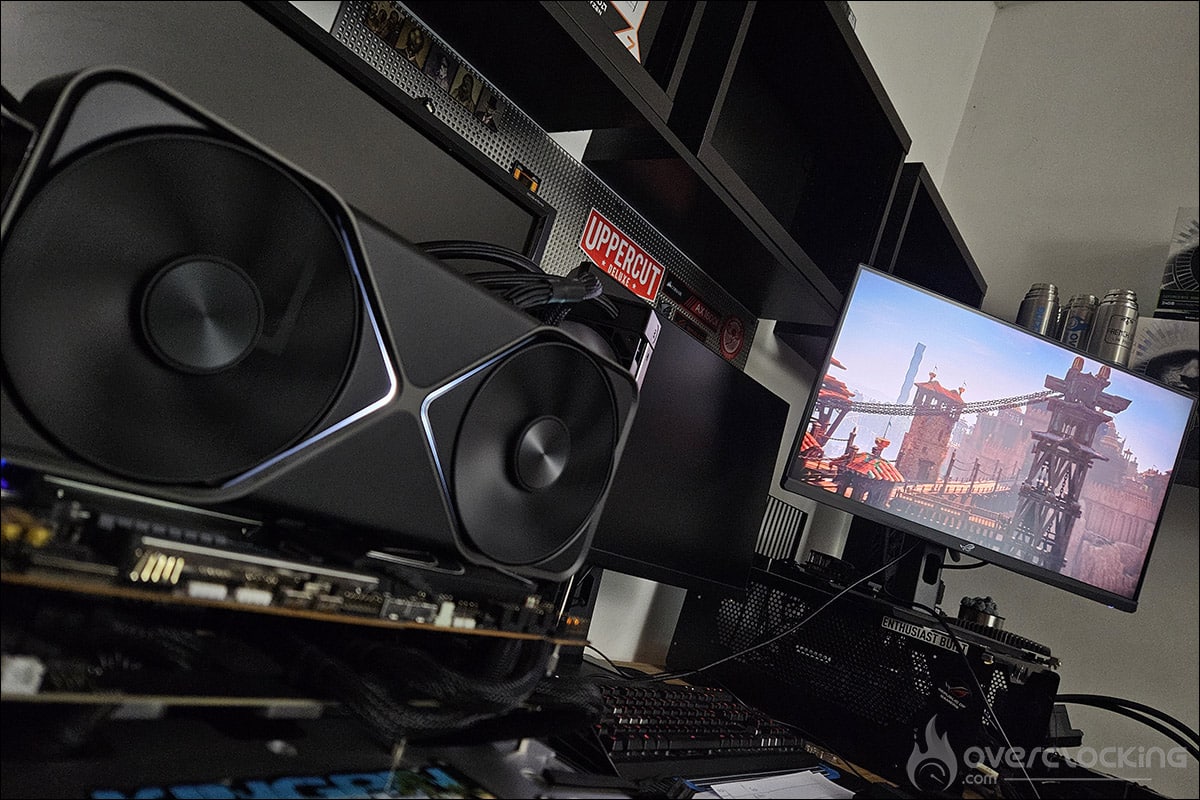
For this test, we used a fairly high-end configuration based on an i9-14900K delid processor and DDR5 memory. Depending on the definition tested, we used either an MSI Oculux NXG253R or a ROG Strix XG27UCS on loan from Asus France.
Our test protocol:
All the cards are tested at stock frequencies and without any optimisation. For the various benchmarks, whether for synthetics or games, we will opt for 1080p, 1440p and 2160p resolutions depending on the card’s performance.

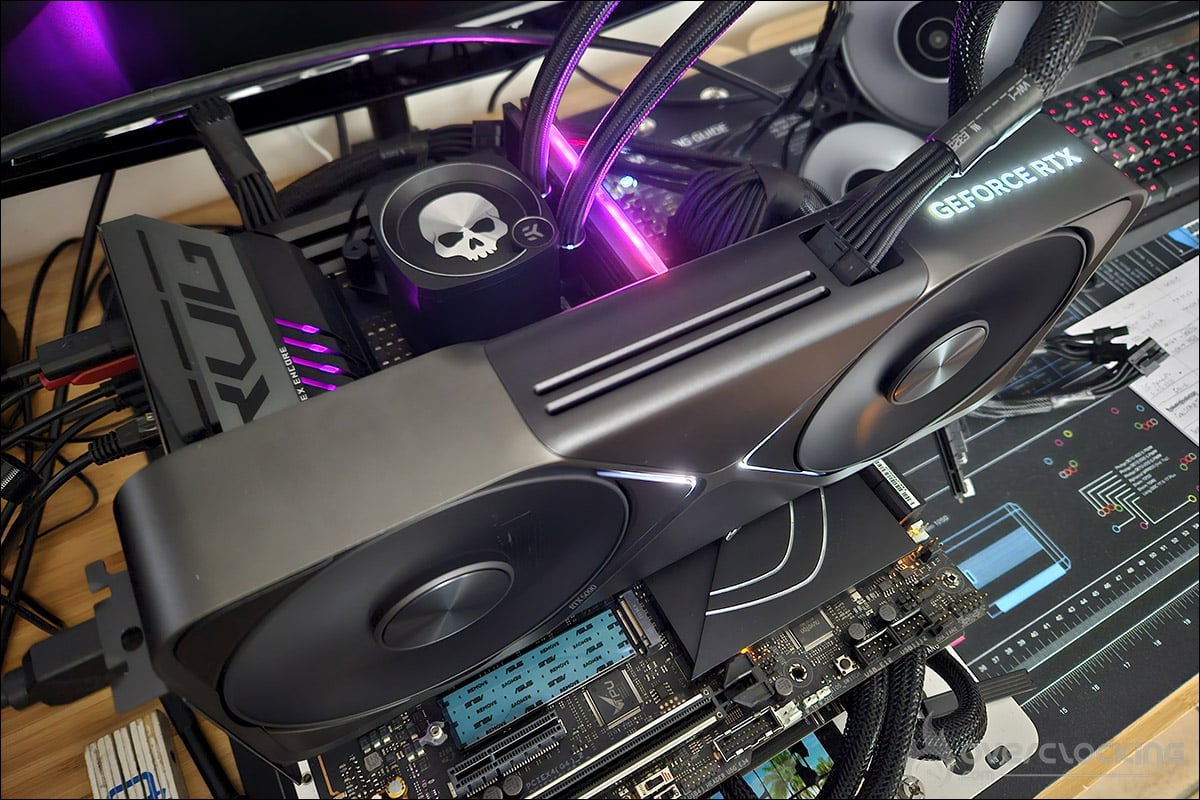
Here, with this NVIDIA RTX 5080 Founders Edition model, there’s no doubt about the definition: it’s going to be 2160p! We’ll be using DLSS Super Resolution in Performance mode, with image generation and ray tracing where available.

As you can see, we’re now running Windows 11 and we’ve activated the ReSize BAR in the BIOS, which can be seen in GPU-Z. Now that you know everything about our test configuration, it’s time to get started!
[nextpage title=”3DMark benchmarks: “]
Our first series of tests will be dedicated to synthetic benchmarks. These are very often used for overclocking competitions , but are also very interesting for comparing different GPUs. So we’ll be focusing on benchmarks from the 3DMark series. For this new version of our graphics, and for the 3DMark tests, we have also isolated the GPU score. So you’ll find, where stipulated in the benchmark, the overall score and the GPU score.
3DMark Fire Strike and Fire Strike Ultra :
Let’s start with 3DMark Fire Strike, which is one of the most widely used benchmarks today. It consists of two graphics tests, a CPU test and a fourth test that combines GPU and CPU. Don’t forget to disable the demo, which makes no difference to the final score and (unnecessarily) prolongs the benchmark. The version used for these tests is, of course, the latest.


We’re starting our tests with the two Fire Strike and Fire Strike Ultra benchmarks, and to say the least, they’re off to a great start. Although we’d have liked to see the RTX 5080 Founders Edition closer to the RTX 4090, it’s well ahead of the RTX 4080 Super.
3DMark Time Spy and Time Spy Extreme:
The second test is 3DMark Time Spy. Although this one is run in 1440p, its main feature is that it uses DirectX 12. It consists of two graphics tests and a CPU test. As with Fire Strike, don’t forget to disable the demo. These first two benchmarks are provided by UL Benchmark.


We continue with Time Spy, where the results are still very high. Our NVIDIA RTX 5080 Founders Edition is still in third place, ahead of the RTX 4080 Super but behind the RTX 4090. Time Spy often gives an initial idea of in-game performance, so we should have our RTX 5080 behind the RTX 4090 in rasterisation, but it remains to be seen by how many percent.
3DMark Speed Way :
This is the latest benchmark from Ulbenchmark, and it’s great to be able to say that we’re going to have a good go at this Speed Way. It uses DirectX 12 and is set to 1440p by default. We haven’t changed anything, so we’re using the original benchmark.

In Speed Way, our sample of the day once again takes third place with a score of 8980 points, leaving the RTX 4080 at 1590 points behind.
3DMark Port Royal :
This is a benchmark that we left out last year, but which you were keen to see again in our tests. It’s still widely used, particularly in the overclocking community . So we’ve decided to add it to our tests.

The result remains the same: third place for our RTX 5080 Founders Edition.
3DMark Steel Nomad :
The latest benchmark in the 3DMark suite, Steel Nomad will replace Time Spy as the most recent benchmark in the 3DMark suite. However, the good news is that it will be free for users who already have a key. The programme includes a test bench based on Microsoft’s DirectX12 API. However, there will be no ray tracing, but the scene will use an ‘extreme’ level of geometry and rasterised light.

Finally, the penultimate benchmark in the 3DMark series, Steel Nomad, which has just been released, keeps our NVIDIA RTX 5080 Founders Edition in third place.
3DMark NVIDIA DLSS :
We’ve added this benchmark here, which highlights the potential of DLSS, as it will now be compatible with DLSS 4, giving us the opportunity to test it with this NVIDIA RTX 5080 Founders Edition.

Finally, the last benchmark in the 3DMark series, the NVIDIA DLSS feature test will allow us to highlight, for the first time, the contribution of DLSS 4 technology. As a reminder, Frame Generation on the RTX 5000 can be selected as x2 (one frame), x3 (two frames) or x4 (three frames). This refers to the number of additional images that can be added between two native images.

Above are the parameters in the benchmark that allow us to choose the number of images generated.
[nextpage title=”Cinebench 2024 and V-Ray 6:”]
Following on from the 3DMark series of benchmarks, let’s tackle a series of tests for productive tasks. Even if this isn’t the primary function we’ll be attributing to the graphics card, we couldn’t do without offering you a small panel of tests, especially concerning AI, which is becoming more and more present.
Cinebench 2024 GPU :
This is a benchmark that we won’t be introducing again, as it’s used so often for our CPU tests, but here, with the 2024 version, it’s our graphics card that we’re going to put to the test. Please note that the version included in BenchMate will not work for this GPU test, so you’ll need to download the full version from the Maxon website.
No results in Cinebench 2024, which will no doubt need updating, as our NVIDIA RTX 5080 Founders Edition is not recognised. As you may remember from previous tests, Intel graphics cards are still not compatible with this benchmark either.
V-Ray 6:
A new benchmark to add to those we use to test our graphics cards. The V-Ray 6 benchmark is produced by the Chaos company to enable users to quickly assess the rendering speeds of both your processor and your graphics card, which is why we’re adding it today. The great thing is that it’s free and can be downloaded directly by following this link. You can then compare your score directly with those below, or directly online on the Chaos page.

Here, for our tests, we’re going to opt for the ‘RTX’ rendering and not the ‘CUDA’ rendering for NVIDIA’s RTX graphics cards. As with the 3DMark benchmarks, the results remain the same: we’re in third place, between the RTX 4090 and the RTX 4080/4080 Super.
[nextpage title=”UL Procyon AI Image / Text Generation:”]
UL Procyon AI Image Generation:
UL Benchmark not only offers its 3DMark benchmark suite but also, UL Procyon, to meet the demand for Artificial Intelligence evaluation. This benchmark was chosen for its ease of implementation. The benchmark will generate 4 x 4 images and provide us with a score as well as a result in the form of the time, in seconds, required to generate an image. The software supports several AI inference engines depending on the GPU used.
We will therefore use the benchmark in Stable Diffusion 1.5 (FP16) mode. It is intended for mid-range GPUs. The test will create 16 images at a resolution of 512 x 512 in batches of 4. There is a test called Stable Diffusion XL (FP16), where 16 images will be created, at 1024 x 1024, in batches of 1.
Unfortunately, our NVIDIA RTX 5080 Founders Edition is not recognised by the software and should be updated as soon as the cards are released. However, here are the performances of our other cards and we will update both graphics as soon as our RTX 5080 is supported.
On the other hand, the 5th generation Tensor Cores provide support for the FP4(Floating Point 4 bits) format, which will double the calculation performance of neural models while halving the memory footprint. This improvement is based on an essential compromise: FP4 uses less precision than traditional formats such as FP16 or FP32. However, for many deep learning models, this precision is sufficient to maintain reliable results while considerably reducing the load on memory and computing units. So we ran the test with our RTX 5080 and here’s the result.


These two FP8 and FP4 tests are based on a beta version that we have received from NVIDIA. We have a licence for UL Procyon, but these tests are not yet available and will probably be as of January 30. As soon as the software is up to date, we’ll run the tests again.
UL Procyon AI Text Generation :
The latest benchmark added to this test suite, AI Text Generation. The Procyon AI Text Generation Benchmark provides a more compact and easier way to repeatedly and consistently test AI performance with multiple LLM AI models. UL says it has worked closely with many AI software and hardware leaders to ensure that the benchmark tests take full advantage of the local AI accelerator of the systems used.


We can see that the differences are smaller between this new RTX 5080 Founders Edition and the RTX 4090, while AMD is a long way behind.
[nextpage title=”2160p gaming rasterisation performance: “]
Let’s get on with the gaming tests. We’ve used all the graphics cards that we thought would be interesting to compare with this NVIDIA RTX 5080 Founders Edition in 2160p definition. In the coming weeks, we’ll be offering you a new type of article, retesting graphics cards from previous generations to find out what they’re still worth in 2025. Our games panel currently consists of 11 titles, and will be growing over the coming weeks.
We have chosen to use the benchmarks built into these different games.
Why have we done this? Quite simply to allow you to compare your results with ours if you also have a copy of one of these games. It’s a thought-provoking idea that will allow you to compare your results with ours. The number and titles selected have changed slightly, and will increase again over the coming weeks as we get our hands on new games.
What is rasterisation?
Before we start, a quick word about ‘rasterisation’, which is currently the subject of much discussion. Rasterisation is the evaluation of the performance of our graphics cards without using upscaling technologies . We choose a graphics quality, often the highest, and test it. The advantage of these tests is that we can quantify the gains made by the architecture between different generations. In our case, to be able to judge the gains obtained between the architecture of the RTX 4090 (ADA Lovelace) and that of the new RTX 5080 (Blackwell).
Borderlands 3 :

It’s off to the gaming part with Borderlands 3 to kick things off. This first game seems to confirm our feelings about our NVIDIA RTX 5080 Founders Edition, which can’t match the performance of the RTX 4090 but is well ahead of the previous generation of RTX 4080s.
Cyberpunk 2077:

A new game and the same findings under Cyberpunk 2077, but with smaller differences. Perhaps a custom version with factory overclocking could match the RTX 4090.
COD Modern Warfare III:

We’re not really changing the shape of our chart, but for the first time, the RX 7900 XTX model comes in second place. We didn’t mention it until now, but the RTX 5080 Founders Edition was still ahead of the RX 7900 XTX.
Forspoken :

Forspoken is a fairly demanding game, and this RTX 5080 Founders Edition model is one of only three cards capable of breaking the 100 FPS barrier.
Horizon Zeron Dawn Remastered:

One of the new games we’ve added to our comparison, and where the gaps are smaller than usual between the RTX 5080 and RTX 4080s.
Shadow Of The Tomb Raider:

Under Shadow Of The Tomb Raider, the 150 FPS mark is easily passed by our NVIDIA RTX 5080 Founders Edition. The RTX 4090 performed almost 18% better.
Black Myth: Wukong Benchmark Tool :

This new game also seems to be very greedy, and doesn’t do NVIDIA graphics cards any favours.
Far Cry 6:

Performance is still identical under Far Cry 6, but with, for the second time, the RX 7900 XTX coming in ahead of our RTX 5080 Founders Edition.
Assassin’s Creed Mirage:

Here, it’s lower performance and a less marked difference between the new generation and the previous one.
Red Dead Redemption II:

Under Red Dead Redemption II, the gaps are still closing between our RTX 5080 and the RTX 4080s.
F1 2024 :

Last Game and nothing will have changed during this series of 11 games, with a high-performance RTX 5080 that just can’t match the RTX 4090.
Average for games in 2160p rasterisation :

In the end, it wasn’t too much of a surprise to see the average performance of this NVIDIA RTX 5080 Founders Edition. It lags behind the RTX 4090 by 13.5% in 2160p rasterisation. As our RTX 4090 model was an ASUS TUF OC, it’s easy to imagine that if we’d had an RTX 4090 Founders Edition, we’d have had a 10% difference, which is good performance in itself. This new RTX 5080 performs 10% better than the RTX 4080, but here again, we’re talking about an ultra-overclocked model, the ZOTAC RTX 4080 AMP Extreme AIRO. The difference should therefore have been greater, which also explains the small difference with the RTX 4080 Super Founders Edition. Now, when we come to a conclusion, we’ll have to take into account the current price of the RTX 4090.
Let’s move on to the tests, activating upscaling, and see how this RTX 5080 Founders Edition will benefit from DLSS 4.
[nextpage title=”Gaming 2160p upscaling performance:”]
In this section, we’re going to test our graphics cards by activating ray tracing, if available, and upscaling depending on the graphics card used. As a reminder, there are currently three upscaling technologies . NVIDIA has DLSS, which can only be activated with NVIDIA cards. Depending on the generation of your GPU, you may or may not be able to take advantage of all the technologies offered by the Greens. At AMD, it’s FSR, which is also evolving and also benefits from Frame Generation for certain games.
Finally, Intel’s in-house upscaling is called XeSS, and with the arrival of this new generation of graphics cards, Intel has taken the opportunity to announce the arrival of XeSS 2, which will introduce two new functions to compete with NVIDIA and AMD, who are already ahead of the game in this area. Intel will be offering Xe Frame Generation (XeSS-FG) and XeSS Low Latency (XeLL).
Today sees the arrival of DLSS 4, and in our comparative tests, only Cyberpunk 2077 is already compatible. On the next page, we’ll be showing you a selection of other games compatible with DLSS 4. Finally, it’s important to point out that some games don’t have ray tracing, but only an upscaling solution. We’ll make this clear in the games below. For 2160p definition, upscaling in either DLSS or FSR will always be in Performance mode.
Cyberpunk 2077:

Here we go again, with Cyberpunk 2077as our first game. It’s our NVIDIA cards that are in front, thanks to DLSS 3. Please note that here, for the purposes of comparison, DLSS 3 is used with our RTX 5080 Founders Edition. DLSS 4 will be discussed on the next page. Our sample of the day remains behind the RTX 4090 and takes full advantage of Frame Generation.
COD Modern Warfare III:

No worries in Call Of Duty Modern Warfare III, where upscaling still allows you to gain FPS, even if our RTX 5080 doesn’t really need it with an average of 120 FPS.
Forspoken:

While the RTX 5080 has no trouble with rasterisation, with an average of 105 FPS, it’s the AMD RX 7000 that benefits from upscaling. Of course, you’ll have to pay close attention to image quality, but as we said, there’s no need to resort to upscaling when you see the average you get.
Horizon Zeron Dawn Remastered:

The same applies to Horizon Zeron Dawn Remastered, with our NVIDIA RTX 5080 in third place.
Black Myth: Wukong Benchmark Tool :

Here we go again with Black Myth: Wukong, a very demanding game that benefits from ray tracing. And it’s in this very type of case that upscaling is useful, as our average with ray tracing activated is 30 FPS, rising to 89 FPS when we use DLSS Performance combined with Frame Generation. This game will benefit from DLSS 4 in the near future.
Far Cry 6:

No DLSS here, we’re using AMD’s upscaling, which explains the very low gain between DXR and upscaling mode.
Assassin’s Creed Mirage :

The same applies to Assassin’s Creed Mirage, with our sample in third place, lagging behind the RTX 4090.
F1 24 :

The last game on our test panel, DLSS Performance combined with Frame Generation enabled our model of the day to achieve an average of 175 FPS.
What about upscaling with our RTX 5080?
While the RTX 5090 didn’t really need upscaling in the end, as performance without it was so good, that’s no longer the case here with the RTX 5080 Founders Edition. It won’t always be necessary to use it, but each time we activated it, it enabled us to have a comfortable average FPS in order to enjoy the game. The gaps remain more or less the same until we switch to DLSS 4, which we’ll do on the next page by testing games that are already DLSS 4-compatible.
[nextpage title=”Games that support DLSS 4:”]
A series of games are already compatible with DLSS 4, on the day of the launch of the RTX 5080/5090. We’ve been able to get hold of them in order to begin a series of tests and highlight the performance achieved thanks to DLSS 4. We’ll be coming back to the qualitative side of the rendering in detail in the coming weeks. Of course, the upscaling principle here will be to support our NVIDIA RTX 5080 against 2160p performance with graphics options at maximum and ray tracing or path tracing if available.
To measure our FPS, we had access to a beta version of CapFrameX v1.7.5. This measurement tool is certainly one of the best and most intuitive when the game doesn’t have an integrated benchmark. If you’re interested, we can come back to the details in an article on how to use it.

Cyberpunk 2077:
In this well-known first game, and with the arrival of DLSS 4, we’re going to opt for the ultra graphics options with path tracing enabled. Here are the graphics options available in Cyberpunk 2077. So we have path tracing, DLSS in Performance mode and Frame Generation in x2, x3 or x4. The idea is to measure the differences in performance between DLSS OFF, one generated frame (x2), two generated frames (x3) and three generated frames (x4). It’s important to understand that you can choose the number of images with Multi Frame Generation.

Here’s the performance we obtained between our ASUS RTX 4090 TUF OC, the NVIDIA RTX 5090 Founders Edition and, of course, our RTX 5080 Founders Edition.

As you can see, from the moment you decide to use DLSS 4 x3, i.e. two AI-generated images between two native ones, our RTX 5080 takes the lead over the RTX 4090. The lead will be even more comfortable with x4 and three generated images. With Overdrive mode, for any graphics card, DLSS is mandatory.
Hogwarts Legacy: The Hogwarts Legacy
Hogwarts Legacy doesn’t have a built-in benchmark, so we’re going to use CapFrameX to take our various readings. In terms of graphics options, there’s no ray tracing in this game, but we have enabled ray reconstruction. As far as DLSS 4 is concerned, we have all the options at our disposal.


The same was true of Hogwarts Legacy, where we were unable to achieve an average of 60 FPS when rasterised. Everything improved with DLSS 4, which enabled our RTX 5080 to get ahead of the RTX 4090.
Alan Wake 2:
From January 30, Alan Wake 2 will also benefit from the DLSS 4 option, as well as RTX Mega Geometry. But what exactly is Mega Geometry? RTX Mega Geometry allows developers to offer up to 100X more triangles in ray tracing. RTX Mega Geometry will reduce processor overload and increase ray tracing performance and image quality.
Now it’s time for the graphics options, and the least we can say is that Alan Wake 2 is surely one of the most comprehensive games to showcase NVIDIA’s technologies (ray tracing, path tracing, ray reconstruction, direct lighting, transparency, etc.). So, of course, we activated all these options.

 Once again, DLSS 4 gives our RTX 5080 the edge over the RTX 4090. I hope you now understand the irrelevance of the NVIDIA slide that talked about RTX 5070 = RTX 4090. Of course, this is possible in a scenario where the RTX 5070 will be in DLSS 4 x4 against an RTX 4090 DLSS 3.
Star Wars Outlaws :
Star Wars Outlaws is the third game to be supported directly. There’s no ray tracing in this game, so we’re using DLSS Performance in 2160p with Multi Frame Generation. We’ve also activated ray reconstruction and NVIDIA Direct Lighting.

 All our cards suffer and the DLSS 3 or DLSS 4 are there to make the most of your game.
Dragon Age: The Veilguard
Finally, our last game on this panel: Dragon Age: The Veilguard. So here, no DLSS 4 available within the game’s graphics options. So we’re going to force DLSS using NVIDIA’s new application. To do this, launch the application and go to Graphics > Program Settings screen under Driver Settings.


This will allow you to make the following changes. Firstly, in DLSS Override – Model Presets, select the ” Latest ” option, which will activate DLSS Super Resolution Transformer. Then go to DLSS Override – Frame Generation to choose between two or three images, and finally, you can also make a change in DLSS Override – Super Resolution. We’re not going to touch that, as we’re going to choose Performance in the game’s graphics options.

NVIDIA has provided a small overlay in the game so that we can check the settings we’ve chosen. There’s no ray tracing here, just DLSS 4 Performance upscaling and Frame Generation.

Here’s the performance we obtained according to our choice of parameters.

Here we can really see the contribution of DLSS 4 and Multi Frame Generation when a game benefits from the various NVIDIA technologies: ray tracing, path tracing, ray reconstruction, direct lighting, transparency, etc. … . On the other hand, you don’t have to activate DLSS if you don’t need it, and you can always opt to generate a single frame and not necessarily three, since you can choose the number you want to activate.
[nextpage title=”Energy consumption and efficiency:”]
We finally have the means to effectively monitor the power consumption of our graphics cards thanks to the Benchlab telemetry system. We’ll now be able to carry out a complete analysis of our graphics card’s total power consumption via the dedicated 3 x PCIe and 2 x 12VHPWR power cables. But that’s not all, because we also need to be able to measure the power supplied via the PCIe slot. So we’re going to use a PCI-E PMD adapter from the ElmorLabs shop. This will give us the overall power consumption of the graphics card under test, completely independently. Here’s a series of photos of our Benchlab installation, to which we’ll be devoting a dedicated test in a few weeks’ time.


These various readings will be taken via Benchlab’s dedicated application. The photos below were taken with the NVIDIA RTX 4060 Ti 8 GB FE graphics card to illustrate our power consumption readings.


To get the total power consumption, we’ll read the 12VHPWR Power consumption, which corresponds to the power supply to the card via its 16-pin mini-connectors, and the EPS1 reading, which supplies the adapter. We export the readings, which are taken every 500 ms, and calculate the average power consumption in the Cyberpunk 2077 game in 4K rasterisation with the graphics options in Ultra and in 4K with ray tracing in Ultra, DLSS Performance x2 and path tracing.
Power consumption in Cyberpunk 2077 :

The good news is that power consumption is pretty close to that of the RTX 4080 Super. The FPS/consumption ratio is in favour of the RTX 4080 Super. This controlled power consumption means that our Founders Edition model heats up very little and makes very little noise. Even though we were already satisfied with the design of the RTX 5090, it fits perfectly with the RTX 5080. As a reminder, NVIDIA recommends an 850-watt power supply for an RTX 5080.
[nextpage title=”The last word:”]
So, what do you think of this RTX 5080 Founders Edition?
One thing’s for sure, as with the RTX 5090, there’s a lot to say. Ever since NVIDIA announced its new range of RTX 5000 graphics cards at CES 2025, we’ve noticed on social networks that things are tense between fans of the greens and those who aren’t at all keen on this new architecture. The majority are criticising the RTX 5090’s lack of gain over the previous generation and its exploding power consumption, but what about this NVIDIA RTX 5080 Founders Edition, is the situation the same?
Performance:
We’re in a similar situation to the RTX 5090, with performance that doesn’t go through the roof, but is actually quite good. We are more or less 12/13% ahead of the RTX 4080 FE and 10% behind the RTX 4090. Performance will also be higher with Multi Frame Generation, compatible with the RTX 5000. As a reminder, the MSRP of the RTX 5080 FE is announced at 1,190 euros and that of the RTX 4090 at launch was 1,959 euros, subsequently reduced to 1,779 euros. The performance/price ratio is therefore largely in favour of our RTX 5080, not to mention the technology that goes with it. Now you have to bear in mind that the RTX 4090 has 24 GB of GDDR6, compared with 16 GB of GDDR7 on the RTX 5080.
We also (really) hope to see a performance boost with the custom models, which will benefit from factory overclocking, and which could then come close to, or even match, the performance of the RTX 4090. We’ll be coming back to this tomorrow, as well as in a few days’ time, on overclocking with this NVIDIA RTX 5080 Founders Edition.
The DLSS 4 :
Highlighted by NVIDIA, DLSS 4 is the big new feature of this Blackwell architecture. Here again, some people, like myself, activate DLSS in certain games and others will never do so, oh God, never, not wanting to use ‘fake’ FPS. It’s true that these are additional images created by the AI, but as the name suggests, anything created by Artificial Intelligence will always have this ‘artificial’ side. Now, we have to admit that it works well, even better than before. We’ve had the opportunity to spend a little more time in the game with this new series of tests, and our opinion remains pretty much the same. Of course, it’s possible to notice a few faults at times, but you really have to have fun looking for most of them, by making movements that you don’t really do when you’re playing. As for the games that benefit from DLSS 4, visually it’s very difficult to see any difference in quality when it’s activated.
If you want to take advantage of ray tracing and path tracing, you can activate them while still enjoying 4K definition (2160p) and retaining a more than sufficient number of FPS. You also have the option of choosing the number of additional frames with DLSS 4. We’ll be coming back to fluidity in games after receiving a 4K 240Hz screen to judge its impact, such as having a sufficient number of FPS for the native image before using upscaling.
A word about NVIDIA’s new DLSS Override application. This will allow games that have not yet been updated to the latest DLSS models and features to activate support via a DLSS override. We’ve tested this with Dragon Age: The Veilguard and it’s very effective!
Consumption :
Where the RTX 5090 Founders Edition blew everything out of the water, this is not the case with the RTX 5080 Founders Edition! Compared to a custom RTX 4080, power consumption increases by around twenty watts, but here the dual-slot design of the Founders Edition copes perfectly with the load. The card is also very quiet, and we’ll come back to that in a moment. It’s SFF-Ready, but you’ll need to design a configuration with good air circulation inside your case.
Price :
NVIDIA has announced an MSRP of €1,179 for its Founders Edition model, compared with €1,959 for the RTX 4090 FE when it was launched and now at €1,779. That’s still a hefty budget, but not outrageous compared with the previous generation, bearing in mind that the card also features GDDR7 memory. We’re pretty close to the RTX 4090, which offered a monstrous gap over the RTX 3090. We hope that the range of custom cards aligned with the MSRP price will be substantial, because if we end up with custom cards at the MSRP price of the RTX 4090, or even higher, we’ll find ourselves in the same situation as with the RTX 5090.
What’s more, the performance of this RTX 5080 FE confirms once again that the RTX 5090 will be dedicated to a niche audience and that it is first and foremost a PRO card, particularly with its 32 GB of GDDR7 memory. As you can see, this RTX 5080 is much more interesting.
Should you sell your RTX 4080?
Not yet! Your RTX 4080 or RTX 4080 Super still have some good days ahead of them. Granted, you won’t be able to take advantage of Multi Frame Generation, but there’s nothing to suggest that NVIDIA won’t be offering it on the RTX 4000 in a few months’ time. What’s more, we could still be in for some pleasant surprises with the other two models announced, the RTX 5070 Ti at €884 and the RTX 5070 at €649. So don’t rush, and wait. Now, if you have a slightly older configuration and want to take advantage of all the NVIDIA technologies, then yes, this could be an interesting upgrade for 2160p gaming. In fact, we’re preparing a series of new articles based on older graphics cards. The other alternative is to keep an eye on the second-hand market, where you could pick up a bargain on an RTX 4080 Super, for example.
Creators will also be able to take advantage of the 9th generation encoder and a new 6th generation decoder.
 While we didn’t give the RTX 5090 Founders Edition an award or a rating, we were much more impressed by this NVIDIA RTX 5080 Founders Edition model and its MSRP price. No revolution in terms of performance, but a reasonable price for performance that’s close to that of the RTX 4090. We’ll see tomorrow whether the RTX 5080 custom versions will have the same appeal.
Thanks to NVIDIA France for making this Founders Edition copy of the RTX 5080 available.

