

Since 2020, Apple has undergone a major strategic shift by moving away from Intel, NVIDIA, and AMD chips to focus exclusively on its own Arm-based architectures. This decision, which began with the M1, has enabled the company to develop increasingly powerful processors for Macs, iPads, and desktop computers. Today, we’re witnessing the arrival of the fifth generation of these chips. The M5 Ultra model will be the flagship of this lineup and promises massive graphics power.
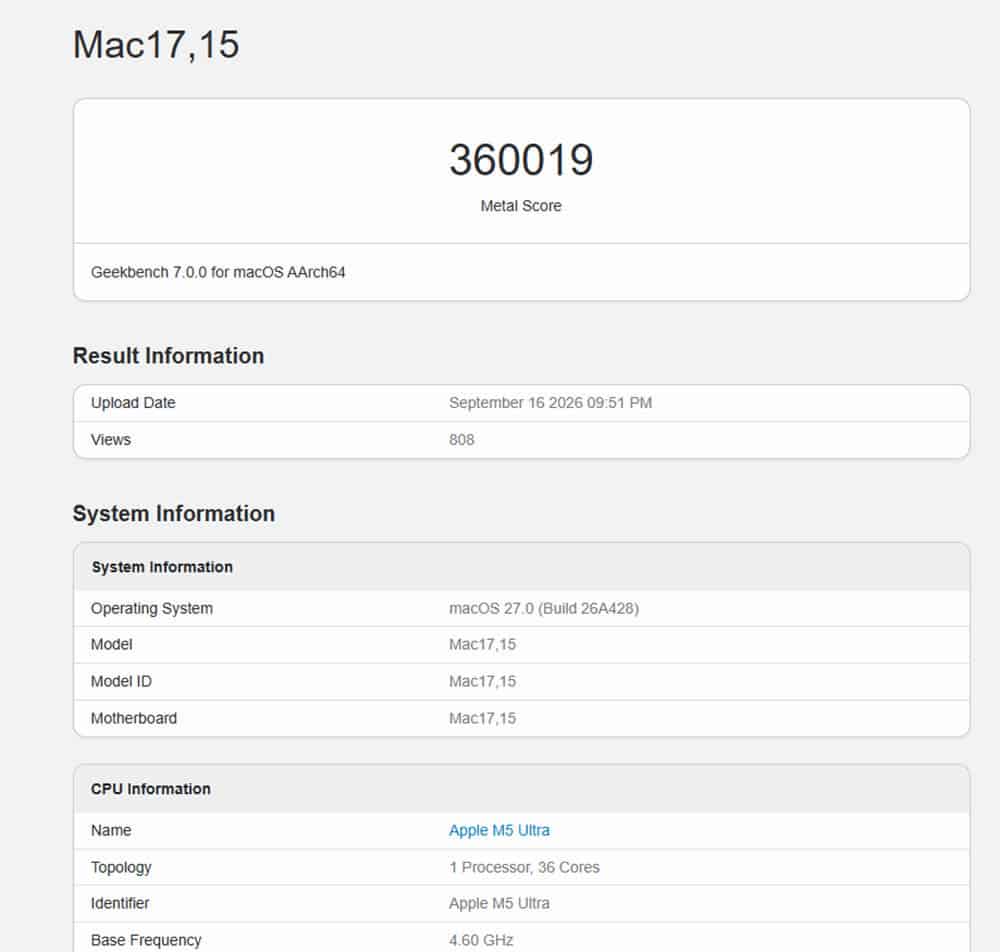
A recent leak, reported by several media outlets, highlights the capabilities of the Apple M5 Ultra SoC through results obtained in the Geekbench 7 benchmark. This data comes from a Mac Studio equipped with this new chip and 256 GB of unified memory (the bill is going to hurt a lot…). The test was conducted on a configuration featuring a 40-core GPU, representing the top-of-the-line model in this series.
M5 Ultra: Record-breaking graphics performance—really?
The numbers are simply staggering. In the Metal section of Geekbench 7, the Apple M5 Ultra SoC scored 360,019 points. To put that into perspective, the previous version, the M3 Ultra, scored 255,009 points in the same test. That represents an improvement of about 41% for this new chip.

The comparison was also extended to consumer graphics cards. According to the reported data, NVIDIA’s RTX 5080 scored 284,429 points in the OpenCL test. Although the testing environments are different—Metal for Apple versus OpenCL for NVIDIA—the M5 Ultra SoC posts a score that is 26% higher. This theoretically places Apple’s chip above NVIDIA’s graphics card… Of course, we need to take this with a grain of salt, as this score appears in only a single submission. But if we consider it credible, then the gap is significant. Thermal or software variations can influence the results, but such an increase suggests substantial graphics performance gains for Apple’s new architecture.
Detailed comparisons and benchmark limitations
The media outlets that revealed this leak decided to conduct a more in-depth analysis by comparing specific subtests to gain a clearer picture of performance. In horizon line detection, the RTX 5080 retains a slight advantage. However, for background blur, the M5 Ultra is three times faster than its competitor.
Face tracking also illustrates this dominance, with a score of 589,323 points for the M5 Ultra compared to just 74,241 for the RTX 5080. However, Apple’s chip doesn’t come out on top in every category. In the particle physics test, the RTX 5080 doubles the M5 Ultra’s performance, scoring 902,982 points compared to 373,097.
It’s crucial to remember that these comparisons aren’t entirely reliable because they don’t measure exactly the same thing. Furthermore, these results come from a leak and do not constitute an official announcement. The question now is whether this superiority in benchmark tests will translate to equivalent—or even superior—performance in actual video games. The answer to this question will have to wait for more comprehensive tests and more platform-agnostic benchmarks, such as Vulkan, or native game tests. Finally, there’s no doubt that with a Mac Studio equipped this way, even at current prices, you could afford several RTX 5080s…