




Overclocking this RTX 5070 FE:
This is where things are going to be a little different, as we’re already going to be talking about overclocking before we get to the gaming part! The potential is really very good and above all very stable, which is why we wanted to do the gaming part in 1440p with our overclocking profile.
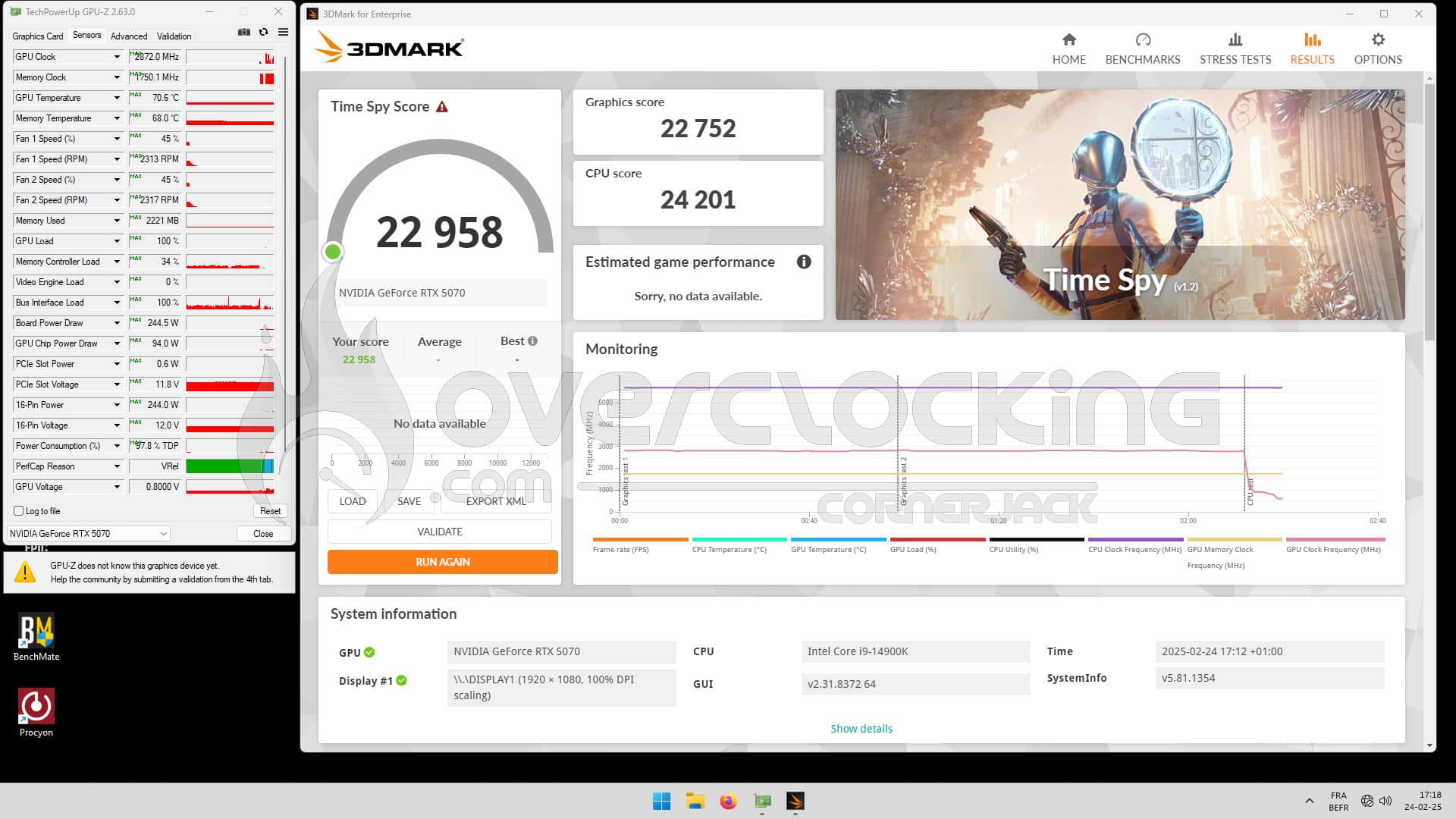
As usual, we started by testing the card at its original frequencies under 3DMark Time Spy, to see what gains we could make. Please note that both fans are in AUTO mode and we haven’t touched the fan curve. So it’s time to analyse the results of this first test. We obtained an overall score of 22,958 points and 22,752 points for the graphics section, with a maximum boost frequency of 2872 MHz. If we look at the TDP, it’s 97.8% and the power consumption is 244 watts, which gives us an initial margin before we change the power limit value. As far as temperatures are concerned, we’re on a benchmark table, with 70.6°C for the GPU and 68°C for the memory.
We’re not going to list all the stages we went through, but the idea is to look for the maximum frequency of the GPU first and then that of the memory. We kept the fans in AUTO mode. This enabled us to reach a boost frequency of 3310 MHz and memory at 2150 MHz. If we continue to increase the memory frequency, it no longer seems to be taken into account and performance remains unchanged.
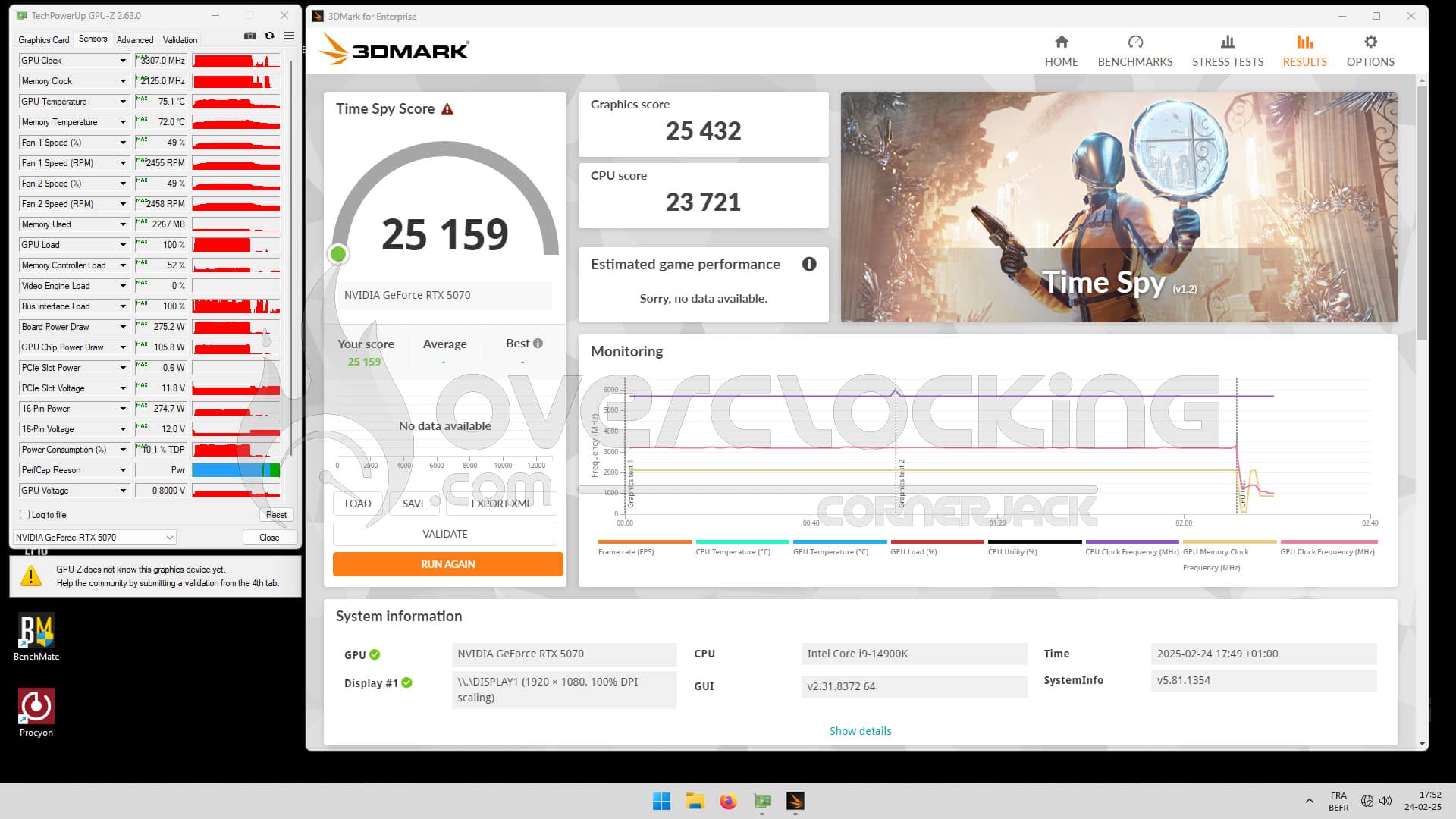
Our total score climbs to 25,159 points (9.6%) and that of the GPU to 25,432 points (11.8%). With the fans in AUTO mode, the temperature remained at 75.1°C for the GPU and 72°C for the memory. We then tested Speed Way, where the gain reached 13.8%, and Port Royal, with a performance increase of 12.5%.


In gaming, we get a gain of 13.6% in rasterisation and 13.1% in ray tracing. That’s a very high gain, which is why we took it into account during our tests. We’re well aware that our gaming tests are carried out over fairly short periods, but the frequency of 2900 MHz for the GPU and 2125 MHz for the memory seemed perfectly stable to us. As far as the partner cards are concerned, they will undoubtedly benefit from factory overclocking, which will reduce the additional potential for overclocking, but let’s hope that some models will have a power limit greater than 10%. So, in addition to the stock tests, we’ve added the performance of our overclocked RTX 5070 Founders Edition to our 1440p graphics.