







Gigabyte RX 9070 XT Gaming OC :
Architecture:
The AMD Radeon RX 9070 series graphics cards are built on the new AMD RDNA 4 architecture with new ray tracing and AI gas pedals as well as support for AMD FidelityFX Super Resolution 4, more traditionally called, AMD FSR 4. This should offer improvements in image quality over AMD FSR 3.1 upscaling.


AMD seems to have determined that $700 was the maximum price that gamers wishing to upgrade their configuration were willing to pay. This is a major factor that AMD has taken into account in order to offer these first two models in the AMD Radeon RTX 9070 series. The slide below shows where the RX 9070 series will be positioned in terms of price.


As far as prices are concerned, AMD is hitting hard, announcing the RX 9070 at $549 and the RX 9070 XT at $599. AMD France is quoting prices in euros from ????. It’s not hard to imagine the rivalry that’s about to set in against NVIDIA’s RTX 5070 ($549) and RTX 5070 Ti ($749).
Gigabyte RX 9070 XT Gaming OC:
As you can see from the photos below, the box of our copy of the Gigabyte RX 9070 XT Gaming OC is very much in the spirit of the series that Gigabyte usually offers. The packaging is quite compact, which is good news for the card’s size. Note that this RX 9070 XT model is smaller than the RX 9070 TUF also tested today. While the box benefits from a touch of green when it’s an NVIDIA model, here we’re usually entitled to red, for AMD, but it’s more discreet on the front panel.


On the rear, Gigabyte highlights the design of the cooling system and radiator. The opening is on the side where we find our graphics card perfectly protected in a block of foam. The bundle comes with installation instructions only. The idea is also to reduce costs on this entry-level model.
This is a ” custom ” board, i.e. with a PCB and cooling system specific to AMD’s partner brand, Gigabyte. There will be no AMD reference board, as with the RX 9070 and RX 9070 XT.
Cooling :
The Gigabyte RX 9070 XT Gaming OC features a cooling system consisting of three 90 mm fans. The design of this Gaming model is visually very pleasing, and features an RGB backlight zone on the top panel with a sliding plate. The dark gray color of the plastic casing will match any motherboard and any case. It’s simple and effective, just the way we like it.


Let’s start with the size of our sample of the day, which measures 288 x 132 x 56 mm and will therefore occupy a width of 3 slots. We can see straight away that Gigabyte hasn’t skimped on cooling, despite the relatively compact board.
The three Hawk fans have 7 blades and remain idle when the card is not in use, and vice versa, they become active again when the temperature requires it. Hawk fans feature a unique blade design inspired by the aerodynamics of the eagle’s wing. This design reduces air resistance and noise levels, resulting in increased air pressure. To reduce turbulence from adjacent fans and increase airflow pressure, fan rotation is alternated.


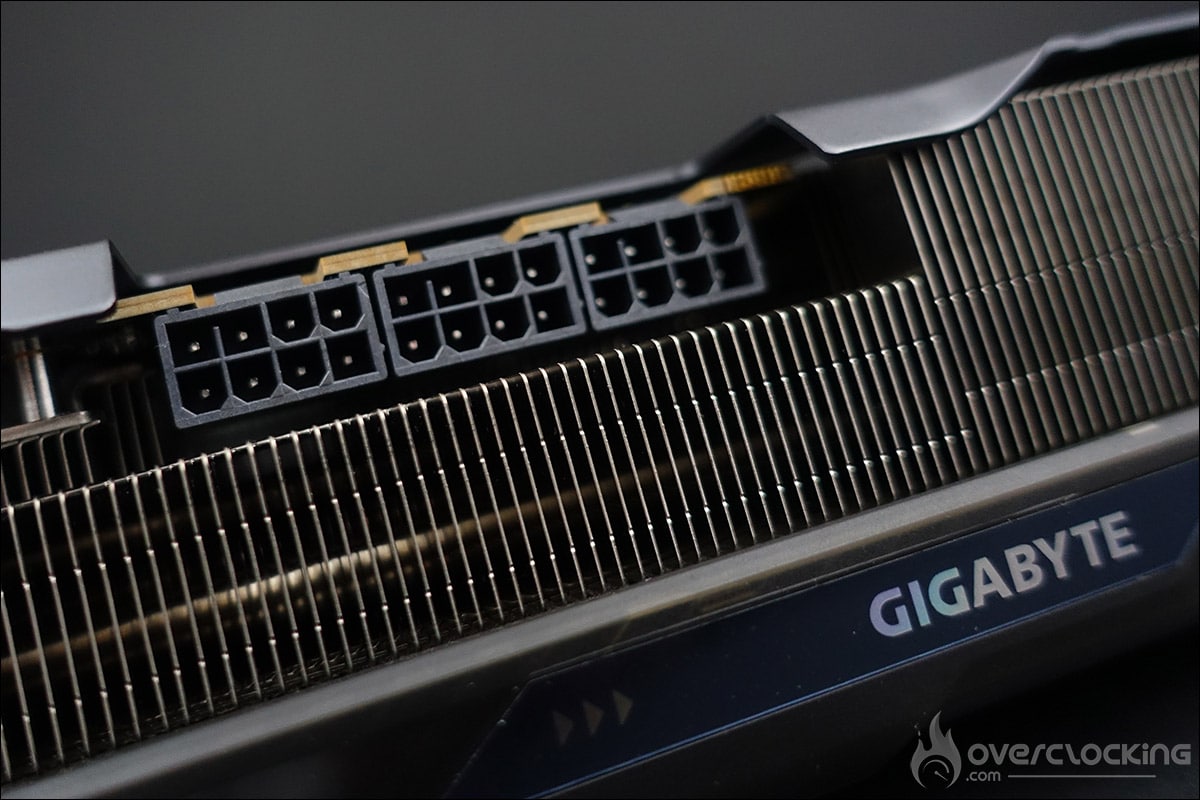
As you can see, hot air escapes through the top edge of the board, through the bracket and also through the aluminium backplate which is cut out at the end. In fact, the PCB is much shorter than the heat sink. The radiator ends at the PCB’s three power connectors.
As previously mentioned, the rear of the board is protected by an imposing grey backplate. Its role is to prevent the PCB from twisting, but it also acts as a heat sink, with the presence of pads between it and the PCB. We’ll be able to judge the temperature of the latter during our tests.


The card also features a dual BIOS: Pmode (performance) and Qmode (quiet). By default, Pmode is selected, and in our opinion, this is the best choice, even if the differences between the two BIOSes are virtually non-existent. As with top-of-the-range AORUS models, this Gigabyte RX 9070 XT Gaming OC also uses thermo-conductive gel to cool critical components such as memory chips and power supply stages. This highly deformable, non-fluid gel offers optimum contact for uneven surfaces and effectively resists deformation due to transport or long-term use, unlike traditional thermal pads. This is good news in itself, but what about once disassembled for reassembly?
Connectors :
To power our board, and this is excellent news, Gigabyte retains three 8-pin power connectors. We also know that, as far as memory is concerned, AMD is using GDDR6 instead of GDDR6X for both boards, mainly because the latter consumes less power and is incidentally less expensive.

This Gigabyte RX 9070 XT Gaming OC features one PCIe 5.0 port, two DisplayPort 2.1a and two HDMI 2.1b.