
[nextpage title=”Introduction:”]
As we begin this review, it’s hard not to think back once again to NVIDIA’s much-talked-about slide, where we could see ” RTX 5070 | 4090 Performance “. Admittedly, we’re here with the launch of the RTX 5070 Ti, but this will give us a little idea of the RTX 5070’s future performance. NVIDIA will not be offering a Founders Edition version of the 5070 Ti, which is why we had the opportunity to receive this MSI RTX 5070 Ti Ventus 3X OC, which will be offered at the MSRP price of 884 euros. It’s worth noting that this MSRP is pretty much the same as that offered for the previous-generation RTX 4070 Ti SUPER. It remains to be seen whether this MSRP, in the absence of a Founders Edition, will be respected by the various online retailers, which we unfortunately doubt at the time of publishing this article.
We’d like to take this opportunity to thank NVIDIA for making this copy available to us. Tomorrow we’ll be bringing you a second test, with the performance of the AORUS RTX 5070 Ti Master OC, which will be priced higher than the MSRP offered by NVIDIA.

[nextpage title=”AORUS RTX 5070 Ti Master:”]
Architecture:
As a reminder, this MSI RTX 5070 Ti Ventus 3X OC is a custom model , i.e., a board offered by an NVIDIA partner that benefits from a brand-specific PCB and cooling system, in this case, from MSI. NVIDIA partners offer their own models. As a reminder, as usual, NVIDIA will not be offering Founders Edition versions of “Ti” models.
This RTX 5070 Ti benefits from the Blackwell architecture and retains a 4-nanometer etching fineness, but switches to the TSMC N4P process, enabling higher transistor density and improved energy efficiency. This architecture features new 5th-generation Tensor Cores and 4th-generation Ray Tracing Cores. The 5th generation Tensor Cores will bring support for the FP4(Floating Point 4 bit) format, which will double the computational performance of neural models while halving the memory footprint. We’ll be coming back to this development in the course of our tests with UL Procyon software, which we’ve been using for several weeks now.
Of course, DLSS 4 support cannot be overlooked. This new RTX 5070 Ti is equipped with 8,960 CUDA Cores, compared with 21,760 for the RTX 5090 version. The differences are clear. The future RTX 5070 will benefit from 6,144 CUDA Cores.


There’s more to come on the memory front too, with 16GB of GDDR7 memory. But let’s move on to the packaging of this MSI RTX 5070 Ti Ventus 3X OC.
The MSI RTX 5070 Ti Ventus 3X OC bundle :
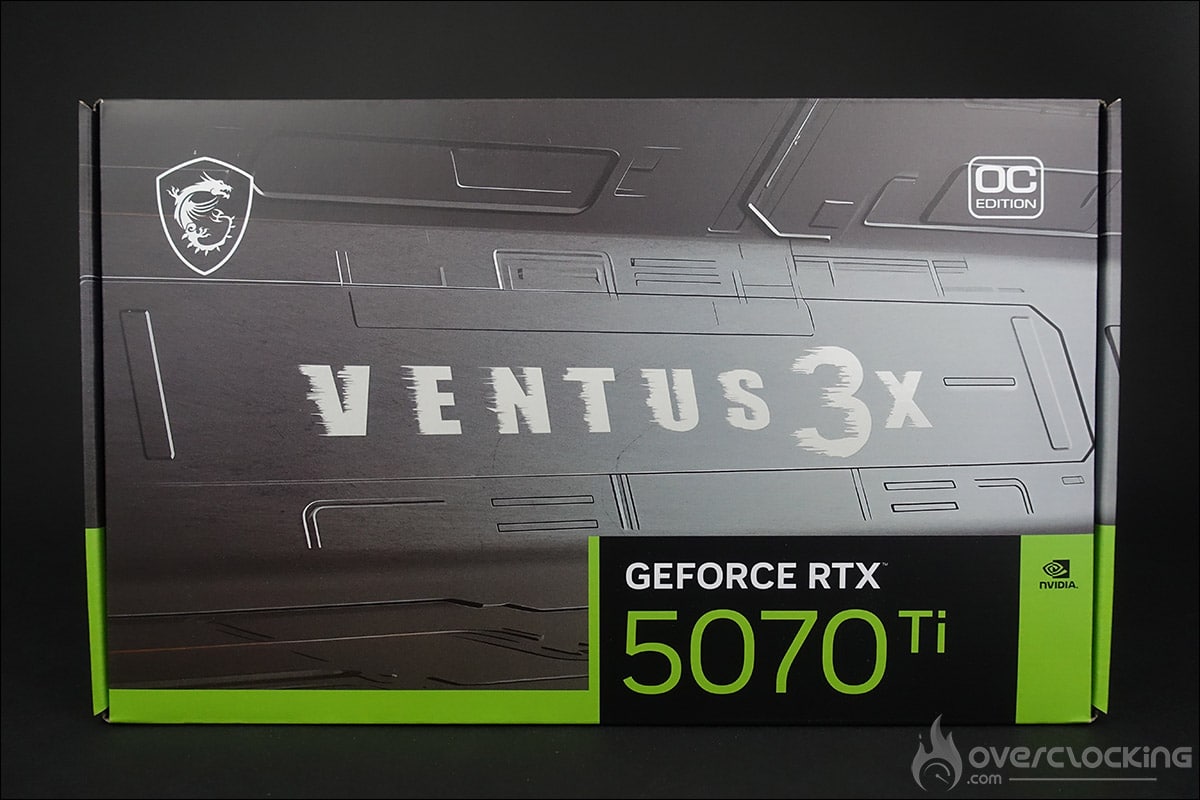
This is the second time we’ve reviewed a model in the “Ventus” series, and it was with a copy of the RTX 4070 Ti Super, the first time. The special feature of this series from MSI is that it is offered at the MSRP price of the RTX 5070 Ti, i.e. 889 euros. The box is fairly compact, with no illustration of the card on the front, but rather the model number. As with every custom card box, the bottom right-hand corner bears the series name, in this case GeForce RTX 5070 Ti in green and black.
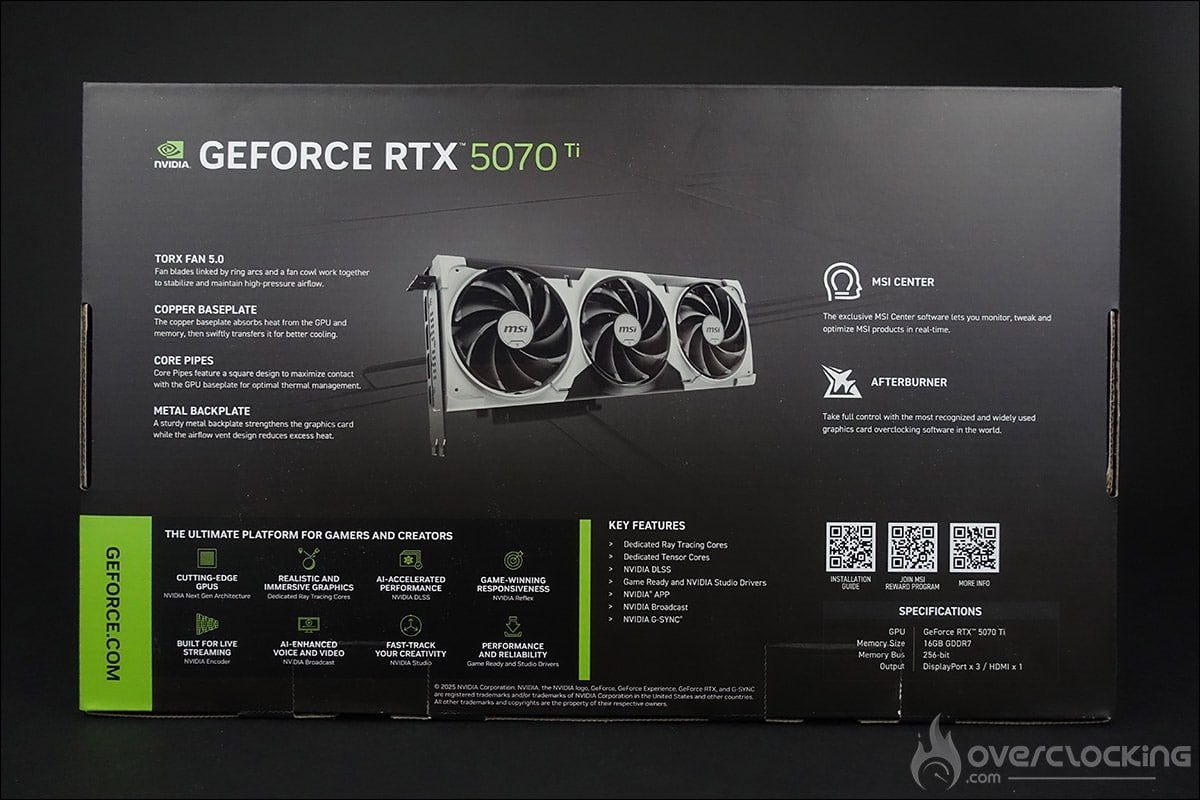
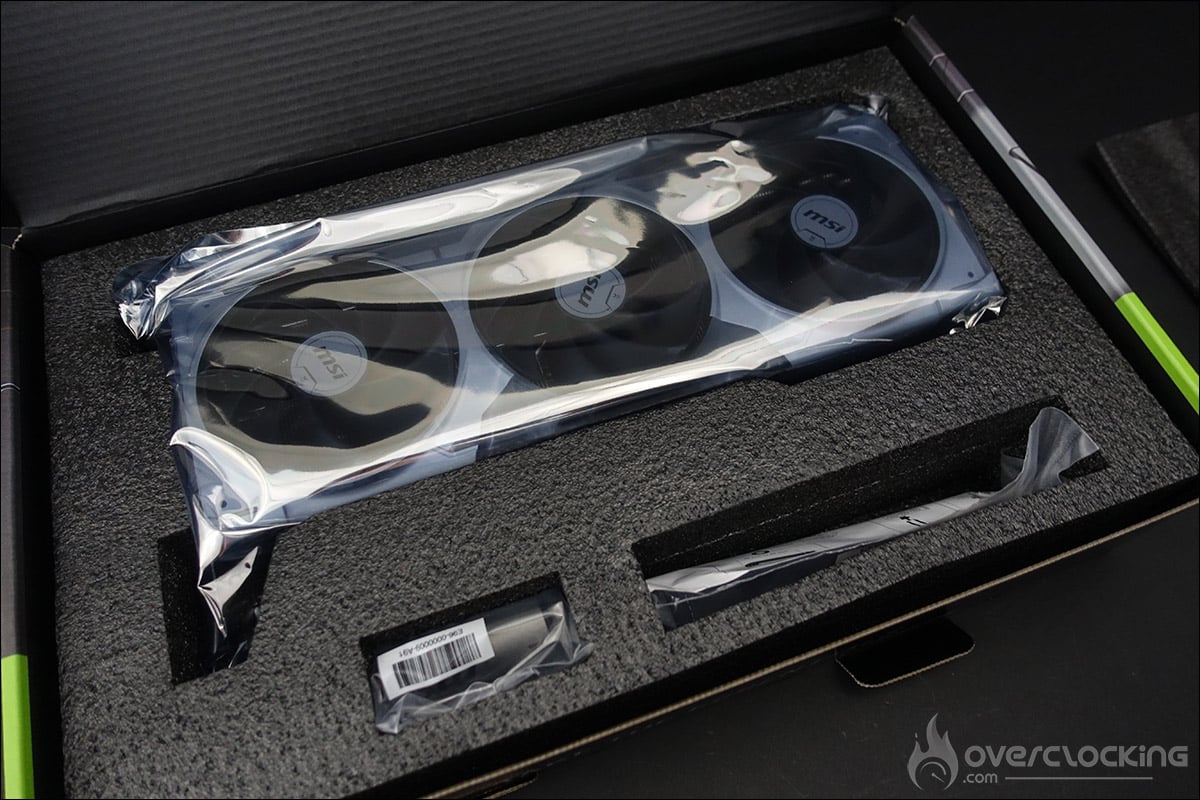
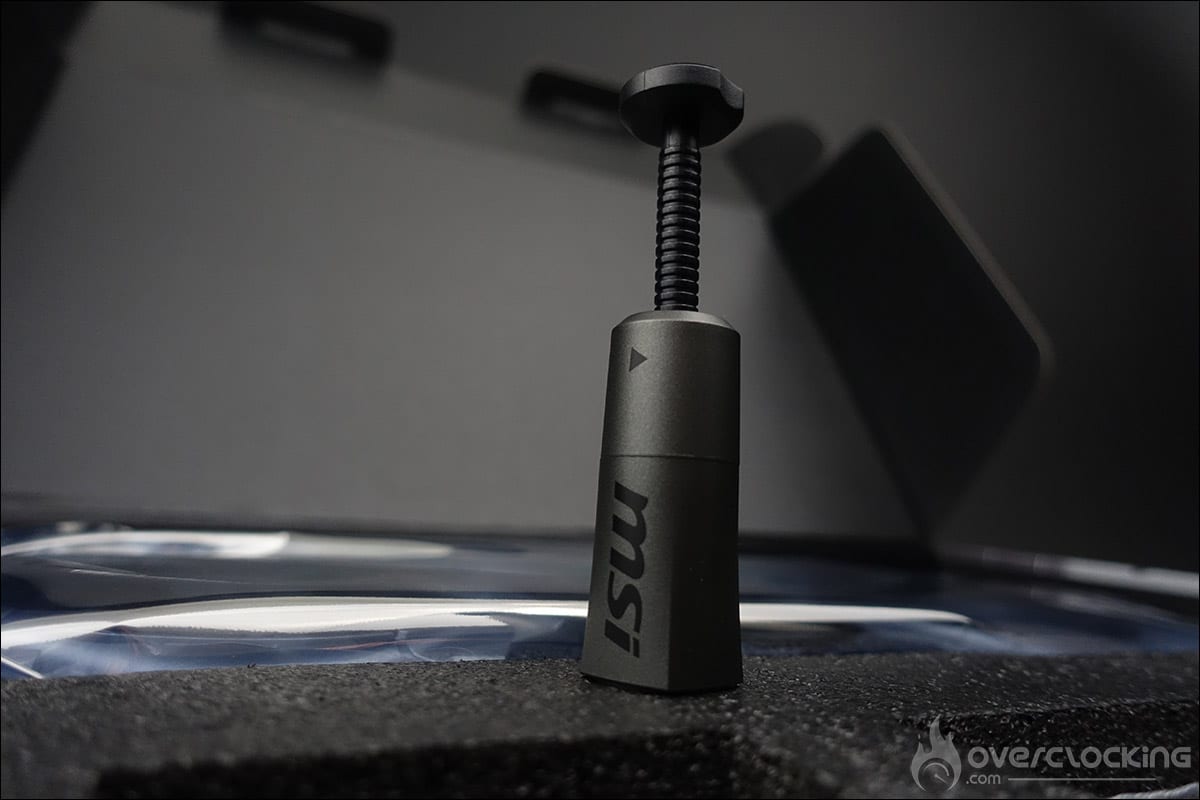
In addition to the 3 x PCIe 8-pin power adapter, the bundle includes a manual, a warranty notice and a vertical stand for the graphics card.
Cooling:
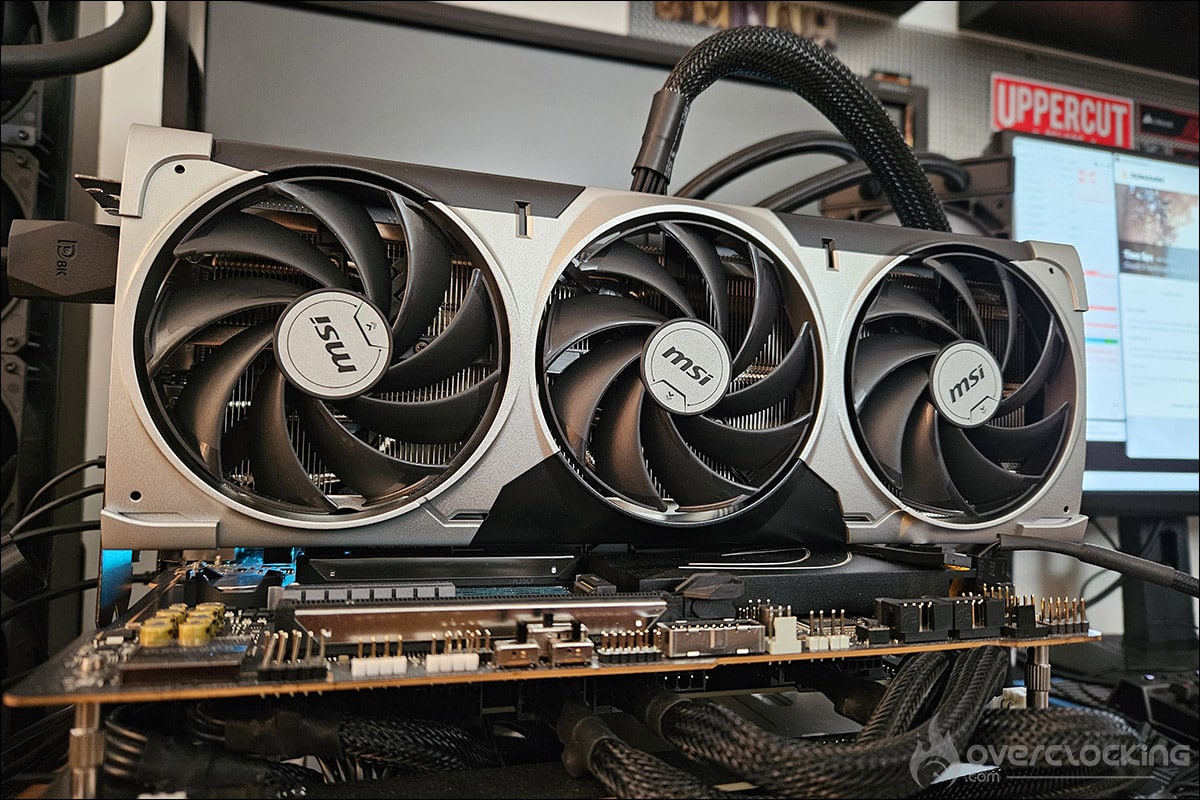
This MSI RTX 5070 Ti Ventus 3X OC has dimensions of 303 x 121 x 49 mm and will occupy 2 slots on your motherboard. These dimensions enable it to be labelled SFF-Ready. This means it can be fitted into a case compatible with the Small Form Factor for those who decide to design a compact configuration.
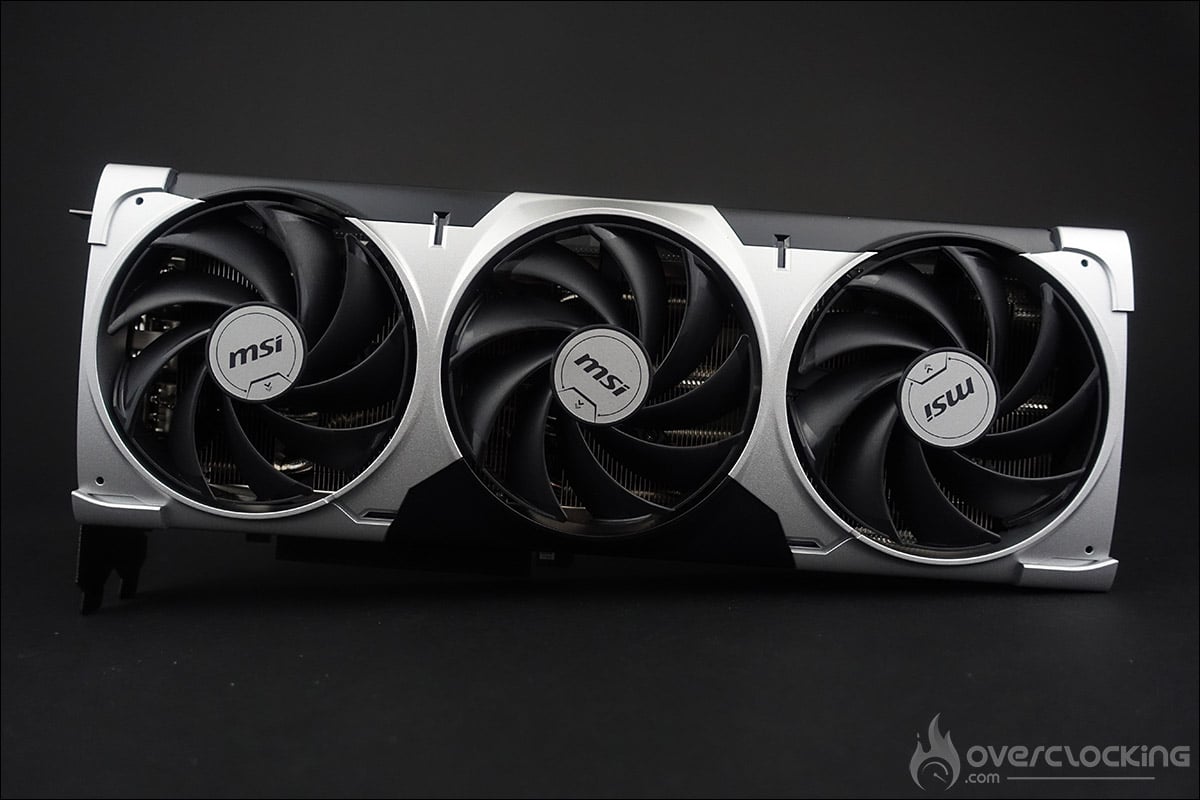
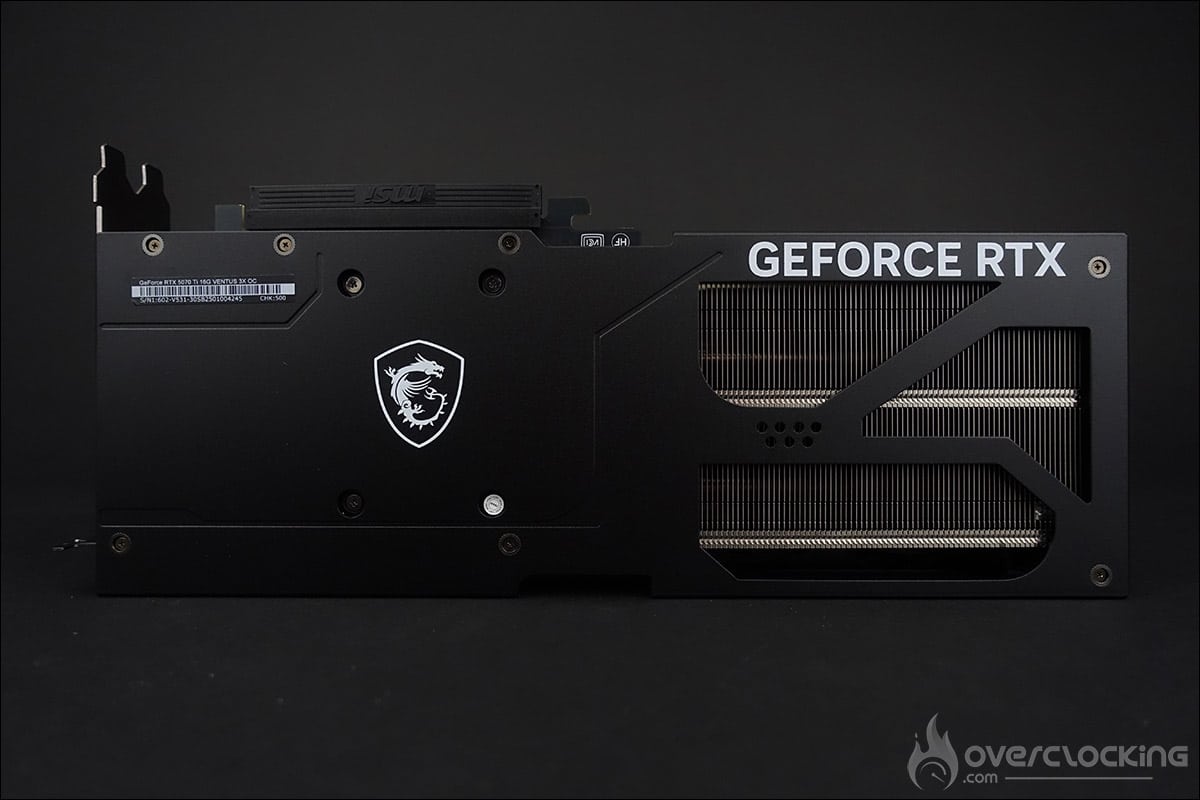
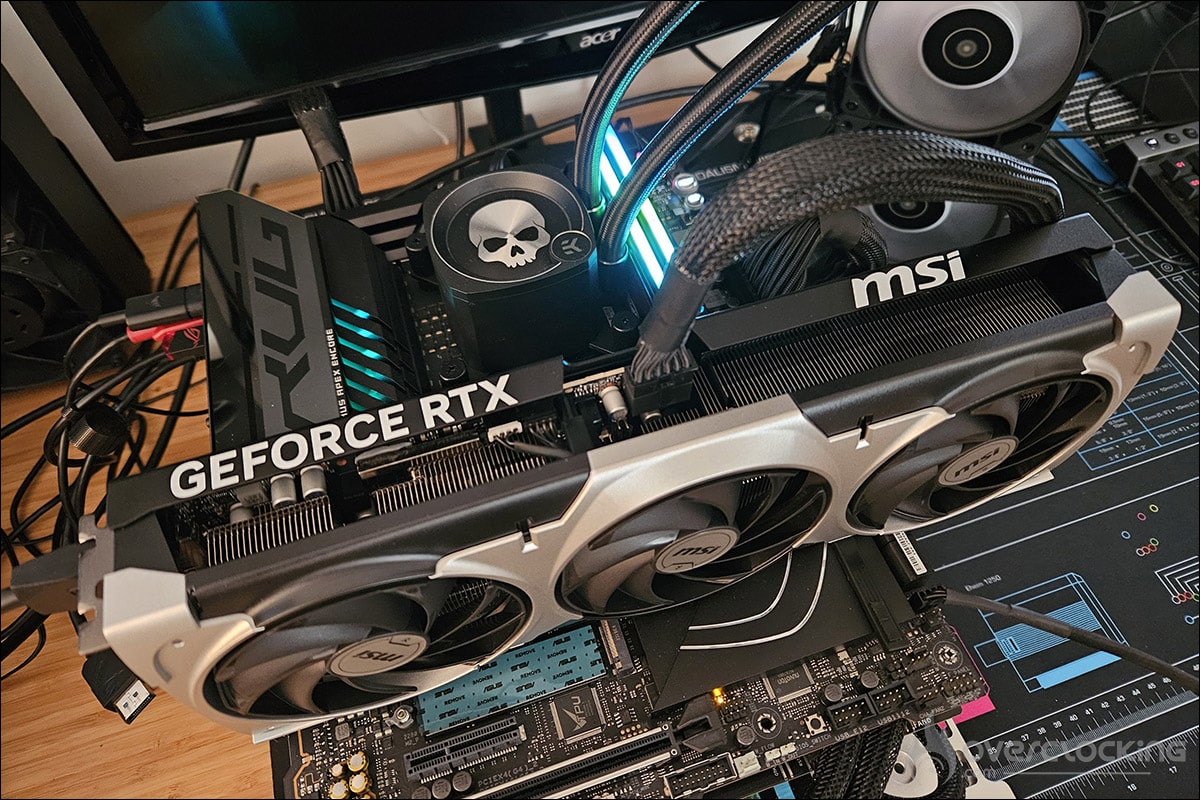
This model is part of the entry-level “Ventus” series, and the only one currently available in this range. MSI has already offered versions equipped only with two fans, with the reference “Ventus 2X”. Aesthetically, the board plays on sobriety, with touches of black and silver-grey, and a plastic fairing. It’s sober but effective, and above all, it’s versatile enough to match any motherboard. The rear features a black metal backplate with a perforated section to allow air to be expelled through the heatsink.
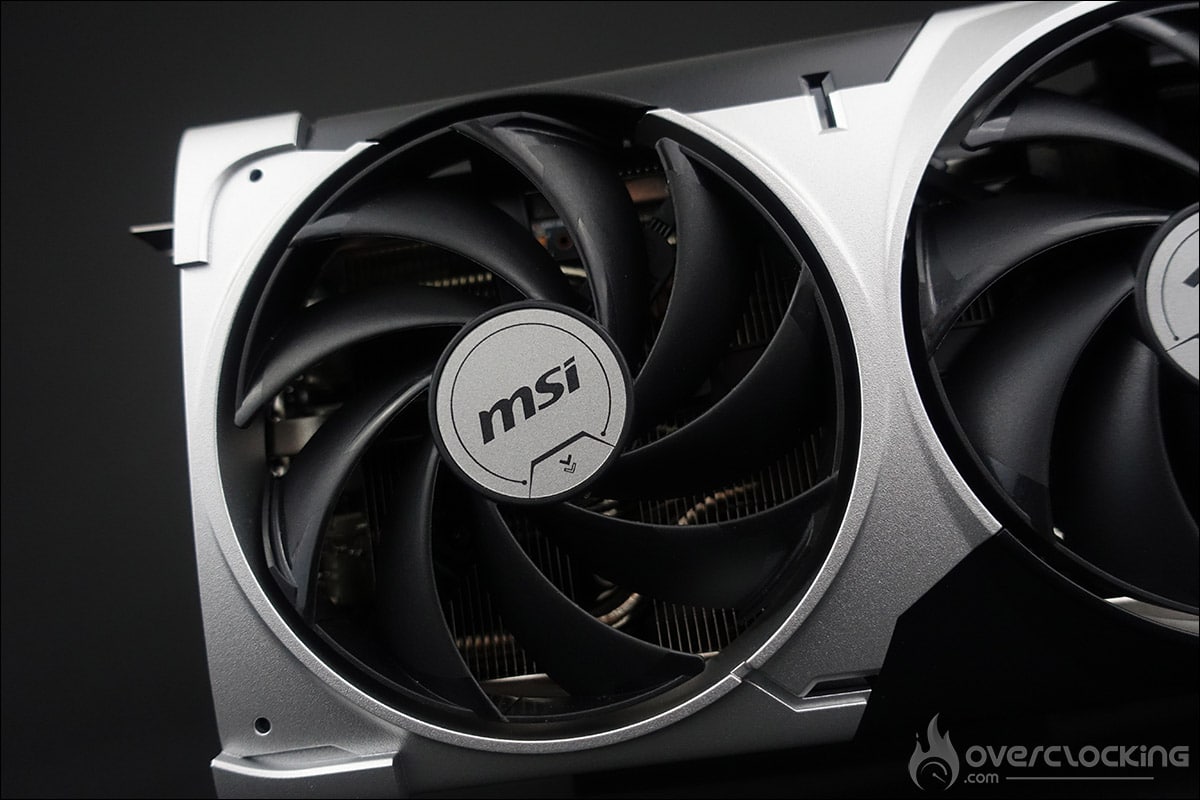
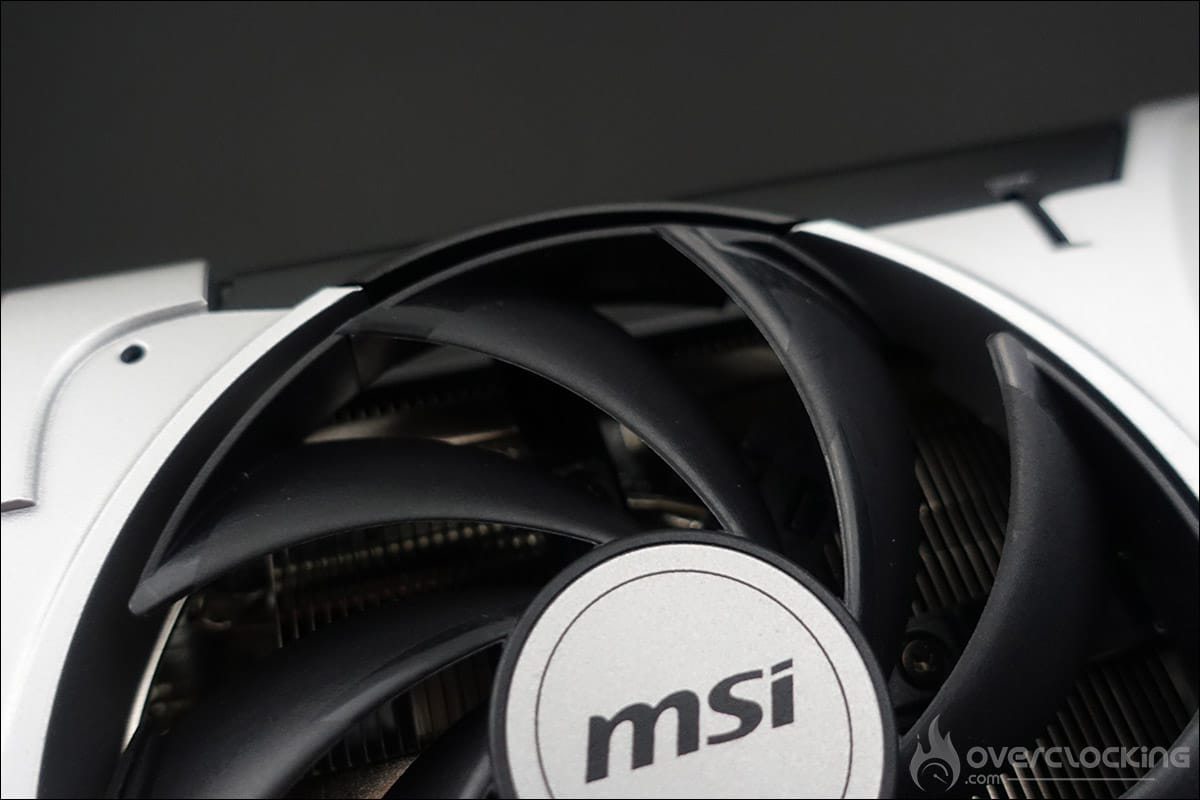
As you can see, the PCB is shorter than the heatsink, making it possible for MSI to offer a Ventus 2x in the future. This is a custom board, i.e. with its own cooling system. The board is labelled “Ventus 3X” to indicate the presence of three 85 mm TORX FAN 5.0 fans. MSI points out that these new fans improve flow and pressure thanks to their new design, in which three blades are linked together and angled at 22°.
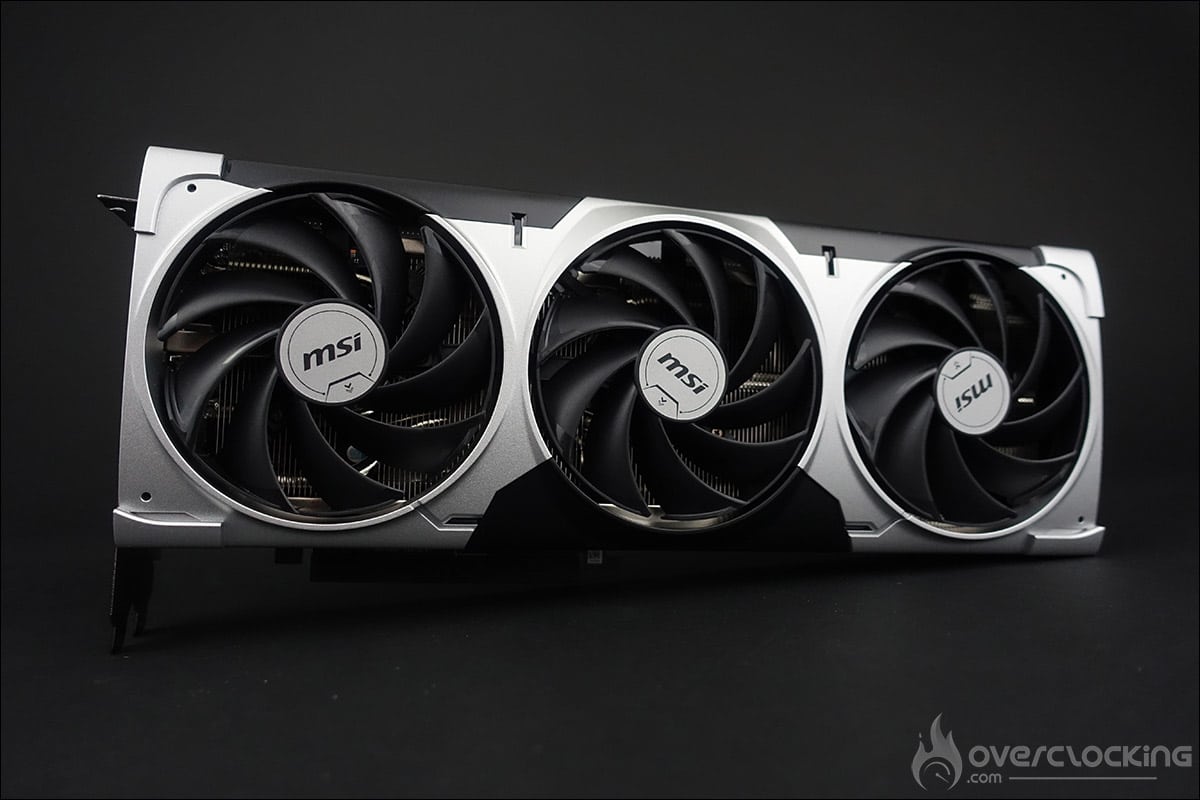
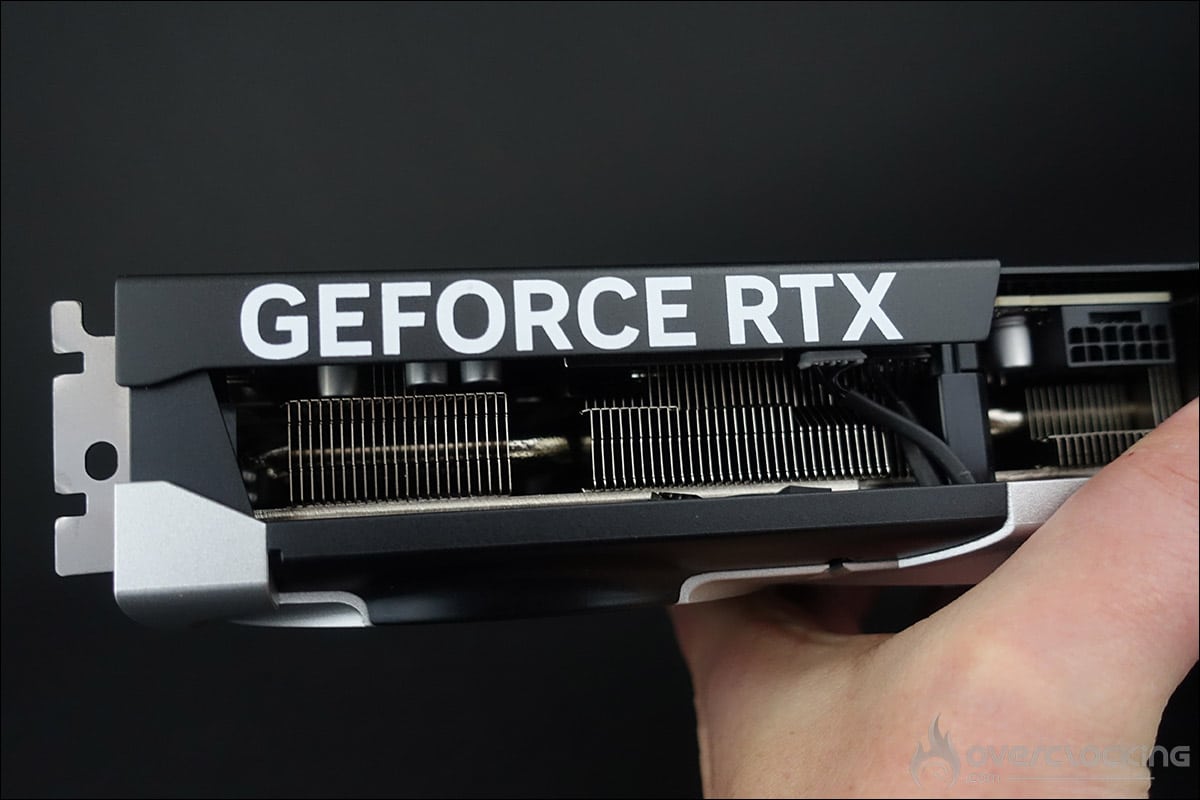
MSI uses its patented ” Zero Frozr ” technology for this card. The principle is to completely shut down the heaters when the GPU temperature is low, in order to eliminate noise pollution. As the card is an entry-level model, we only have one BIOS, and in the end, that’s quite sufficient. The same applies to RGB backlighting, which this Ventus 3X model does without. All these choices allow us to cut costs and offer NVIDIA‘s MSRP pricing.
Connectors :
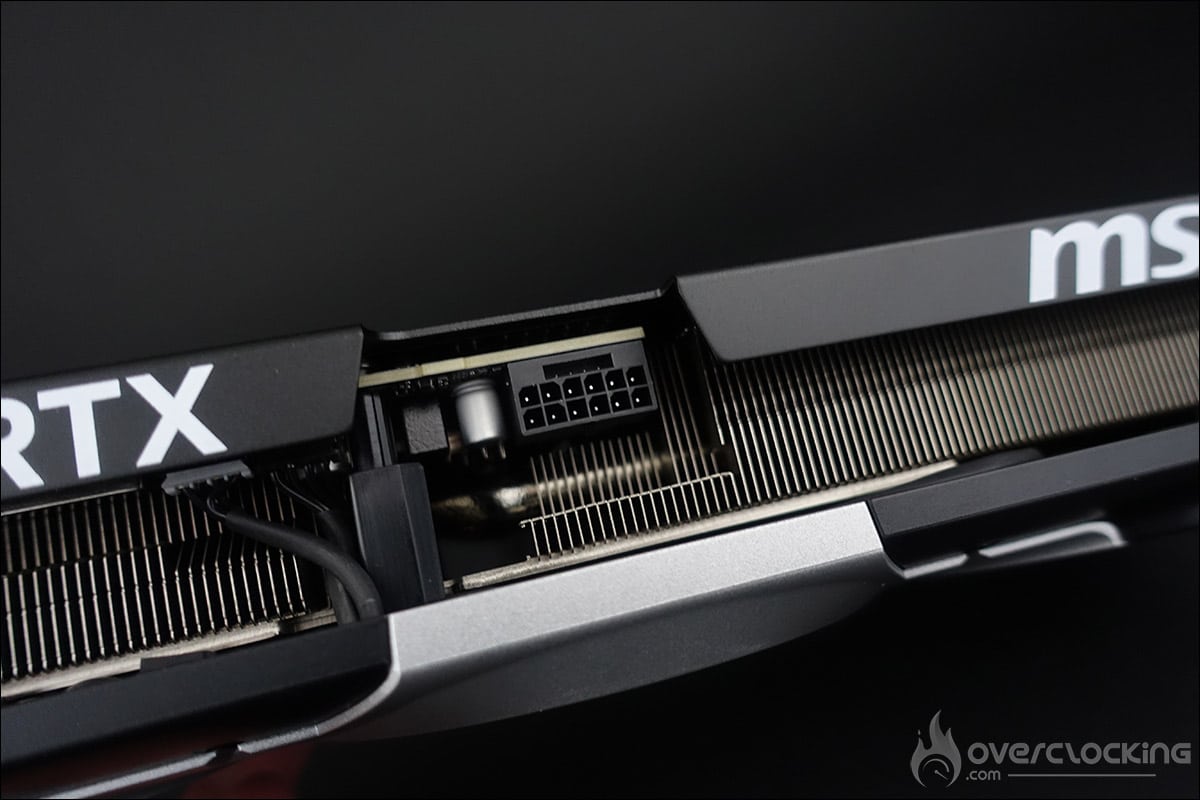
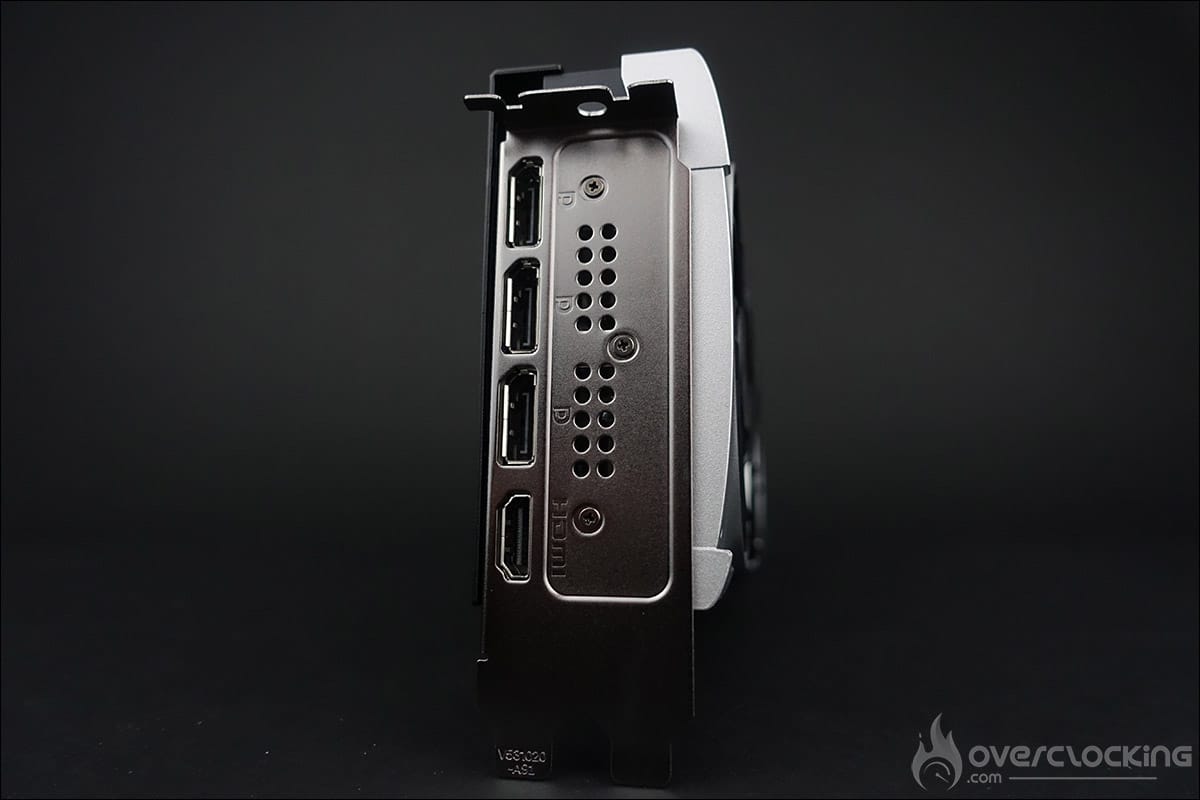
To power this MSI RTX 5070 Ti Ventus 3X OC, there’s a single 12V-2×6 connector, but you can use the 3 x PCIe 8-pin adapter supplied in the bundle, if your power supply doesn’t have this connector. Finally, the card’s video outputs include three DisplayPort 2.1b and one HDMI 2.1b.
[nextpage title=”Full of new technologies:”]
DLSS4: what’s new?
With the announcement of its new range of graphics cards, the GeForce RTX 5090, RTX 5080, RTX 5070 Ti and RTX 5070, it was also an opportunity for the greens to announce the arrival of DLSS 4, the fourth generation of Deep Learning Super Sampling combined with Multi Frame Generation (MFG). As a reminder, the Blackwell architecture features new 5th-generation Tensor Cores and 4th-generation Ray Tracing Cores. It is these hardware innovations from Blackwell and DLSS that will enable MFG, which would have been technically impossible on the previous generation ADA Lovelace.
According to NVIDIA, Multi Frame Generation can deliver up to 8 times better performance in games like Cyberpunk 2077, compared with raw image rendering. Up to 15 of the 16 pixels per frame are generated by AI. The 240 FPS mark can thus be reached in 4K ray tracing, and path tracing can also be used in compatible games.

So, what does this new generation bring to the table? The main difference lies in Frame Generation. Whereas with the RTX 4000 series, DLSS 3 was able to insert an additional frame between two native frames, DLSS 4 will be able to insert up to three, hence the addition of the term Multi FG. You’ll have the choice of generating a single image (x2) for the RTX 40 and RTX 50 series, two images (x3) for the RTX 50 series or three images (x4) for the RTX 50 series.


It’s the AI that will generate up to three images, resulting in increased FPS, smoother gameplay and reduced memory consumption thanks to RTX Neural Shaders that can be used to compress textures. This new AI model is 40% faster, uses 30% less VRAM and only needs to run once per rendered image to generate multiple frames. The only downside is that these AI-generated images will add latency to the creation process, but NVIDIA will be introducing Reflex 2, which we’ll come back to later in this article.
One thing is certain: NVIDIA is reaping the benefits of having jumped on the AI bandwagon very quickly, and is now benefiting from its many years of research in the face of the competition. It’s important to realize that it’s no longer possible to increase raw performance by 25-30% with each generation of graphics cards – it’s the same problem faced by processors, for example. This is why NVIDIA has chosen to integrate AI into its cards in order to offer upscaling.

DLSS 4 is only compatible with this new generation of RTX 5000s, but the other accompanying technologies will have a positive impact on previous generations. The RTX 5000 and 4000 will also benefit from the improved Frame Generation, with gains of 5 to 10% according to NVIDIA, and lower memory consumption.
As soon as the RTX 5000s arrived, i.e. at the end of January, on the 30th to be precise, 75 games and applications were compatible with DLSS 4 at launch, including Alan Wake 2, Cyberpunk 2077, Indiana Jones and the Great Circle, and Star Wars Outlaws.
The new “Transformer”:
DLSS 4 features an updated architecture for DLSS Ray Reconstruction, DLSS Super Resolution and DLAA. Previously, DLSS used convolutional neural networks (CNNs) to generate new pixels, now add a new model based on a Transformer type of model. This should offer greater stability, less ghosting, more detail on moving objects and smoother edges.

This could translate into the possibility of using a Performance mode for DLSS, which would no longer be visually average, but could approach the Balanced/Quality mode on the previous-generation CNN model. Of course, this will have to be tested and compared in terms of image quality between the RTX 4000 and RTX 5000. It will also be relevant to compare the different DLSS modes in terms of image quality.


The new Transformer will offer improved image quality in Ray Reconstruction, as seen, for example, in the image on the left, in Alan Wake 2 with the chain-link fence. The image on the right shows the improved detail between the CNN model and this new generation model.
Reflex 2 technology:
As we said earlier, Multi Frame Generation will enable you to increase the number of FPS, but will add latency due to the creation process. NVIDIA will therefore be offering its version 2 for Reflex, which we have already had the opportunity to present to you here. These few milliseconds will make a real difference, especially in competitive games.


NVIDIA Reflex 2 will combine Reflex Low Latency mode with Frame Warp technology, and will be compatible with all RTX models. The idea, of course, is to reduce latency, i.e. the time that elapses between the moment you click your mouse button and its manifestation on the screen, by displaying a predictive image that is as close as possible to reality. Reflex 2 will be available in the coming weeks.
Override DLSS or the replacement for DLSS:
NVIDIA’s latest application, NVIDIA App, will enable games that have not yet been updated to the latest DLSS models and features to activate support via DLSS override. The version of the app we’ll be testing is a press version, and the DLSS replacement options are available in the Graphics > Program Settings screen under Driver Settings.

We’ll of course be testing Override DLSS during this test to see how easy it is to manipulate. We’ve taken a first look at these new technologies, even if we haven’t gone into detail about everything the new RTX 5070 Ti has to offer. It features two 9th-generation encoders and a new 6th-generation decoder.
[nextpage title=”Technical specifications:”]
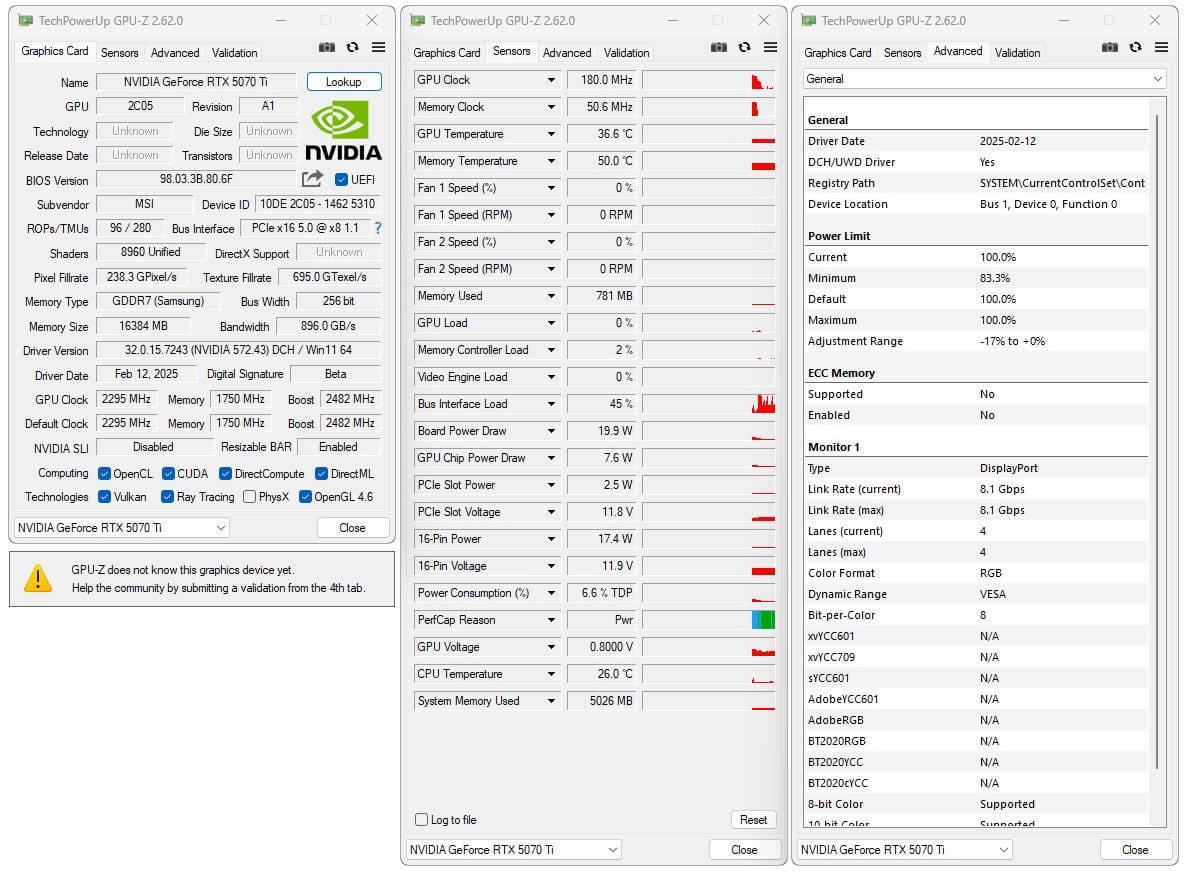
A quick visit to GPU-Z to check that the information read is correct. GPU-Z has (finally) released the new version, 2.62.0, which supports the new RTX 5000s – it’s about time, but not the new RTX 5070 Ti. In the meantime, let’s see what we can learn from our copy of the MSI RTX 5070 Ti Ventus 3X OC.
In terms of frequency, GPU-Z has announced a base frequency of 2295 MHz and a boost frequency of 2482 MHz for the MSI RTX 5070 Ti Ventus 3X OC. The card features 16 GB of GDDR7 memory (896 GB/s) on a 256-bit bus. This model features factory overclocked frequencies, as it is an OC model. This increase in frequency should enable some gains in terms of FPS.
Bear in mind that the GPU frequency may be higher in benchmarks, depending on the quality of your chip and the cooling system used.
In fact, we ran a test under 3DMark Time Spy to observe the GPU boost frequency. At certain points, the GPU reaches the maximum frequency of 2865 MHz. Memory frequency, on the other hand, remains unchanged at a perfectly normal 1750 MHz.
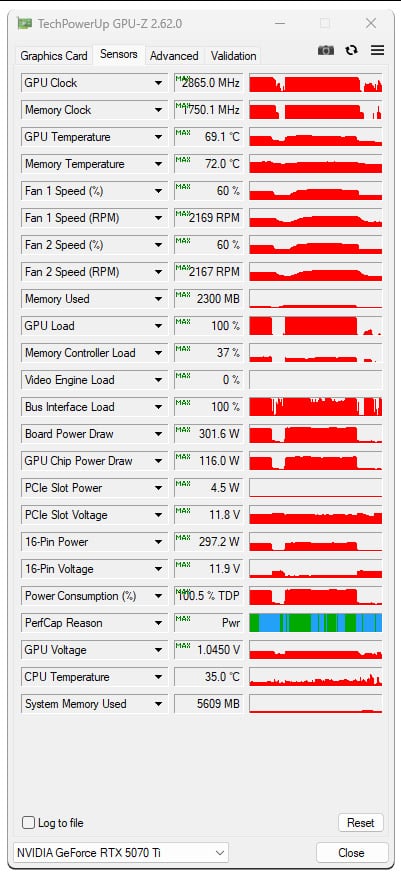
As for temperatures, they rise to 69.1°C and the memory to 72°C. At the time of this first test, it was 20°C in the lab. Temperatures will therefore be verified during our more in-depth tests. The fans are far from running at maximum speed, and the card is fairly quiet. As a reminder, we’re on a bench, not inside a case. Let’s get to testing!
[nextpage title=”Test configuration: “]
As we said in the introduction, we’ve updated all our graphics using the latest drivers from NVIDIA, AMD and, of course, INTEL. We also took the opportunity to slightly modify our test configuration and add new games to our protocol. So here we go again, with a new series of tests and graphics on this slightly modified configuration:
- Motherboard: ROG Maximus Z790 APEX Encore
- Processor : Intel Alder Lake i9-14900K delid
- Cooling system: EK-Nucleus AIO CR360 Direct Die D-RGB – 1700
- Memory: 48 GB Corsair Dominator Titanium 8000 MT/s CL38
- Graphics card: MSI RTX 5070 Ti Ventus 3X OC, NVIDIA RTX 4070 Ti Super FE, NVIDIA RTX 4070 Ti FE, NVIDIA RTX 4070 Super FE, NVIDIA RTX 4070 FE, AMD RX 7900 GRE and AMD RX 7800 XT
- SSD: Western Digital Black SN750 2 TB radiator EKWB
- Power supply: Corsair AX1600i
- Operating system: Windows 11 64-bit 24H2 (26100.2894)
For this test, we used a fairly high-end configuration based on an delided i9-14900K processor and DDR5 memory. Depending on the definition tested, we’re using either an MSI Oculux NXG253R or a ROG Strix XG27UCS on loan from ASUS France.
Our test protocol :
All cards are tested at stock frequencies and without any optimization. For the various benchmarks, whether synthetics or games, we’ll opt for 1080p, 1440p and 2160p resolutions, depending on the card’s performance.
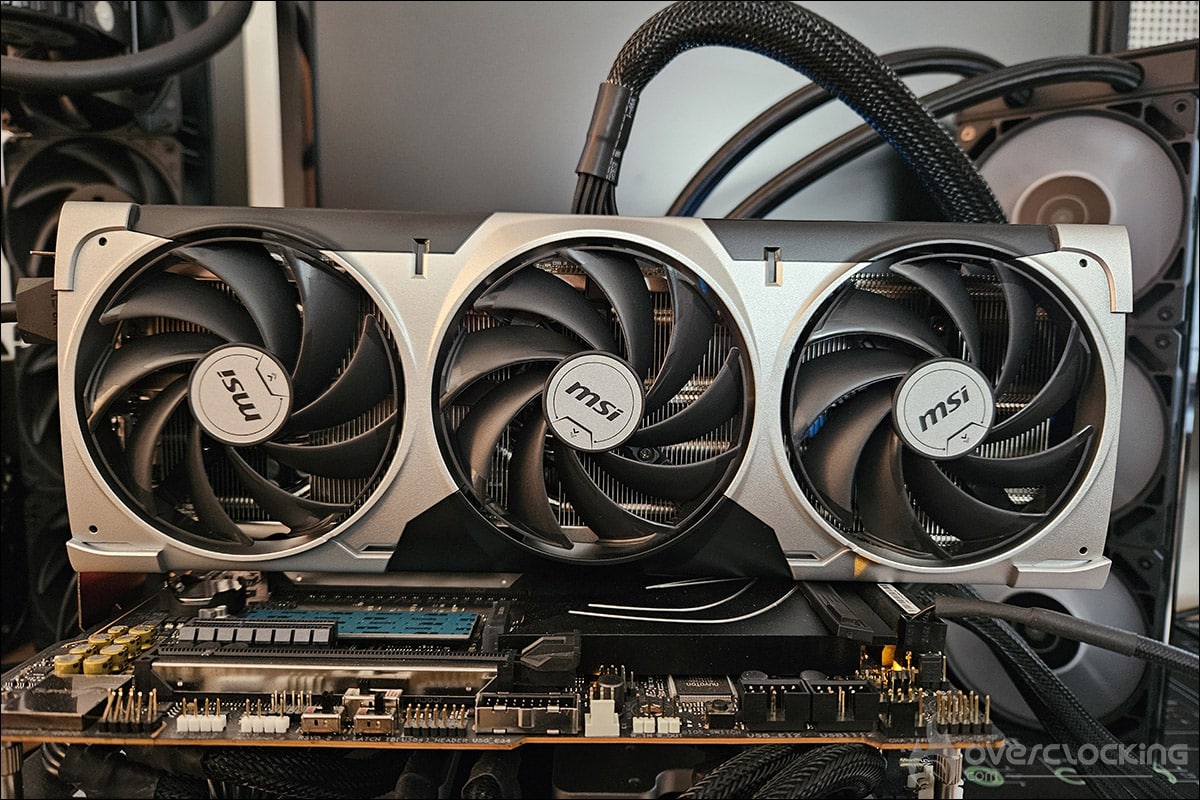
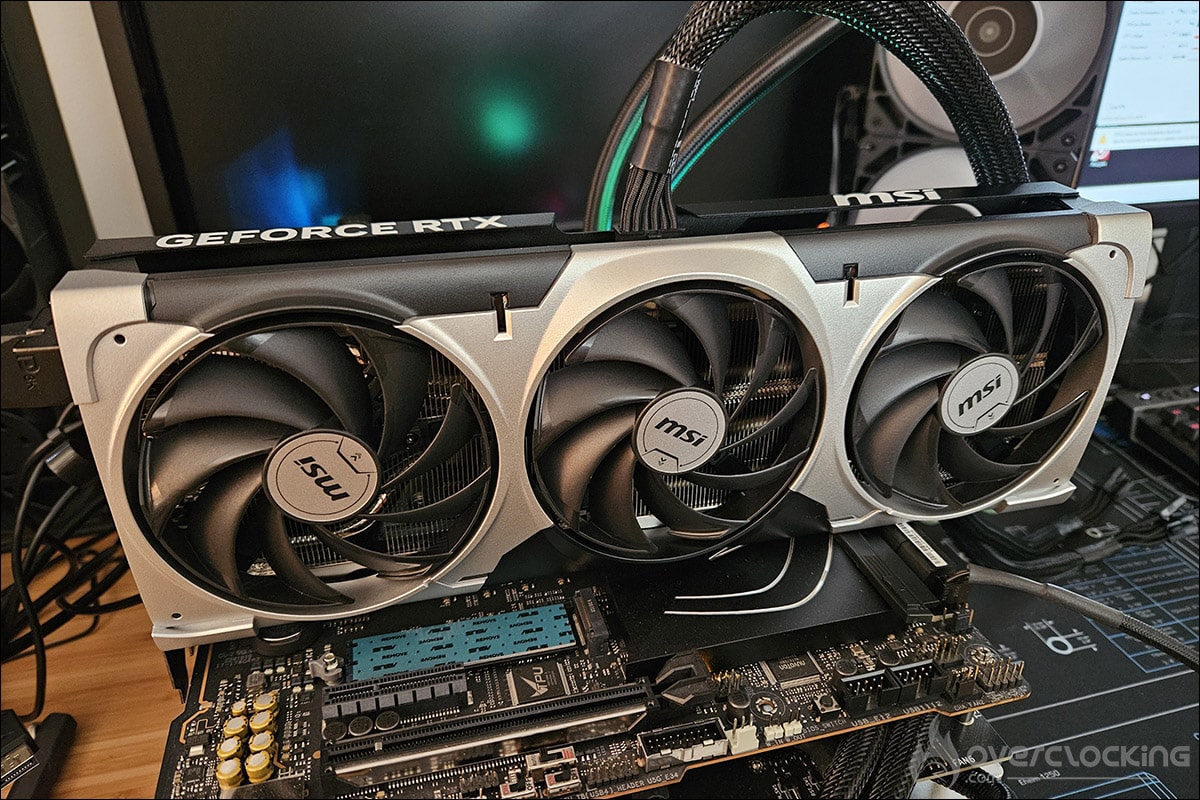
Here, with this MSI RTX 5070 Ti Ventus 3X OC model, there’s no doubt about the definition: it’s 1440p! So, of course, in some older, lighter games, it’s quite possible to envisage 2160p definition, but we’re convinced, especially with ray tracing, that this model is more suited to 1440p. We’ll be using the DLSS Super Resolution in Performance mode, with image generation and ray tracing where available.
As you can see, we’re now running Windows 11 and we’ve activated the ” ReSize BAR ” in the BIOS, which can be seen in GPU-Z. Now that you know everything about our test configuration, it’s time to get started!
[nextpage title=”3DMark benchmarks: “]
Our first series of tests will be dedicated to synthetic benchmarks. These are often used for overclocking competitions , but are also very interesting for comparing different GPUs. We’ll be focusing on benchmarks from the 3DMark series. For this new version of our graphics, and for the 3DMark test section, we’ve also isolated the GPU score. You’ll therefore find, where stipulated in the benchmark, both the overall score and the GPU score.
3DMark Fire Strike and Fire Strike Ultra:
Let’s start with 3DMark Fire Strike, one of the most widely used benchmarks today. It consists of two graphics tests, a CPU test and a fourth test that combines GPU and CPU. Don’t forget to deactivate the demo, which makes no contribution to the final score and prolongs the benchmark ‘s duration (unnecessarily). The version used for these tests is, of course, the latest available.

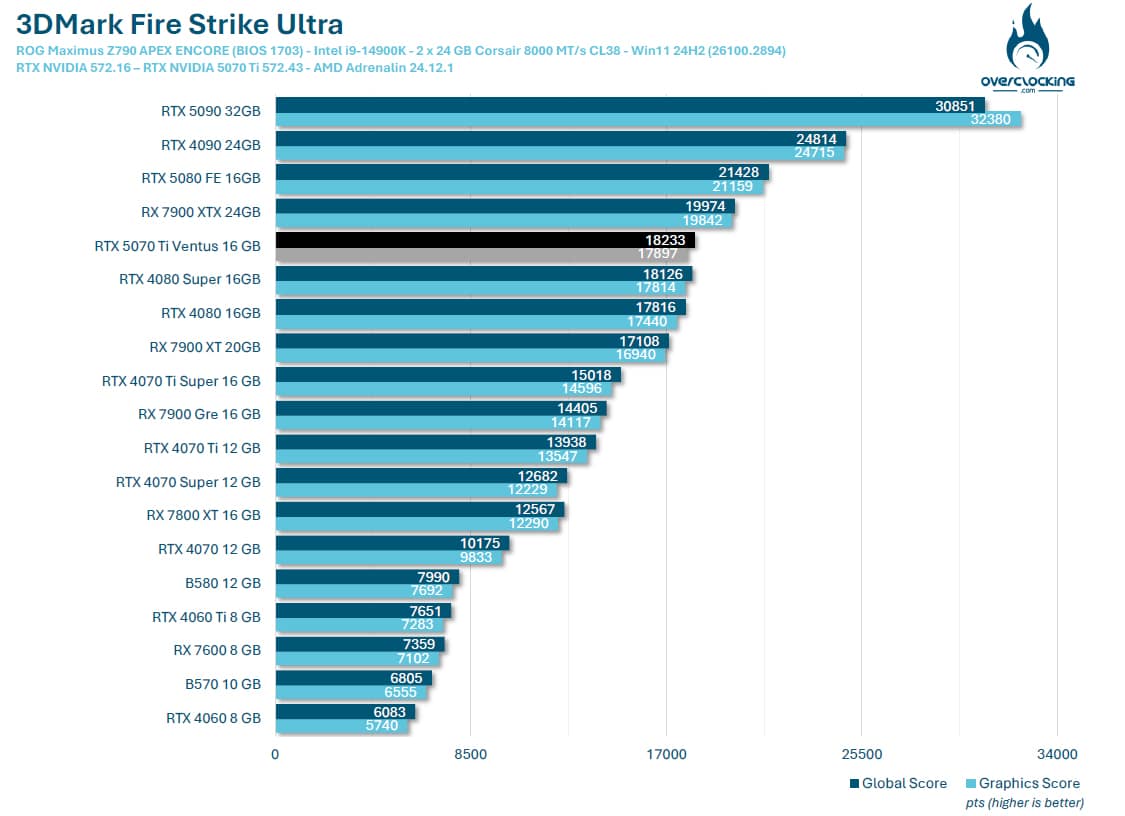
We kick off our tests with the two Fire Strike and Fire Strike Ultra benchmarks, and it’s off to a great start, to say the least! The MSI RTX 5070 Ti Ventus 3X OC is ahead of the previous-generation RTX 4080 Super.
3DMark Time Spy and Time Spy Extreme:
The second test is 3DMark Time Spy. Although this one is performed in 1440p, its main feature is that it uses DirectX 12. It consists of two graphics tests and a CPU test. As with Fire Strike, don’t forget to disable the demo. These first two benchmarks are provided by UL Benchmark.
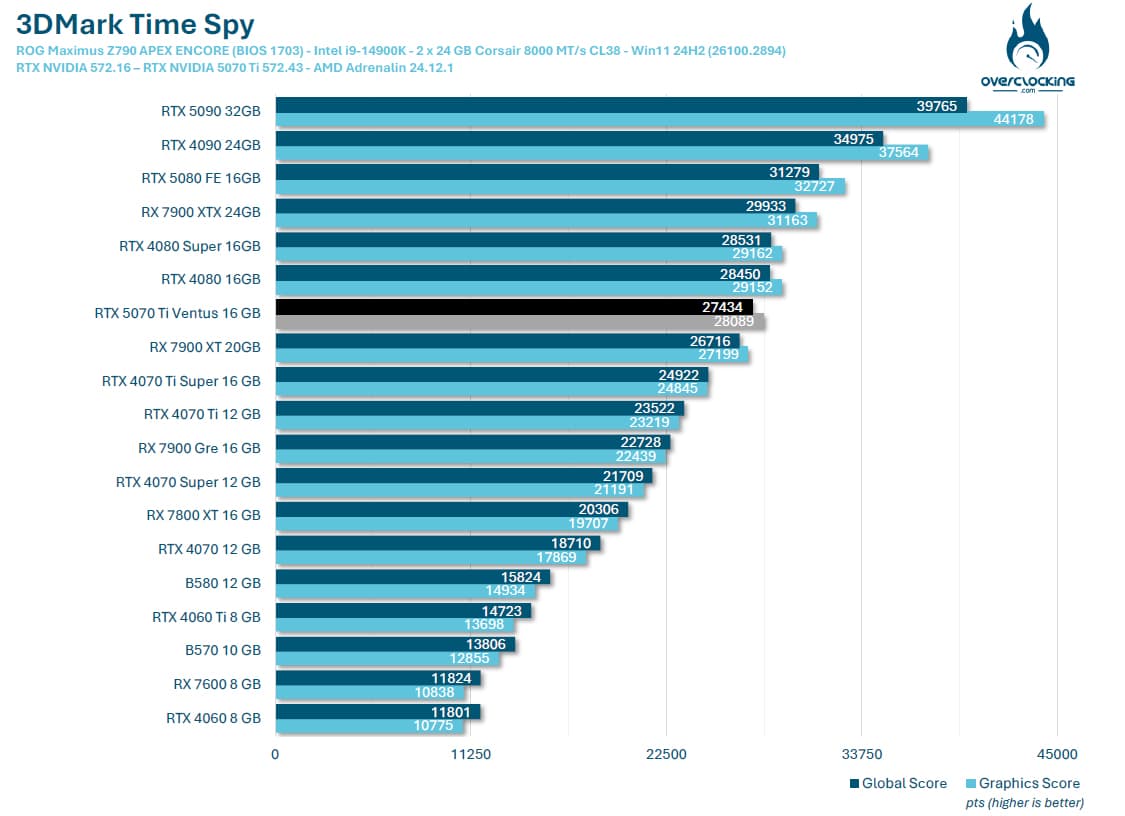
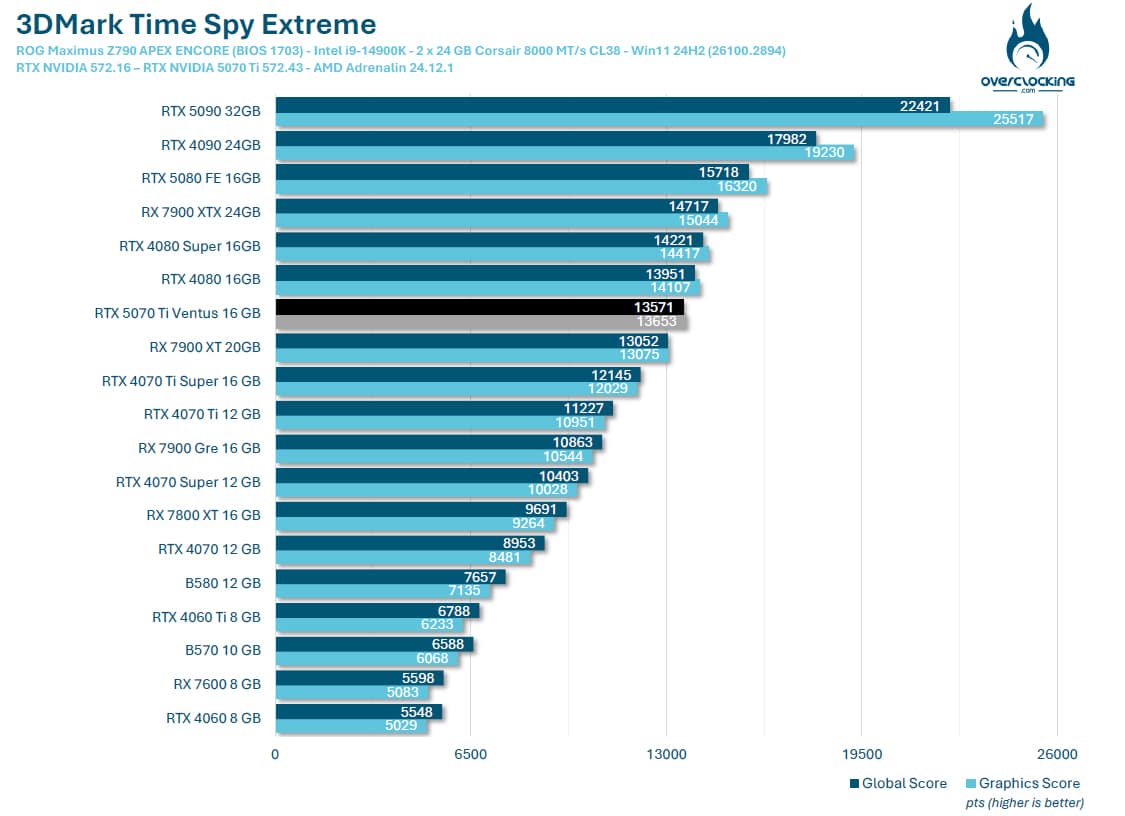
We continue with Time Spy, where the results change slightly. Our MSI RTX 5070 Ti Ventus 3X OC drops a little in the rankings and takes up a rather logical place, behind the previous-generation RTX 4080, even if performance is quite similar, we have to admit. Time Spy often gives a first idea of in-game performance, so we should have our RTX 5070 Ti, which is sure to become the new benchmark for 1440p definition.
3DMark Speed Way:
Ulbenchmark’s latest benchmark, and it’s nice to be able to say we’re going to benchmark this Speed Way. It uses DirectX 12 and defaults to 1440p. We haven’t modified anything, so we’re using the original benchmark.
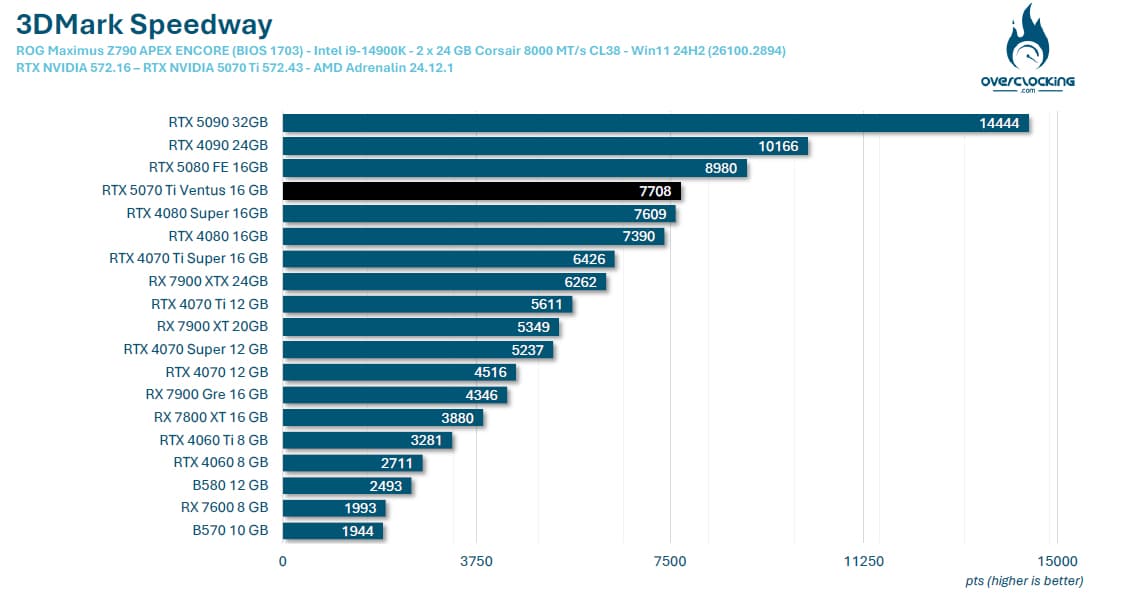
In Speed Way, our sample of the day beats the RTX 4080 Super with 7708 points.
3DMark Port Royal :
Here’s a benchmark we left out last year, but which you may have wanted to see again in our tests. It’s still widely used, especially in the overclocking community. So we’ve decided to add it to our tests.
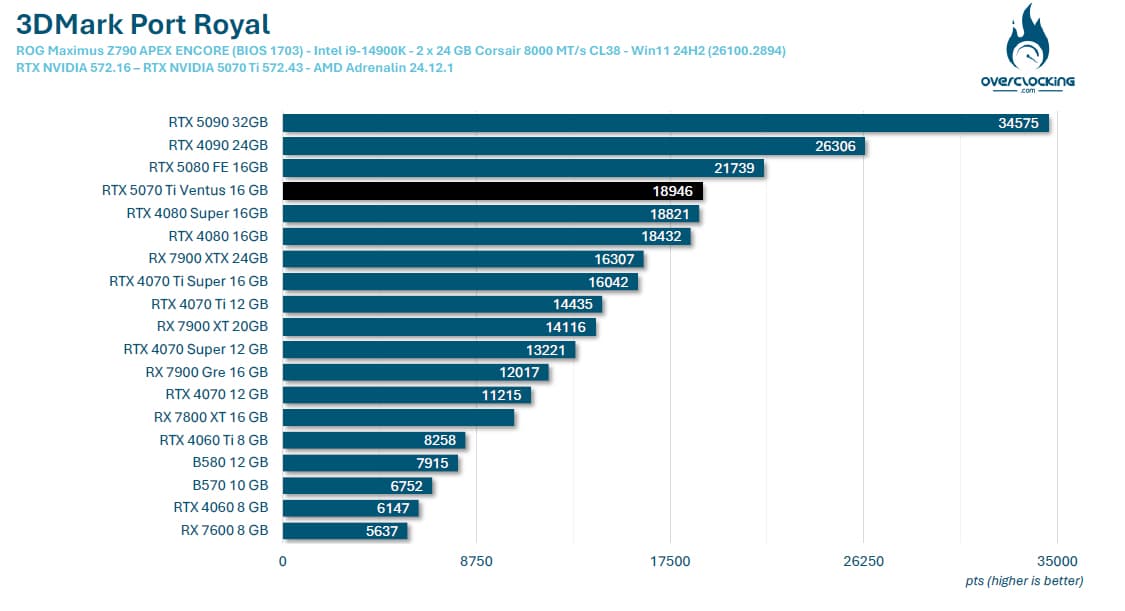
The result remains the same: fourth place for our MSI RTX 5070 Ti Ventus 3X OC. The gain over the previous generation, the RTX 4070 Ti, is 31%.
3DMark Steel Nomad:
The latest benchmark in the 3DMark suite, Steel Nomad will replace Time Spy as the most recent benchmark in the 3DMark suite. The good news, however, is that it will be free for users who already have a key. The program includes a test bench based on Microsoft’s DirectX12 API. However, there will be no ray tracing, but the scene will use an “extreme” level of geometry and rasterized light.
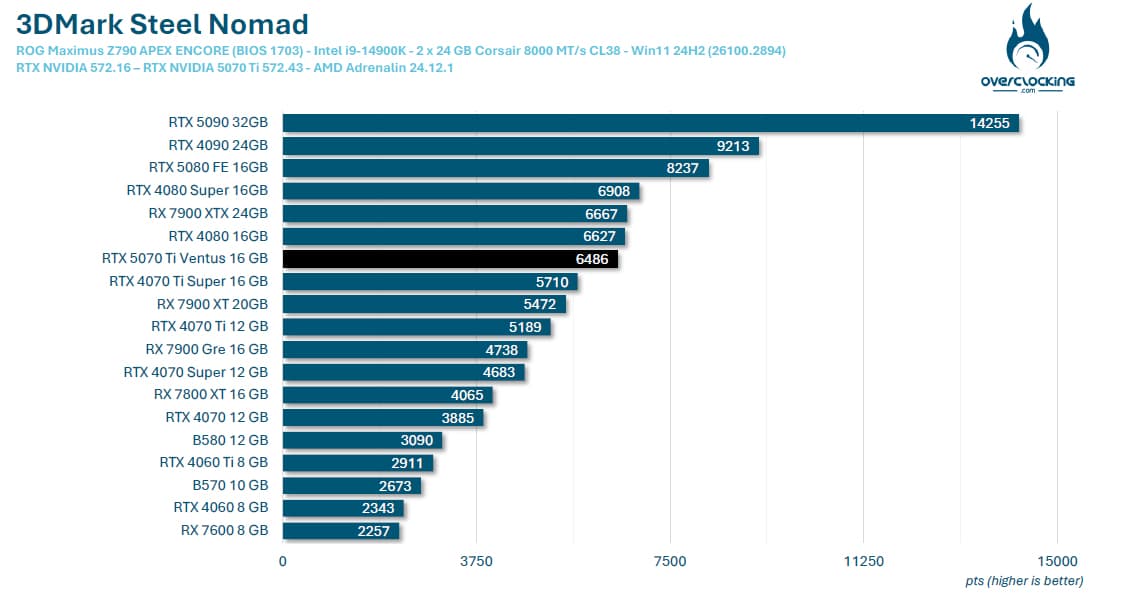
Finally, the penultimate benchmark in the 3DMark series, Steel Nomad, puts our MSI RTX 5070 Ti Ventus 3X OC behind the RTX 4080.
3DMark NVIDIA DLSS:
We’ve added this benchmark here, highlighting the potential of DLSS, which will now be compatible with DLSS 4, and giving us the opportunity to test it with this RTX 5070 Ti Ventus 3X OC
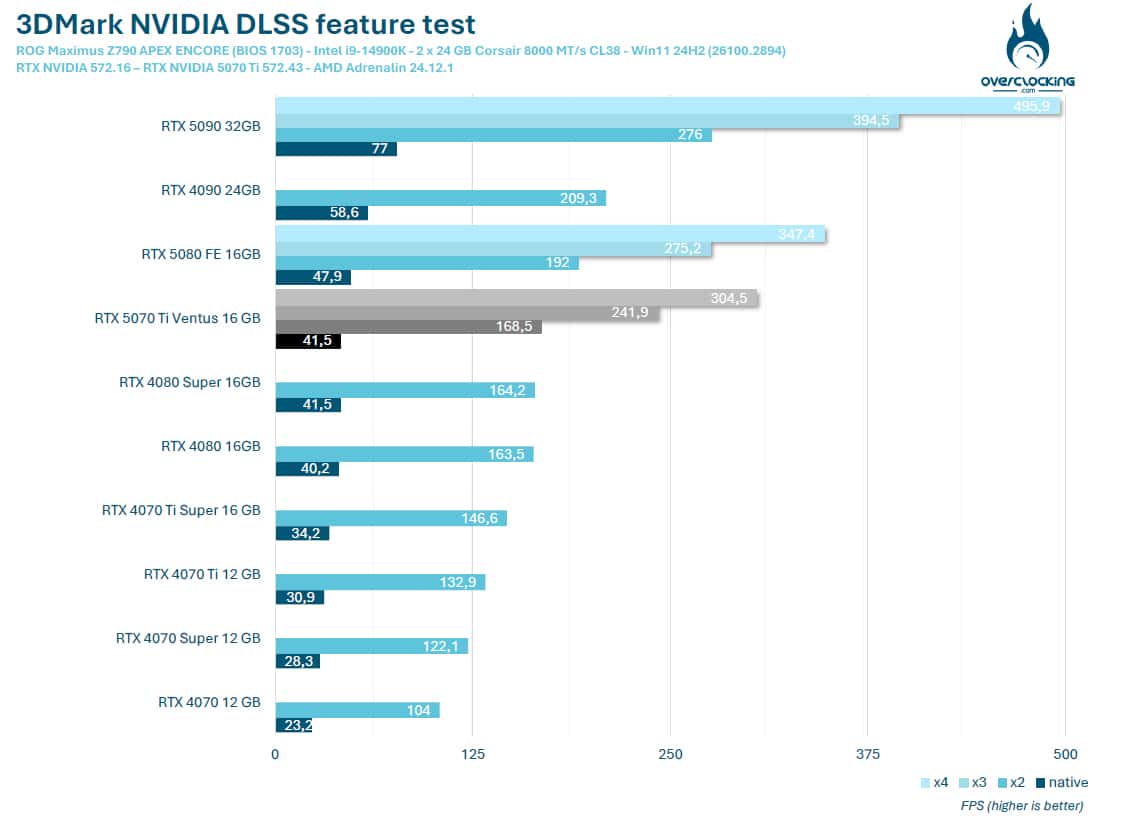
Finally, the last benchmark in the 3DMark series, the NVIDIA DLSS feature test will enable us to highlight, for the first time, the contribution of DLSS 4 technology. As a reminder, Frame Generation, on RTX 5000s, can be selected as x2 (one frame), x3 (two frames) or x4 (three frames). This refers to the number of additional frames that can be added between two native frames. Our MSI RTX 5070 Ti Ventus 3X OC is once again ahead of the RTX 4080 Super.
[nextpage title=”Cinebench 2024 and V-Ray 6:”]
After the 3DMark series benchmarks, let’s tackle a series of tests concerning tasks for productive use. Even if this is not the primary function we’ll be attributing to the graphics card, we couldn’t do without offering you a small panel of tests, especially concerning AI, which is becoming more and more present.
Cinebench 2024 GPU:
This is a benchmark that we won’t be introducing again, as it’s used so often for our CPU tests, but here, with the 2024 version, it’s our graphics card that we’re going to put to the test. Please note that the version included in BenchMate will not work for this GPU test, so you’ll need to download the full version from the Maxon website.
No results in Cinebench 2024, which will probably need updating, as our MSI RTX 5070 Ti Ventus 3X OC is not recognized. As you may remember from previous tests, Intel graphics cards are still not compatible with this benchmark either.
V-Ray 6:
A new benchmark to add to those we use to test our graphics cards. The V-Ray 6 benchmark is produced by the Chaos company to enable users to quickly evaluate rendering speeds for both your processor and your graphics card, which is why we’re adding it today. The advantage is that it’s free and can be downloaded directly by following this link. You can then compare your score directly with those below, or directly online on the Chaos page.
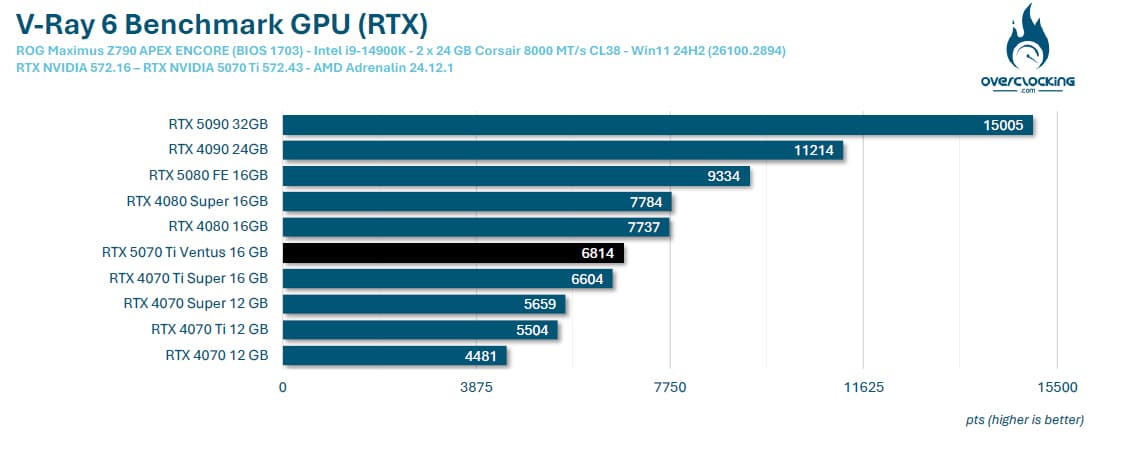
Here, for our tests, we’ll be opting for “RTX” rather than “CUDA” rendering for NVIDIA’s RTX graphics cards. As with the 3DMark benchmarks, our findings remain the same: we are positioned behind the RTX 4080, but with a much wider gap.
[nextpage title=”UL Procyon AI Image / Text Generation:”]
UL Procyon AI Image Generation:
UL Benchmark not only offers its 3DMark benchmark suite, but also UL Procyon, to meet the demand for Artificial Intelligence evaluation. This benchmark was chosen for its ease of implementation. The benchmark will generate 4 x 4 images and provide us with a score as well as a result in the form of the time, in seconds, required to generate an image. The software supports several AI inference engines, depending on the GPU used.
We’ll be using the benchmark in Stable Diffusion 1.5 (FP16) mode. It is intended for mid-range GPUs. The test will create 16 images at a resolution of 512 x 512, in batches of 4. There’s a test called Stable Diffusion XL (FP16), where 16 images will be created, at 1024 x 1024, in batches of 1.
Unfortunately, our MSI RTX 5070 Ti Ventus 3X OC is not recognized by the software and should be updated shortly. The software crashes systematically. On the other hand, the 5th generation Tensor Cores bring support for the FP4(Floating Point 4 bit) format, which will double the computational performance of neural models while halving the memory footprint. This improvement is based on an essential compromise: FP4 uses less precision than traditional formats such as FP16 or FP32. However, for many deep learning models, this precision is sufficient to maintain reliable results while considerably lightening the load on memory and computing units. We’ll be testing the cards with this press release in the near future.
UL Procyon AI Text Generation:
The latest benchmark to be added to this test suite, AI Text Generation. The Procyon AI Text Generation Benchmark offers a more compact and easier way to repeatedly and consistently test AI performance with multiple LLM AI models. UL claims to have worked closely with many AI software and hardware leaders to ensure that the benchmark tests take full advantage of the local AI gas pedal of the systems used.
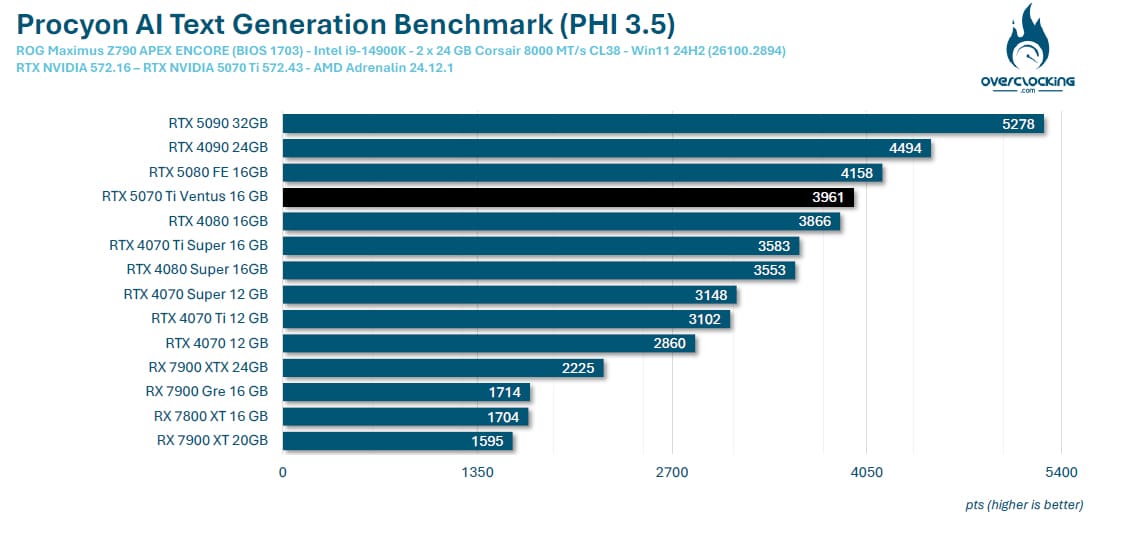

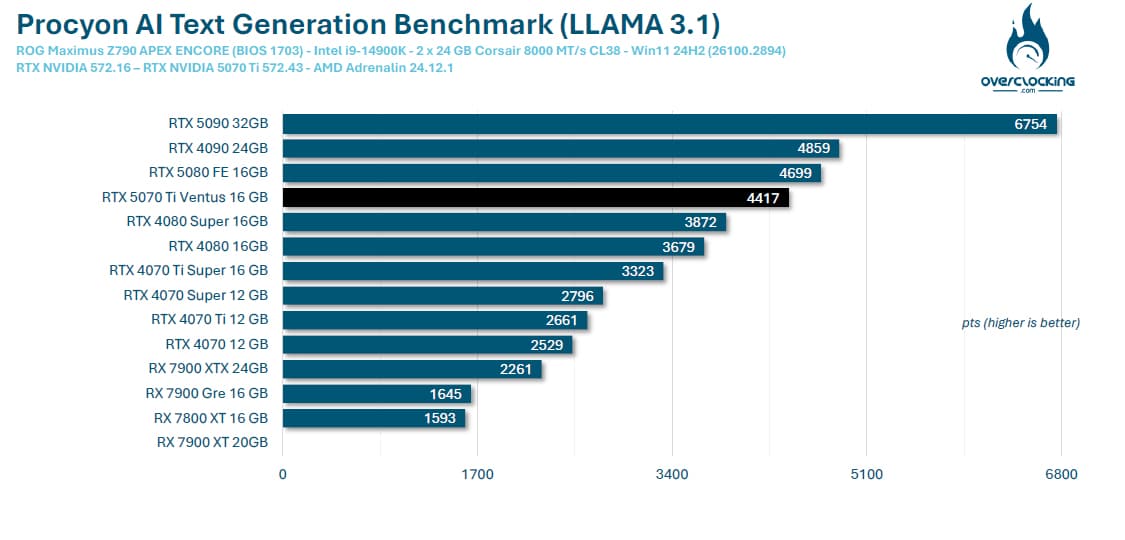
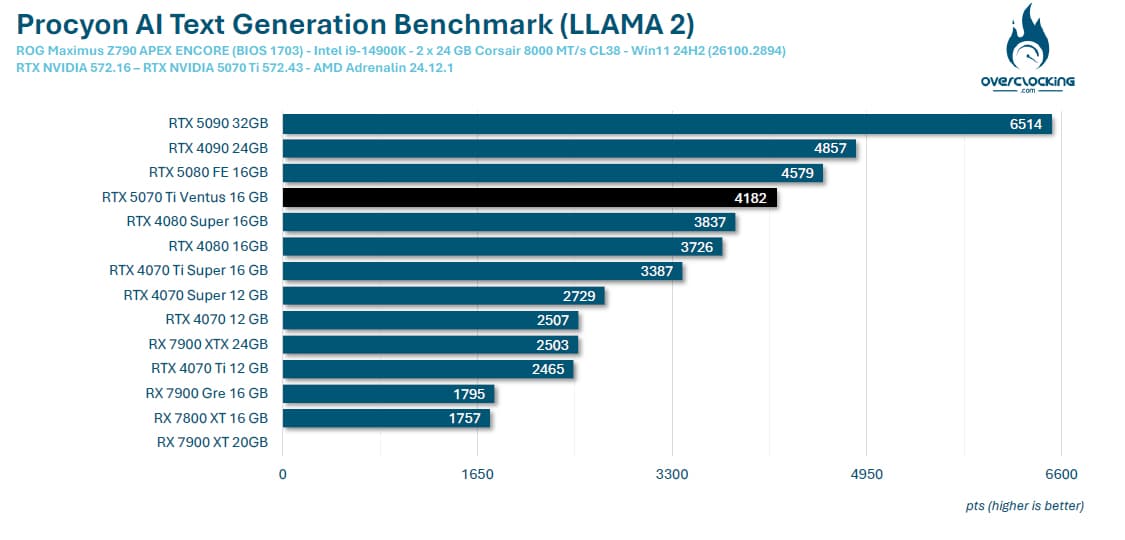
We can see that the differences are greater with the RTX 4080 Super, proof of the improved AI performance of this new generation of graphics cards.
[nextpage title=”1440p gaming rasterization performance: “]
Let’s get on with the gaming tests. We’ve used all the graphics cards we thought would be interesting to compare with this MSI RTX 5070 Ti Ventus 3X OC in 1440p definition. In the coming weeks, we’ll be offering a new type of article, retesting graphics cards from previous generations to find out what they’re still worth in 2025. Our games panel currently consists of 13 titles, and will be expanded in the coming weeks.
We have chosen to use the built-in benchmarks of these games.
Why do we do this? Quite simply to enable you to compare your results with ours if you also own a copy of one of these games. It’s a thought-provoking idea, and one that will enable you to compare your results with ours. The number and titles selected have changed slightly, and will increase again in the coming weeks as we get our hands on new games.
What is rasterization?
A quick word about “rasterization”, which is currently the subject of much discussion. Rasterization is the evaluation of the performance of our graphics cards without the use of upscaling technologies . We choose a graphics quality, often the highest, and test it. The advantage of these tests is that we can quantify the gains made by the architecture between different generations. In our case, this means being able to judge the gains obtained between the architecture of the RTX 4070 Ti (ADA Lovelace) and that of the new RTX 5070 Ti (Blackwell).
Borderlands 3 :

It’s off to the gaming part, with Borderlands 3 to kick things off . This first game seems to confirm our feelings about this MSI RTX 5070 Ti Ventus 3X OC, which offers a very interesting gain over the previous generation, with a 28% increase in performance.
Cyberpunk 2077:

The same applies to Cyberpunk 2077, but the differences are still significant, with a 31.2% gain over the RTX 4070 Ti and its 12 GB. Compared with the 16 GB RTX 4070 Ti Super, the difference is 25%.
COD Modern Warfare III:

We’re not really changing the shape of our chart, but for the first time, the RX 7900 GRE model takes first place. The performance of our MSI RTX 5070 Ti Ventus 3X OC is still very good.
Forspoken:

Forspoken is a pretty demanding game, and this MSI RTX 5070 Ti Ventus 3X OC model is the only card that offers itself the opportunity to go titillate the 100 FPS mark.
Horizon Zeron Dawn Remastered:

One of the new games we’ve added to our comparison, and where the differences are smaller than usual between the RTX 4070 Ti and our MSI RTX 5070 Ti Ventus 3X OC. Here, we note a difference of 15%.
Shadow Of The Tomb Raider:

Under Shadow Of The Tomb Raider, the 250 FPS mark is easily passed by our MSI RTX 5070 Ti Ventus 3X OC.
Black Myth: Wukong Benchmark Tool :

This new game, seems greedy too and doesn’t shine a good light on NVIDIA graphics cards.
Far Cry 6:

Performance remains identical under Far Cry 6. We find greater differences with our MSI RTX 5070 Ti Ventus 3X OC, which outperforms the RTX 4070 Ti by 22% and the RTX 4070 Ti Super by 9.5%.
Assassin’s Creed Mirage:

Here, performance is lower, and the gap narrows with the RTX 4070 Ti Super model.
Red Dead Redemption II:

Under Red Dead Redemption II, the MSI RTX 5070 Ti Ventus 3X OC is still well ahead, even if we’re seeing smaller differences with the previous generation.
F1 2024 :

The first time there’s virtually no difference between the MSI RTX 5070 Ti Ventus 3X OC and the RTX 4070 Ti Super. In the case of the RTX 4070 Ti, the difference is 13%.
Monster Hunter Wilds:

We’ve added a new benchmark for this MSI RTX 5070 Ti Ventus 3X OC. It’s available free of charge on Steam. This future game allows our sample to move to the top of the ranking, ensuring a significant gain over the previous generation.
Alan Wake 2:

The last game, Alan Wake 2, won’t disrupt the order of our graphics, with a 22% gain for our MSI RTX 5070 Ti Ventus 3X OC. Let’s take a look at the average performance of our 13 games.
Average performance of 13 games in 1440p rasterization :

Finally, it’s not too much of a surprise to find out the average performance of this MSI RTX 5070 Ti Ventus 3X OC. Compared with the previous generation, the RTX 4070 Ti and its 12 GB (only), there’s a gain of 20.7%, which is still not negligible. The gap narrows with the 16 GB RTX 4070 Ti Super, to 12%. That’s better, but not exceptional either, given that the RTX 4070 Ti Super benefited from an MSRP almost identical to that of the RTX 5070 Ti.
It’s also worth noting that, in certain games, given the number of FPS, the choice of 2160p definition would be quite feasible. Let’s move on to the upscaling tests and see how this MSI RTX 5070 Ti Ventus 3X OC will benefit from DLSS 4 and Multi Frame Generation.
[nextpage title=”Gaming performance 2160p upscaling:”]
In this section, we’ll test our graphics cards by enabling ray tracing, if available, and upscaling, depending on the graphics card used. As a reminder, there are currently three upscaling technologies . NVIDIA has DLSS, which can only be activated with NVIDIA cards. Depending on the generation of your GPU, you may or may not be able to benefit from all the technologies offered by the Greens. At AMD, it’s FSR, which is also evolving and, for certain games, also benefits from Frame Generation.
Finally, Intel’s in-house upscaling is called XeSS, and with the arrival of this new generation of graphics cards, Intel has taken the opportunity to announce the arrival of XeSS 2, which will introduce two new features to compete with NVIDIA and AMD, who are already ahead of the game. Intel will offer Xe Frame Generation (XeSS-FG) and XeSS Low Latency (XeLL).
Today sees the arrival of DLSS 4, and in our comparative tests, only Cyberpunk 2077 is already compatible. On the next page, we’ll be showing you a selection of other games compatible with DLSS 4. Finally, it’s important to point out that some games don’t feature ray tracing, but only anupscaling solution. We’ll make this clear in the games below. For 1440p definition, upscaling in either DLSS or FSR will always be in Performance mode.
Cyberpunk 2077:
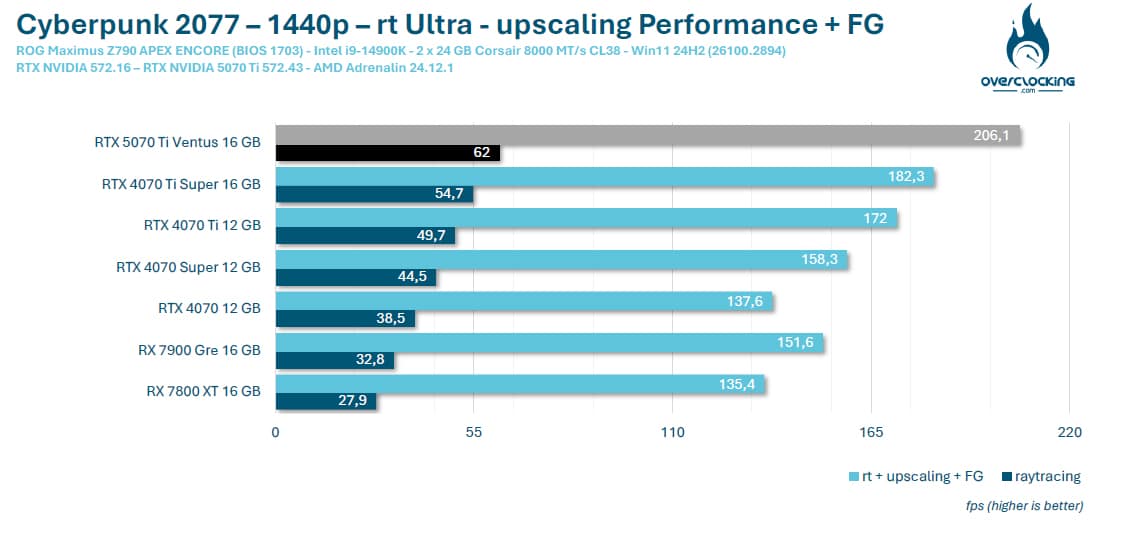
Here we go again, with Cyberpunk 2077as our first game. Our NVIDIA cards are in the lead, thanks to DLSS 4. Please note that, for comparative purposes, only Frame Generation is used here, with the MSI RTX 5070 Ti Ventus 3X OC. Multi Frame Generation will be discussed on the following page. Our sample of the day remains well ahead of the pack, maintaining a 25% gain with ray tracing on the RTX 4070 Ti.
COD Modern Warfare III:
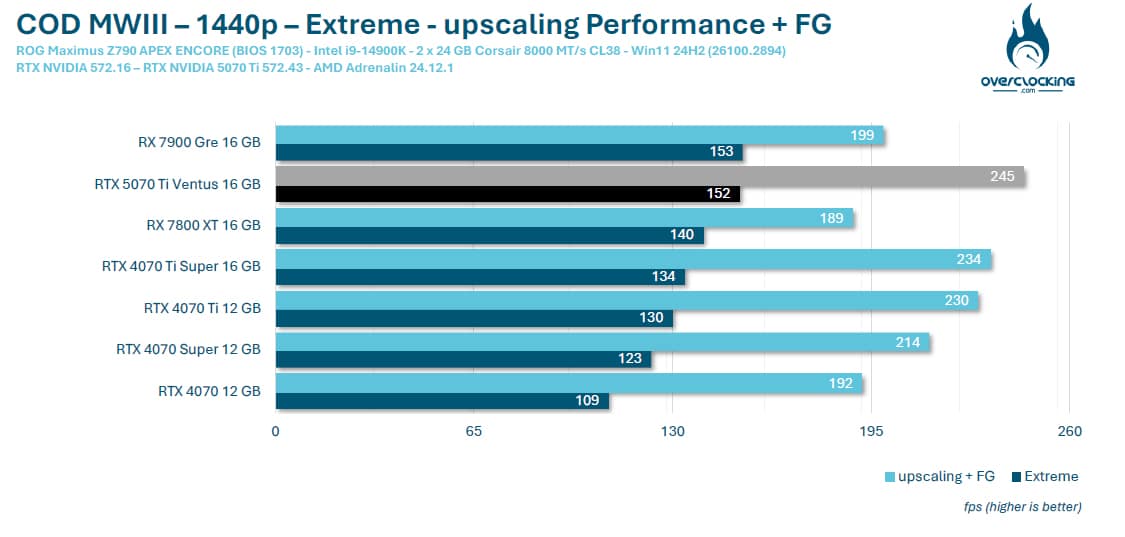
No worries in Call Of Duty Modern Warfare III, where upscaling still allows you to gain FPS, even if our MSI RTX 5070 Ti Ventus 3X OC doesn’t really need it, with an average of 152 FPS in rasterization. This is obviously the type of game in which we could benefit from 2160p definition.
Forspoken:
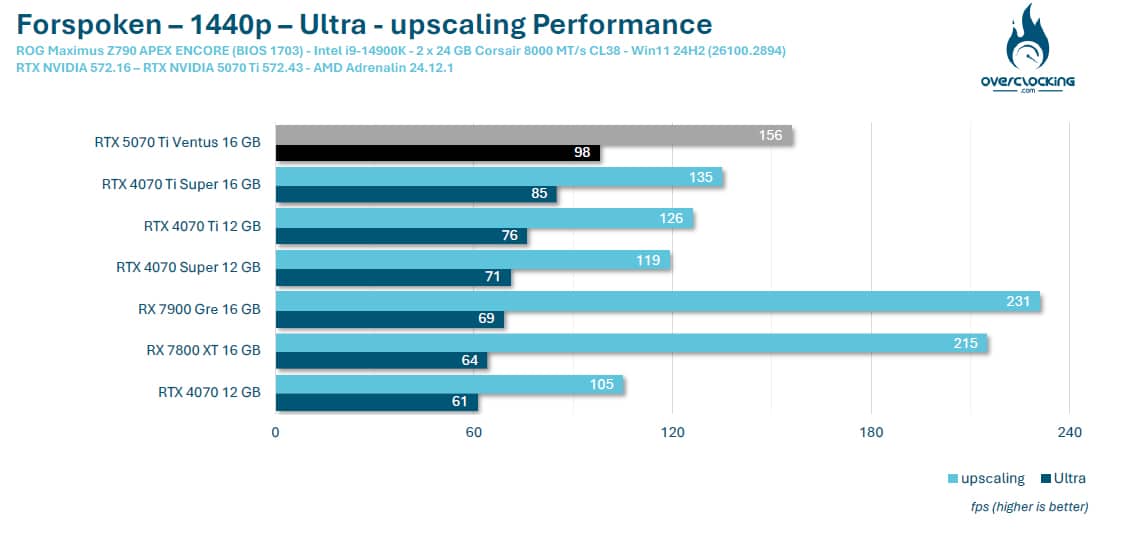
While the MSI RTX 5070 Ti Ventus 3X OC has no trouble with rasterization, averaging 98 FPS, it’s the AMD RX 7000 that benefits most from upscaling. Of course, you’ll have to pay close attention to image quality, but as we said, there’s no need to resort to upscaling when you see the average you get.
Horizon Zeron Dawn Remastered:
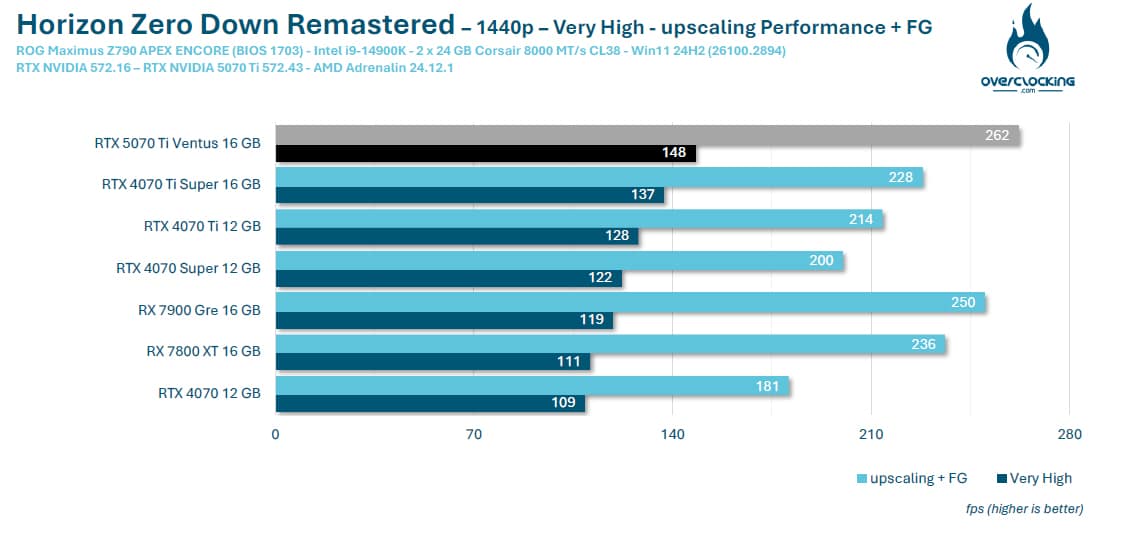
The same applies to Horizon Zeron Dawn Remastered, with our MSI RTX 5070 Ti Ventus 3X OC taking first place.
Black Myth: Wukong Benchmark Tool :
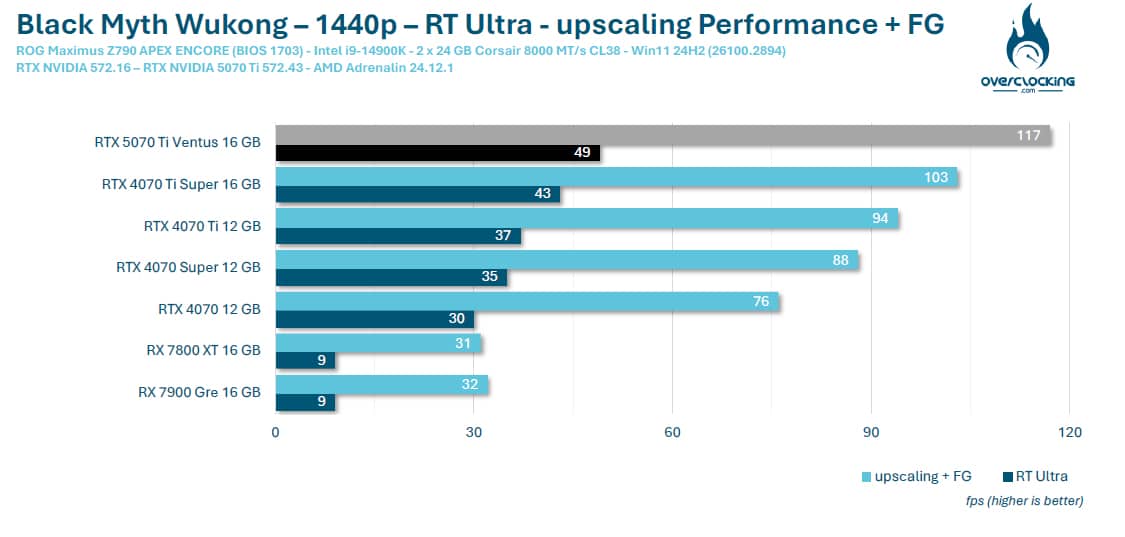
Ah, here we go again with Black Myth: Wukong, a greedy game that benefits from ray tracing. And this is exactly where upscaling comes in handy, as our average with ray tracing enabled is 49 FPS, rising to 117 FPS when using DLSS Performance combined with Frame Generation. This game will benefit from DLSS 4 in the near future.
Far Cry 6:
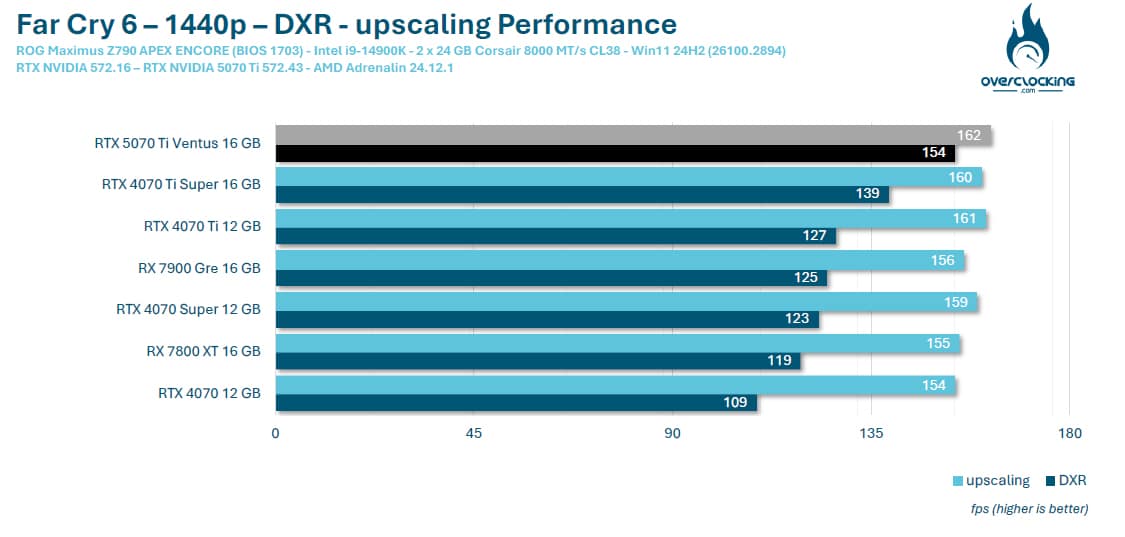
No DLSS here, we’re using AMD upscaling, which explains the very low gain between DXR and upscaling modes.
Assassin’s Creed Mirage:
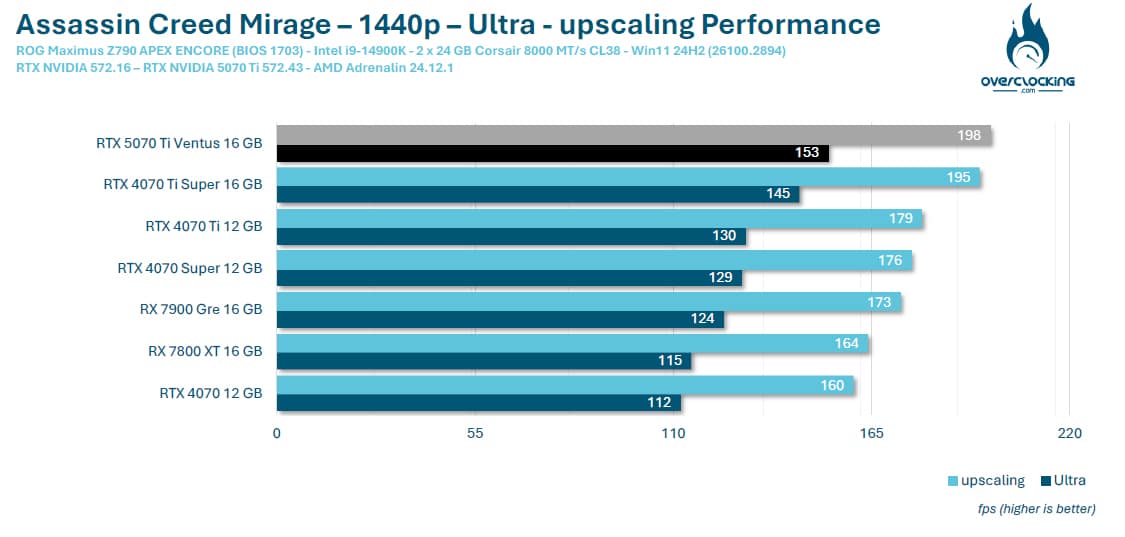
The same applies to Assassin’s Creed Mirage, with our sample still in first place.
F1 24 :
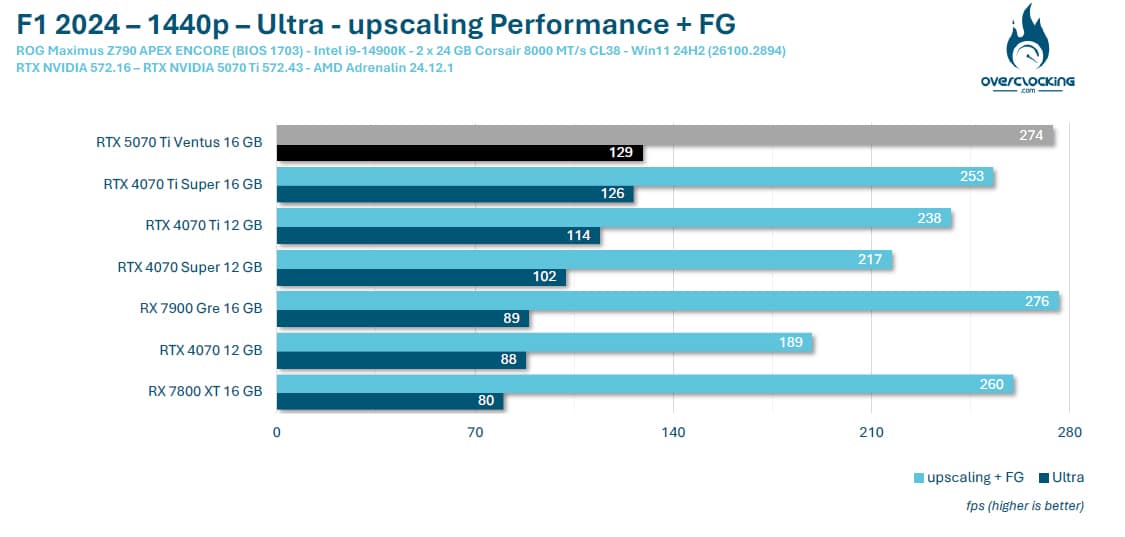
The penultimate game on our test panel, DLSS Performance combined with Frame Generation enabled our model of the day to achieve an average of 274 FPS. As was the case with rasterization, the differences are very small with the RTX 4070 Ti Super.
Monster Hunter Wilds:
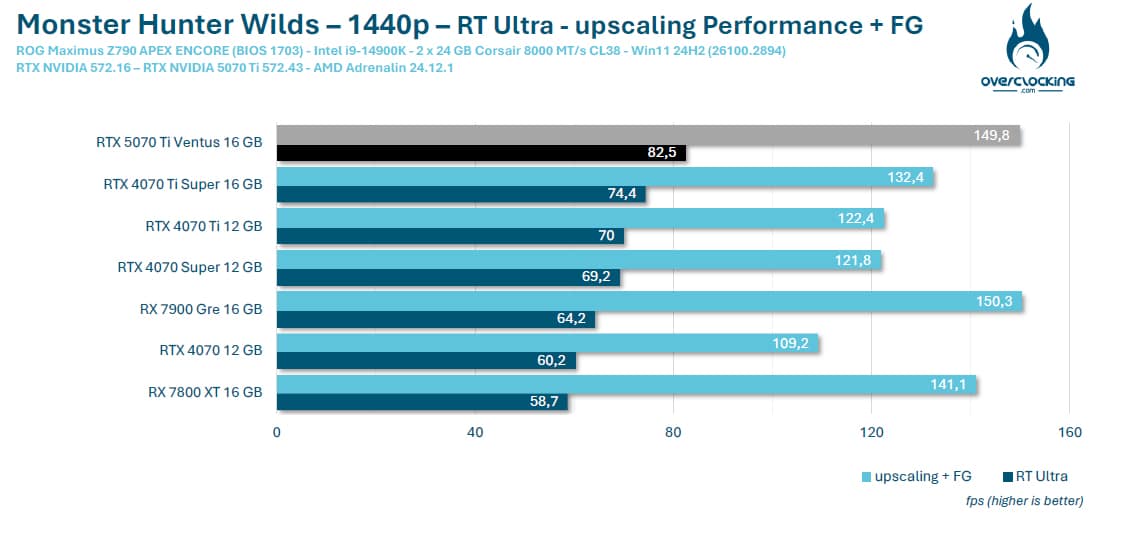
Ninth and final game, and the same conclusion, with performance gains of almost 20% over the RTX 4070 Ti and 11% over the RTX 4070 Ti Super.
What about upscaling with the MSI RTX 5070 Ti Ventus 3X OC?
The MSI RTX 5070 Ti Ventus 3X OC can take full advantage of upscaling, with an already ample FPS count, in the vast majority of cases, even with active ray tracing. Upscaling allows you to boost your FPS, so you can enjoy your favorite title in the best possible conditions. Let’s move on to DLSS 4 and, above all, Multi Frame Generation support.
[nextpage title=”Games that support DLSS 4:”]
A number of games are already DLSS 4-compatible on the day of the RTX 5080/5090 launch, and we’ve been able to get our hands on them in order to begin a series of tests and highlight the performance achieved thanks to DLSS 4. We’ll be coming back to the qualitative side of rendering in detail in the weeks to come. Of course, the upscaling principle here is to support our NVIDIA RTX 5070 Ti in the face of 1440p performance, with graphics options at maximum and ray tracing or path tracing if available.
To measure our FPS, we had access to a beta version of CapFrameX v1.7.5. This measurement tool is certainly one of the best and most intuitive when the game doesn’t have an integrated benchmark. If you’re interested, we’ll be back with a detailed article on how to use it.

Cyberpunk 2077:
In this well-known first game, and with the arrival of DLSS 4, we’ll be opting for ultra graphics options with path tracing enabled. Here are the graphics options available in Cyberpunk 2077. We have path tracing, DLSS in Performance mode and Frame Generation in x2, x3 or x4. The idea is to measure the differences in performance between DLSS OFF, one generated frame (x2), two generated frames (x3) and three generated frames (x4). It’s important to understand that you can choose the number of frames with Multi Frame Generation.

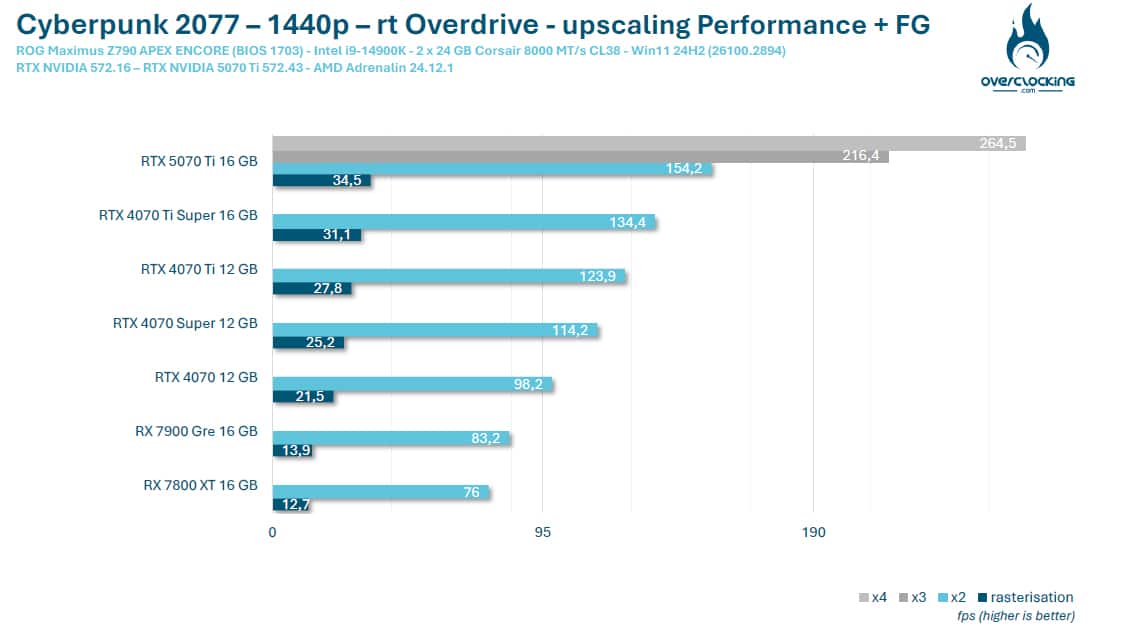
As you can see, from the moment you decide to use Multi Frame Generation x4, i.e. three AI-generated images between two native ones, performance soars. With Overdrive mode, for any graphics card, DLSS is mandatory. It will also be important to evaluate how it feels to play, hoping to find some time during my vacations to enjoy these different games.
Hogwarts Legacy: The Hogwarts Legacy
Hogwarts Legacy has no built-in benchmark, so we’ll be using CapFrameX to take our various readings. As far as graphics options are concerned, there’s no ray tracing in this game, but we have enabled ray reconstruction. As far as DLSS 4 is concerned, we have all the options at our disposal.

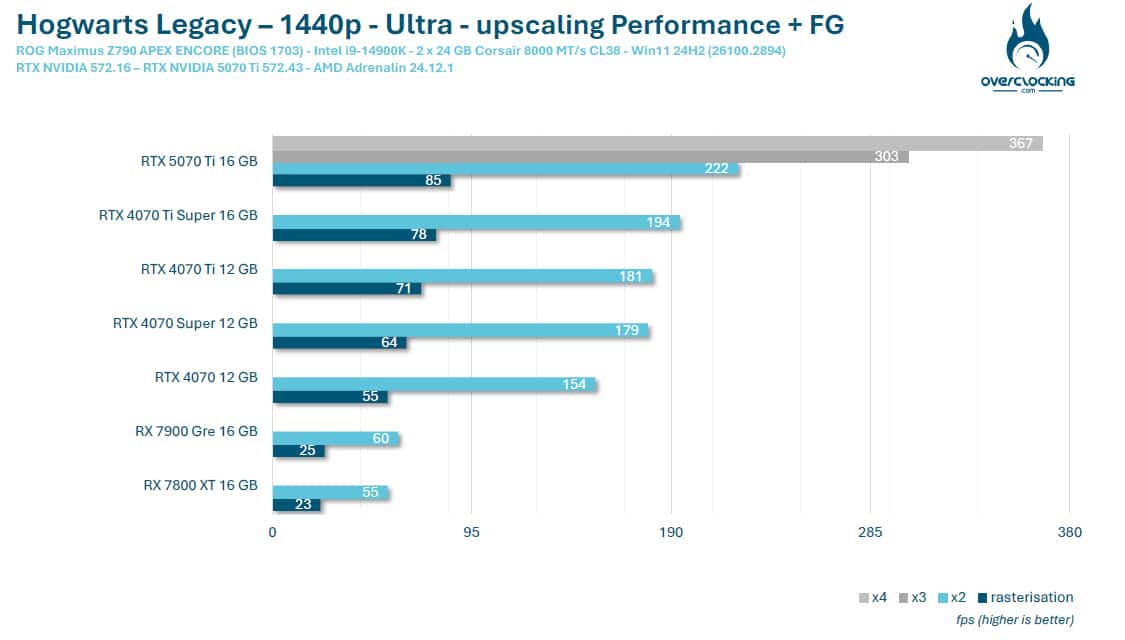
The same applies to Hogwarts Legacy, where in rasterization mode we were unable to reach an average of 85 FPS, which is already an excellent performance, while Multi Frame Generation boosts the number of FPS even further.
Alan Wake 2:
From January 30,Alan Wake 2 will also benefit from the DLSS 4 option, as well as RTX Mega Geometry. But what is Mega Geometry? RTX Mega Geometry enables developers to offer up to 100X more triangles in ray tracing. RTX Mega Geometry will reduce CPU overload and increase ray tracing performance and image quality.
It’s off to the graphics options, and the least we can say is that Alan Wake 2 is surely one of the most comprehensive games to showcase NVIDIA technologies(ray tracing, path tracing, ray reconstruction, direct lighting, transparency, etc.). Naturally, we activated all these options.

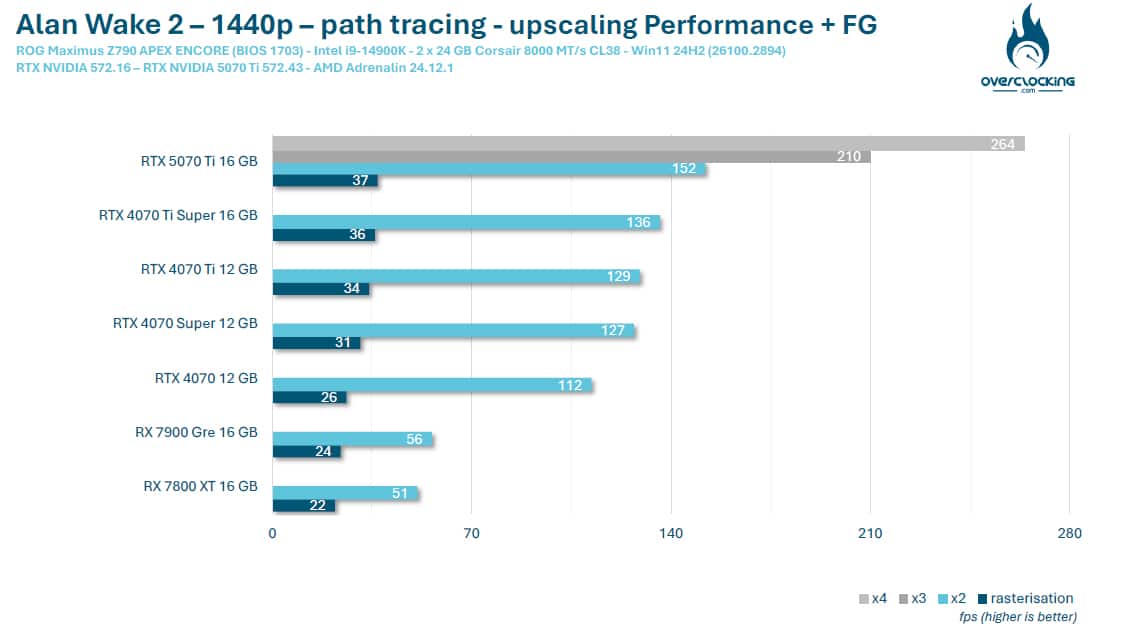
Here too, Frame Generation and Multi Frame Generation will come in handy to boost the performance of our MSI RTX 5070 Ti Ventus 3X OC.
Star Wars Outlaws:
The third game with direct support, Star Wars Outlaws is quite demanding. There’s no ray tracing in this game, so we’re using DLSS Performance in 2160p with Multi Frame Generation. We’ve also enabled ray reconstruction and NVIDIA Direct Lighting.

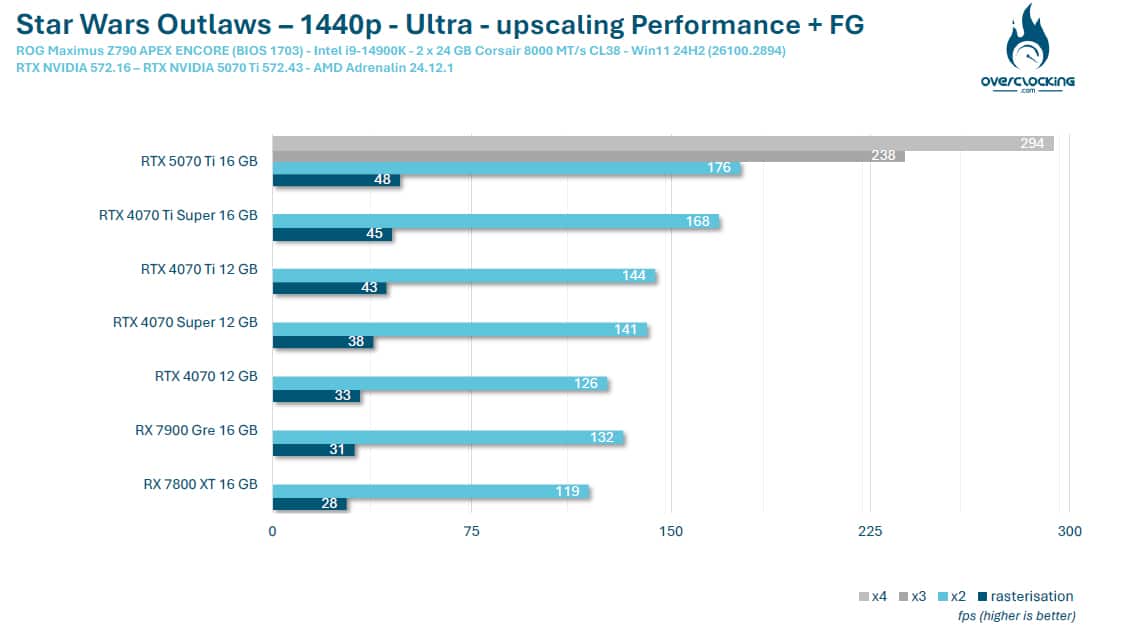
All our cards suffer, and Frame Generation or Multi Frame Generation are here to help you get the most out of your game. This is where we’re going to have to raise a point about the value of Multi Frame Generation for this card.
DLSS 4 for 2160p with the RTX 5070 Ti?
No, we don’t think so. We’ll try to make you understand how we feel. In the end, in 1440p definition, Frame Generation is more than sufficient most of the time, and the contribution of Multi Frame Feneration isn’t really necessary. So, we’d be tempted to say, thank you Multi Frame Generation, and let’s move on to 2160p definition! Well, it’s not quite that simple. Although we haven’t yet had the opportunity to play the game to the full, as we would have liked, we have noticed – and this in itself is quite logical – that you need a minimum of native FPS in rasterization or with ray tracing in order to benefit from Multi Frame Generation technology , at the risk of having a very poor gaming experience. We think you need at least 40/50 FPS, but we’ll be testing this further in the near future, to maintain fluidity and an optimal gaming experience. Basically, running the MSI RTX 5070 Ti Ventus 3X OC at 2160p with an average of 15 FPS and then climbing to 250 thanks to MFG x4 is not a good gaming experience in our opinion.
[nextpage title=”Overclocking:”]
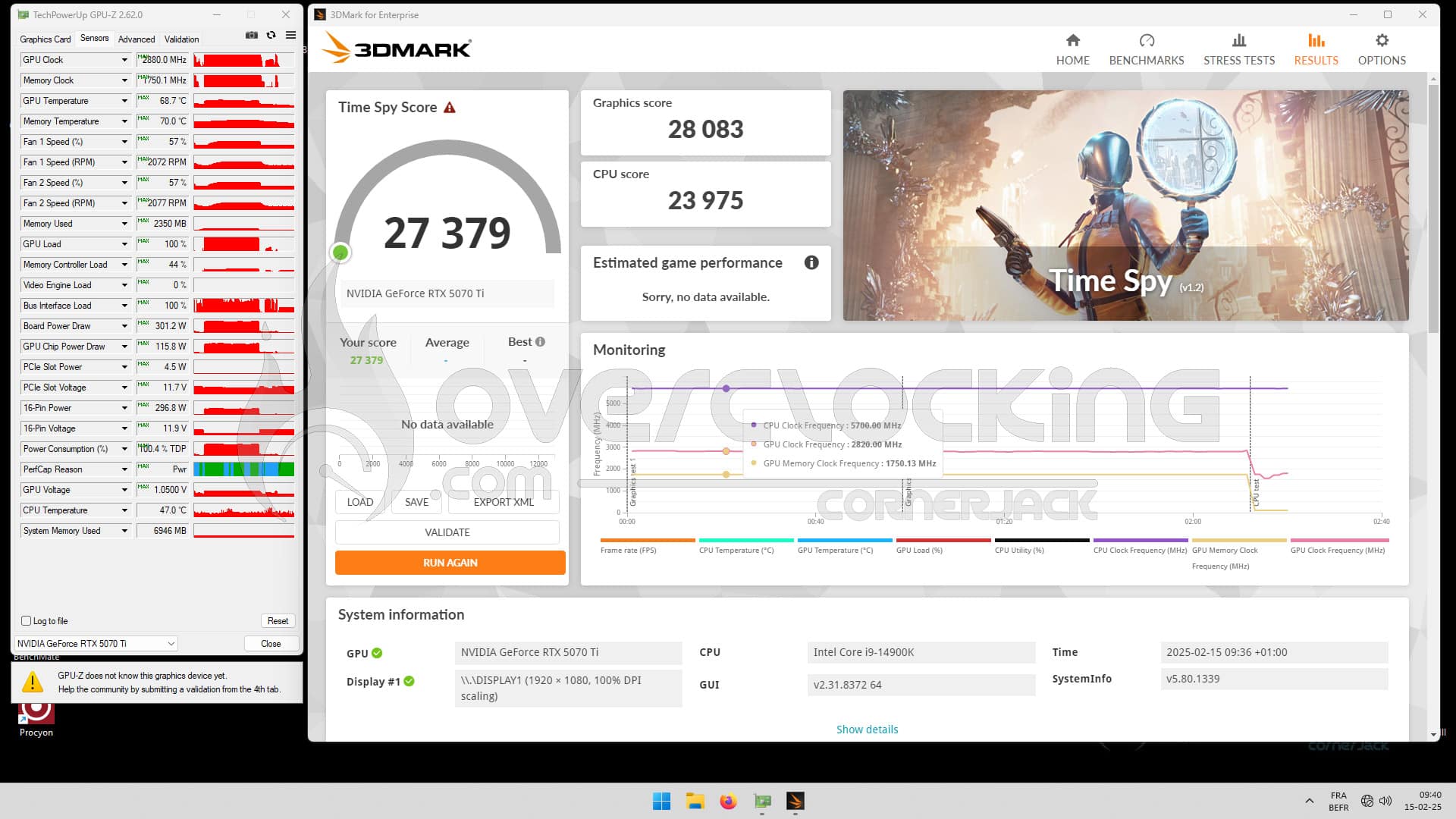
Here we go, with our copy of the MSI RTX 5070 Ti Ventus 3X OC. The first step is to create a reference score, i.e. a score achieved at stock, without any modification of the card’s parameters. We’ve chosen Time Spy as our benchmark so that you can compare our results with the performance of your graphics card. Here, we obtain an overall score of 27,379 points and a GPU score of 28,083 points. As you can see, the GPU’s maximum frequency has risen to 2880 MHz. Mind you, this doesn’t mean that it’s constant at this frequency, it’s just the max frequency at a given moment during the benchmark.
As for the TDP, it’s 100%, and the maximum power consumption given by GPU-Z is 301.2 watts. As far as temperatures are concerned, we’re on a benchmark table, with 68.7°C for the GPU and 70°C for the memory.
We’re not going to list all the stages we went through, but the idea is to look for the GPU’s max frequency first and then that of the memory. We kept the fans in AUTO mode. This has enabled us to reach a boost frequency of 3210 MHz, with memory at 2250 MHz. If we continue to increase the memory frequency, it no longer seems to be taken into account.
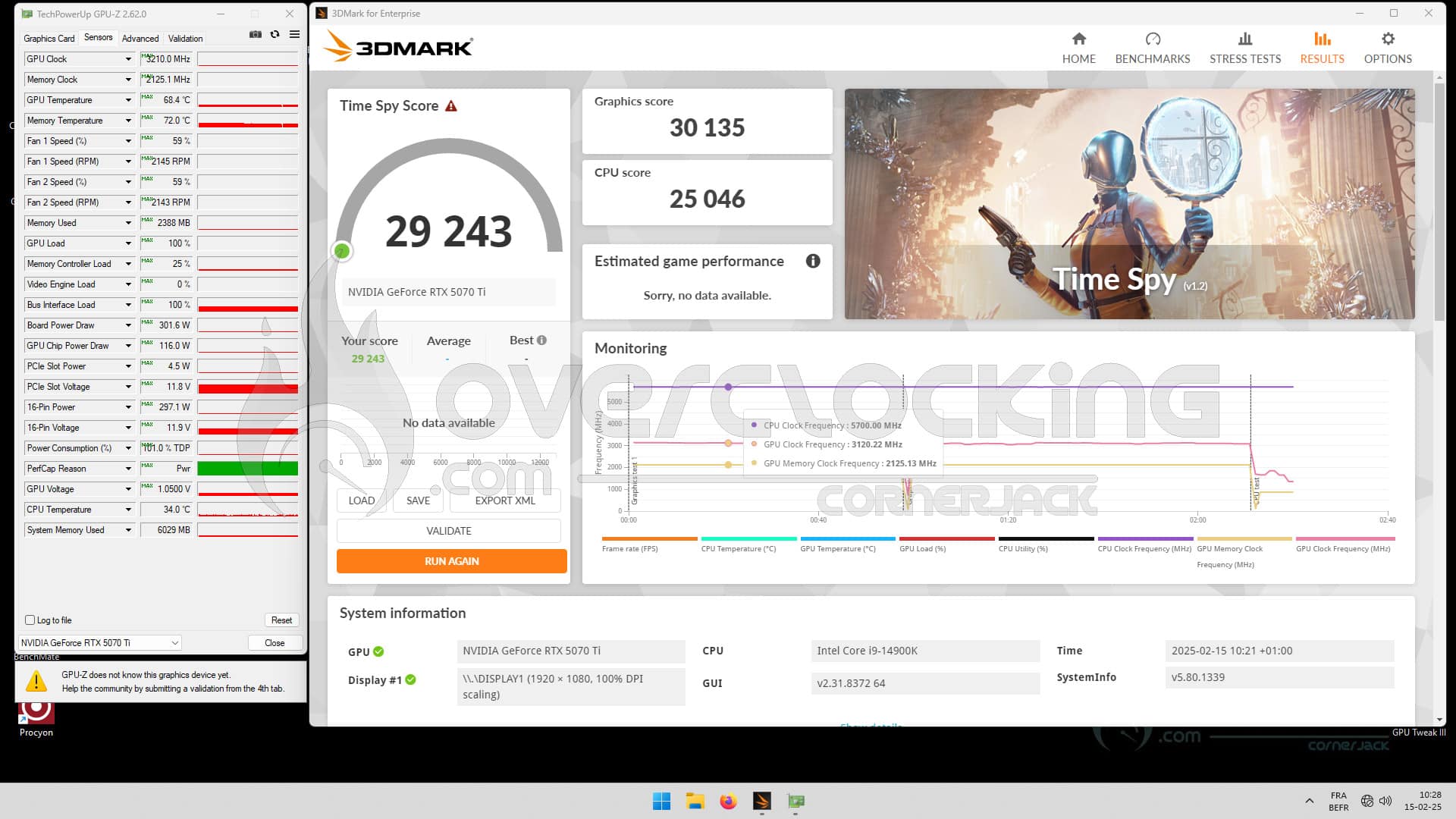
Our total score rises to 29,243 points (6.8%) and that of the GPU to 30,135 points (7.3%). With the fans in AUTO mode, the temperature remains at 68.4°C for the GPU and 72°C for the memory.
We retested this overclocking under Cyberpunk 2700 and found a gain of 5.3% in rasterization and 8.7% in ray tracing. It’s a gain not to be overlooked, even if this MSI RTX 5070 Ti Ventus 3X OC doesn’t really need it in 1440p.
[nextpage title=”The last word:”]
So, what do you think of this MSI RTX 5070 Ti Ventus 3X OC?
If we were to play along with some of our colleagues, we could say that this MSI RTX 5070 Ti Ventus 3X OC is actually an “RTX 4070 Ti Super PLUS”. But as we’ve known for several weeks now, this generation of RTX 5000s won’t be the most satisfying. We’ll be looking at a limited gain in rasterization performance, compared with what we’re entitled to expect from a new generation. Of course, this certainly doesn’t mean there’s nothing to expect from this RTX 5070 Ti.
Performance:
We’re in a similar situation to the RTX 5090 and RTX 5080: performance doesn’t explode, but it’s there. We’re more or less 20% up on an RTX 4070 Ti FE, and 12% up on the RTX 4070 Ti SUPER. As a reminder, the MSRP of the RTX 5070 Ti is announced at 884 euros, and that of the RTX 4070 Ti Super was 889 euros, which is its main competitor, also with 16 GB, but GDDR6. So, on paper, it’s an interesting deal: over 12% savings for the same price.
Performance has improved, and you’ll be able to take full advantage of 1440p definition, and even 2160p for certain games. Ray tracing also passes easily at 1440p, and the FG gives you the boost you need to enjoy your game to the full. The question is: “Does this RTX 5070 Ti need Multi Frame Generation?
Multi Frame Generation: “the card that benefits the least?”
Highlighted by NVIDIA, DLSS 4 combined with Multi Frame Generation is the big news of this Blackwell architecture. Here again, some people, like myself, activate DLSS in certain games, while others never, oh God, never, want to use “false” FPS. It’s true that these are additional images created by AI, but as the name suggests, anything created by Artificial Intelligence will always have this “artificial” side. Now, it’s clear that it works well, even better than before on the RTX 5080 and RTX 5090.
And with our RTX 5070 Ti? In 1440p, Multi Frame Generation never seemed necessary, since MFG x2, equivalent to FG, is more than sufficient in most situations.
So why didn’t we test Multi Frame Generation in 2160p? Quite simply because we’ve noticed that, in order to maintain fluidity and a good gaming experience, it’s necessary to have a sufficient average native FPS. If we switch our RTX 5070 Ti to 2160p with ray tracing, the FPS number often falls to around 15/20 FPS on the heaviest games, and this is not sufficient as a basis for activating MFG x4, for example. The number of FPS will of course explode, but the ratio between native and AI-added FPS is not balanced. The only solution, if you wish to opt for 2160p, is to lower the graphics settings, not to activate ray tracing in order to have an average FPS of 50/60 before activating Multi Frame Generation. Our aim in this test was to get the most out of our RTX 5070 Ti, i.e. with the best graphics settings, and to do so, we used 1440p.
The price: “No FE model = no MSRP cards?
Our MSI RTX 5070 Ti Ventus 3X OC is advertised at the MSRP price of 884 euros, but early indications, particularly on certain online sites, already speak of a price of over 1250 euros for this model. Nothing is official, of course, and we’ll be watching tomorrow’s official launch to see if any models actually meet the MSRP! One thing’s for sure: if prices soar, the RTX 5080 Founders Edition could be a much better choice, and the appeal of the more limited RTX 5070 Ti versions could be lost.
Should you sell your RTX 4070 Ti / 4070 Ti Super?
Not yet! Your RTX 4070 Ti or RTX 4070 Ti Super still have good days ahead of them. Granted, you won’t be able to take advantage of Multi Frame Generation, but as we’ve seen above, it’s of limited interest in 1440p and 2160p, so you’ll have to make concessions on graphics options. So don’t hurry, and wait, since AMD will be unleashing its RX 9070 (XT) cards in a few weeks’ time, even if performance and, above all, price remain unclear. Now, if you have a slightly aging configuration and want to take advantage of all NVIDIA technologies, then yes, this could be an interesting upgrade for 1440p gaming. In fact, we’re preparing a series of new articles based on older graphics cards. Creators will also be able to take advantage of the 9th-generation encoder and a new 6th-generation decoder.
 While the RTX 5080 Founders Edition won a silver award for its performance and MSRP, it’s hard to repeat the same accolade with the RTX 5070 Ti. The MSI RTX 5070 Ti Ventus 3X OC offers superior performance at an MSRP almost identical to that of the RTX 4070 Ti Super, so it’s a no-brainer. But will online stores respect this 884 euro price tag in the absence of a Founders Edition model? We find it hard to believe. Prices for custom models are already skyrocketing due to the lack of available stock on the RTX 5080 and RTX 5090, so we’ll have to keep a close eye on the prices of these new cards this Thursday, February 20. If the price is indeed that indicated by NVIDIA, i.e. 884 euros, our award could take on a more silvery hue.
NVIDIA should also make official the arrival of the RTX 5070 FE at 649 euros, which should take better advantage of Multi Frame Generation in 1440p. Thanks to NVIDIA France for making this copy of the MSI RTX 5070 Ti Ventus 3X OC available.

