
[nextpage title=”Introduction:”]
On December 3, Intel unveiled a new range of graphics cards, including the Intel ARC B580 Limited Edition. If you’ve missed the news about this new range of Intel graphics cards, we invite you to take a look at our summary and unboxing.
We had the opportunity to pick up a sample of the Intel ARC B580 Limited Edition to test. As specified by Intel, this model is intended as a direct competitor to the NVIDIA RTX 4060. Before the official announcement, and given the positioning of this B580, we imagined a competitor for 1080p resolution. However, Intel surprised us by indicating that this model would be aimed at 1440p. The timing was therefore a little tight for us, as we’ve just updated all our tests with the latest drivers from NVIDIA, AMD and Intel. You’ll also see that our test configuration has changed slightly since the arrival of the i9-14900K processor.
Many thanks to Intel for making this ARC B580 Limited Edition available to us.
[nextpage title=”Intel ARC B580 Limited Edition:”]
Architecture:
This isn’t Intel’s first foray into graphics cards: almost two years ago, we tested the ARC A770 16 GB and ARC A750 8 GB models. These graphics cards featured the ARC Alchemist architecture, and even back then Intel was confirming its desire to continue offering other models in the years to come. We also seemed to have understood that Intel was more interested in the entry-level market. So, at the end of this year, Intel arrives with a new architecture, the Arc Battlemage.
Packaging:
So here we go, with the discovery of this Intel ARC B580 Limited Edition graphics card. If you’re a graphics card addict, you’ll have noticed that this ARC B580 contains the “Limited Edition” reference specific to cards offered by Intel. A comparison could be made with NVIDIA’s Founders Edition models. The proportions of the box are quite similar to those of the previous generation.

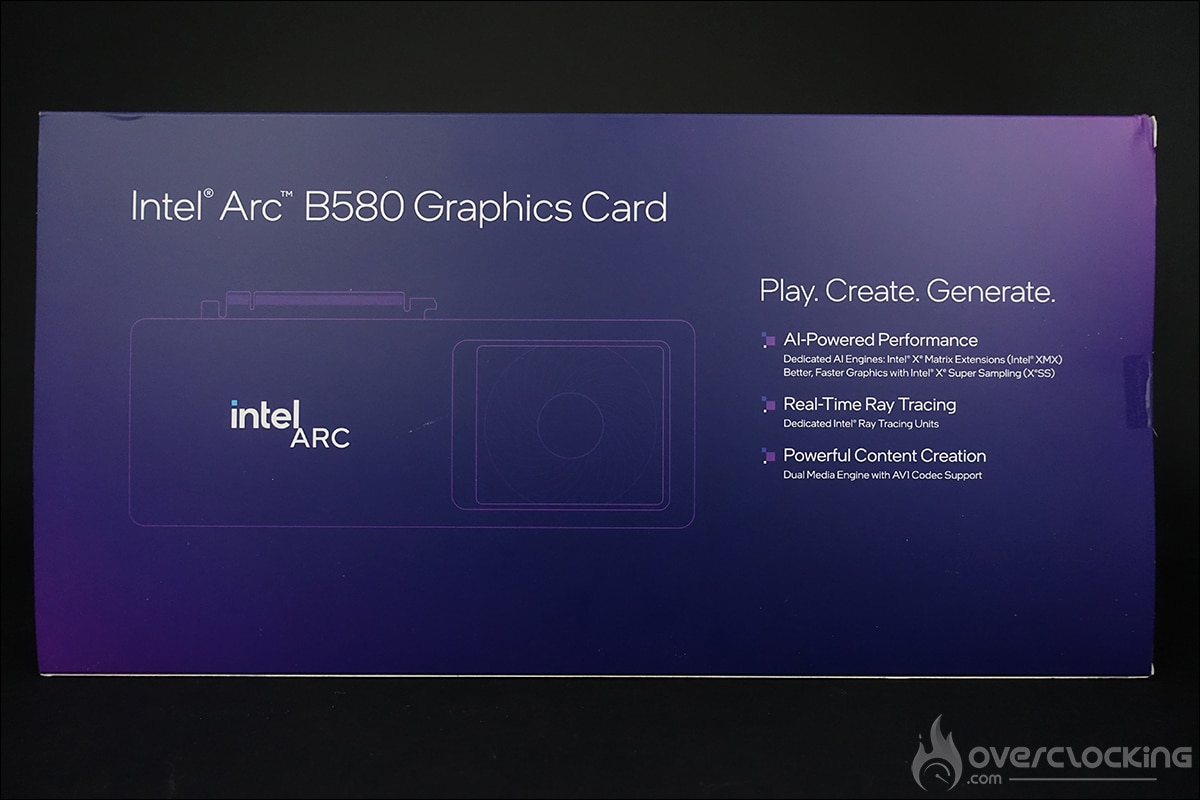
To reveal the box containing this new GPU, you’ll need to remove the tab on the side panel, which will release it. Then simply slide it out to reveal a cardboard box, all in black. The front panel bears the inscription “Intel ARC”.
The opening is from the bottom and … does not yet reveal the graphics card. It’s still concealed under a black cloth, which will allow it to reach you in the best possible conditions. First, let’s deal with the documents that seem to be hidden on the top.

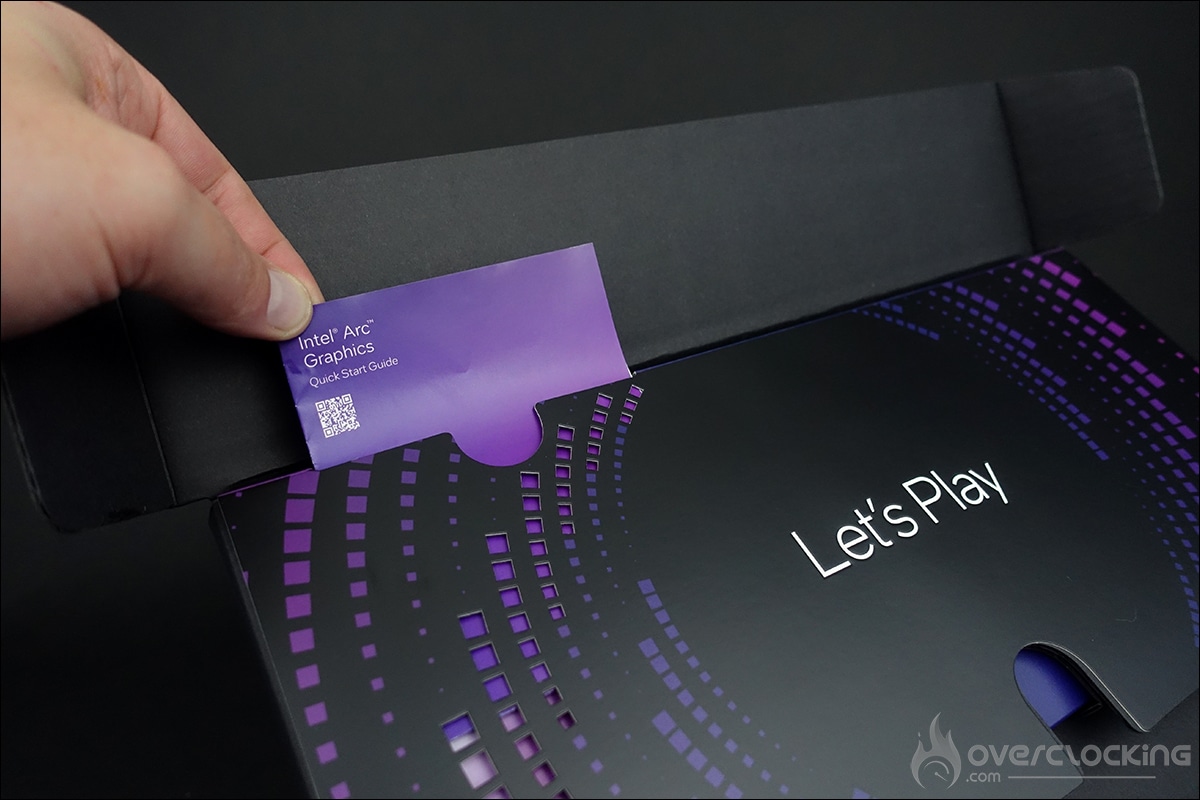
First of all, there’s a quick-start guide and an imposing envelope. On the latter, we’re treated to a note from Intel: ” Thank you for choosing Intel ARX B-Series Graphics for the next capter in your hardware odyssey with us! But what could it possibly contain?
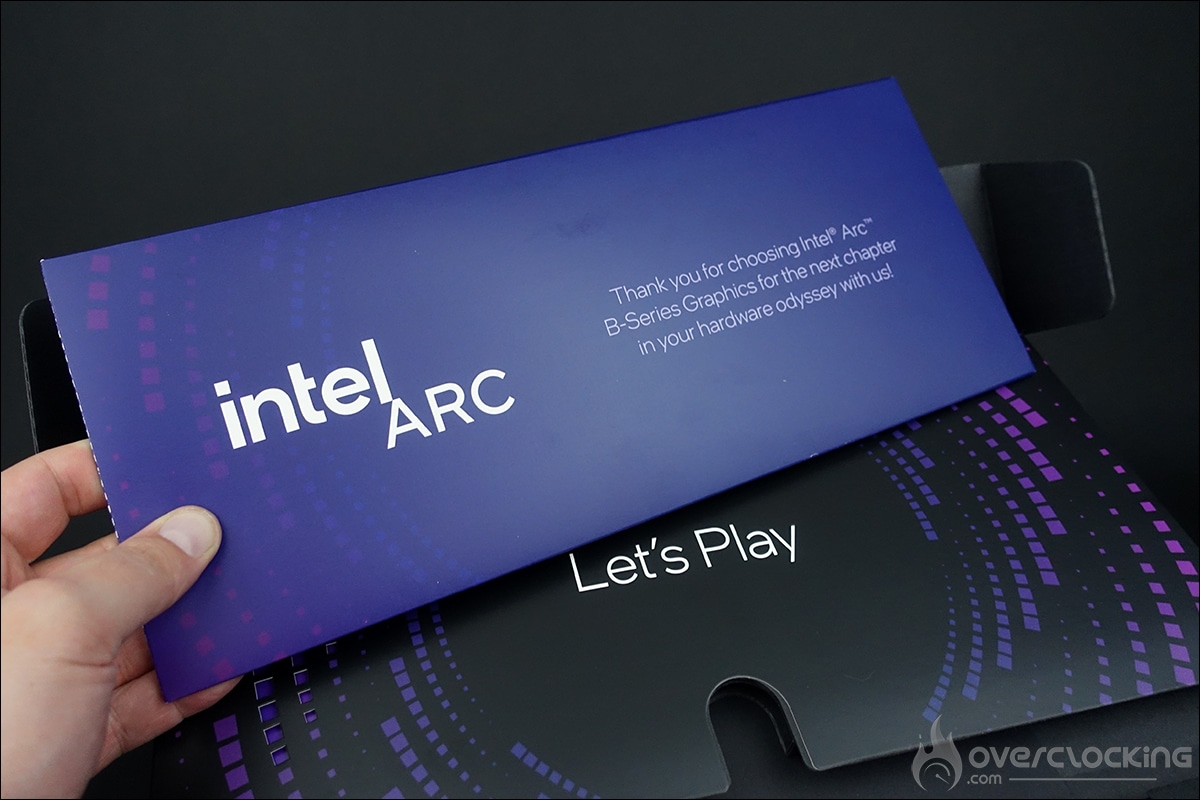
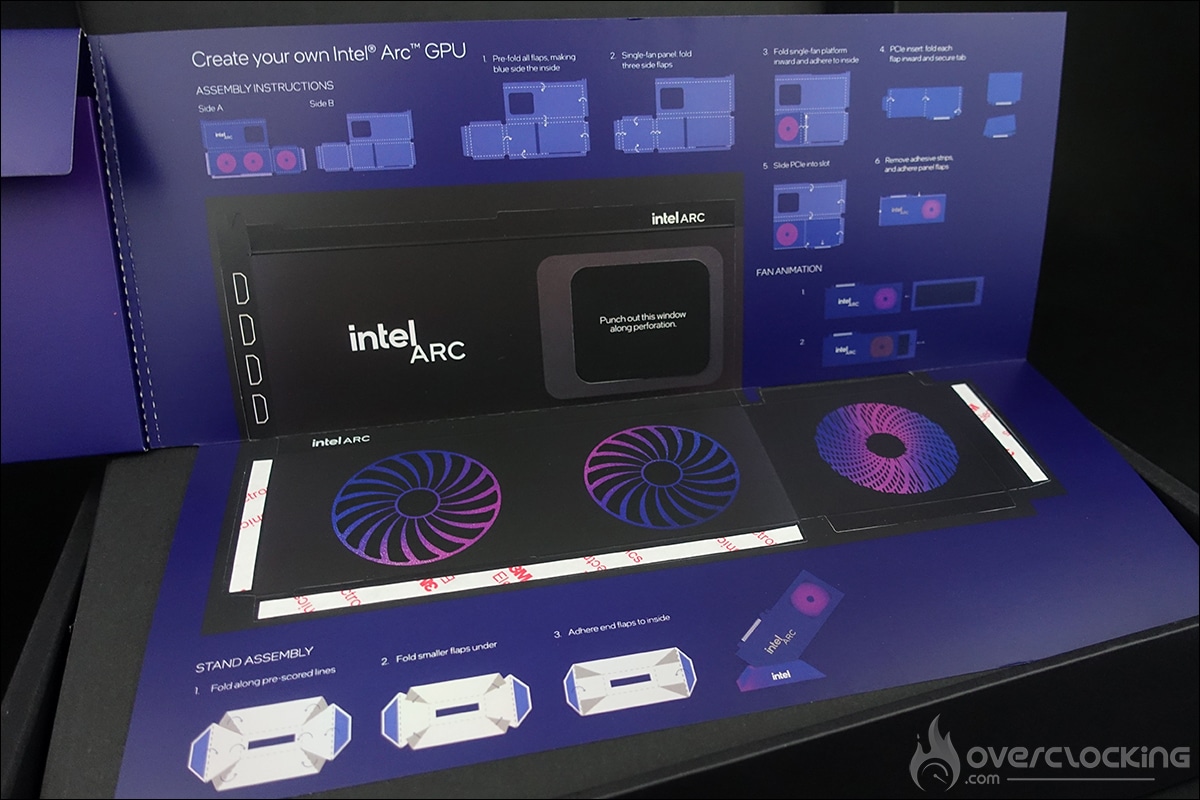
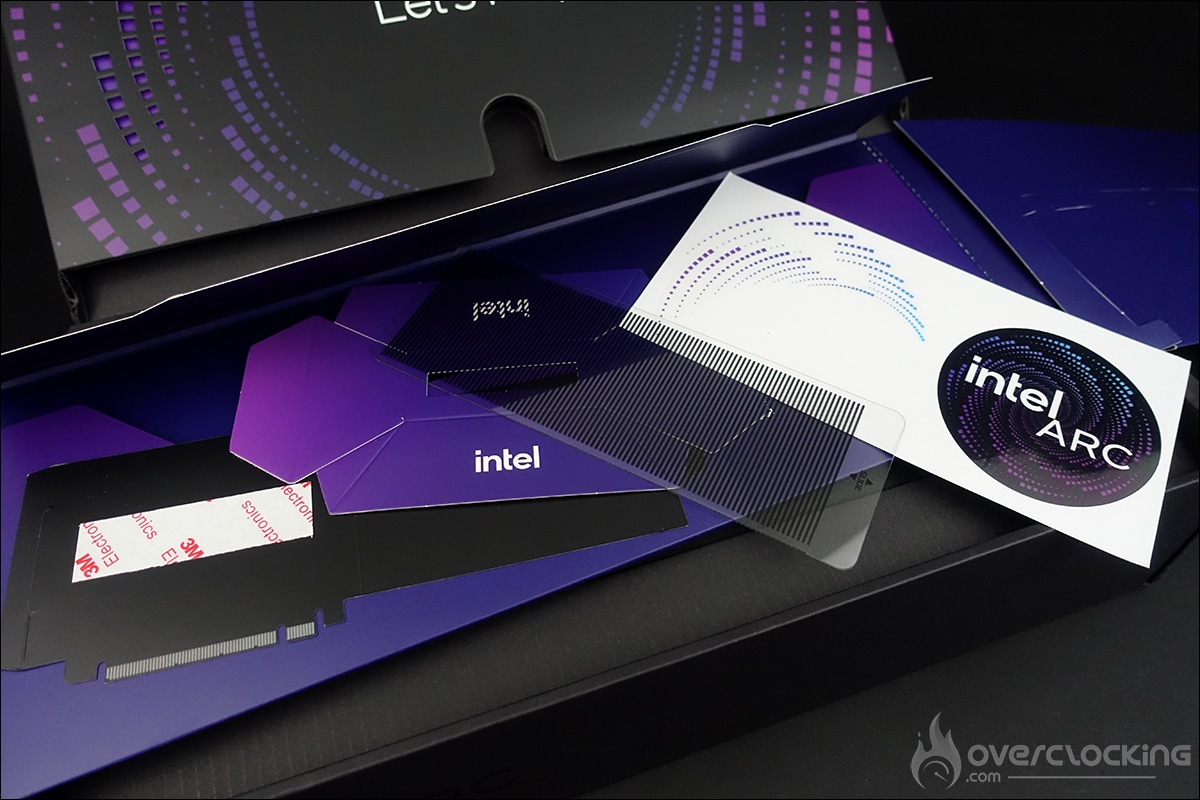
What we actually find is a model, not of a small plane, but of an Intel ARC graphics card. We had to resist the urge to mount it directly, but we thought it would be nice to make a little video of it while we were editing it! We look forward to bringing it to you this week.
Let’s move on to the most important element of all, our Intel ARC B580 Limited Edition graphics card.
Intel ARC B580 Limited Edition:
Once the piece of cloth has been removed, the back of the board is revealed. The first obvious difference from the ARC A750/A770 Limited Edition is the cutout in the backplate, which reveals the radiator. This is a good thing, as it should optimize the cooling of this B580.


In terms of proportions, this new generation is quite similar to its predecessor. Also on the front are two 85 mm fans with 11 blades, with a different design from the ARC A750/A770 models. Here, all blade tips are connected together. Current GPUs often use this type of fan to improve airflow.


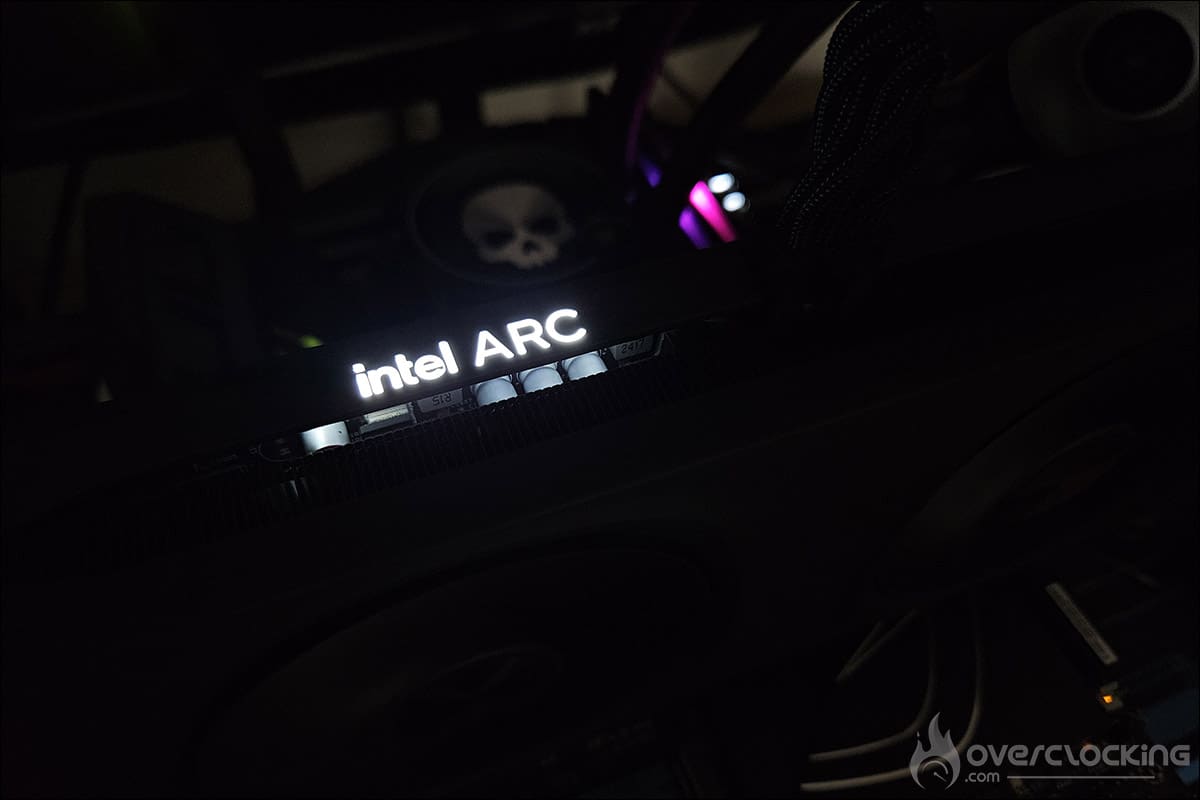
One thing that strikes you when you pick it up, however, is its weight! The ARC B580 Limited Edition seems much lighter. We have weighed this new GPU and its weight is 785 g, compared with 1080 g for the ARC A770 Limited Edition model and 1065 g for the ARC A750. Aesthetically, Intel is offering a black version, with no real brand logo, just “Intel ARC” on the top edge and “Intel ARC B580” on the backplate.

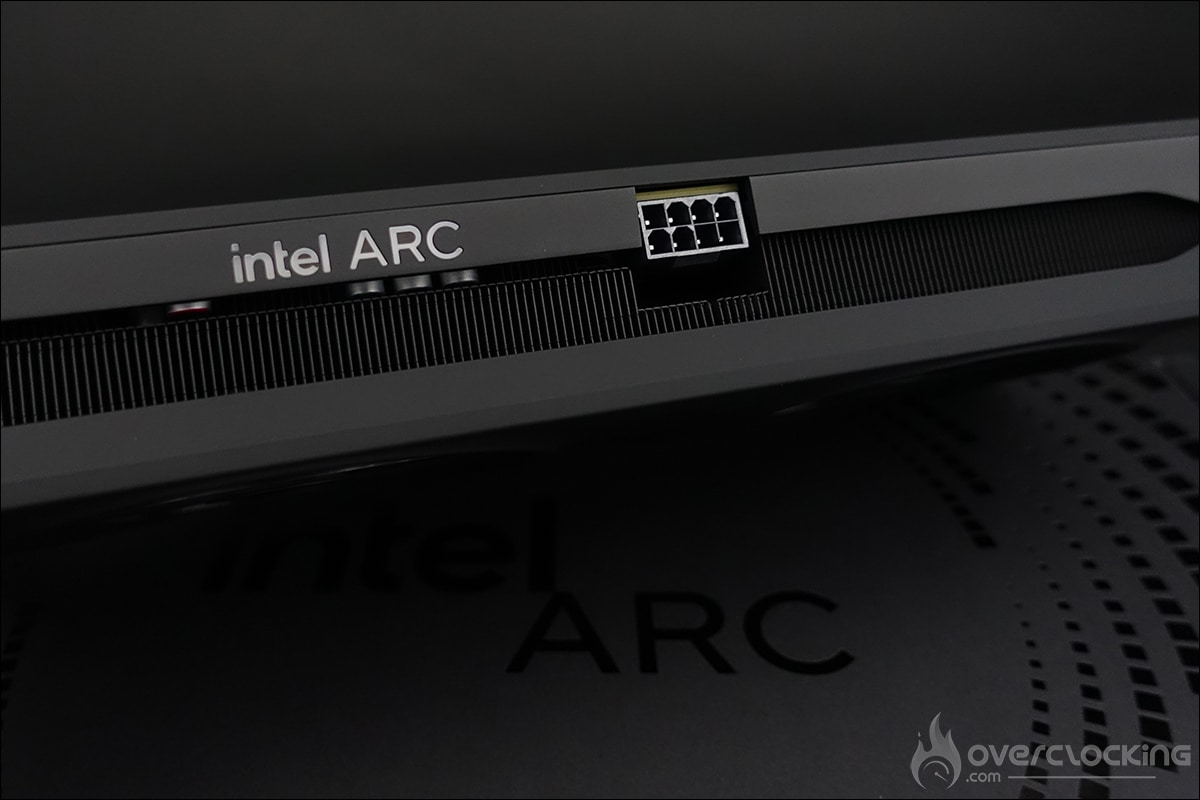
To power this ARC B580 Limited Edition, you’ll need a single 8-pin connector. Intel has retained the use of “traditional” power connectors, and all the better for it. There’s nothing to suggest the presence of RGB backlighting, and that’s not to our displeasure – quite the contrary.

The exploded view confirms that the PCB is much shorter than the cooling system. The end of the radiator and the second fan will, as we imagined, improve heat dissipation. The radiator is crossed by 4 heat pipes to optimize cooling.

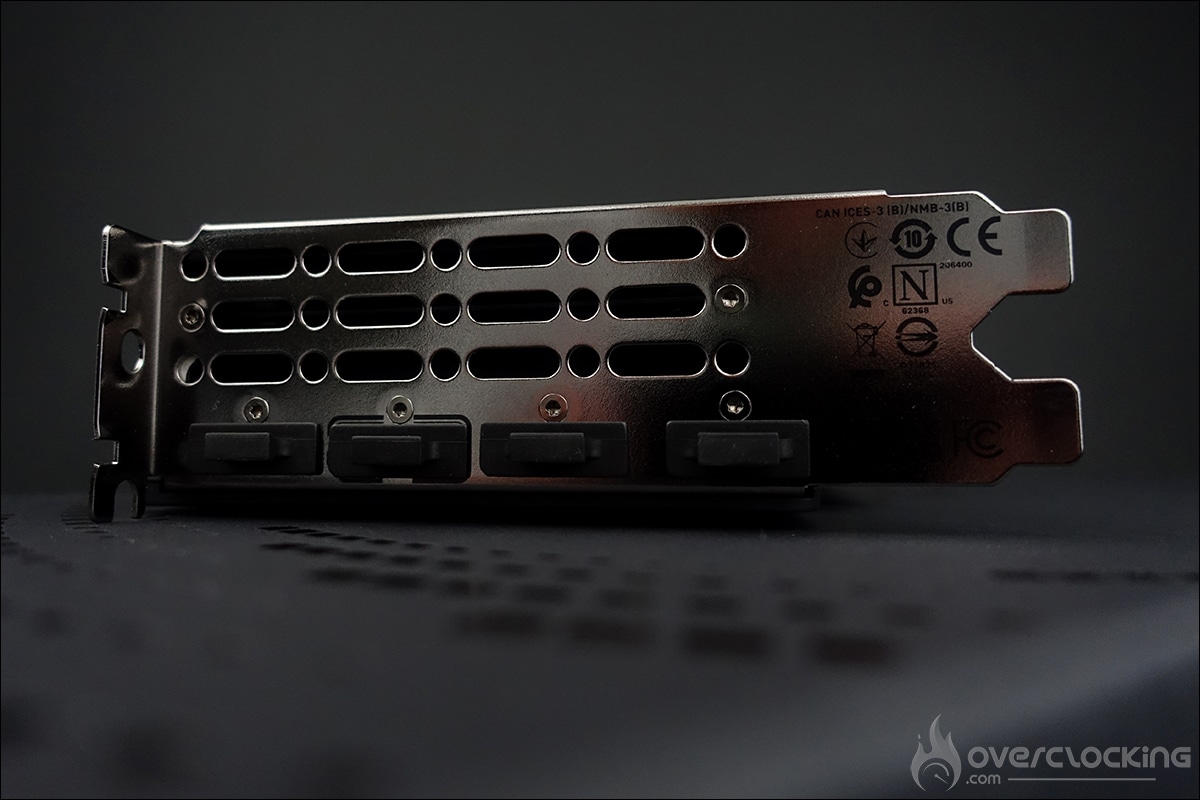
Finally, in terms of video outputs, you’ll have three DisplayPort 2.1 and one HDMI 2.1 port.
The PCB:
We didn’t set out to disassemble the cooling system of our Intel ARC B580 Limited Edition just yet, since we had a photo of its PCB at our disposal. As we said, the PCB is much shorter than the heat sink.

The PCB of this Intel B580 is composed of 8 layers and benefits from a 6-phase power stage for the GPU and 2 phases for the memory. Intel announces that it has simplified its thermal solution, compared with the previous generation, in the interests of repairability.
To conclude this presentation, the Intel ARC B580 will go on sale on December 13, 2024, with a recommended retail price of US$249, while you’ll have to wait until January 16, 2025 to see the B570 model, priced at US$219. These are very aggressive prices, given that the ARC A770 was launched at $329 and the ARC A750 at $289. We’ll see what’s really going on today in the online stores. So it’s time to install and test this new Intel graphics card. So, what does it have in store for us?
[nextpage title=”Technical specifications:”]
At the time of publishing this review, GPU-Z did not yet support this new B580 graphics card. Fortunately, Intel has provided us with an update capable of perfectly recognizing the specifications of our model of the day!
In terms of frequency, Intel has announced a base frequency of 2670 for this ARC B580 Limited Edition, while the 12 GB of GDDR6 memory run at 2375 MHz (456 GB/s) on a 192-bit bus. This model therefore features the reference frequencies proposed by Intel. We already know that some models, such as the ASRock B580 Steel Legend, will feature factory overclocking.
Let’s take a look at GPU-Z to check that the information is correct. Don’t forget that the GPU frequency may be higher in benchmarks, depending on the quality of your chip and cooling system.

In fact, we ran a test under 3DMark Time Spy to observe the GPU frequency. We can see that it climbs to 2850 MHz when the GPU is called upon. Memory frequency remains unchanged, which is perfectly normal.

As for temperatures, they are perfectly under control, with a maximum temperature of 66°C and two fans that are far from running at maximum speed. Which makes us even more impatient to start testing!
[nextpage title=”The test configuration: “]
As we said in the introduction, we updated all our graphics using the latest drivers from NVIDIA, AMD and, of course, INTEL. We also took the opportunity to slightly modify our test configuration and add new games to our protocol. So here we go again, with a new series of tests and graphics on this slightly modified configuration:
- Motherboard: ROG Maximus Z790 APEX Encore
- Processor: Intel Alder Lake i9-14900K delid
- Cooling system: EK-Nucleus AIO CR360 Direct Die D-RGB – 1700
- Memory: 48 GB Corsair Dominator Titanium 8000 MT/s CL38
- Graphics card: Intel ARC B580 Limited Edition, Intel ARC A770 16 GB, Intel ARC A750 8 GB, AMD RX 7600 8 GB, Gigabyte RTX 4060 8 GB, NVIDIA RTX 4060 Ti 8 GB and NVIDIA RTX 3060 Ti 8 GB.
- SSD: Western Digital Black SN750 2 TB radiator EKWB
- Power supply: Corsair AX1600i
- Operating system: Windows 11 64-bit 24H2 (26100.2454)

We’d have liked to include the AMD RX 7600 XT 16 GB and the NVIDIA RTX 4060 16 GB, but we weren’t able to get our hands on sample of these cards for publication, despite having approached several partner brands.
For this test, we used a fairly high-end configuration featuring an i9-14900K delid processor and DDR5 memory. Depending on the definition tested, we used either an MSI Oculux NXG253R or a ROG Strix XG27UCS on loan from ASUS.
Our test protocol :
All cards are tested at stock frequencies and without any optimization. For the various benchmarks, whether synthetics or games, we’ll opt for 1080p, 1440p and 2160p resolutions, depending on the card’s performance.
Here, with this Intel ARC B580 Limited Edition model, we thought we’d limit ourselves to 1080p definition in rasterization in order to compare performance with other competing models and thus assess its potential. But Intel’s announcements force us to add 1440p as well, even if we’re not convinced in rasterization.
As you can see, we’re now running Windows 11, and we’ve activated the ” ReSize BAR ” in the BIOS, which you can see in GPU-Z. Now that you know everything about our test configuration, it’s time to get started!
[nextpage title=”3DMark benchmarks: “]
Our first series of tests will be dedicated to synthetic benchmarks. These are often used for overclocking competitions , but are also very interesting for comparing different GPUs. We’ll be focusing on benchmarks from the 3DMark series. For this new version of our graphics, and for the 3DMark test section, we’ve also isolated the GPU score. You’ll therefore find, when stipulated in the benchmark, both the overall score and the GPU score.
3DMark Fire Strike and Fire Strike Ultra :
Let’s start with 3DMark Fire Strike, one of today’s most widely used benchmarks. It consists of two graphics tests, a CPU test and a fourth test that combines GPU and CPU. Don’t forget to deactivate the demo, which makes no contribution to the final score and prolongs the benchmark’s duration (unnecessarily). The version used for these tests is, of course, the latest available.


We kick off our tests with the two Fire Strike and Fire Strike Ultra benchmarks, and it’s off to a flying start, to say the least! Our ARC B580 Limited Edition takes first place, ahead of the RTX 4060 Ti.
3DMark Time Spy and Time Spy Extreme:
The second test is 3DMark Time Spy. Although this one is performed in 1440p, its main feature is that it uses DirectX 12. It consists of two graphics tests and a CPU test. As with Fire Strike, don’t forget to disable the demo. These first two benchmarks are provided by UL Benchmark.


We continue with Time Spy, where the results are just as convincing. We’re pleasantly surprised by the ARC B580 Limited Edition’s performance on these first four benchmarks.
3DMark Speed Way:
Ulbenchmark’s latest benchmark, and it’s nice to be able to say we’re going to benchmark this Speed Way. It uses DirectX 12 and defaults to 1440p. We haven’t modified anything, so we’re using the original benchmark.

In Speed Way, our sample of the day is in the middle of the ranking, 320 points behind the RTX 4060. These are the two models we’ll be keeping a close eye on.
3DMark Port Royal:
Here’s a benchmark we left out last year, but which you may have wanted to see again in our tests. It’s still widely used, especially in the overclocking community. So we’ve decided to add it to our tests.
 Things are looking up in Port Royal, since Intel’s latest GPU is back in second place, right on the heels of the RTX 4060 Ti.
3DMark Steel Nomad:
The latest benchmark in the 3DMark suite, Steel Nomad will replace Time Spy as the most recent benchmark in the 3DMark suite. The good news, however, is that it will be free for users who already have a key. The program includes a test bench based on Microsoft’s DirectX12API. However, there will be no ray tracing, but the scene will use an “extreme” level of geometry and rasterized light.

Finally, the last benchmark in the 3DMark series, Steel Nomad, which has just arrived, allows our Intel ARC B580 Limited Edition to take first place. This first series of tests augurs well for the future!
[nextpage title=”Cinebench 2024, Geekbench AI and UL Procyon:”]
After the 3DMark series benchmarks, let’s tackle a series of tests concerning tasks for productive use. Even if this is not the primary function we’ll be attributing to the graphics card, we couldn’t do without offering you a small panel of tests, especially concerning AI, which is becoming more and more present.
Cinebench 2024 GPU:
This is a benchmark we won’t be presenting again, so much so that it’s used for our CPU tests, but here, with version 2024, it’s our graphics card we’re going to put to the test. Please note that the version included in BenchMate will not work for this CPU test, so you’ll need to download the full version from the Maxon website. As you can see, Intel graphics cards are still not compatible with this benchmark.

We decided to integrate the Cinebench 2024 benchmark to test our GPUs, but unfortunately, Intel cards are not currently supported. These graphics will be expanded in the coming weeks with the addition of other RTX 4000 and AMD 7000 cards.
UL Procyon AI Image Generation:
UL Benchmark not only offers its 3DMark benchmark suite, but also UL Procyon, to meet the demand for Artificial Intelligence evaluation. This benchmark was chosen for its ease of implementation. The benchmark will generate 4 x 4 images and provide us with a score as well as a result in the form of the time, in seconds, required to generate an image. The software supports several AI inference engines, depending on the GPU used.
As we’re dealing here with entry-level models, we’ll be using the benchmark in Stable Diffusion 1.5 (FP16) mode. It is intended for mid-range GPUs. The test will create 16 images at a resolution of 512 x 512, in batches of 4. There’s a test called Stable Diffusion XL (FP16), where 16 images will be created, at 1024 x 1024, in batches of 1.


As you can see, we’ve indicated both results: one is expressed as a score and the other as the time, in seconds, required to generate an image. The more reliable the latter, the faster the image generation. The B580’s improvement on the previous generation is striking. It does better than the RTX 4060, but is not on a par with the RTX 4060 Ti.


On the “XL” version, even if the scores seem fairly identical, it’s the rendering in seconds per frame that needs to be particularly observed. We can see that it takes longer to generate an image, which is logical, but here it’s our ARC B580 that fares best.
The software has also just added a new test, the AI Text Generation Benchmark, which we’ll be adding to these tests shortly.
Geekbench AI 1.1.0:
As you may have gathered, Geekbench AI will measure AI performance in machine learning, deep learning and AI-specific workloads. The application can be run on the CPU, GPU or NPU, provided the latter is compatible. As is already the case for other applications, Geekbench AI will provide three scores: ” Full precision “, ” Half precision ” and ” Quantized “.
Since a new version has just been released, we’ve had to repeat a series of new tests, so we’re updating our tables and will be publishing them shortly.
[nextpage title=”Gaming performance 1080p/1440p rasterized: “]
Here we go with the gaming tests. We used all the graphics cards we felt would be interesting to compare with this ARC B580 Limited Edition in 1080p. For 1440p definition, our choice was more limited for lack of time, but will be completed shortly. We’ve also decided to devote ourselves to overclocking and add the ARC A770 model in 1440p, for the weekend. Our games panel currently consists of 10 titles, and will be expanded further in the next few weeks.
We’ve chosen to use the built-in benchmarks of these games.
Why do we do this? Quite simply to enable you to compare your results with ours if you also own a copy of one of these games. It’s a thought-provoking idea, and one that will enable you to compare your results with ours. The number and titles selected have changed slightly, and will continue to do so over the coming weeks as we get our hands on new games. Please note that if we have the low 1% reading, it will be added to our charts from now on.
By placing our graphics in this way, we’ll be able to see whether our ARC B580 Limited Edition, with its 12 GB, performs better in 1440p. Basically, does it move up the rankings in higher definition?
Borderlands 3 :


Let’s get to gaming. In 1080p, this first benchmark favors the ARC B580 over the RTX 4060. Note also the gain over the previous generation of Intel cards. Do things change in 1440p? Indeed, our sample of the day takes the lead over the RX 7600.
Cyberpunk 2077:


Our Intel ARC B580 Limited Edition performs perfectly, whether in 1080p or 1440p, where it is either in second or first place. The RTX 4060 is a distant second.
COD Modern Warfare III:


Things get even more complicated with Modern Warfare III, which doesn’t seem to be doing the Intel ARCs any favors at all. They take the last three places, while the two NVIDIAs fare much better.
Forspoken:


Forspoken is a very demanding game, and it shows. In 1080p, our B580 is behind 1080p, but things reverse when you switch to 1440p.
Horizon Zeron Dawn Remastered:


One of the new games we’ve added to our comparison, and it’s a no-brainer for the Intel ARC B580 Limited Edition.
Shadow Of The Tomb Raider:


Once again, the B580 takes the lead over the RTX 4060. We haven’t mentioned it yet, but the RTX 3060 Ti is still doing very well.
Black Myth: Wukong Benchmark Tool :


This new game also seems to be very greedy and does not feature Intel graphics cards. A change of register and it’s NVIDIA cards that dominate the top of the ranking.
Far Cry 6:


Although the difference is very slight at 1080p, once again it becomes more pronounced at 1440p with the RTX 4060.
Assassin’s Creed Mirage:


While our B580 was in last place in 1080p, it took second place in 1440p with the RX 7600. This seems to confirm that, in rasterization, our ARC B580 is doing rather well!
Red Dead Redemption II:


Last game, and certainly one of the biggest gaps in today’s game panel. Let’s take a look at the averages for 1080p and 1440p, although we’ve already got a pretty good idea.
Average 1080p and 1440p rasterized games:


Let’s start with the results in 1080p definition. We see that our Intel ARC B580 Limited Edition is 4.2% better than NVIDIA’s RTX 4060. In the end, the cards are fairly close, and as always, some games benefit NVIDIA more than others. That’s why our gaming panel will be growing in the weeks to come.
In 1440p, the differences are greater between the B580 and 4060, perhaps thanks to the 12 GB of memory on the Intel model versus the 8 GB of the 4060. But it’s also worth noting that, despite its 8 GB, our RTX 4060 Ti performs perfectly, but is not in the same price range. Here, we’re talking about a 12.7% gain, which corresponds to the 10% claimed by Intel for 1440p.
[nextpage title=”Gaming performance 1080p/1440p upscaling:”]
In this section, we’ll be testing our graphics cards, activating raytracing if available, as well as upscaling depending on the graphics card used. As a reminder, there are currently three upscaling technologies . NVIDIA has DLSS, which can only be activated with NVIDIA cards. Depending on the generation of your GPU, you may or may not be able to benefit from all the technologies offered by the greens. AMD’s FSR is also evolving and, for certain games, also benefits from Frame Generation.
Finally, Intel’s in-house upscaling is called XeSS, and with the arrival of this new generation of graphics cards, Intel has taken the opportunity to announce the arrival of XeSS 2, which will introduce two new features to compete with NVIDIA and AMD, who are already ahead in this field. Intel will offer Xe Frame Generation (XeSS-FG) and XeSS Low Latency (XeLL). The aim is similar to that of other upscaling solutions: to improve the visual quality, performance and responsiveness of games. At present, only a few games are compatible with XeSS 2, including F1 24, which we’ve just received and added to our 1440p tests here.
Finally, it’s important to point out that some games don’t feature ray tracing, but rather anupscaling solution. We’ll make this clear in the games below.
Cyberpunk 2077:


Here we go again, with Cyberpunk 2077as our first game. Note that during our tests, this one just received patch 2.2, which seems to bring its FPS gain. The B580 model handles ray tracing well, and on this title, upscaling is convincing at 1440p compared with NVIDIA cards.
COD Modern Warfare III:


As was already the case in rasterization, our ARC B580 suffers under COD Moder Warfare III. DLSS 3 and Frame Generation give NVIDIA 4000 cards a far superior edge. In 1080p, you can see how the new NVIDIA technologies benefit the RTX 4000, while the RTX 3060 Ti does not.
Forspoken:


In 1080p, it’s the RTX 4060 that performs better than our Intel model, but, as in rasterization, as soon as we opt for 1440p definition, things reverse and our ARC B580 takes over. It’s in this type of situation that we’d really have liked to have a copy of the RX 7600 XT and the RTX 4060 Ti 16 GB in the lab.
Horizon Zeron Dawn Remastered:


This is a clear example of the potential of NVIDIA upscaling. Despite our Intel’s very good rasterization performance, once the two RTX 4000s take advantage of greenscaling, they come out ahead.
Shadow Of The Tomb Raider:


In Shadow Of The Tomb Raider, our two challengers of the day match each other in 1440p definition.
Black Myth: Wukong Benchmark Tool :


Nothing changes in Black Myth: Wukong, as AMD and Intel cards suffer. The game proves to be very greedy, and even NVIDIA models will have to lighten their graphics options to benefit from perfect gameplay fluidity. It was too late in terms of timing, but the Intel drivers released yesterday, the 6252s, should correct the problem and deliver increased performance.
Far Cry 6:


Here, our ARC B580 Limited Edition outperforms the RTX 4060 in both 1080p and 1440p, even with upscaling enabled. Note that this game has the particularity of only offering FSR upscaling, which explains these results. Remember that FSR and XeSS can also be activated with an NVIDIA card, but DLSS is only available for NVIDIA models.
Assassin’s Creed Mirage:


In 1080p, the B580 lags behind, but comes second in our 1440p ranking. However, we’ll have to keep a close eye on the scaling, which puts the RTX 4060 well ahead.
F1 24 :

Let’s finish off with the case of this last game, F1 24, which features XeSS 2upscaling, allowing our ARC B580 Limited Edition card to benefit from XeSS-FG for the first time. If we activate only balanced XeSS without XeSS-FG, the average FPS is 86. With the arrival of XeSS-FG, the average FPS is 143.
Now it will also be necessary to compare the images offered by the different upscaling systems in order to judge their qualities and shortcomings, but this will be the subject of a future test. It will also be very interesting to see a game with all three cutting-edge technologies: DLSS 3, FSR 3 and XeSS 2, each with its own Frame Generation.
[nextpage title=”Energy consumption and efficiency:”]
At last, we’ve got the means to effectively measure the power consumption of our graphics cards, thanks to the Benchlab telemetry system. We’ll now be able to carry out a complete analysis of our graphics card’s total power consumption via the dedicated 3 x PCIe and 2 x 12VHPWR power cables. But that’s not all, as we also need to be able to measure the power supplied via the PCIe slot. So we’re going to use a PCI-E PMD adapter from the ElmorLabs store. This will enable us to measure the overall power consumption of the graphics card under test in a totally independent way. Here’s a series of photos of our Benchlab installation, to which we’ll be devoting a dedicated test in a few weeks’ time.


These various readings will be taken via Benchlab’s dedicated application. Let’s take the NVIDIA RTX 4060 Ti 8 GB FE graphics card to illustrate our power consumption readings.


To obtain the total power consumption, we’ll record the 12VHPWR Power consumption, which corresponds to the card’s power supply via its 16-pin mini-connectors, and the EPS1 reading, which supplies the adapter. We export the readings, which are taken every 500 ms, and calculate the average consumption in the Cyberpunk 2077 game. We obtain an average of 28 watts for the PCIe port and 112 watts on the 12VHPWR connector, giving us an average of 140 watts during the benchmark for this RTX 4060 Ti 8 GB FE.
Note that Intel’s reviewers’ guide to power testing indicates that the number of screens has an impact on consumption. Please note that for all boards, a second screen is connected.
Power consumption under Cyberpunk 2077 :

As you can see, at rest, the card continues to consume much more power than other models, even if it’s a hair better than previous-generation ARCs. Once running Cyberpunk 2077, power consumption improves markedly on the previous generation, dropping from an average of 217.2 watts for the A770 and 207.6 watts for the A750 to 158.8 watts for our ARC B580. This is excellent news, even if it’s still a long way from the RTX 4060’s 118.7-watt average. Energy efficiency is still largely in the green’s favor!
In its guide, Intel provides recommendations for optimizing the power consumption of this ARC B580, by carrying out a few manipulations within the BIOS and OS. We’ll be testing this over the next few days and editing this section if the results prove convincing, as we also want to retest all the other cards after making these various optimizations. It’s the PCIe consumption reading that’s very high, and that’s where we could do something about it.
[nextpage title=”A little overclocking:”]
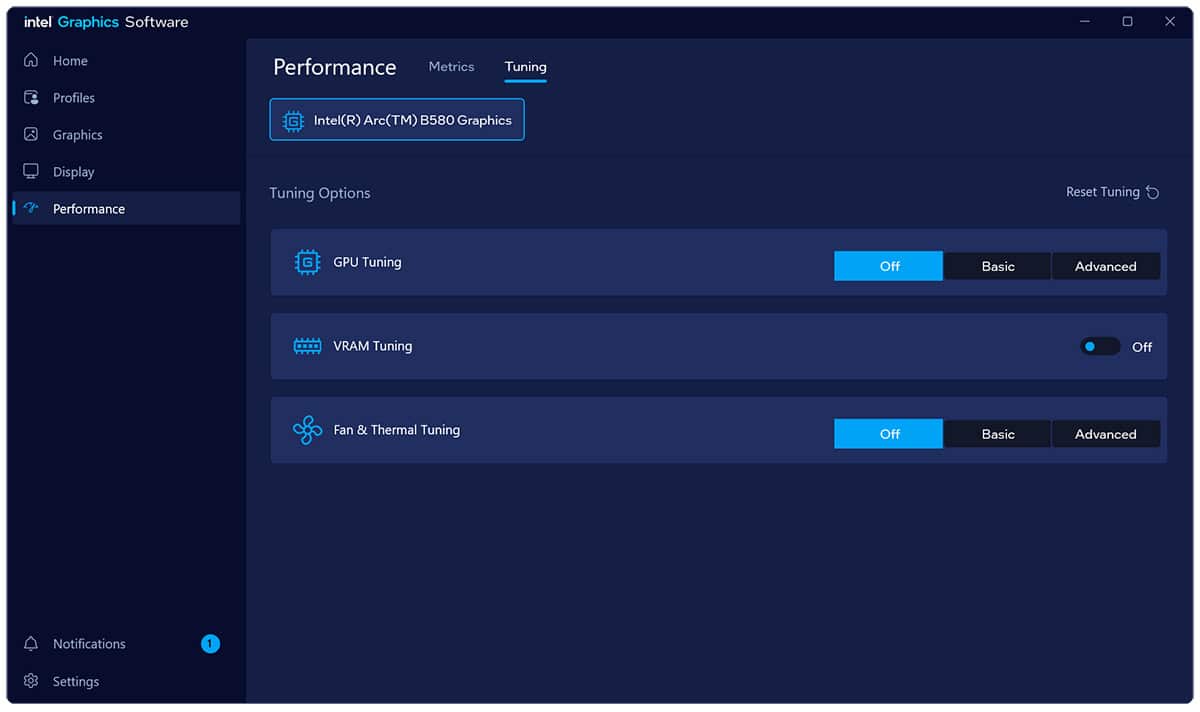
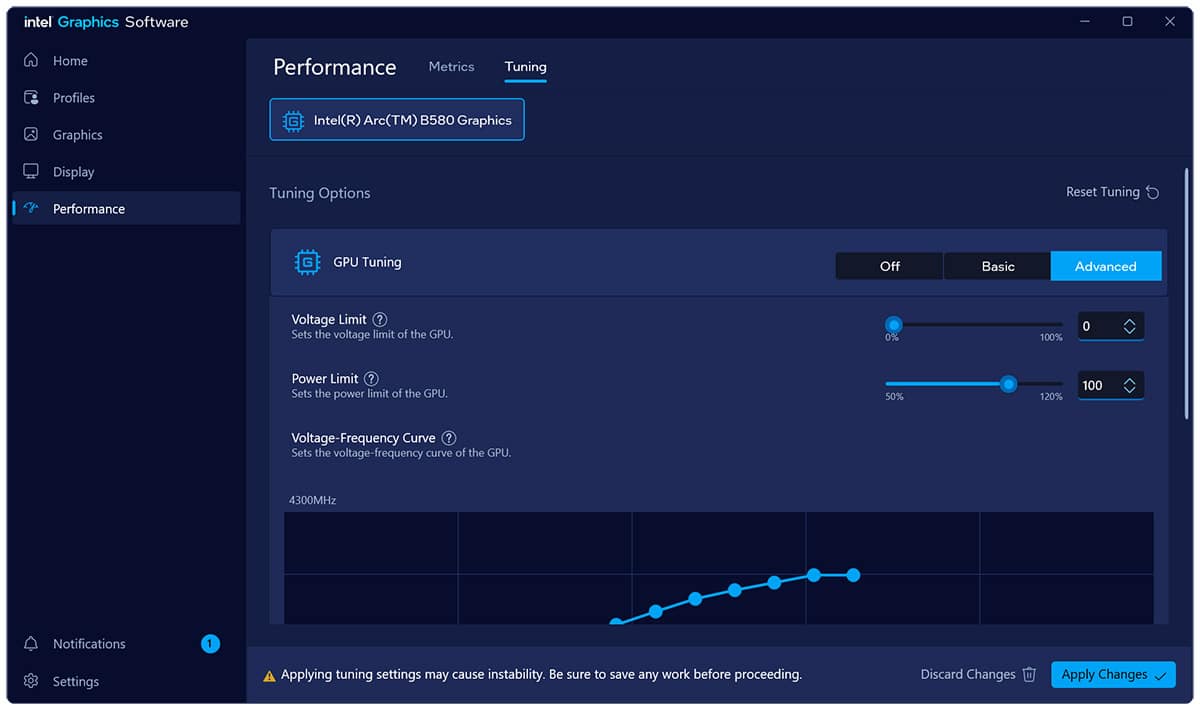
For lack of time, we couldn’t do without quickly trying, once again, to overclock our copy of the Intel ARC B580 Limited Edition. To do this, go to the drivers, and more specifically to the “performance” option. You’ll be able to act on three elements: the GPU, memory and fans. There are also two different modes, basic and advanced, which offer the same modifications. Advanced mode lets you act directly on the curve.
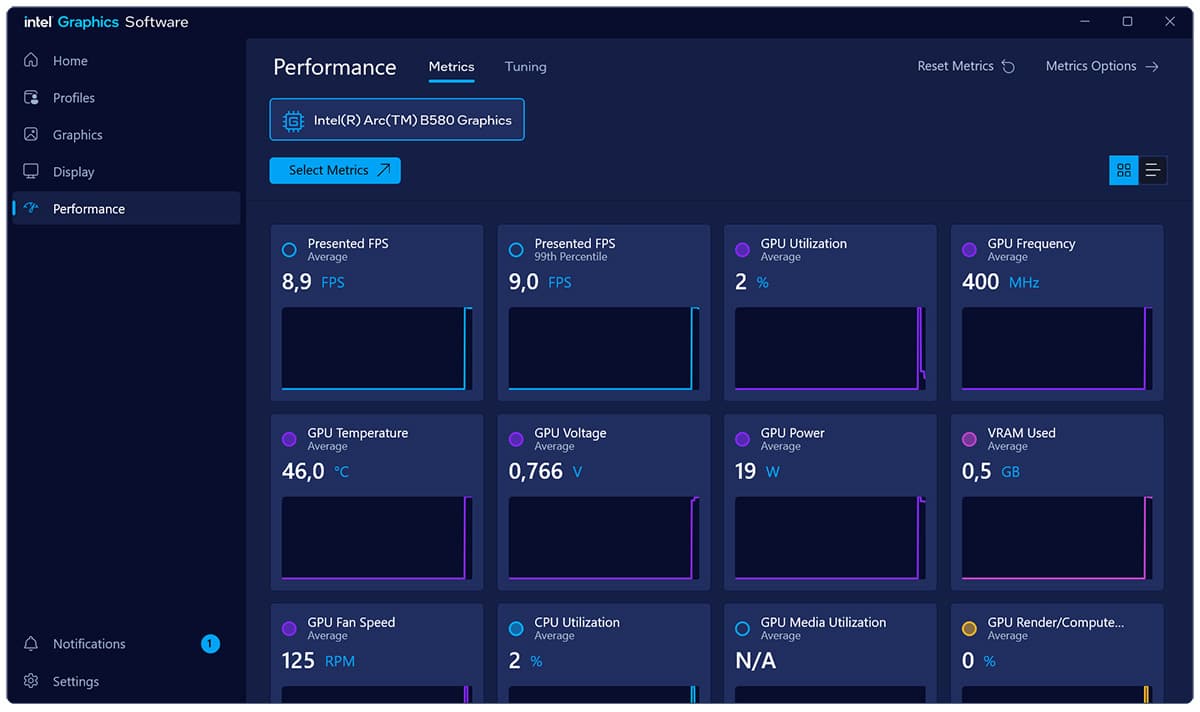

First step: we’ll need a reference score, i.e. a score achieved at stock, without any modification of the card parameters. We’ve chosen Time Spy as our benchmark, so that you can compare it with your own score. Here, we obtain an overall score of 15825 points and a GPU score of 14931 points.

After a few modifications to the power limit, voltage and memory frequency, and by pushing the cooling a little, we were able to obtain an overall score of 16770 points (6%) and a GPU score of 15922 points (6.6%).

We’ll be coming back to overclocking the B580 in the weeks to come, and why not, with a short run under DOD.
[nextpage title=”The last word: “]
Rasterization: its strong point!
Here we are, and now it’s time to give you our impressions of this new generation of GPUs from Intel, with the ARC B580 “Limited Edition” model. Our first impressions are excellent, because in just two generations, Intel has been able to match the performance of NVIDIA and AMD. In fact, in pure rasteration, the three manufacturers – NVIDIA, AMD and Intel – have managed to offer a card with virtually the same performance in 1080p, with the RTX 4060, the RX 7600 and now the ARC B580.
XeSS 2: the promise of the future
We were also pleasantly surprised by the performance offered by the ARC B580 in 1440p definition. Of course, for certain games, you’ll have to make compromises or go through the ” upscaling ” process with the XeSS. Intel’s second-generation XeSS will bring us two new features to compete with NVIDIA and AMD: Xe Frame Generation (XeSS-FG) and XeSS Low Latency (XeLL). Unfortunately, only ten games are currently compatible with XeSS 2. As for the first generation of XeSS, it will fluctuate according to the game. Sometimes it’s generous in FPS, sometimes less so in “balanced” mode. It will also be interesting to compare image quality after upscaling, between FSR, DLSS and XeSS, but that’s for another file.
Improved power consumption :
Power consumption is much improved compared to the ARC A750 and ARC A770, but still not up to the level of NVIDIA’s RTX 4060 and RTX 4060 Ti. On this point, it’s the green ones that are the best, and still hold the advantage in terms of energy efficiency. It’s also a pity that our Intel ARC B580 Limited Edition retains such high idle power consumption.
The price, always the price:
Yes, at the time of writing, the only certainty we have is the price in $ of the Limited Edition model, announced at $249. On paper, this is very attractive, but what about European prices? The first prices announced, notably at LDLC, known as one of the most expensive online stores, announce the ASRock ARC B580 Challenger model at €359.95 and the Steel Legend version at €369.95. Unfortunately, this is too expensive. NVIDIA models, such as the RTX 4060, are likely to see their prices drop in order to clear stocks, in view of the imminent arrival of the RTX 5000.
Now, we were talking about an entry-level card, before our article appeared, but is it really one? If we go back a decade or so, entry-level cards were models running at 60 FPS, sometimes with compromises on graphics options, and running at 1080p. Now, demand has shifted to 1440p, with the certainty of being able to benefit from 60 FPS, even with very high graphics options.
As for this reference model, proposed by Intel, it is not due to arrive in EU stores until early 2025. Once again, competition is likely to be tough for Intel.
This new generation augurs well for the future:
 For us, Intel has made a huge leap forward with this second generation, offering rasterization performance close to or even superior to that of NVIDIA and AMD. So, yes, not everything is perfect yet, but we can only applaud the work of the engineers, who have succeeded in placing themselves in direct competition with the two current market leaders. Intel’s reference board is perfectly designed, and the finish has nothing to be ashamed of when compared with other manufacturers’ offerings. Intel is also upgrading its in-house upscaling to integrate XeSS-FG and XeLL. We’re now eagerly awaiting the Intel ARC B570, scheduled for January 16, which could also be a pleasant surprise, and a truly entry-level card.

