

Intel has officially confirmed the existence of its upcoming Raptor Lake Next processors. This confirmation comes following the release of an internal test driver labeled “RPL-NEXT” and the discovery of shipping manifests dating back to August 2026. These documents, analyzed by industry observers, detail the technical specifications of four distinct models intended for the LGA 1700 platform.
The driver, initially spotted by the community on social media before being identified in Intel’s software database, is marked as a “test build” and locked. It is a driver for Smart Sound Technology (SST), which has been integrated into chips since Alder Lake. Although this file is not intended for public release, its presence confirms that the underlying hardware is currently being developed and tested by the manufacturer.
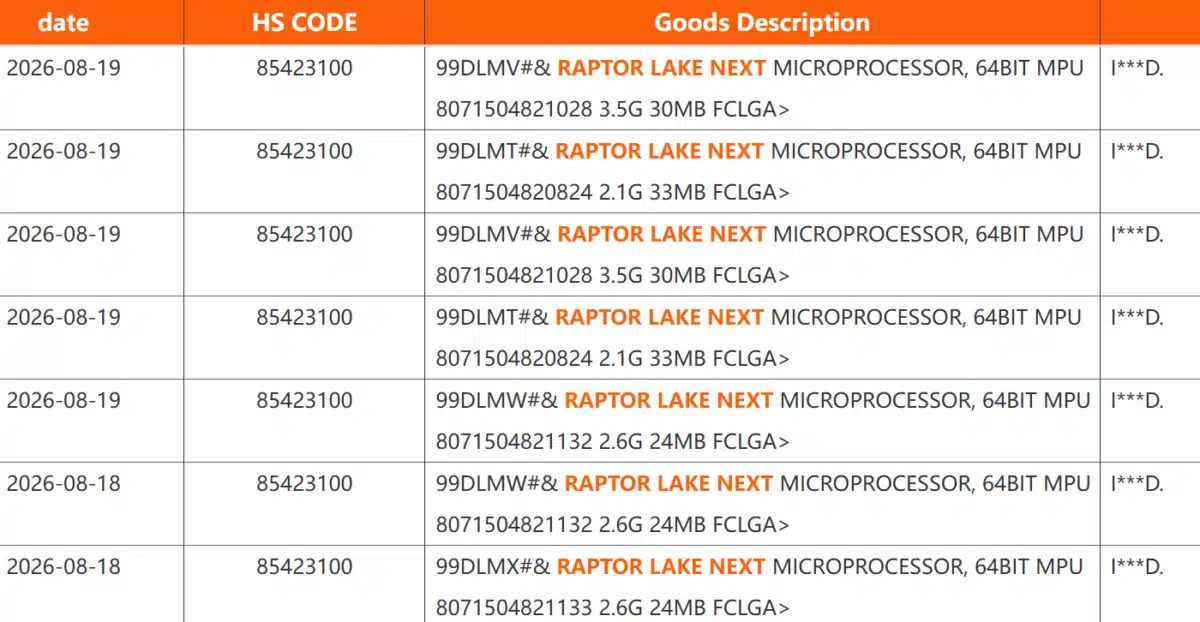
Meanwhile, commercial and customs records published by Club386 reveal that Raptor Lake Next processors began leaving Intel’s assembly plants in Vietnam as early as August. These documents list four distinct part numbers, all described as desktop microprocessors in the FCLGA form factor. The data includes base frequencies and cache capacities, offering a detailed glimpse into the upcoming lineup.
Raptor Lake Next Specifications
The most powerful model identified, with the part number 99DLMV, features a 16-core configuration (8 Performance and 8 Efficient cores) with a base clock of 3.5 GHz and 30 MB of cache. With a thermal design power of 125 W, this processor appears set to replace the current Core i5-14600K. Its base frequency even exceeds that of the Core i7-13700K, suggesting high gaming performance despite having fewer cores than current high-end models.
Another model, the 99DLMT, features a 20-core configuration (8 Performance and 12 Efficient). Equipped with 33 MB of cache and a thermal design power (TDP) of 65 W, this model appears geared toward productivity with a more modest base frequency of 2.1 GHz. The other two models, the 99DLMW and 99DLMX, share a configuration with 6 Performance cores and 4 Efficient cores, 24 MB of cache, and a TDP of 65 W, although their exact configuration remains partially unconfirmed by sources.
This information reinforces rumors that Intel does not plan a direct successor to the Core i9-14900K for this generation. Continued compatibility with DDR4 memory—already confirmed by BIOS updates from Gigabyte—could be a major advantage given the high prices of DDR5 modules. The official launch of the Core 200 series for these desktop processors is expected in early 2027.