

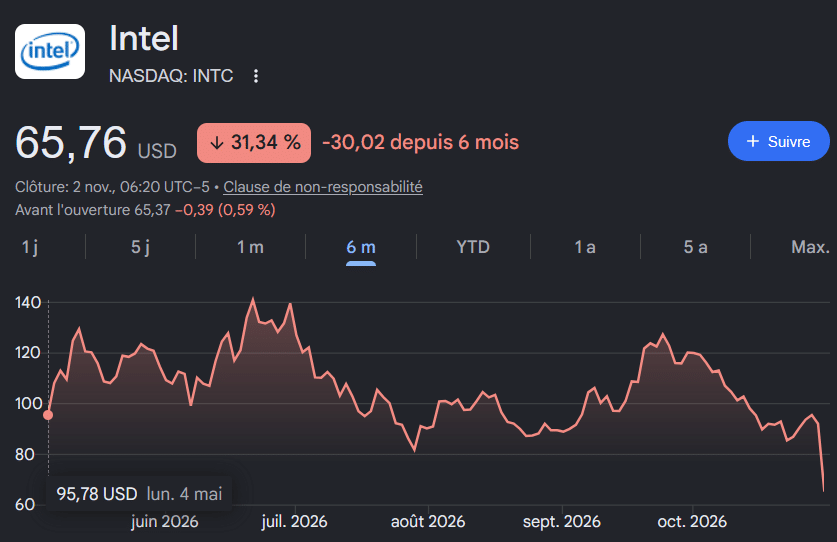
The stock market saw a major surprise this Friday involving Intel stock. After quadrupling in value between January and an all-time high last June—driven by demand for processors for agent-based AI—the chip giant lost a large portion of those gains in a single trading session. The stock price plummeted nearly 29% to close at $65.76, marking its worst day since 1974.
The situation is all the more surprising given that the past quarter went well for the company. Intel beat Wall Street estimates, and its revenue in the data center sector surged nearly 80% year-over-year, reaching $7.3 billion. However, the outlook for the final three months of the year was disappointing: while analysts had expected around $17 billion, Intel now anticipates only $15 billion to $16 billion.
Sluggish sales of consumer PCs are weighing on Intel
The weak spot lies in the personal computer sector. Strong demand for memory for AI data centers has driven up component prices, making laptops and workstations more expensive and less attractive. As a result, PC sales have declined. Intel now forecasts a decline in PC shipments of about 12% in 2026 and another 10% in 2027. The company does not see any improvement until memory supply and prices return to normal.
These forecasts must also factor in the closure of a factory in Kiryat Gat, Israel, where an explosion killed two workers earlier this month. Based on Yahoo Finance data dating back to 1973, only a drop of about 30% in July 1974 was more severe than Friday’s decline. Several financial institutions, including Bank of America, D.A. Davidson, Seaport, and Roth, downgraded Intel’s rating to “neutral” on the same day.
The U.S. government, which holds about 10% of the shares, also took a hit, losing nearly $12 billion on paper. Despite this loss, the government’s shares are still worth more than three times the purchase price of $20.47 per share paid last year. This decline comes one day after Alphabet’s worst trading session, during which its market capitalization fell by about $500 billion following a report showing that spending on AI infrastructure had reduced free cash flow.
A Broad-Based Decline?
Meta didn’t fare much better either, and both giants are now trading more than 20% below their 52-week highs. Even Nvidia, which has reached its peak, is down about 12%, mainly because investors fear that its largest customers will cut spending in 2027. In South Korea, SK Hynix fell 7% and Samsung 3%, contributing to a nearly 3.5% drop in the KOSPI index.
For consumers looking to buy a PC, none of this news points to cheaper hardware in the short term. Memory prices could continue to climb through next year, and some forecasts don’t anticipate any real relief until 2028.