

[nextpage title=”Introduction: “]
We thought that 2024 was going to end quietly after the launch of the Intel Core Ultra 200S processors, but no, Intel is unveiling a new range of graphics cards on 3 December, including an Intel ARC B580 and an Intel ARC B570. We attended a press conference on Monday evening, which was packed with announcements. Today we’re going to take a look at the unboxing of the Intel ARC B580 Limited Edition graphics card that we’ve just received. Of course, we won’t be revealing any results just yet, so you’ll just have to be patient. Many thanks to Intel France for making this copy of the Intel ARC B580 Limited Edition available.
Arc Battlemage: two models for launch
This week we’ll be bringing you a full report on the new technologies on board this new range of Intel GPUs. However, we can already announce the arrival of an Intel ARC B580 and an Intel ARC B570. These two Arc Battlemage models will feature the second generation of Xe cores. As you might expect, these will be more powerful and there will be fewer of them than in the previous generation.


The Intel ARC B580 Limited Edition will be equipped with 20 Xe2 cores and 20 ray tracing units. It will have 12 GB of GDDR6 memory with a 192-bit memory interface, providing a bandwidth of 456 GB/s. The GPU frequency is announced as 2670 MHz. Its little sister, the ARC B570 Limited Edition, will have 18 Xe2 cores and 18 ray tracing units. It will have 10 GB of GDDR6 memory with a 160-bit memory interface, providing a bandwidth of 380 GB/s. The GPU frequency is announced as 2500 MHz.


Despite some rumours in recent weeks, these two models will indeed be PCIe 4.0 x8. As far as TDP is concerned, the B580 has been announced at 190 watts and the B570 at 150 watts, which is also excellent news. We’ll also be keeping a close eye on idle power consumption, which was a negative point at the launch of the ARC A750/A770.


The Intel ARC B580 will go on sale on 13 December 2024 at a recommended retail price of US $249, while we’ll have to wait until 16 January 2025 to see the arrival of the B570 model, priced at US $219. These are very aggressive prices, given that the ARC A770 was launched at $329 and the ARC A750 at $289.


Intel has also announced the list of partners that will be offering Intel boards. These include Acer, ASRock, Gunnir, MaxSun, Onix and Sparkle. As you can see, there’s not much that’s new, apart from MaxSun, which has been added as a new Intel partner. These models will have their own cooling systems and in-house PCBs, with the ASRock ARC B580 Steel Legend, for example, featuring two power connectors.
Intel ARC B580: a board for 1440p definition?
This was the announcement that surprised us the most. Intel explains in its slides that the trend among competitive gamers is to move away from 1080p and towards 1440p definition. This is indeed a new trend that is taking shape, and one that has already been highlighted by NVIDIA.


Intel has announced that its ARC B580 card will be designed for this 1440p definition and has therefore compared the performance of the B580 with that of the A750. The blues show an average gain of 24%. It would also have been interesting to know the gains over the A770 version.


But where we’re a little confused, and we have to admit it, is when Intel compares the performance of its ARC B580 model with NVIDIA’s RTX 4060 and AMD’s RX 7600, two fully 1080p-oriented cards. We were convinced that this ARC B580 model was intended for 1080p definition, unless concessions were made on graphics options within games. Is Intel relying on its in-house upscaling to promote the use of 1440p?


Intel will also be offering a second-generation XeSS with XeSS-SR (Super Resolution), XeSS-FR (Frame Generation) and XeSS-LL (Low Latency). In the end, our tests will provide a clearer picture of performance in 1080p and 1440p.

Overclocking evolves!
The good news is that while overclocking was not the easiest thing to do with the first generation ARC GPUs, Intel seems determined to change all that. We already know that certain custom models will benefit from higher frequencies than the B580 Limited Edition. Intel has announced that it has carried out an in-depth review of the various options in the ‘ Performance, Overclocking & Controls ‘ section.


We’ll see what gains we can expect from overclocking this Intel ARC B580 Limited Edition in our test.
[nextpage title=”Intel ARC B580 Limited Edition :”]
Packaging:
So here we go with the discovery of this Intel ARC B580 Limited Edition graphics card. If you’re a graphics card addict, you’ll have noticed that this ARC B580 contains the ‘Limited Edition’ reference specific to cards offered by Intel. The comparison could be made with NVIDIA’s Founders Edition models. The proportions of the box are quite similar to those of the previous generation.

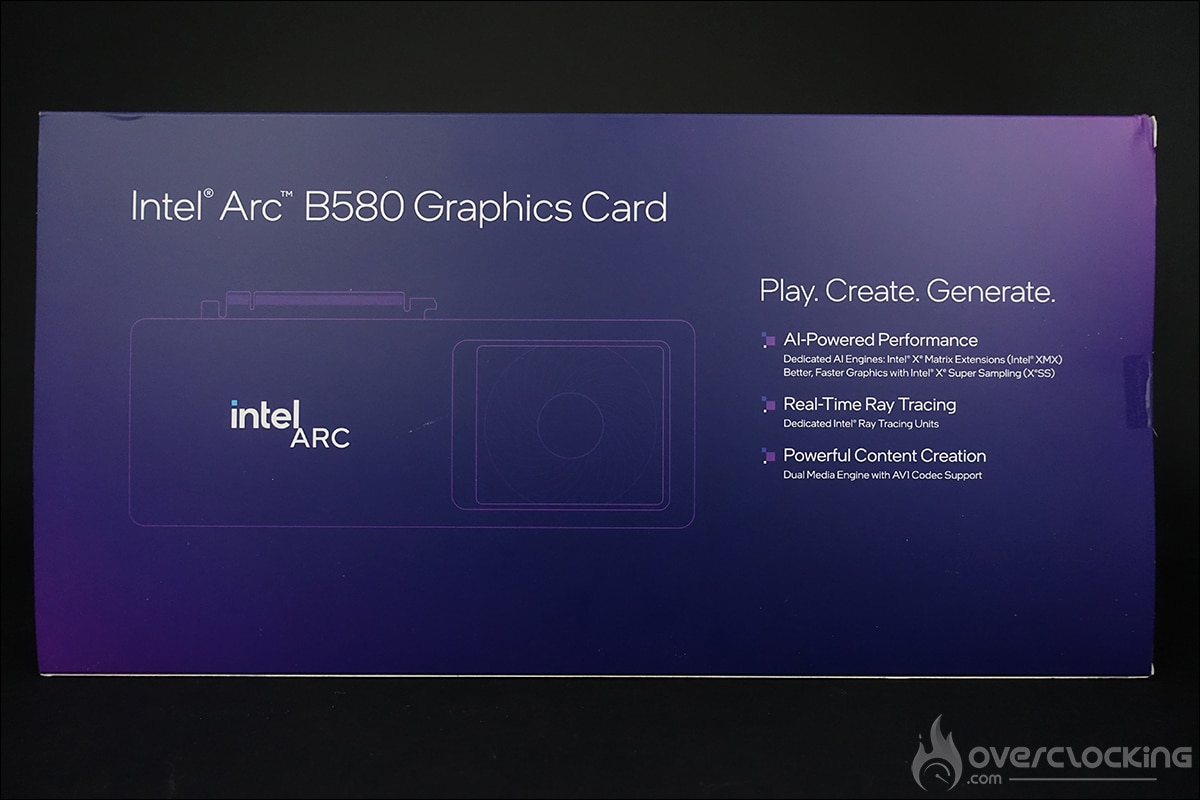
To reveal the box containing this new GPU, you’ll need to remove the tab on the side panel, which will release it. Then simply slide it out to reveal a cardboard box, all in black. The front of the box reads ‘Intel ARC’.
The opening is from the bottom and … does not yet reveal the graphics card. It’s still hidden under a black cloth, which will allow it to reach you in the best possible conditions. Let’s start with the documents that seem to be hidden on the top.

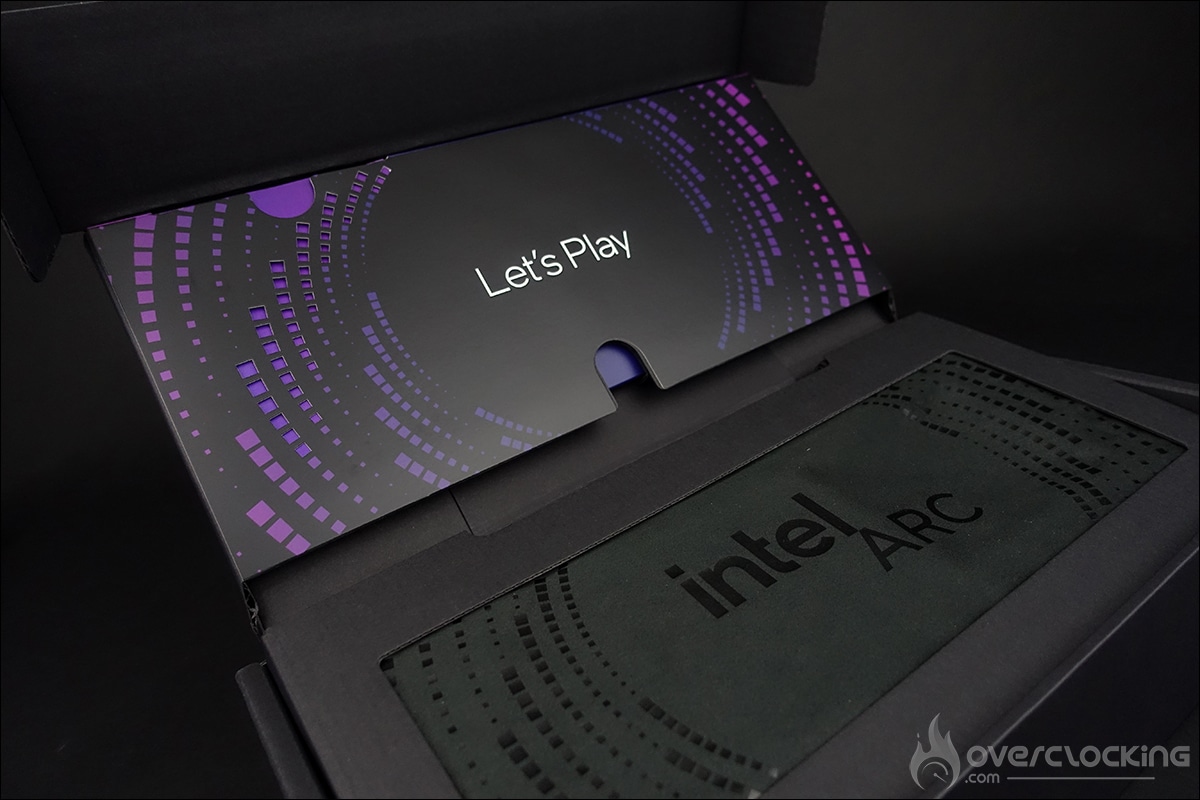
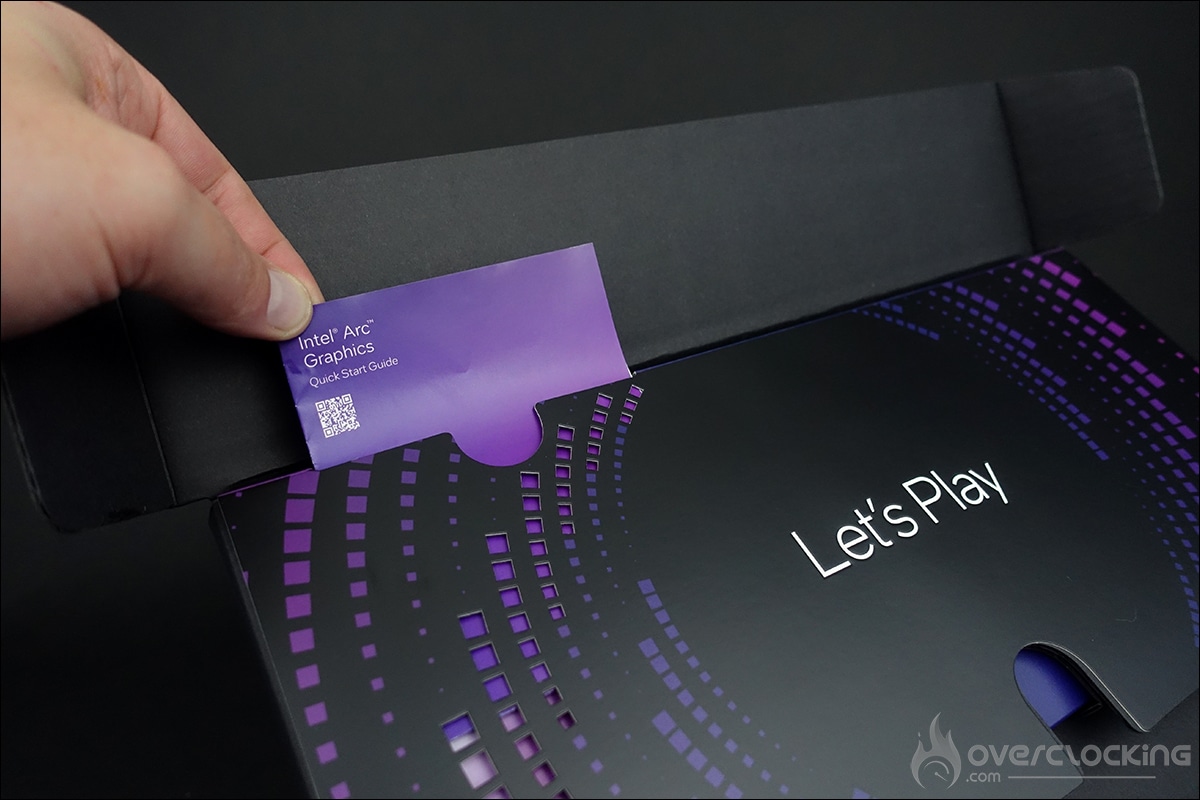
First of all, there’s a quick start guide and an imposing envelope. On the envelope is a note from Intel: ” Thank you for choosing Intel ARC B-Series Graphics for the next chapter in your hardware odyssey with us! But what could it possibly contain?
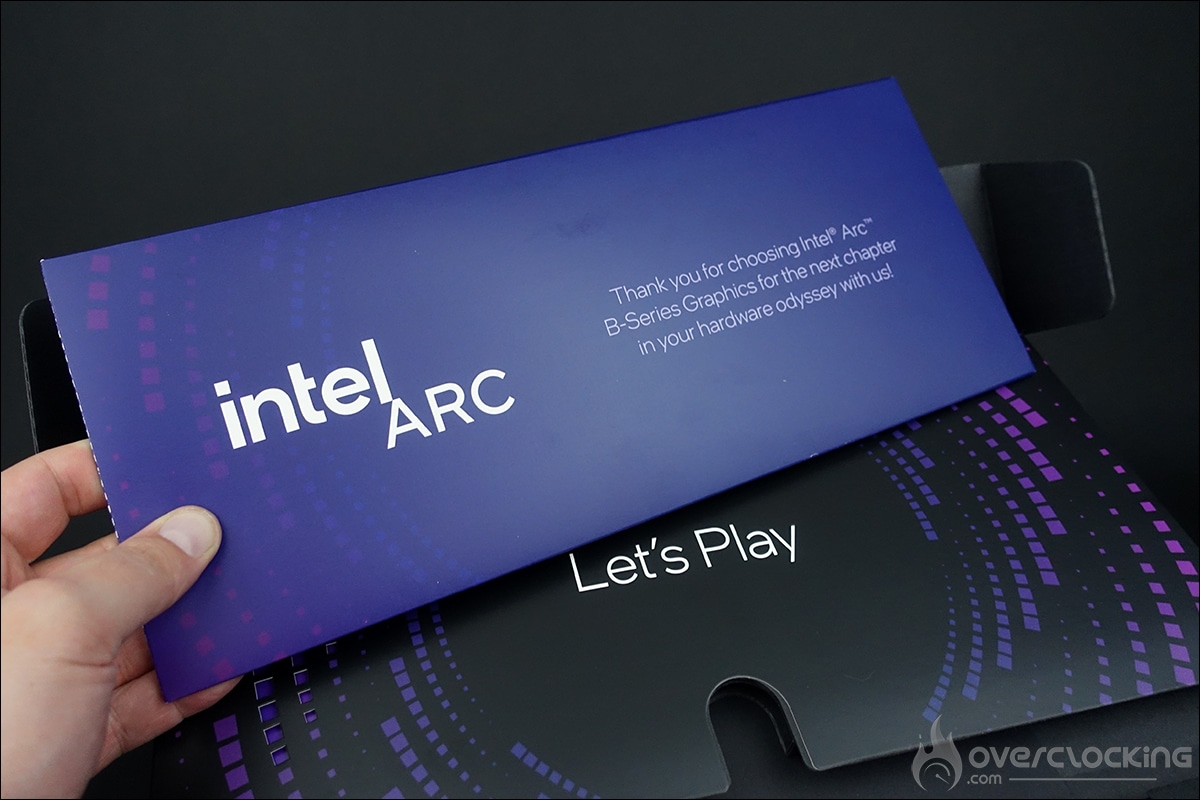
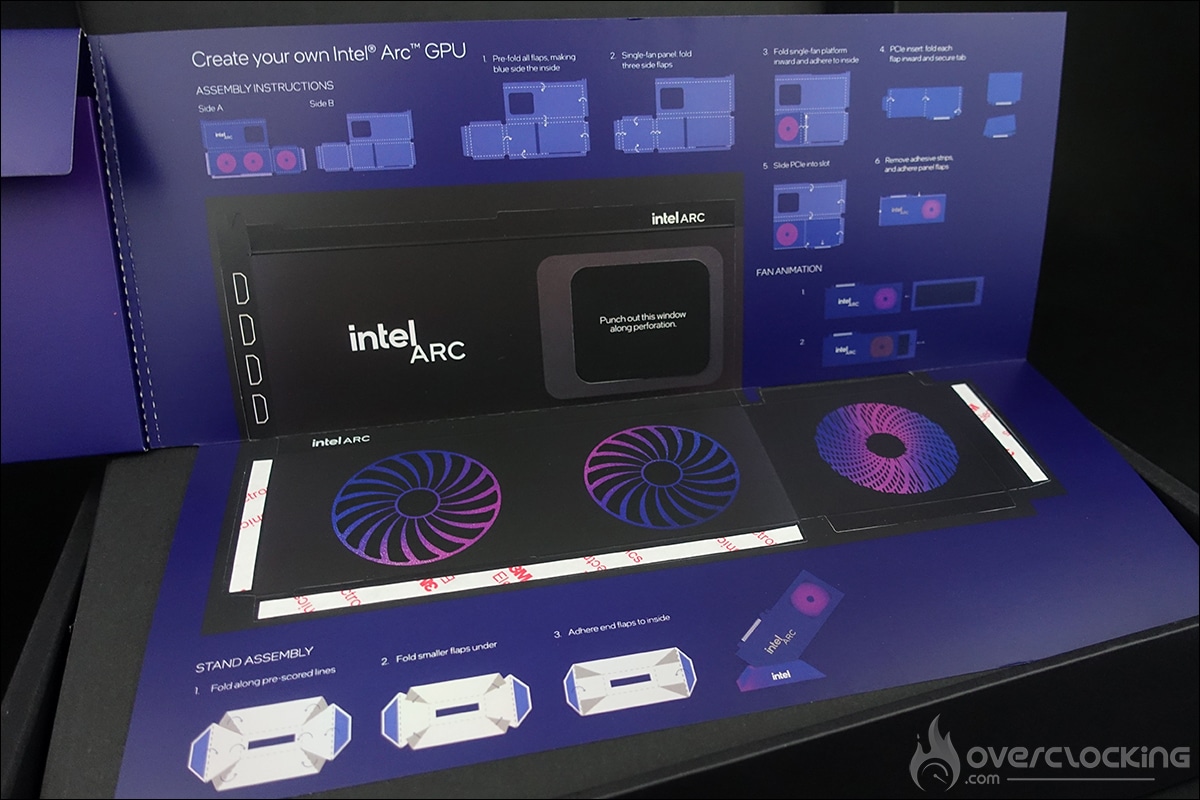
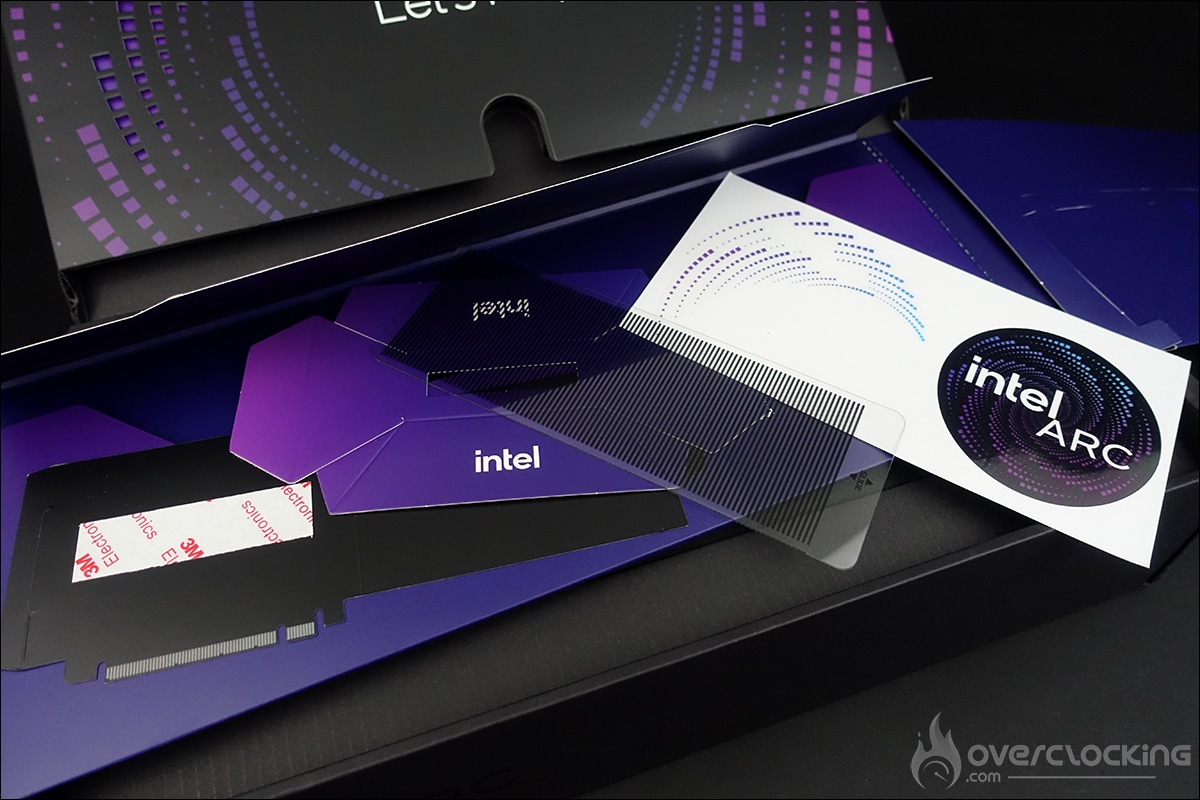
What we actually found was a model, not of a small plane, but of an Intel ARC graphics card. We had to resist the urge to assemble it directly, but we thought it would be a good idea to make a short video of it while we were putting it together! We should have it for you this week.
Let’s move on now to the most important item, our Intel ARC B580 Limited Edition graphics card.
Intel ARC B580 Limited Edition :
Once the piece of cloth has been removed, the back of the card is revealed. The first obvious difference compared to the ARC A750/A770 Limited Edition is the cut-out in the backplate, which reveals the radiator. This is a good thing, as it should optimise the cooling of this B580.


In terms of proportions, this new generation is fairly similar to its predecessor. There are also two 85 mm fans with 11 blades on the front panel, with a different design to the ARC A750/A770 models. Here, all the tips of the blades are connected together. Current GPUs often use this type of fan to improve airflow.


One thing that strikes you when you pick it up, however, is its weight! The ARC B580 Limited Edition seems much lighter. We weighed this new GPU and its weight is 785 g compared to 1080 g for the ARC A770 Limited Edition model and 1065 g for the ARC A750. Aesthetically, Intel is offering a black version, with no real brand logo, just “Intel ARC” on the top edge and “Intel ARC B580” on the backplate.
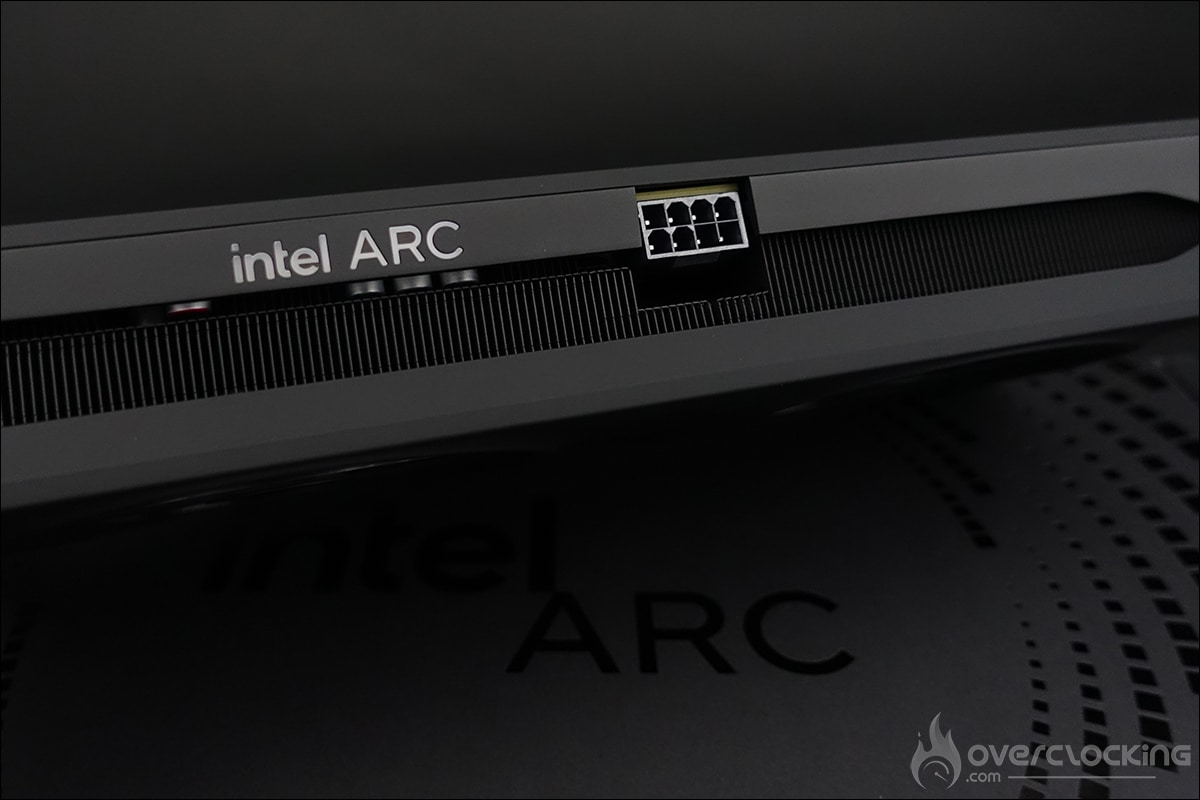

To power this ARC B580 Limited Edition, you’ll need a single 8-pin connector. Intel is retaining the use of ‘traditional’ power connectors, and that’s just as well. There’s nothing to suggest the presence of RGB backlighting, and that’s not to our displeasure, quite the contrary.

The exploded view confirms that the PCB is much shorter than the cooling system. The end of the radiator and the second fan will, as we imagined, improve heat dissipation.

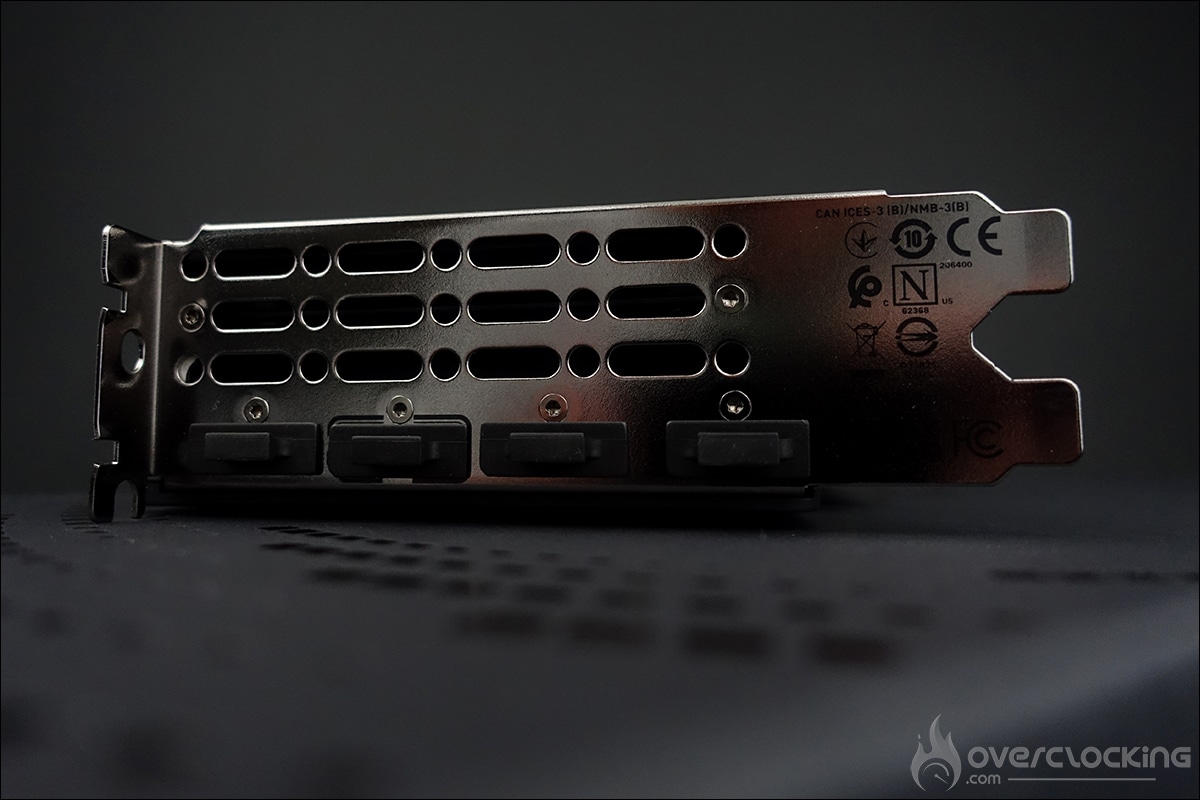
Finally, in terms of video outputs, you’ll have three DisplayPort 2.1 and one HDMI 2.1 port.
What about the previous-generation design?
To conclude, here are a few photos of our Intel ARC B580 Limited Edition against the ARC A770 Limited Edition. You’ll be able to see for yourself that the design remains in the same spirit, even if there are some visually identifiable differences.

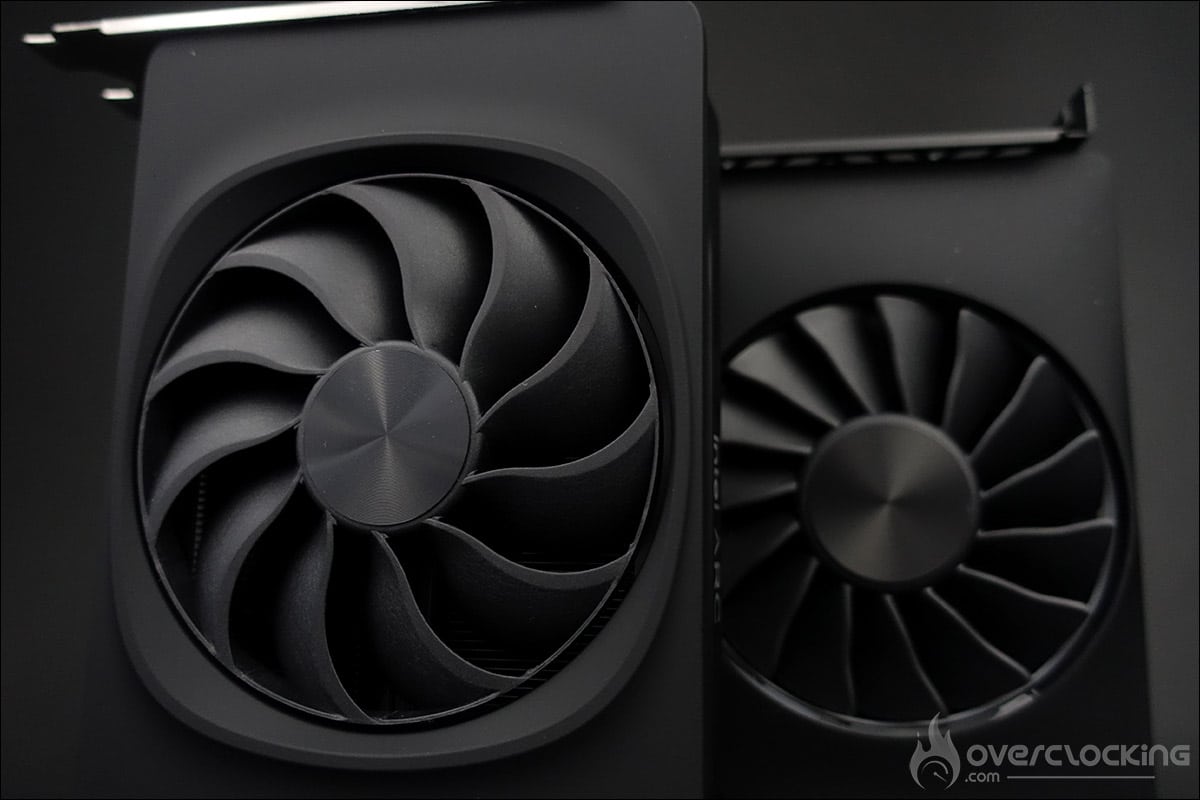
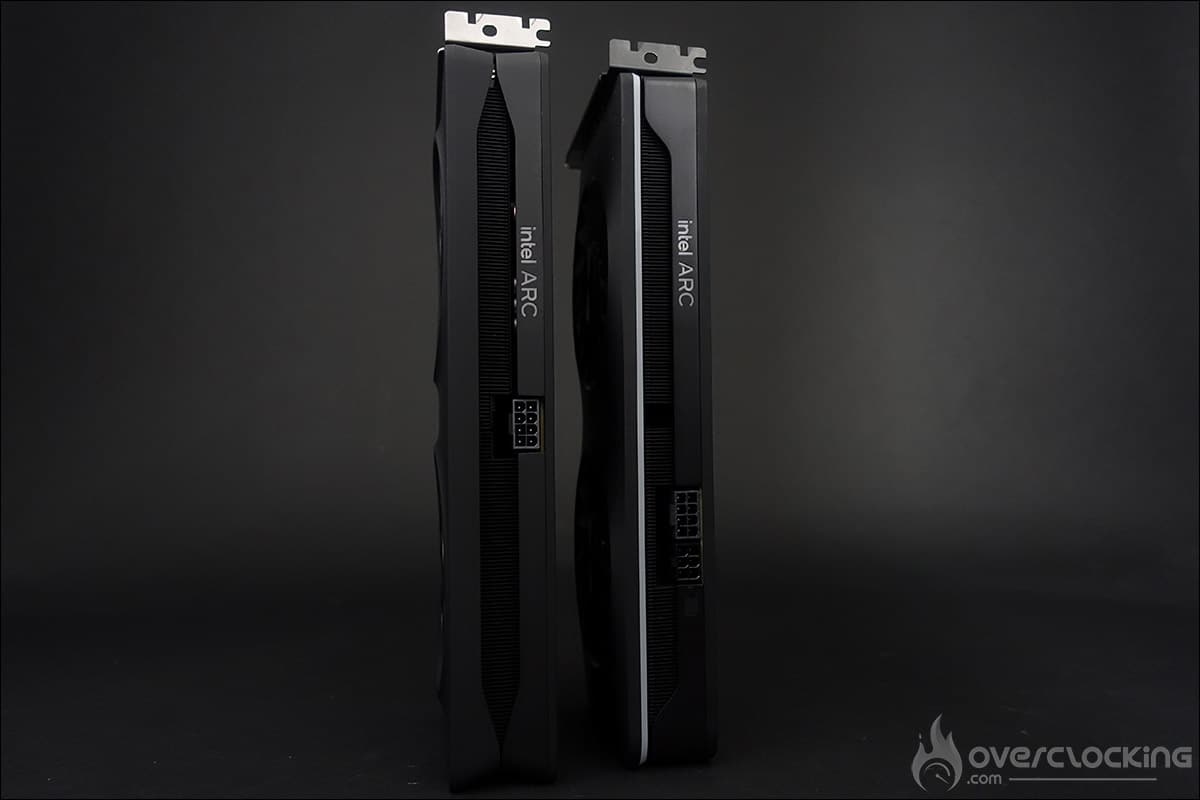

Unfortunately, that’s all for today. You’ll still have to be patient to (finally) discover the performance of this Intel ARC B580 Limited Edition. See you in a few days’ time to find out how this new GPU performs against the competition, and in particular against NVIDIA’s RTX 4060 and AMD’s RX 7600. So, do you see this GPU in the 1080p or 1440p range?