










Arrow Lake 1/2 architecture:
The Intel Core Ultra 200S processors in the press kit:
This one uses the same colour code as the one we received for the launch of Gen 14, with blue dominating. The first step is to open it from the left, like a book.
There’s an illustration of a Core Ultra 200S processor, and on the right there’s a transparent block into which is inserted, not a processor, but a cardboard illustration of a Core Ultra 200S. At the back is a table listing the five processors officially launched on 24 October: the Core Ultra 9 285K, the Core Ultra 7 265K/265KF and the Core Ultra 5 245K/245KF. We currently only have the Core Ultra 9 and Core Ultra 5 models, but we should be bringing you the test of the Core Ultra 7 265K very soon.


Finally, if you open the second part, on the right, the Core Ultra 9 285K and Core Ultra 5 245K are revealed. They are, of course, protected by a plastic shell before being placed on one of our Z890 motherboards.


Let’s take a look at all the announcements surrounding this launch.
Five processors for the launch :
The first things we’re going to be looking at are, of course, the new Intel Core Ultra 200S desktop processors, aka the Arrow Lake-S. Intel will no doubt be aiming to make you forget the stability problems encountered by its 14th generation, which now seem to have been completely resolved by a series of updates and fixes via your motherboard’s BIOS.
Initially, Intel will be concentrating on launching five ‘K’ or ‘KF’ version processors. As a reminder, the ‘K’ processors have an unlocked multiplier and the ‘KF’, in addition to the unlocked multiplier, also lack the integrated graphics chip.


Intel will be launching the Core Ultra 9 285K, the Core Ultra 7 265K/265KF and the Core Ultra 5 245K/245KF. These new processors will again feature a “hybrid” architecture, mixing two types of cores: Lion Cove P-Cores and Skymont E-Cores. These cores naturally have different roles. The first, the Performance cores, are used for tasks requiring computing power, while the second, the Efficient cores, are used for office automation or background tasks. Now, the two types of core will work together depending on the task in hand. Another very important point to note is the absence of hypertreading on this generation of processors.
The Core Ultra 9 285K will be the most powerful model at launch, with its 24 cores (8P 16E), 36MB Intel Smart Cache and 40MB L2 cache. The Boost frequency of the P-Cores will be up to 5.7 GHz.
The mid-range will be represented by the Core Ultra 7 265K/KF and its 20 cores (8P 12E). It will benefit from 30 MB Intel Smart Cache and its 36 MB L2 cache, with a Boost frequency flirting with 5.5 GHz.


Finally, the Core Ultra 245K/KF will have 14 cores (6P 8E) and a boost frequency of 5.2 GHz. It will have 24 MB Intel Smart Cache and 26 MB L2 cache. For these five processors, the maximum frequency of Efficient cores will be 4.6 GHz. In terms of performance, Intel has announced a gain of 9% for the Lion Cove P-Cores and 32% for the Skymont E-Cores, compared with the 13th and 14th GENs.


As far as the integrated graphics chip is concerned, it will have 4 Xe cores and a maximum frequency of 2 GHz on the Intel Core Ultra 285K and 265K, and 4 Xe cores and a maximum frequency of 1.9 GHz for the 245K. This new generation also benefits from an NPU, a chip designed for AI calculations, with a power of 13 TOPS.
A new chipset and a new socket :
While Intel will initially be offering just three processors, there will also be just one chipset, the Z890. The rest of the range, in terms of processors and chipsets, is not due to arrive until 2025.
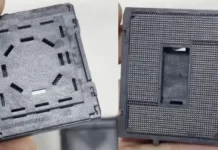
If you want to buy an Intel Core Ultra 200 processor, you’ll have to change motherboards because this new CPU requires a new socket with more pins, 1851 to be exact, and therefore an LGA-1851 socket. This socket retains the same dimensions as its predecessor, i.e. 450 x 357 mm.


The good news is that the mounting holes are still compatible with the LGA-1700. This means you can keep your current cooling system if you have this Intel platform. We have learned, however, that the hot spot on Arrow Lake processors may have moved upwards. It will be interesting to see what impact this has on temperatures, as some brands seem to be talking about an adapter for LGA-1851 sockets. We’ll be keeping a close eye on this during our tests.