

[nextpage title=”CPU, chipset and socket:”]
On Monday evening, we were able to follow Intel‘s online presentation of the new generation of Intel Core Ultra 200S processors. Here’s a short report on what we learned and some of the slides presented during the online conference. The main point made by Intel is the reduction in power consumption, which in some cases is quite drastic. We are going to try to be as precise as possible about this presentation given by Roger Chandler, VP/GM Enthusiast PC and Workstation and Robert Hallock, VP/GM Client AI and Technical Marketing.
Five processors for launch :
The first things we’re going to be looking at are, of course, the new Intel Core Ultra 200S desktop processors, aka Arrow Lake-S. Intel will no doubt be aiming to make you forget the stability problems encountered by its 14th generation, which now seem to have been completely resolved by a series of updates and fixes via your motherboard’s BIOS.
Initially, Intel will be concentrating on launching five ‘K’ or ‘KF’ version processors. As a reminder, the ‘K’ processors have an unlocked multiplier and the ‘KF’, in addition to the unlocked multiplier, also lack the integrated graphics chip.


Intel will be launching the Core Ultra 9 285K, the Core Ultra 7 265K/265KF and the Core Ultra 5 245K/245KF. These new processors will again feature a “hybrid” architecture, mixing two types of cores: Lion Cove P-Cores and Skymont E-Cores. These cores naturally have different roles. The first, the Performance cores, are used for tasks requiring computing power, while the second, the Efficient cores, are used for office automation or background tasks. Now, the two types of core will work together depending on the task in hand. Another very important point to note is the absence of hyperthreading on this generation of processors.
The Core Ultra 9 285K will be the most powerful model at launch, with its 24 cores (8P + 16E), 36MB Intel Smart Cache and 40MB L2 cache. The Boost frequency of the P-Cores will be up to 5.7 GHz.
The mid-range will be represented by the Core Ultra 7 265K/KF and its 20 cores (8P + 12E). It will benefit from 30 MB Intel Smart Cache and its 36 MB L2 cache, with a Boost frequency flirting with 5.5 GHz.


Finally, the Core Ultra 245K/KF will have 14 cores (6P + 8E) and a boost frequency of 5.2 GHz. It will have 24 MB Intel Smart Cache and 26 MB L2 cache. For these five processors, the maximum frequency of Efficient cores will be 4.6 GHz. In terms of performance, Intel has announced a gain of 9% for the Lion Cove P-Cores and 32% for the Skymont E-Cores, compared with the 13th and 14th GENs.


As far as the integrated graphics chip is concerned, it will have 4 Xe cores and a maximum frequency of 2 GHz on the Intel Core Ultra 285K and 265K, and 4 Xe cores and a maximum frequency of 1.9 GHz for the 245K.
A new chipset and socket:
While Intel will initially be offering just three processors, there will also be just one chipset, the Z890. The rest of the range, in terms of processors and chipsets, is not due to arrive until 2025. Today, you can discover the unboxing of four Z890 motherboards with the ROG Maximus Z890 HERO, the ROG Maximus Z890 APEX and the AORUS Z890 MASTER.
If you want to buy an Intel Core Ultra 200 processor, you’ll have to change motherboards because this new CPU requires a new socket with more pins, 1851 to be exact, and therefore a LGA-1851 socket. This socket retains the same dimensions as its predecessor, i.e. 450 x 357 mm.


The good news is that the mounting holes are still compatible with the LGA-1700. This means you can keep your current cooling system if you have this Intel platform. We have learned, however, that the hot spot on Arrow Lake processors may have moved upwards. It will be interesting to see what impact this has on temperatures, as some brands seem to be talking about an adapter for LGA-1851 sockets. We’ll be keeping a close eye on this during our tests.
[nextpage title=”Memory, performance and price: “]
DDR5 memory continues to evolve:
As far as memory is concerned, there’s no change. You can keep your DDR5 kit if you already have one. However, Intel has announced support for DDR5 CUDIMM(Clocked Unbuffered Dual Inline Memory Module) memory kits. What’s special about these new modules, compared to what we currently have with DDR5 UDIMMs, is the presence of a new chip integrated into the PCB, called the CKD(Client Clock Driver).
OK, but what does this actually change? These new CUDIMM memory kits will make it possible to reach higher frequencies than we currently know. This CDK chip will dynamically adjust the memory frequency and voltage according to the workload. From what we’ve been able to read, DDR5 CUDIMM kits will require an Arrow Lake processor, and therefore the 15th GEN memory controller. We’ll be testing these new kits carefully, as we’ve already received one at the editorial office.

As for the rest, the Z890 chipset will support memory modules up to 48 GB, for a total of 192 GB. Finally, Intel is no longer expected to offer DDR4-compatible Z890 motherboards.
Synthetic and gaming performance:
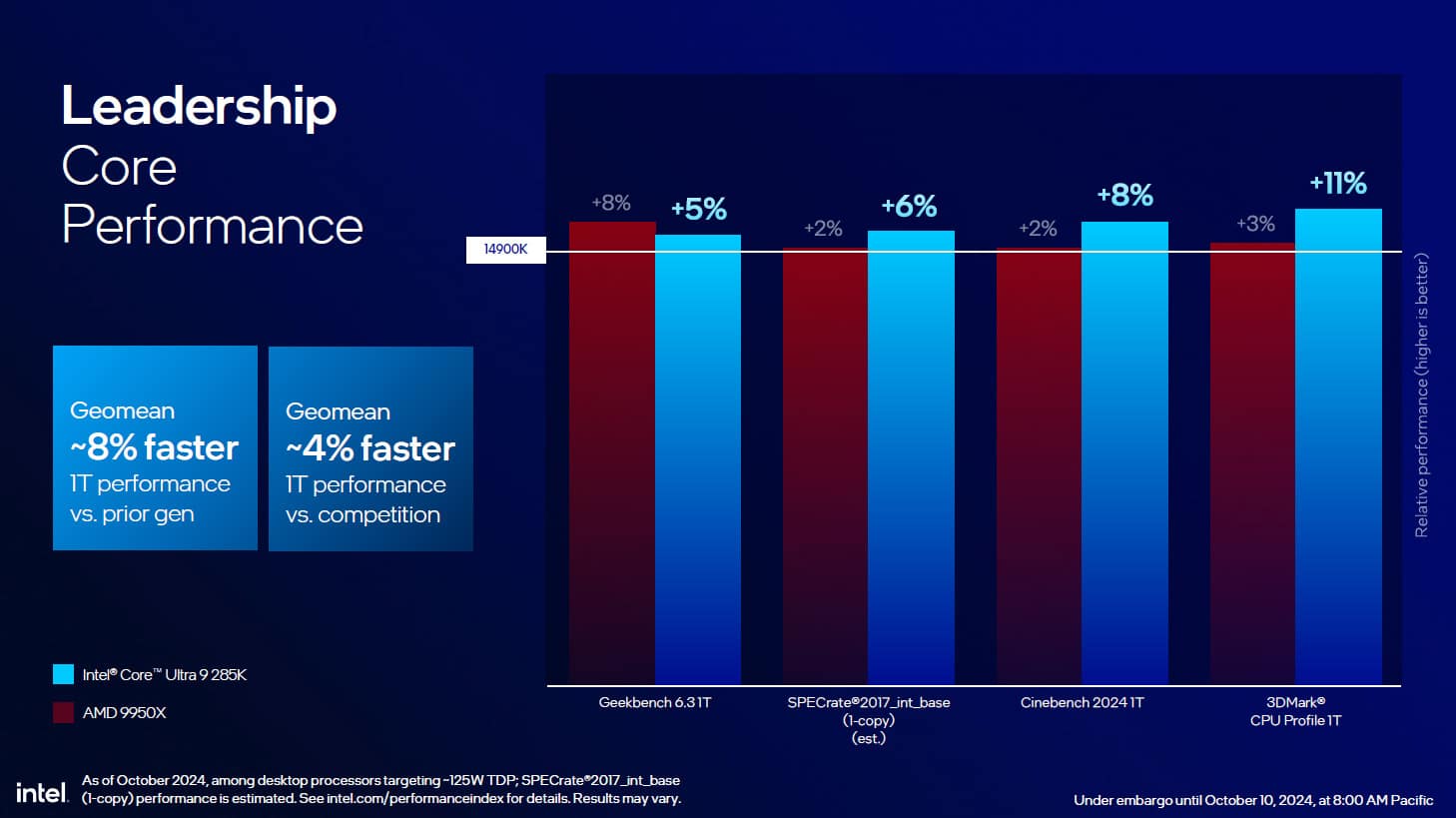
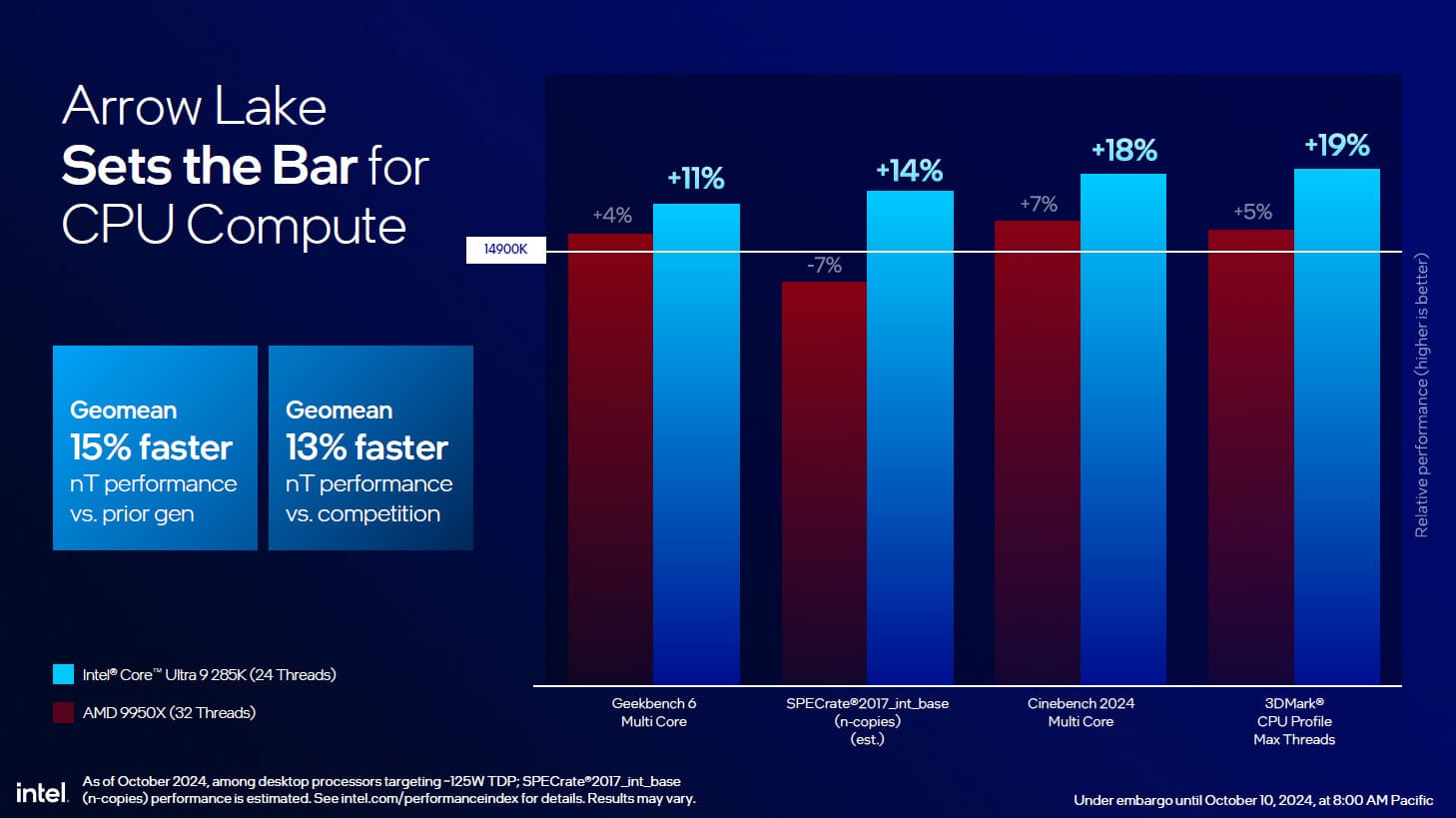
We were also able to discover Single Core performance, which has improved even further compared to the 14900K and will also outperform the latest AMD Ryzen 9 9950X. The latter performed spectacularly well against the previous generation of Ryzen 7000s. In terms of multithreaded tasks, the gain is much greater, and could exceed 15% depending on the application used.
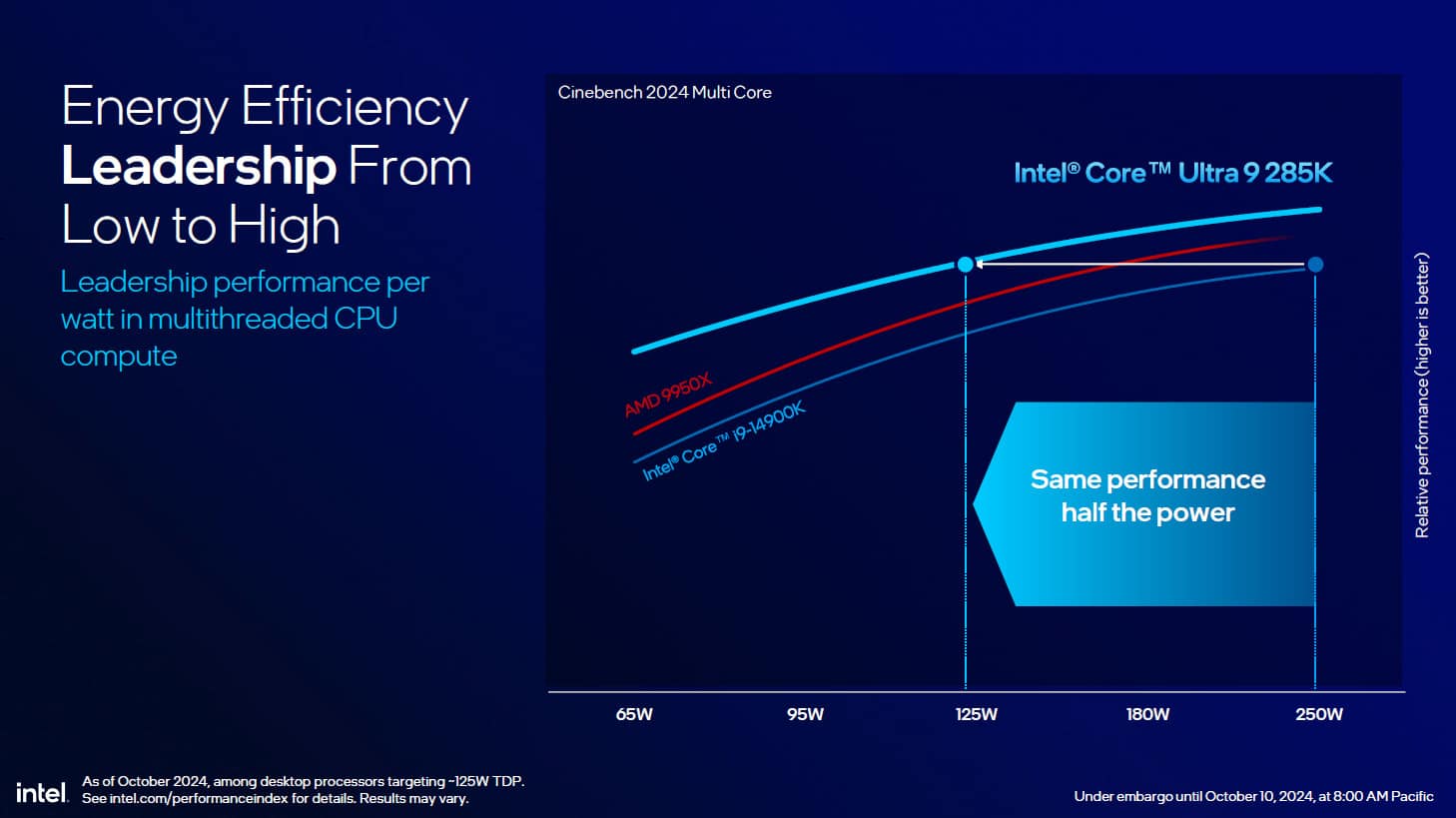
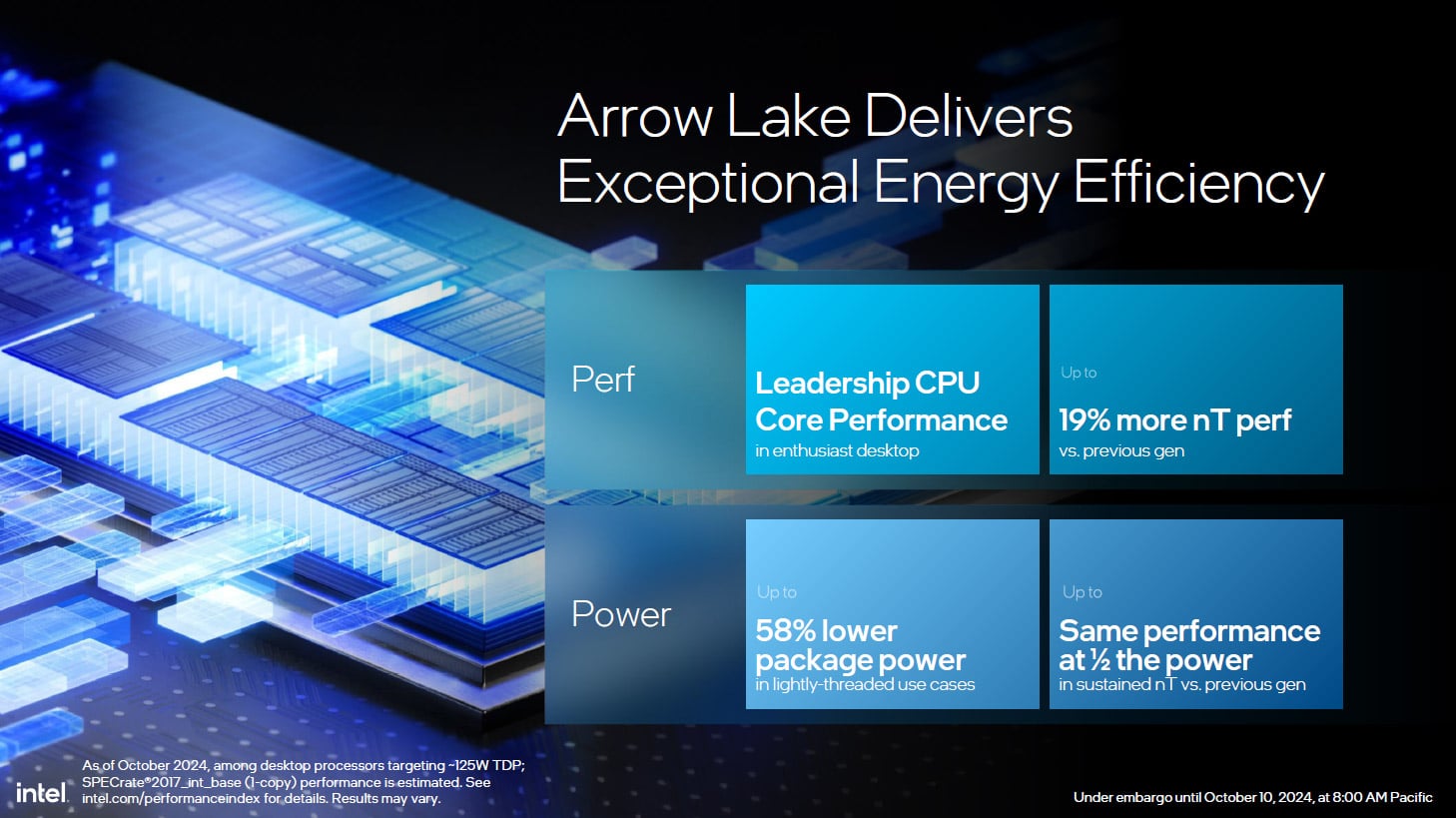
As we said in the slide below, Intel has demonstrated that the same performance as the 14900K can be achieved by the Core ULTRA 9 285K at 125 watts, whereas the 14900K requires 250 watts, i.e. double the power.
This section should be taken with a pinch of salt, as we will be reacting to Intel’s slides. We’ll be able to form our own opinion during our tests. One thing is certain, the performance of the Core ULTRA 200S should be very close to what we had with Raptor Lake Refresh in terms of gaming performance , but with much more controlled power consumption, as shown in the slide below against the i9-14900K
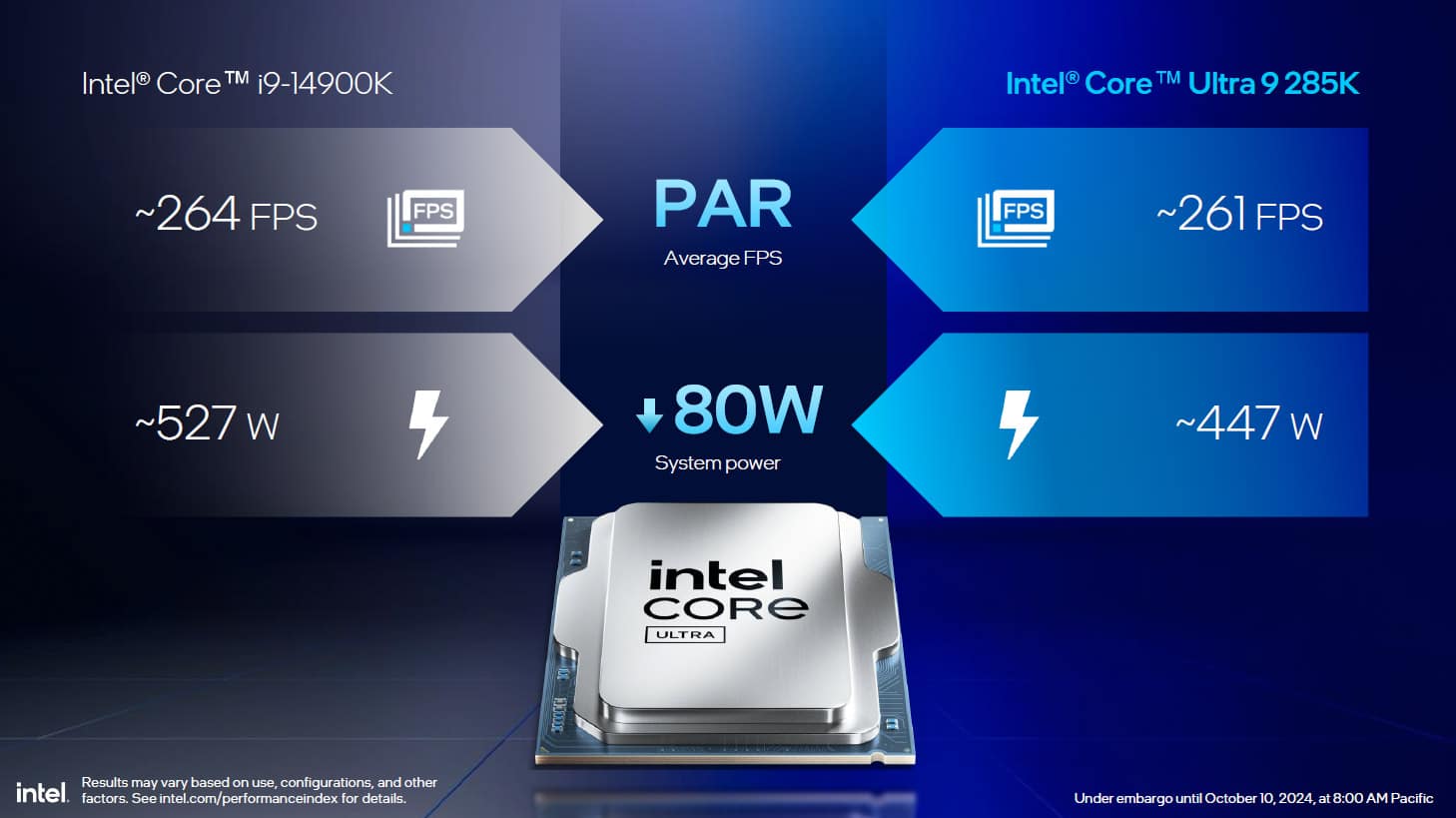
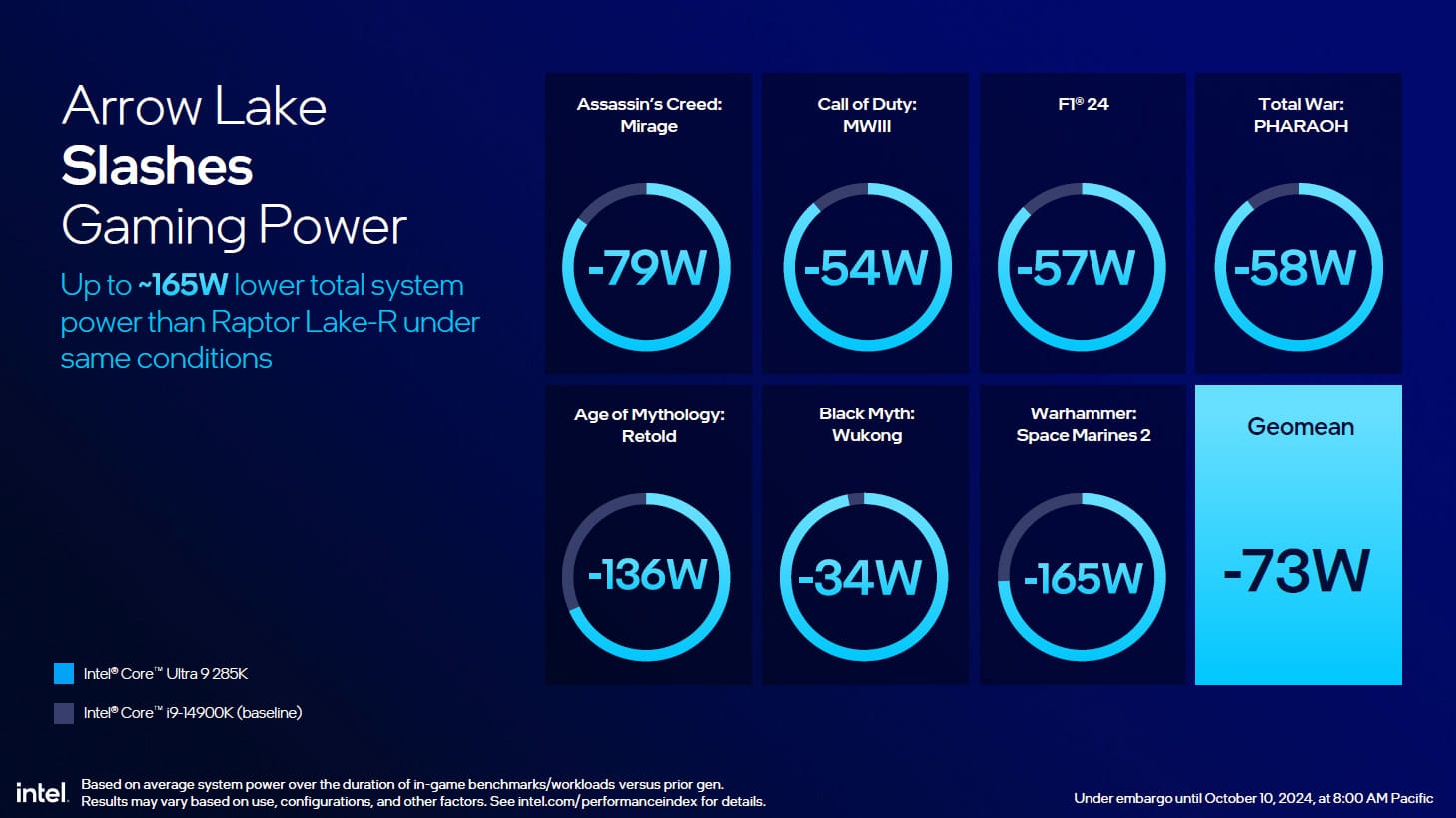
When it comes to gaming, don’t expect a revolution in terms of raw performance. Even if a gain is visible in certain games, Intel is once again highlighting the drop in power consumption of its Core ULTRA 200 processors. Now, it’s important to point out, because we haven’t done so yet, that this gain in terms of power consumption will have a direct impact on the temperatures of this new generation.
On the following slide, we can see the readings taken with a 360 mm AIO-type cooling system, where the gains measured can reach 17°C between the i9-14900K and the Core ULTRA 9 285K. This was one of the criticisms we made of the 14900K during our test: “performance that takes off, but at what price? Consumption and temperatures”. This should no longer be the case with the Intel Core ULTRA 200s, but we’ll see when we carry out our own tests.
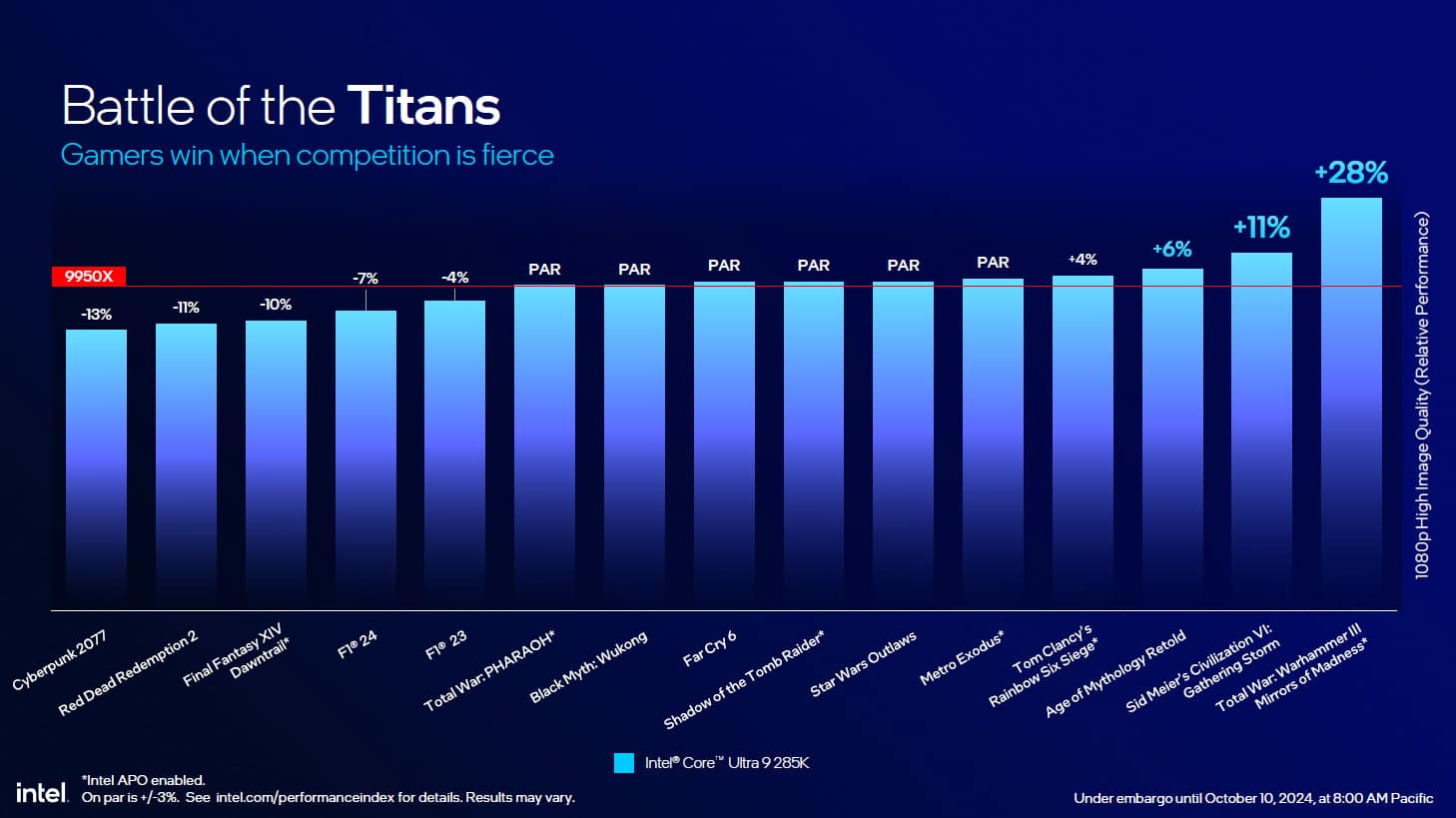
Faced now with AMD’s latest processor, the Ryzen 9 9950X, performance is fairly similar, and depending on the game chosen, it’s sometimes Intel, sometimes AMD that takes the lead. Note, however, that some of these games benefited from Intel APO technology.
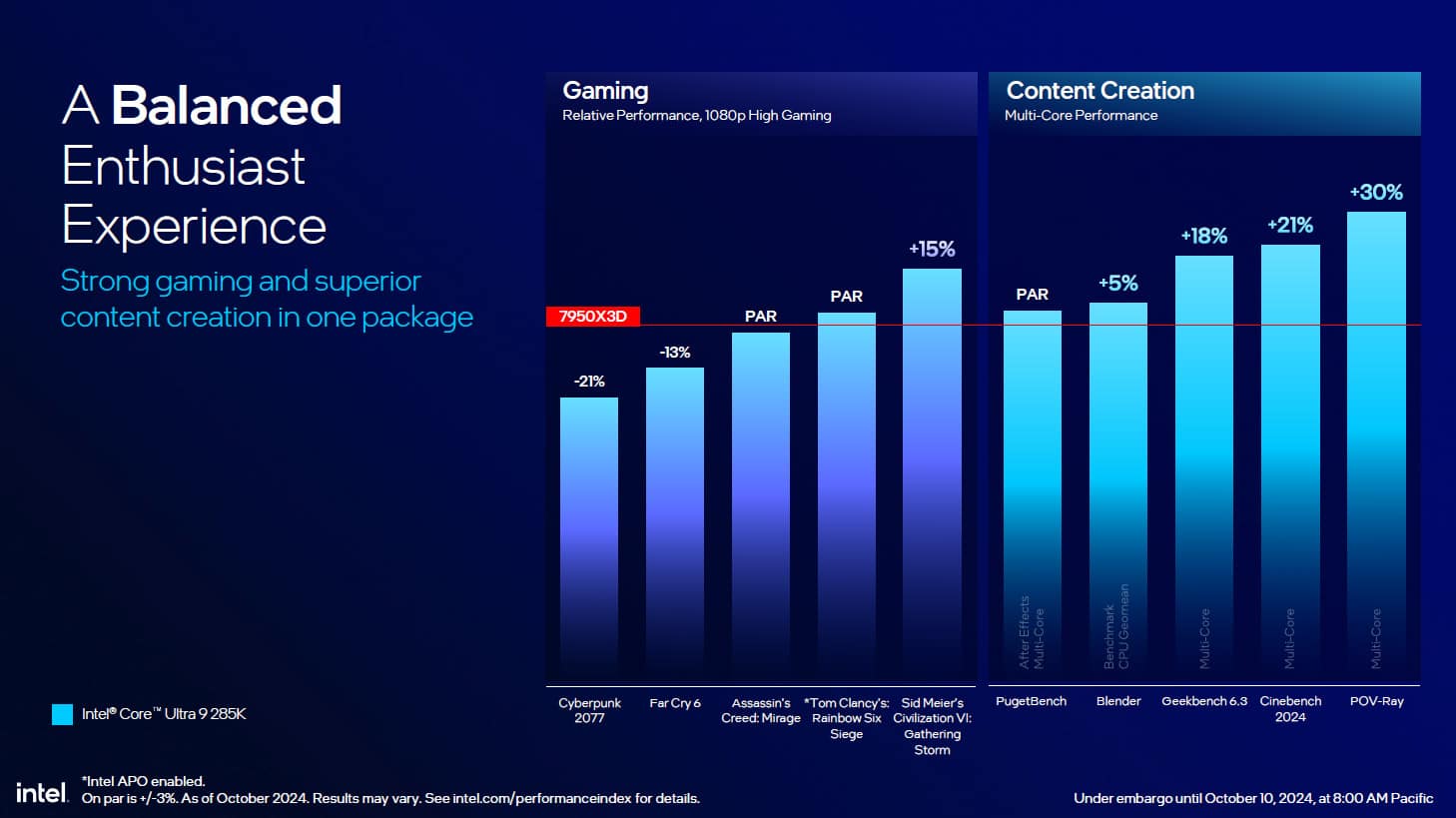
Intel has also revealed performance data for games and creative work against the Ryzen 9 7950X3D. We can see that the Core ULTRA 9 285K can lag by up to 21% in a game like Cyberpunk 2077, but performs better in creative applications.
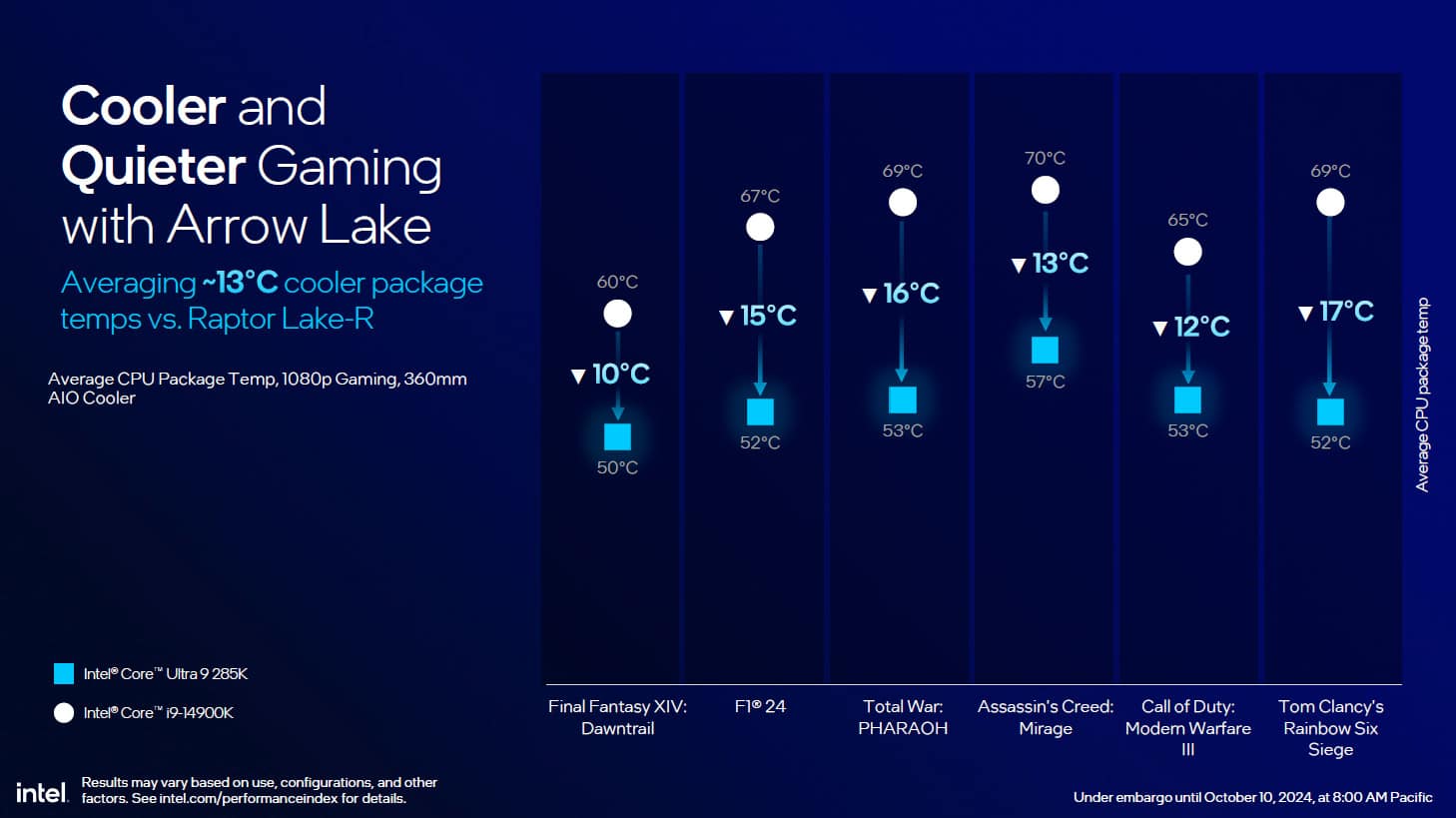
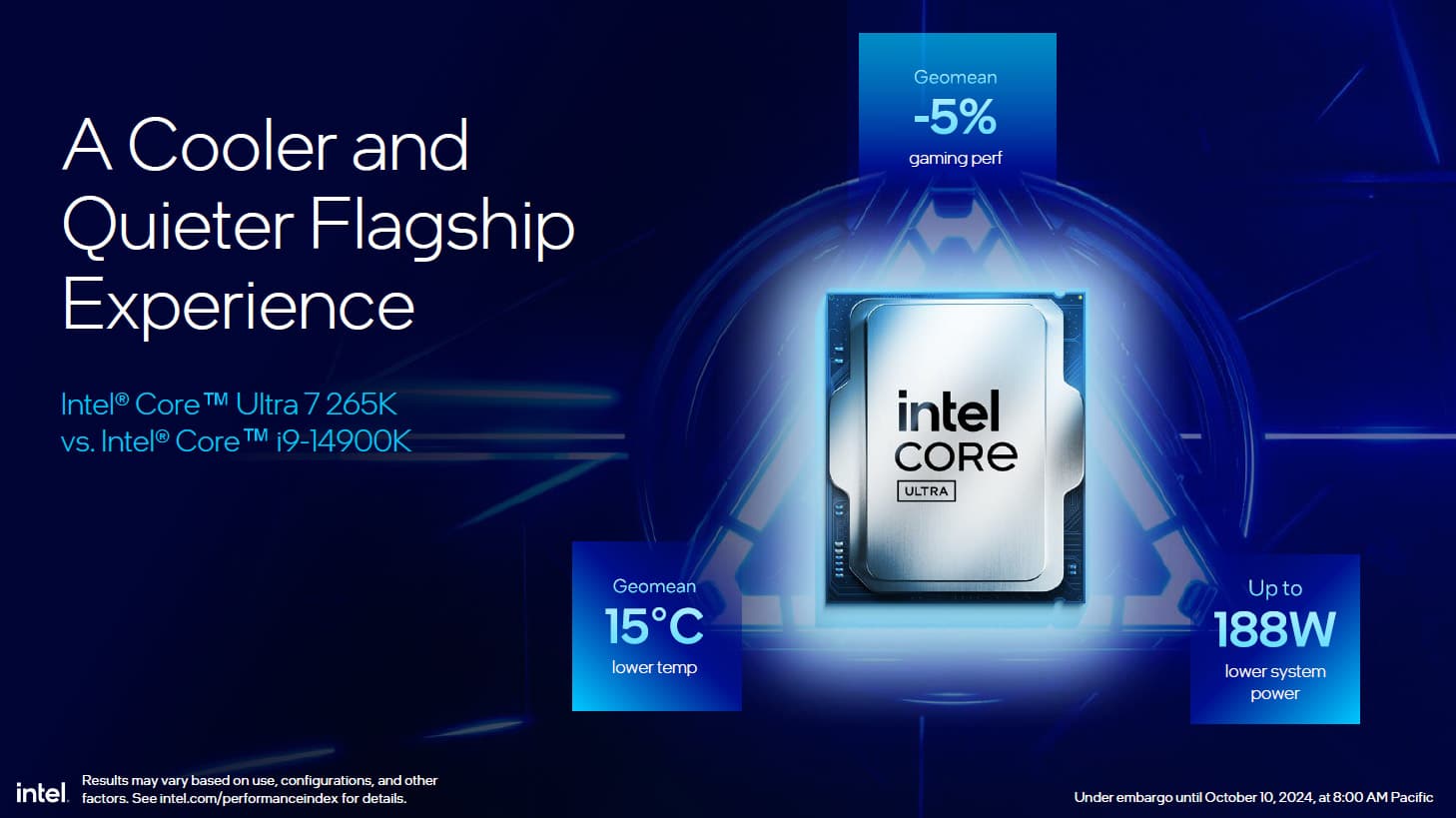
Finally, this drop in power consumption will have a direct impact on the processor’s temperature, making it possible (at last) to return to temperatures that are acceptable for high-end processors. We’ll be coming back to this in detail during our tests.
Prices for this generation of Intel Core Ultra 200S :
As far as prices are concerned, here are those available to us with the Intel Core Ultra 9 285K priced at $589 and the current entry-level at $294 for the Intel Core Ultra 5 245KF model. Even if we don’t yet know the prices in euros at the time of closing this presentation, one thing is certain: the prices in dollars are lower or identical to those of the previous generation.

All you have to do now is wait for our tests to arrive, but leave us a comment on Intel’s decision to give priority to gaming performance similar to that of the previous generation, but with improved power consumption. Is this a wise choice? In any case, Intel needed to catch up with AMD on this front.