
After a long period of testing all-in-one watercooling kits, we’re back to something more rustic. Indeed, today’s test concerns an aircooling CPU heatsink. As you probably know, DeepCool was planning to launch a new series of AK heatsinks with a digital display on top.
Well, we’ve just received the double-tower version, the famous AK620 Digital. What’s more, it’s the only model in this AK series that we haven’t yet had in our hands. So it’s a good opportunity for us to see what it’s got up its sleeve on our new protocol, here we go!

Presentation:
If we had to give you a brief introduction to this model, we’d say it’s part of DeepCool’s Digital series. The latter includes all the models from the AK range, but with a small digital display on top. This will be used primarily to monitor processor temperature and fan speed.
Otherwise, this AK620 Digital takes up a double-tower format, all in 120 mm. The aim is to maximize performance. Of course, double-tower fans also mean double ventilation. For the occasion, we’re treated to two FK120 blowers from the brand’s catalog.
Otherwise, the Chinese brand has opted for a convex copper base and six copper heat pipes. The aim is to offer high heat transfer capacity, especially as the heat will be conveyed to dense stacks of aluminum fins. Even so, there’s plenty of room for RAM, with 43 mm of free space and two fans.
Finally, the company emphasizes multi-platform compatibility with Intel and AMD. It also points out that assembly will be simple, using metal rather than plastic mounting elements.

As for the price, it’s hard to say exactly how much it will cost, as we don’t yet know the retail price. However, we assume it will be higher than the €80 charged for the Zero Dark and WH versions.
[nextpage title=”The AK620 Digital”]


As usual, DeepCool offers its usual packaging. It features a cardboard box with a green border. We’re also treated to a white flap featuring an illustration of the product, with detailed product specifications on the back.
Inside, we find a heatsink properly protected in white foam plastic. On the side is a small cardboard box containing all the elements of the bundle. In short, the protections are effective since everything arrived unscathed, not a fin bent, no shocks, nothing.
The radiator:
Weight and dimensions:
It’s been a while since we’ve had a double-turn heatsink in our hands. Nevertheless, on this type of product, dimensions are on the decline, as the AK 620 Digital displays 127 (W) x 110 (D) x 157 (H) mm. A few years ago, dual-tower fans were real monsters, but now we’re down to 160 mm. These dimensions will enable it to fit into a good number of cases. Remember that the limit is often 160 mm.
Moreover, this is a rather heavy model, weighing in at no less than 1486g on the scales. The best thing to do when moving it is to disassemble it to avoid any problems.
The base :

Out of the box, the AK620 Digital has only the fixing tab mounted on top of its base. Unlike NZXT’s T120 RGB, there are no mounting lugs.
The base is made of nickel-plated copper, but the finish is not mirror-like. Indeed, under the fingers, you can feel very slight traces of machining, classic for this type of product. In terms of dimensions, the base measures XX x XX mm, enough to serenely cover theIHS of a Ryzen 7000 or a Core i in LGA-1700.
Otherwise, you’ll notice the presence of a rather large number of copper heat pipes. There are six of these, measuring six mm in diameter. They are evenly distributed around the base. We’ll see if this is enough to cool a Ryzen 7000 😉
The radiator:


There’s a lot to be said for the radiator. The first thing you notice is the waffle-cut shape of the fins. What’s more, the first five fins, starting from the base, have also been shortened. The aim is to maximize compatibility with the RAM and VRM heatsinks positioned behind the cooler.
Otherwise, the upper part containing the digital display is removable, leaving the heat pipes and fans visible. It’s important that it can be removed for assembly, to gain access to the clamping tab screws.
Otherwise, we notice the typical structure of a double-tower with the double stack of aluminum fins.
Finish:

With this AK620 Digital, we can’t complain about a dubious finish – quite the contrary. This model is very well finished, with an attractive matte black coating on the aluminum fins and heatpipes. The upper part features a glossy finish with aRGB edging on the sides. In short, all this contributes to a sober and very uniform heatsink.
Compatibility :
We now come to the compatibility of this heatsink’s sockets. On this subject, DeepCool announces :
- Intel: LGA-115x – LGA-1200 – LGA-1700 – LGA-2000
- AMD: AM4 – AM5
Clearly, this is not a model that will be compatible with all motherboards on the market. However, we can say that the compatibility goes to the essentials, since it lacks support for TR4 and derivative models. That said, this is a very special socket in terms of its dimensions. And if you want to mount a heatsink on it, you need a suitable model!
Fans:
The AK620 Digital features a fan duo well known in our columns. In fact, we’re talking about two FK120s, mills already found on the AK500 and LT720.

The mills feature a square frame with square silentblocs . The blades are nine in number and feature a significant curvature. They start out thin at the hub, then broad at the tips.
Connection to the motherboard is via a single four-pin PWM-type fan plug. The cable is flat and black, measuring 26 cm.
But what interests us most are the specifications, and these fans run from 500 rpm to 1850 rpm. At full speed, airflow will then reach 68.99 CFM while static pressure rises to 2.19 mmAq.
The bundle:

The accessory section is housed in a small cardboard box and features:
- Assembly instructions
- Screwdriver
- A splitter for two fans
- A syringe of thermal paste
- Intel multi-socket backplate
- Mounting arms and mounting hardware
All in all, the accessory section goes straight to the point, providing everything you need for mounting. However, we’d like to emphasize the quality of the components supplied, since both the backplate and the various mounting arms are made of steel. What’s more, once they’re in place, they’ll be very discreet, since they’re black in color, while the screws and bolts are dark.
Roughly speaking:
Broadly speaking, DeepCool’s AK620 Digital is a very attractive cooler with a meticulous finish. The accessory section is limited to the bare essentials, but provides solid components that will prove unobtrusive once fitted!
[nextpage title=”Installation”]
For installation, you’ll need to keep your AMD backplate, as the manufacturer doesn’t supply one. If you don’t have one any more, a quick look on eBay should make it easy to find one.
AK620 Digital assembly:


Assembling the heatsink is simple, and even preparing the motherboard can be done without tools. The spacers and nuts can easily be handled by hand.
In all cases, start by removing the original mounting arms from the AMD socket motherboard. On the Intel side, you’ll need to remove the backplate from the back of the motherboard. Once this first step has been completed, spacers are screwed into the four corners of the socket. Next come the heatsink mounting arms, which are then screwed in place with nuts.

After applying a small amount of thermal paste, the AK620 Digital can now be positioned on top of the processor. To screw it in, you’ll need to remove the top cover and the intermediate fan, to free the fixing tab. The supplied screwdriver makes it easy to slip between the two cooling towers.


Once mounted, the AK620 Digital will cover all four memory slots on our MSI Carbon motherboards. However, there’s still plenty of room for 42.3 mm high RAM modules. We’ve even got a few extra millimeters to spare, but not much more: don’t go putting HyperX Predators in there, they won’t fit 😉
[nextpage title=”Protocol”]
A small update to our test protocol. We’ve changed the software we used to stress our configuration. The same applies to the different profiles. You can view our test method and the hardware of our test machine via this link.

For test purposes, we’ll be comparing the AK620 Digital with other single-turn models in 120 mm and 140 mm:
- AK620 Digital (DeepCool)
- HX6250 (Jonsbo)
- NH-U12A chromax.black (Noctua)
- T120 RGB (NZXT)
[nextpage title=”Speed and noise”]
Fan speed :
We’re starting from scratch with our series of temperature readings. Let’s specify the fan speeds recorded during our readings (for 12V, 8V, 5V):
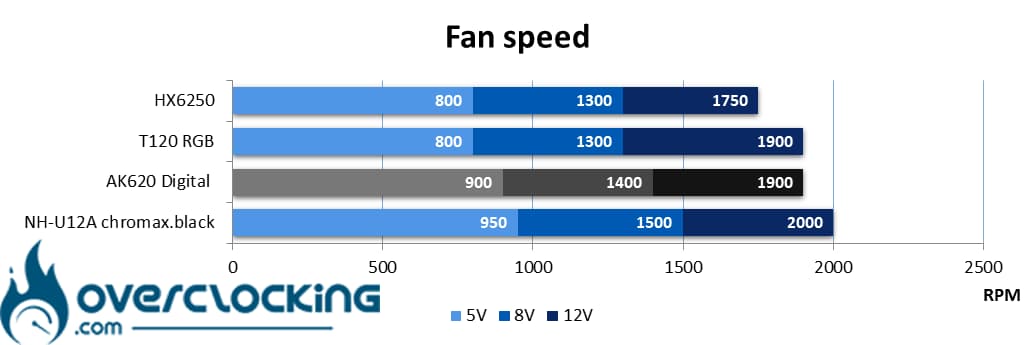
Broadly speaking, the fans on our four heatsinks show fairly similar speed profiles. The DeepCool model is close to 2000 rpm at full speed, compared with 1400 at half speed and 900 rpm at low speed. In the end, we’re very slightly above NZXT’s T120 RGB and very slightly below Noctua’s NH-U12A chromax.black.
Noise :
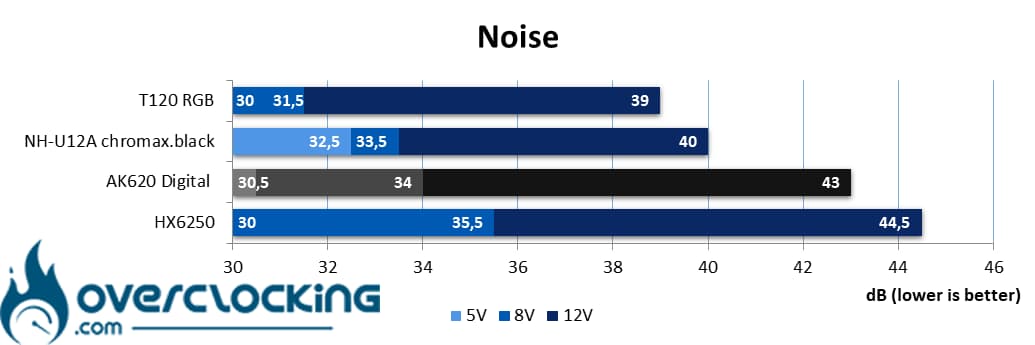
Unfortunately, when it comes to noise, DeepCool’s heatsink is not as efficient as Noctua’s when its fans are running at full speed. Under these conditions, we recorded 43 dB. Fortunately, the heatsink is a little more discreet once you ease up on it. In fact, at low speed, it’s quieter than the NH-U12A chromax. black, but less than its rivals Jonsbo and NZXT.
[nextpage title=”AMD CPU temperatures”]
65W processor:
We start with our 65W profile, a fairly low power consumption, especially when you consider today’s monsters. This power consumption is intended to simulate small processors with few cores or low power consumption.
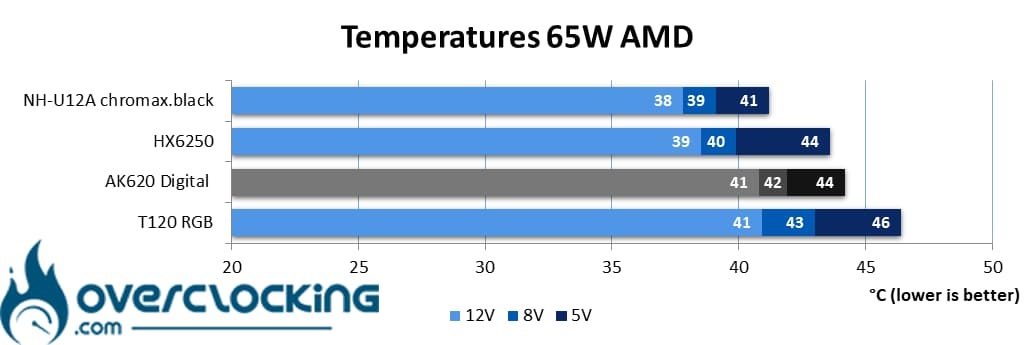
Of course, at 65W power consumption, all our aircooling fans manage to keep our CPUs cool… However, this is done at different levels. Unsurprisingly, NZXT’s T120 RGB, which is the least imposing, fares the worst. However, the small disappointment comes from the AK720 Digital, which is closer to the T120 RGB than to the HX6250 and NH-U12A chromax.black at high speeds.
100W processor:
Here, our CPU will run at 3.30 GHz constantly and on all its cores. We apply a VCore of 1.132 to obtain a power consumption of around 100 watts. To simplify reading the graph, we’ve rounded off some values to the nearest integer.
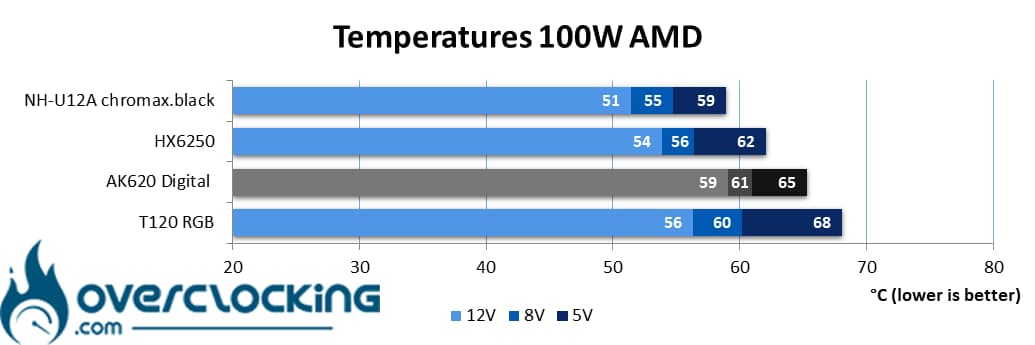
Moving up to 100W of consumption, the situation of DeepCool’s AK620 Digital doesn’t improve. It’s even worse than NZXT’s T120 RGB at higher speeds, despite being half the size. Meanwhile, Noctua’s heatsink dominates the world, keeping our Ryzen 9 7900X below 60°C at low speeds.
150W processor:
Finally, we end with our 150W profile. Here, the heat release is greater, so let’s see how our coolings fare!
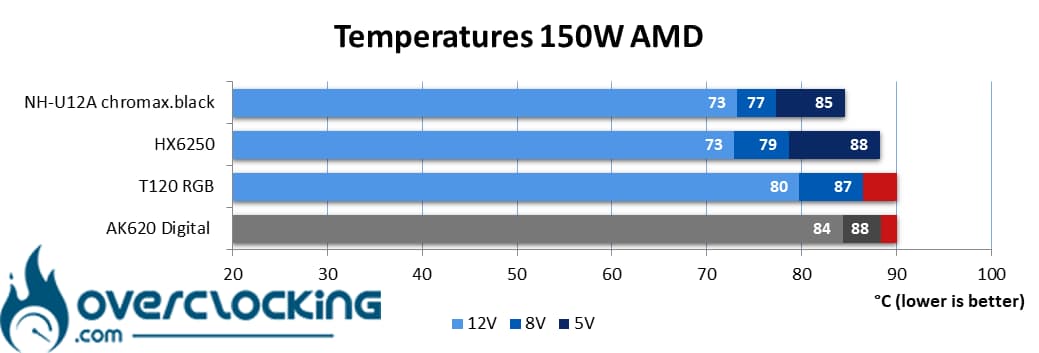
Ouch, ouch, ouch, the 150W profile really puts DeepCool’s AK620 Digital to the test. As you can see, the cooler is in check at low speeds, while the HX6250 and NH-U12A chromax.black him nearly a dozen degrees in view at full speed and mid-range. Even the T120 RGB performs better despite failing at low speed.
Summary:
While the AK620 Digital’s structure looks solid on paper, it’s ill-suited to cooling a Ryzen 9 7900X. Indeed, with its Ryzen 7000s, AMD continues to offer multi-die MCM processors. The only drawback is that the CCDs, the dies that generate the most heat, are actually covered by only two or three of the six heat pipes, since they cover the CPU horizontally. In fact, we’re prepared to put a coin down on the fact that dual-tower fans, on the whole, are likely to struggle with this type of CPU.
As you’ll see with the 13600K, the heatsink fares much better with this CPU, which features a monolithic die!
[nextpage title=”AMD temperature/noise ratio”]
On these perf/noise ratio graphs, we remind you that it’s best to be positioned as far to the bottom left of the graph as possible. For reading purposes, the leftmost point symbolizes 12V ventilation, the central one 8V ventilation and the rightmost 5V.
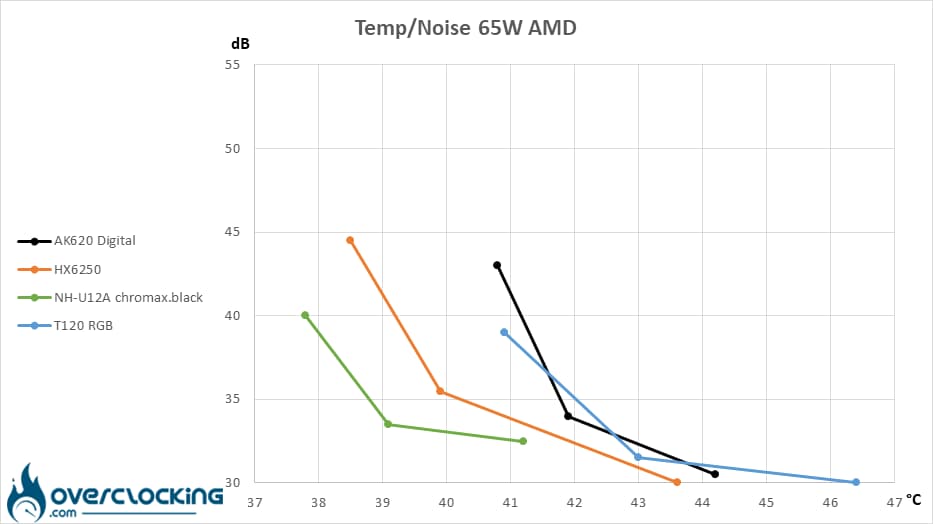
At 65W, we note that DeepCool’s AK620 Digital is not positioned to the left, but to the right, towards the least efficient heatsinks. In these conditions, it behaves like a single-tower fan, like NZXT’s T120 RGB. What’s more, its two fans don’t do it much good in the sense that, at full speed, it’s noisier than its American rival.
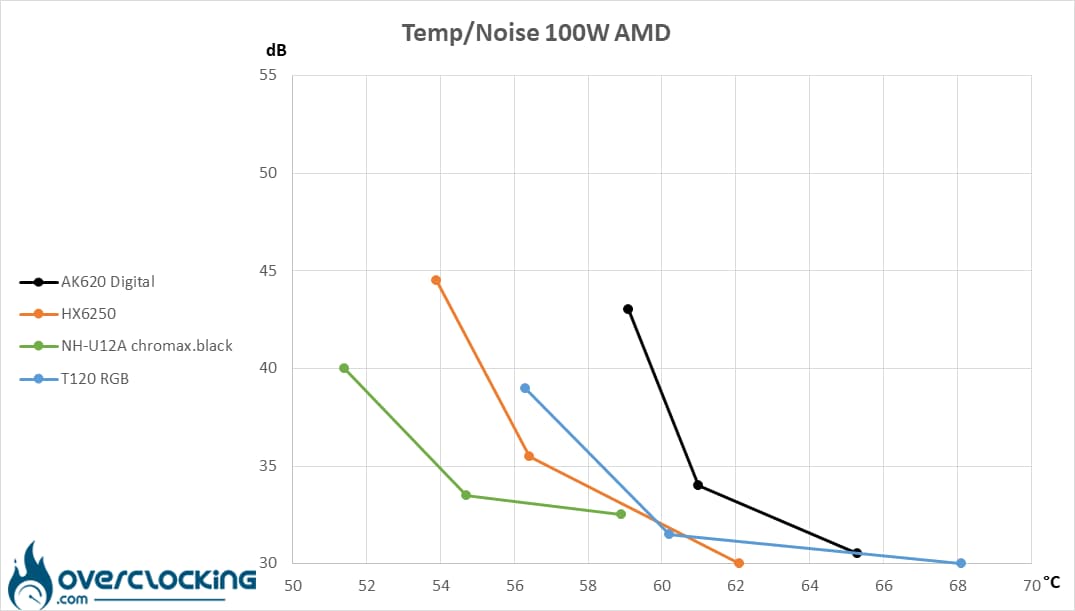
At 95W, the gap between DeepCool’s model and NZXT’s widens. Admittedly, the Chinese heatsink saves the day at low revs, but this is not the case at higher speeds. What’s more, there’s a small margin for manoeuvre when it’s running at full speed – in these conditions, we can only advise you to reduce its speed!
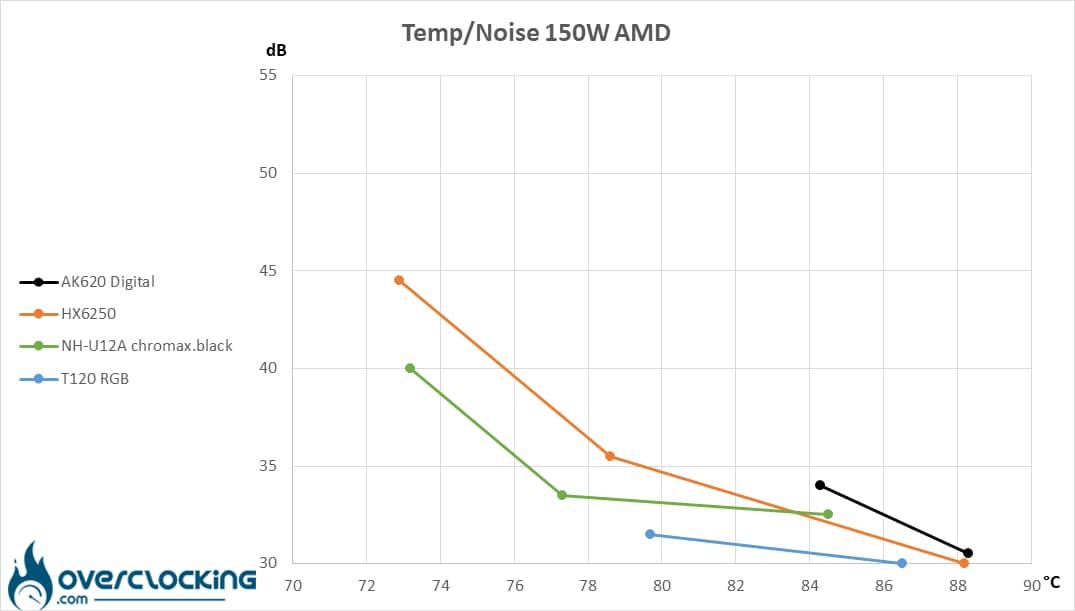
At 150W, the AK620 Digital failed to keep our Ryzen 9 7900X at decent temperatures at low revs. What’s more, it continues to struggle against its competitors. On this CPU, it’s better to have one trick than two!
[nextpage title=”Intel CPU temperatures”]
Processor at 65W:
We’ll start with the 65W profile, a fairly low power consumption, especially when you consider the base consumption of this 13600K. We’re here to simulate the power consumption of small processors with few cores or low power consumption. In theory, everyone should do well!
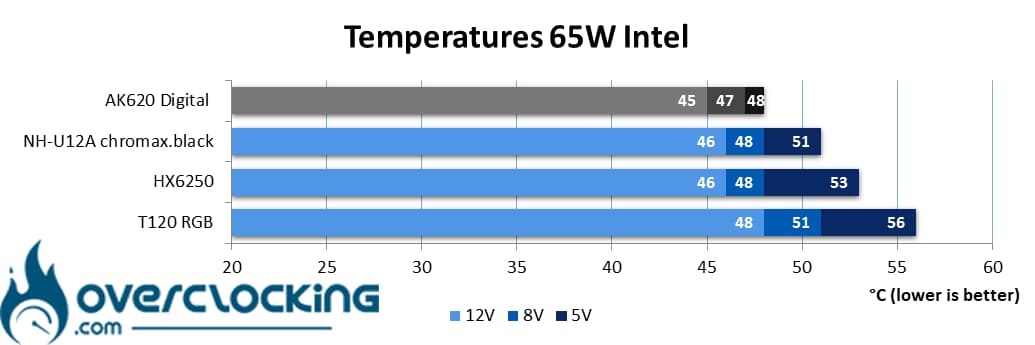
Compared with the Ryzen 9 7900X, it’s clearly night and day. Here, the AK620 dominates our entire panel, even spanking the NH-U12A chromax.black at low speeds. It’s efficient enough to achieve, at low revs, the same temperature as its Austrian rival when running at medium speed!
95W processor:
Here, we take our readings on a Core i5 13600K, which consumes 95W of power. To achieve this, both the P-Core and E-Core run at 3.5 GHz, while the VCore is set to 1.210V!
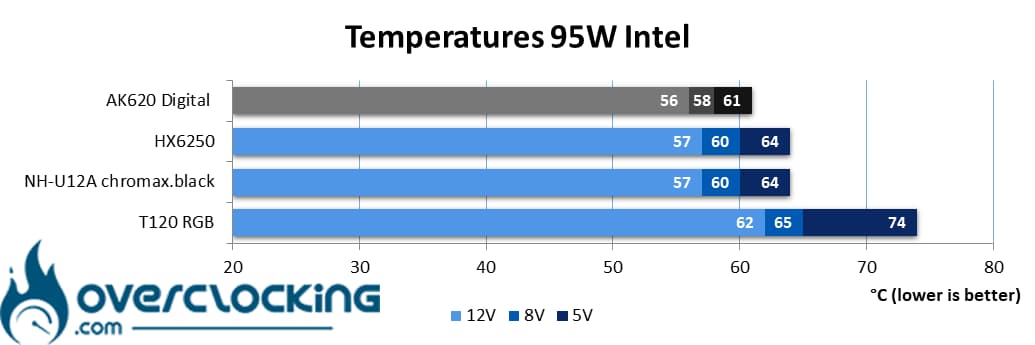
On this power consumption profile, DeepCool’s AK620 is as comfortable as ever, placing it ahead of all the other heatsinks in the comparison. In fact, the Jonsbo and Noctua models are tied for first place, while the small NZXT model lags far behind at low revs. On the other hand, in its defense, it doesn’t really box in the same category as the other three.
130W processor :
Finally, we conclude our series of readings with our Core i5 13600K, which consumes 130W. To achieve this, we push the frequencies a little further, as well as the VCore, which now rises to 1.270V!
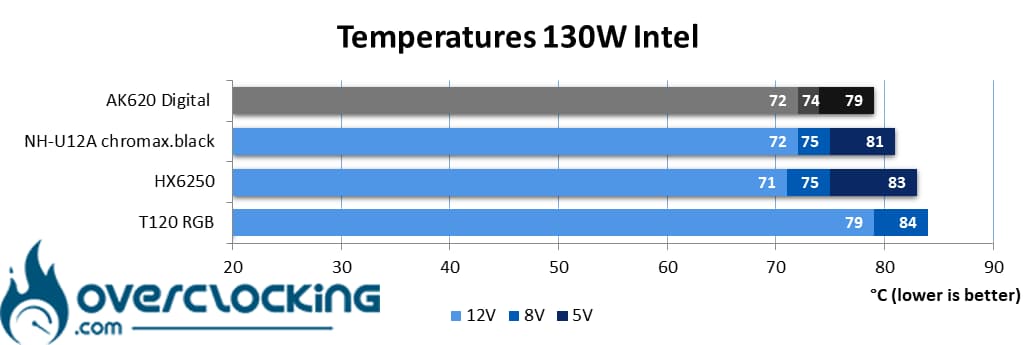
On this 130W profile, the cooler still feels at ease, achieving results comparable to Noctua’s model at high and mid-range speeds. At minimum speed, it fares better, with a 2°C lead. However, we shouldn’t underestimate Jonsbo’s cooler either, which posts the best temperatures at full speed, while the T120 RGB fails at low speed.
Summary:
On a processor with a monolithic die, DeepCool’s AK620 Digital offers remarkable temperatures. Where it struggled on the Ryzen 9 7900X, it outperforms all heatsinks on our Core i5 13600K. It has to be said, the die of this processor is perfectly covered by the six heatpipes of the heatsink, which helps greatly with temperatures. At least, that’s the explanation we have to justify such a performance gap between the two platforms.
[nextpage title=”Intel temperature-to-noise ratio”]
On these perf/noise ratio graphs, we remind you that it’s best to be positioned as far to the bottom left of the graph as possible. For reading purposes, the left-most point symbolizes 12V ventilation, the central one 8V ventilation and the right-most 5V.
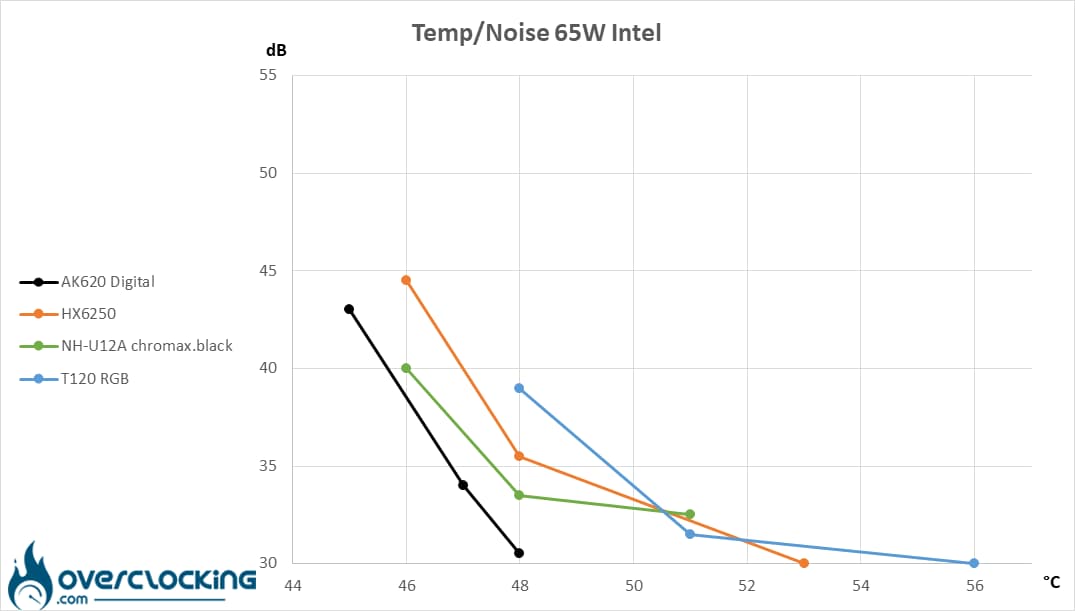
On our Core i5 13600K, the AK620 Digital is positioned where it should be, at least in view of its size and design. In these conditions, the cooler takes the lead and dominates its three rivals, even Noctua’s NH-U12A chromax.black. What’s more, it proves quite formidable at low revs, where its second fan greatly limits the damage.
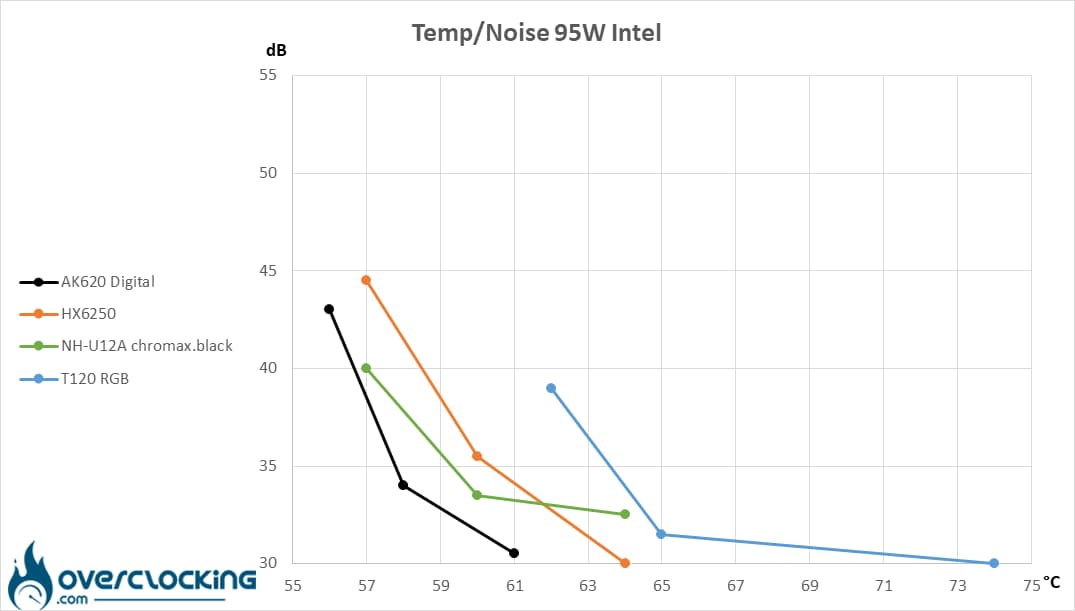
At 95W, it once again comes out on top, with a narrow lead over the Noctua heatsink. It also has an advantage over the HX6250, particularly at low revs. On the other hand, you can feel that four heat pipes mounted through a thin stack of aluminum fins is becoming limiting. Just look at how NZXT’s T120 RGB drags its feet at low speeds.
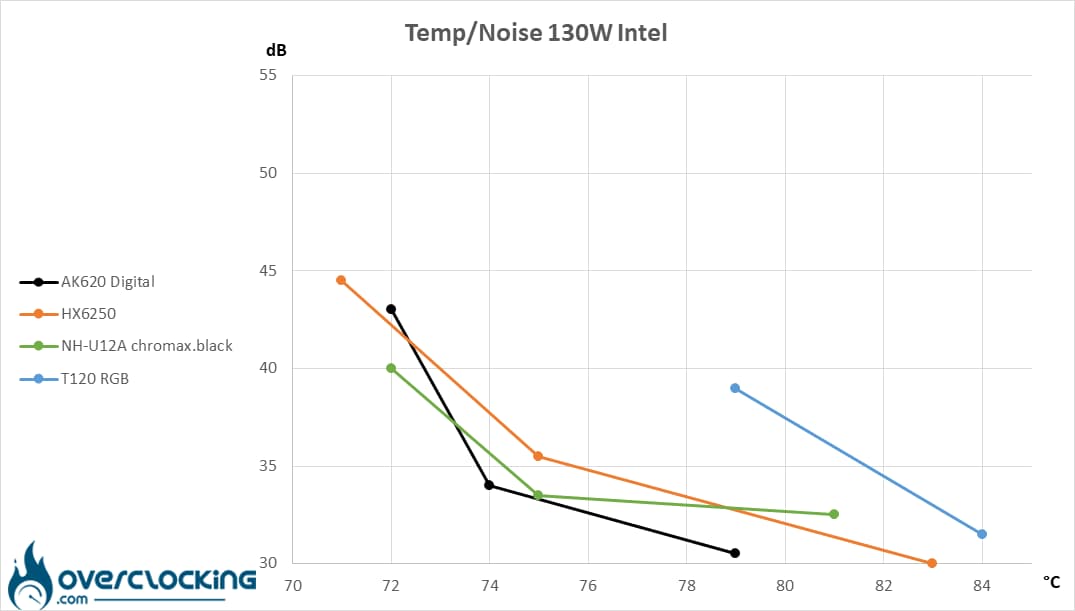
Unfortunately for DeepCool, in 125W, its champion, however good, ends up being overtaken by the competition. Here, we find a NH-U12A chromax. black playing elbows with the Chinese heatsink in 12V and 8V. Once again, it’s helped by its size and its two fans.
[nextpage title=”Conclusion”]
We’ve come to the end of this test of DeepCool’s AK620 Digital. Are we dealing with a successful product? Let’s take a closer look!
A fine finish!
With this model, DeepCool offers us a well-finished, but above all sober reference. In visual terms, the brand has taken up where it left off with its Zero Dark version, with a full black coating. It also features a digital display showing processor temperature. In any case, it looks great, but you’ll have to be careful when cleaning it, as the upper part is prone to scratches.
Otherwise, assembly will go smoothly on both AMD and Intel platforms. With this, we note the presence of discreet black mounting elements for the backplate and mounting arms in particular. Once in place, the mechanism is discreet and unobtrusive. As for the heatsink, even if it covers all four DIMM slots on a motherboard, it still leaves a usable space for memory: at least 42-43 mm.
Finally, the accessory section is complete with a screwdriver and a splitter offering two female fan sockets.
Processor-dependent performance!
Having tested the cooler on AMD Ryzen 7000 and Core i 13000, it’s night and day in terms of performance. On the AMD platform, the heatsink is quickly put to the test by the Ryzen 9 7900X due to the positioning of the heat pipes. Two or even three of the six heatpipes cover the processor’s CCDs, the elements that heat up the most. As a result, the results are not as good, so much so that a heatsink with four heatpipes in a single 120 mm tower achieves better results.
What’s more, as soon as you mount the heatsink on a processor with a monolithic die, like the 13600K, it’s night and day. In these conditions, the heatsink shows its full potential and outperforms all its rivals, even the NH-U12A chromax. black. All the more so as this model’s double-tower format offers an interesting temperature-to-noise ratio at low revs.
Finally, the only thing to avoid is running the fan at high speed. As we’ve seen, it’s not the quietest of heatsinks in these conditions. Fortunately, at low speeds it’s almost inaudible!
55 € for this model:
At present, it’s hard to say how much the AK620 costs in this Digital version, as DeepCool has not provided us with the invoice assembly. On the other hand, we can legitimately assume that the amount will be higher than the €80 charged for the Zero Dark or white versions, but the question remains: by how much?
DeepCool AK620 Digital:
We like:
- The meticulous finish, especially in full black
- The presence of a small digital display, a welcome little gadget
- Complete accessory kit with screwdriver
- Simple assembly
- Discreet mounting mechanism: full black
- Space available for RAM: 42-43 mm
- Controlled temperatures on Intel CPUs
- Silent operation at low speeds
We didn’t like :
- Poor temperatures on Ryzen 7000oi
- Noisy at high speeds
 Finally, this AK620 Digital forces us to pull out the double Gold/Bronze award… In reality, the conclusion will depend on the processor you’re going to mount it on. If it’s Intel, no problem, you can go for it, but if it’s Ryzen 7000, you might as well go for a single-tower heatsink like the HX6250, for example. Otherwise, the brand shows that it knows how to make heatsinks with an excellent finish and simple assembly, especially as you’ll have plenty of room for memory.
Many thanks to DeepCool !

