
[nextpage title=”Introduction:”] This week, we talked about the arrival on the market of the first NZXT thermal paste, the High-performance Thermal Paste. Today, we offer you the test, let’s see if this new arrival manages to make a name for itself among the biggest references. The High-performance Thermal Paste is available on the NZXT website in 3g and 15g for 9,99 € and 19,99 €.  We also take this opportunity to thank NZXT for the samples offered for these tests. [nextpage title=”The NZXT High-performance Thermal Paste:”] The High-performance Thermal Paste comes in an unpainted cardboard box, inside you will find the 3g or 15g thermal paste syringe as well as a manual and a wipe for cleaning the processors and coolers.


The tubes are partially covered by a plastic in the color of NZXT. One area remains transparent, which allows to know the level of paste still present in the syringe.


Regarding the specifications of this paste, we are on a density of 3.5g / ml. The thermal conductivity is 6.3 W/m.K and the viscosity is 35~220 Pa.s. Below is a table of the different thermal pastes tested on our configuration.  [nextpage title=”The test configuration:”]
Here is the configuration that will be used for the test:
- Motherboard : EVGA Z690 DARK KINGPIN (BIOS 1.10)
- Processor : INTEL CORE I9 12900KS
- Memory : 2x16gb ADATA XPG LANCER RGB 6000C40
- Graphics Card : GTX 750 Ti
- Cooling system : Watercool Heatkiller IV basic + MO-RA3 420
- SSD : Western Digital SN850 500gb
- Power supply : Be Quiet ! Dark Power Pro 12 1200W
- Operating system : Windows 11 64 bits (version 21H2)
- Screen : DELL S2421NX
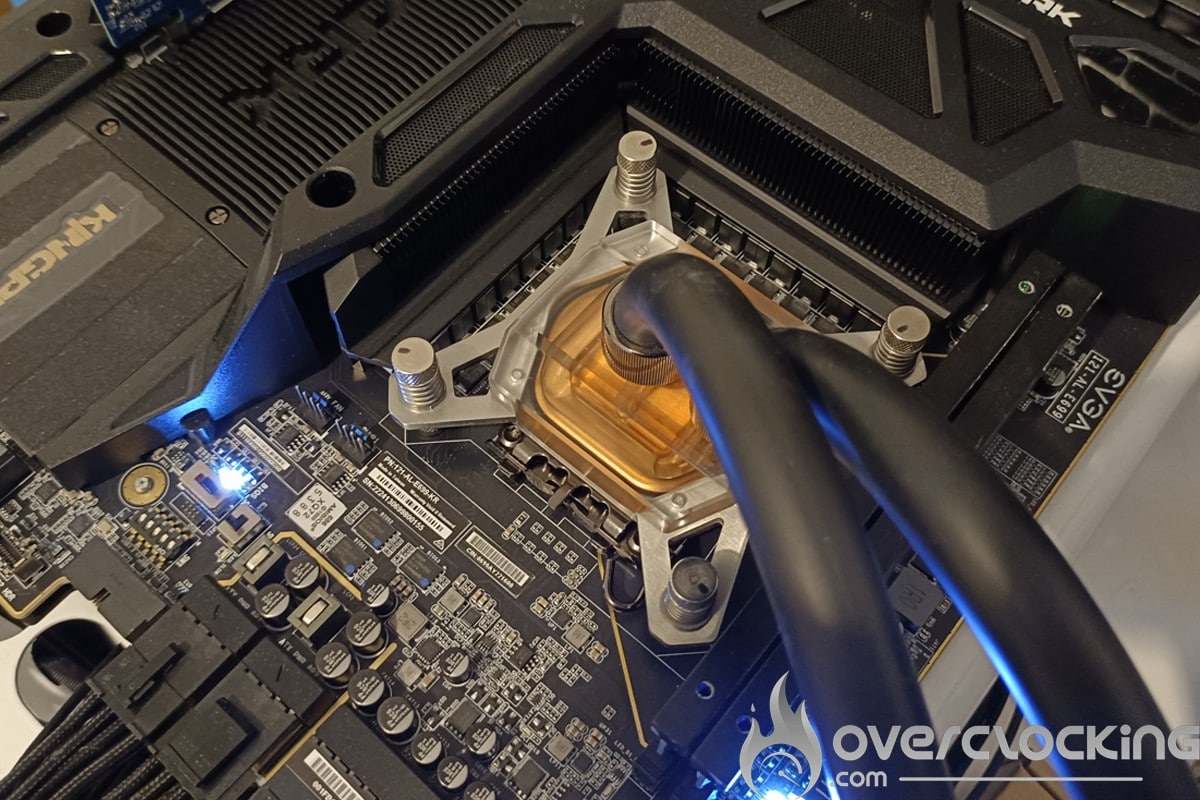
[nextpage title=”Results:”] Our thermal paste test protocol is very young, it is based on an Intel Alderlake platform with an I9-12900KS and an EVGA Z690 DARK KINGPIN. The tests are performed under the same conditions with a Heatkiller IV water block at constant pressure.
Protocol:
The I9 12900KS is set to get 250W of load on cinebench R20. The Pcore are at 5200MHz, the E-core at 4000MHz and the cache at 4400MHz for a voltage of 1,335V bios LLC +25%. Thermal paste applications are done crosswise on the CPU, this is the method that works best with all thermal pastes on the market. The water block is mounted and tightened to the screw stop to let the springs apply the right pressure.  Then, a cinebench R23 stress test is run to bring the thermal paste up to temperature with 10min of heavy load. Three cinebench R20 are launched in a row. Taking care to have the same water temperature between each benchmark start. Each thermal paste is applied three times with three cinebench R20 per application. The minimum delta T° value between the water and the CPU is recorded among these nine measurements.
Results:
As can be seen, NZXT’s thermal paste is not at the level of the competition. Although it is less expensive than the major brands such as the NOCTUA NT-H2, it does not manage to compete with the MX-4 from Arctic, which is less expensive.


The measurements were made with water at 28°C and a flow rate of 235L/h. Here are the details of the best measurements out of nine readings per thermal paste. 
 [nextpage title=”Conclusion:”] We are coming to the end of this test. And, for a first time as a thermal paste manufacturer, NZXT misses the mark. Although the packaging is very nice, the product inside doesn’t perform as well as we expected. So we hope that the brand will propose an update of this thermal paste to provide us with a real High-performance Thermal Paste.
 As a reminder, the High-performance Thermal Paste is available on the NZXT website in 3g and 15g for 9,99 € and 19,99 €.
NZXT High-performance Thermal Paste
We liked:
- The bundle with wipe
- The view on the thermal paste level
- The price
We would have liked:
- Performance on par with the competition
 NZXT offers for its first test gallon in the world of thermal paste manufacturers a product whose performance is not up to par. This High-performance Thermal Paste will however remain a possible choice for long term use.

