
At last, be quiet! is renewing its range of high-end aircooling ventirads. To do so, the company is highlighting two references with the Dark Rock Elite and Dark Rock Pro 5. If you’re familiar with the brand, you’ll have an idea which product we’re dealing with. Anyway, we’ve received both models, so we’ll see what concrete difference there is between them, here we go!

Presentation:
The Dark Rock Pro series of heatsinks represents the top-of-the-range range from be quiet! To achieve this, the company opts for a double-tower design for its fans, backed up by top-of-the-range fans. Ultimately, the difference between the Dark Rock Elite and Dark Rock Pro 5 lies in the ventilation and TDPs managed by these two models.
In both cases, our German heatsinks boast top-level performance. This is made possible by the use of a total of seven copper heat pipes and a black coating containing ceramic particles.
Otherwise, our two heatsinks benefit from a nickel-plated copper base. This makes them compatible with liquid metal. As a reminder, this type of TIM(Thermal Interface Material) is absolutely not recommended if your heatsink uses an aluminum base. On the other hand, it performs much better than traditional paste, helping to gain degrees on the processor.
To easily manage fan speed, there’s a selector positioned under the upper fan cover. Depending on its position, the selector allows you to increase silence or temperature. The maximum speed of the mills can be set to 2000 rpm or 1500 rpm.

In both cases, ventilation promises to be high-performance, since we’re dealing with Silent Wings-type grinders. There is a slight difference in the choice of fans. The Dark Rock Elite uses two 135 mm Silent Wings, while the Pro 5 benefits from a 120 mm model at the front and a second 135 mm fan in the center. As the Dark Rock Elite uses a double 135 mm, the fan will be rail-mounted to ensure good RAM compatibility.
As for prices, the be quiet! heatsinks are set to be highly priced, with the Dark Rock Pro 5 already priced at €99.90 and the Dark Rock Elite at €114.90. It remains to be seen whether these prices will be met in retail outlets. In the meantime, they’re obvious rivals to the Assassin IV and MA824 Stealth.
[nextpage title=”Dark Rock Pro 5 and Dark Rock Elite”]


As far as the packaging is concerned, we’re back to the be quiet! style: sober. Indeed, the box appears entirely black, with an illustration of the heatsink on the front. On the rear, the main features are presented, while detailed specifications are found on the sides.
Internally, the heatsinks are seriously protected, with white foam surrounding the fans. So there’s nothing to worry about, the fans will arrive in excellent condition… Provided the carrier doesn’t play soccer with your package.
The radiator:
Weight and dimensions:
When we take our radiators of the day out of their packaging, we’re dealing with imposing models. Surprisingly, they are larger than DeepCool’s Assassin IV. They are deeper and taller, measuring 136 (W) x 146 (D) x 168 (H) mm. Note that the Pro 5 is only 1 mm deeper.
In all cases, you’ll need to keep their weight in mind when moving around. It may not look like it, but they weigh over 1 kg on the scales – 1.29 kg for the Pro 5 versus 1.34 kg for the Elite!
The base :

Overall, both fans have the same base, and the radiator is virtually identical. In fact, the copper base measures 44 x 40 mm. As you can see, the base is nickel-plated, allowing liquid metal to be applied without fear of corrosion, as stipulated by be quiet!
Once again, we’re treated to a meticulous finish in the sense that the traces of machining are very fine. They’re barely noticeable to the touch. What’s more, we’re light years ahead of heatsinks whose heat pipes are mounted in direct contact with the CPU, for example.
Talking of heat pipes, there are seven copper heat pipes extending from the base. These are quite standard in size, with a diameter of 6 mm each. They are distributed across the two towers of aluminum fins to carry the CPU’s heat.
The radiator:


As for the radiator, the finish is once again meticulous, as the brand applies a black treatment to all the aluminum fins. However, compared with the previous generation, the shape is much simpler, being straight. However, the first 9 fins have been shortened to maximize RAM compatibility. At least, on the front of the first stack. At the rear, they are staggered every three fins.
As for their number, we count a total of 45 per turn. This puts us somewhere between the Assassin IV and MA824 Stealth. As a reminder, Cooler Master’s heatsink featured 40, while DeepCool’s was 53.
Finish:


With these heatsinks, be quiet! offers us models with an exemplary finish. The upper parts of the Dark Rock Pro 5 and Dark Rock Elite feature aluminum, but in different forms. The Elite features brushed aluminum surrounded by an aRGB border. On the Dark Rock Pro 5, the aluminum is sandblasted, more basic. In any case, this part features the brand’s logo at its center with mesh metal parts.
Beneath this cover, which is held in place by magnets, we find the famous switch labelled “P” or “Q” for “Performance” or “Quiet”.

Finally, a word about the Dark Rock Elite’s front fan, which is mounted on a rail. Be careful when handling it, as the notches are so pronounced that it’s not impossible to have to force the fan to adjust its height. However, the system remains practical since, depending on the height of the RAM, the height of the fan can easily be adjusted.
Compatibility:
In terms of compatibility, be quiet! indicates that its fan can be mounted on the following motherboards:
- Intel: LGA-115x – LGA-1200 – LGA-1700
- AMD: AM4 – AM5
Unfortunately, if you have an Intel or AMD HEDT platform, you won’t be able to mount these Dark Rock Elite and Dark Rock Pro 5 on it. On the AMD side, the requirements are not met by these models, since they would have needed a much larger base. As for Intel, let’s face it, LGA-2000 motherboards are now completely obsolete, and we can’t maintain their support indefinitely either.
Fans:
When it comes to ventilation, be quiet! doesn’t supply fans whether you have a Dark Rock Pro 5 or a Dark Rock Elite. On the Elite model, we find a Duo of Silent Wings in 135 mm, with seven fine but strongly curved blades. The format also means that replacing them in the event of a problem will be tricky. The front-mounted fan has a flattened frame at the corners, while the center-mounted fan is attached to a structure that includes the upper part of the heatsink… In addition to having a completely non-standard shape.

While the Dark Rock Pro 5 has a central fan identical to that of the Elite, the front fan is a standard 120 mm. In fact, it’s a Silent Wings 4 that doesn’t give its name. You can recognize it by the shape of its particularly curved and pointed blades.
Of course, all this little world will benefit from a PWM power supply. However, connectivity is rather unusual, since the front fan connects to the middle one via a non-standard four-pin plug.
Unfortunately, we can’t tell you much more about their specifications. Indeed, the be quiet! product sheet only mentions the maximum speeds, which are :
- Dark Rock Elite :
- Quiet : 1500 rpm
- Performance: 2000 rpm
- Dark Rock Pro 5 :
- Quiet : 1300 rpm (135 mm) – 1500 rpm (120 mm)
- Performance: 1700 rpm (135 mm) – 2000 rpm (120 mm)
The bundle:

The accessory section is housed in a small cardboard box and features :
- Assembly instructions
- A warranty guide
- Intel multi-socket backplate with arms and accompanying hardware
- Mounting arms for AMD sockets
- A syringe of thermal paste
- Long screwdriver
Whether you’re dealing with a Dark Rock Pro 5 or a Dark Rock Elite, the accessory section remains identical. In this case, we greatly appreciate the tools provided, which will enable you to assemble your ventirad, and your entire configuration, without the need for a tool kit.
Roughly speaking:
Roughly speaking, these are top-of-the-range ventirads with attractive finishes. However, ventilation is provided by non-standard fans, which means that in the event of failure, it will be difficult to replace them yourself, and you’ll have to turn to the company’s after-sales service. In addition, both models feature a switch to regulate the maximum speed of the grinders, for greater silence or performance, depending on the scenario.
[nextpage title=”Installation”]
For installation, you’ll need to keep your AMD backplate, as be quiet! doesn’t supply one. If you don’t have one any more, a quick look on eBay should make it easy to find one.
Assembly of Dark Rock Pro 5 and Dark Rock Elite :
Broadly speaking, assembly of the two ventirads is identical. Here’s how it’s done.
 The first thing to do with an Intel motherboard is to prepare the backplate. To do this, you’ll need to thread screws into the four corners of the backplate, and secure them with rubber washers. On the AMD side, you’ll simply need to dismantle the board’s original mounting arms before moving on.


The next step is to fit the mounting arms around the motherboard socket. To do this, spacers must be installed at the four corners of the socket. On the Intel platform, these will be screwed onto the backplate, while on the AMD side, the plastic ones simply need to be removed. Next, screw on the fan mounting arms. In all cases, the procedure is exactly the same as for the brand’s Pure Loop 2 280.

The next step is to mount the ventirad on the processor. After applying thermal paste to the CPU, the ventirad is screwed onto its mounting system. Before doing so, we’ll need to remove the central fan to gain access to the base screws. Note that if the heatsink is not sufficiently screwed in, the central fan will not be able to take its place.


Once installed, we had to raise the Dark Rock Elite’s front fan slightly, as it came up against the memory. As for the Dark Rock Pro 5, its 120 mm fan offered no resistance, so we left it as is. But in the event of a problem, you’ll simply have to lift it up using its steel claws.
[nextpage title=”Protocol”]
A small update to our test protocol. We’ve changed the software we used to stress our configuration. The same applies to the different profiles


For test purposes, we’ll be comparing the MA824 Stealth with other single-turn and double-turn models in 120 mm and 140 mm:
- AK620 Digital (DeepCool)
- Assassin IV (DeepCool)
- Dark Rock Pro 5 (be quiet!)
- Dark Rock Elite (be quiet!)
- HX6250 (Jonsbo)
- MA824 Stealth (Cooler Master)
- NH-U12A chromax.black (Noctua)
- T120 RGB (NZXT)
[nextpage title=”Speed and noise”]
Fan speed :
We’re starting from scratch with our series of temperature readings. Let’s specify the fan speeds recorded during our readings (for 12V, 8V, 5V):

In terms of fan speeds, we note that the Dark Rock Pro 5 runs slower than the Elite. However, we suspect that our rehobus is reading the speed of the central fan, which is slower than the front one. As a reminder, be quiet! advertised speeds of 1700 rpm officially at full speed. Here, we have 1600 rpm, still within the margin of error. In terms of other speeds, this is also the slowest fan in the selection, with 700 rpm at low speed and 1100 rpm at medium speed.
The Dark Rock Elite, on the other hand, is slightly faster, averaging 200 rpm at full and half speed. However, the gap drops to 100 rpm difference at low revs.
Noise :

be quiet! has kept noise levels under control. At full speed, the Dark Rock Pro 5 generates 37.5 dB of noise. However, these levels drop drastically as soon as you adjust the speed: 31.5 dB, while at low speeds our sound level meter no longer detects it.
The Dark Rock Elite is immediately more audible with its two 135 mm fans operating at 1800 rpm. However, at 41 dB, we consider it to be within the acceptable range. Again, barely regulated, the noise is greatly attenuated and even goes unnoticed at low speeds.
[nextpage title=”AMD CPU temperatures”]
Processor at 65W :
We start with our 65W profile, a fairly low power consumption, especially when you consider today’s monsters. This power consumption is intended to simulate small processors with few cores or low power consumption.

Unfortunately, due to a technical problem with our AMD test platform, we were unable to take temperature readings for the Dark Rock Pro 5. However, the results are available in the Intel section.
As it happens, the Dark Rock Elite proves to be a formidable competitor to the Assassin IV, which it easily overtakes on this 65W consumption profile. As you can see, it performs just as well at full speed and only slightly less well at low revs. What’s more, these results put it ahead of the NH-U12A chromax.black.
Processor at 100W :
Here, our CPU will run at 3.30 GHz constantly and on all its cores. We apply a VCore of 1.132 to obtain a power consumption of around 100 watts. To simplify reading the graph, we’ve rounded off some values to the nearest integer.

With a power consumption of 100W, the Dark Rock Elite still performs well, even widening the gap with the NH-U12A chromax.black. However, the Assassin IV is slightly ahead of it at full power. Nevertheless, the performance of the German heatsink is solid!
Processor at 150W :
Finally, we end with our 150W profile. Here, heat dissipation is higher, so let’s see how our coolings fare!

At 150W, the Dark Rock Elite is up there with the Assassin IV, as you can see. In fact, it’s comfortable enough to be really at home in front of the Cooler Master MA824 Stealth.
Summary:
While we were unfortunately unable to test the Dark Rock Pro 5 on this platform, the Elite is very promising. As we’ve seen, it does very well, rivalling the Assassin IV and outclassing the other dual-tower models in our selection! What about the temperature/noise ratio?
[nextpage title=”AMD temperature-to-noise ratio”]
On these perf/noise ratio graphs, we remind you that it’s best to be positioned as far to the bottom left of the graph as possible. For ease of reading, the leftmost point symbolizes 12V ventilation, the central one 8V ventilation and the rightmost 5V.
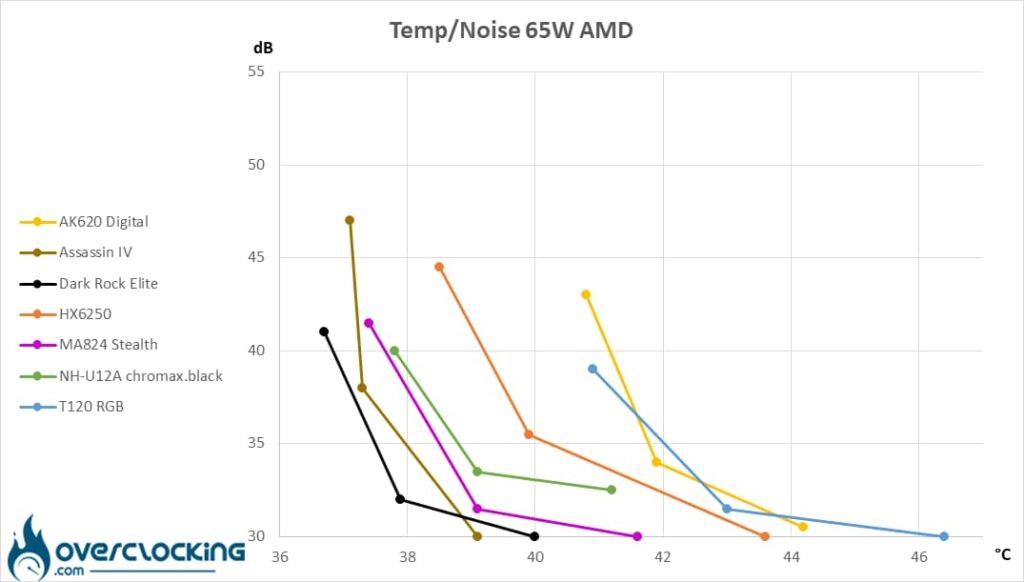
Aided by its controlled noise levels, Dark Rock Elite boasts the best temperature/noise ratio of our selected ventilators. Only the Assassin IV rivals it at low revs, thanks to its higher temperatures.
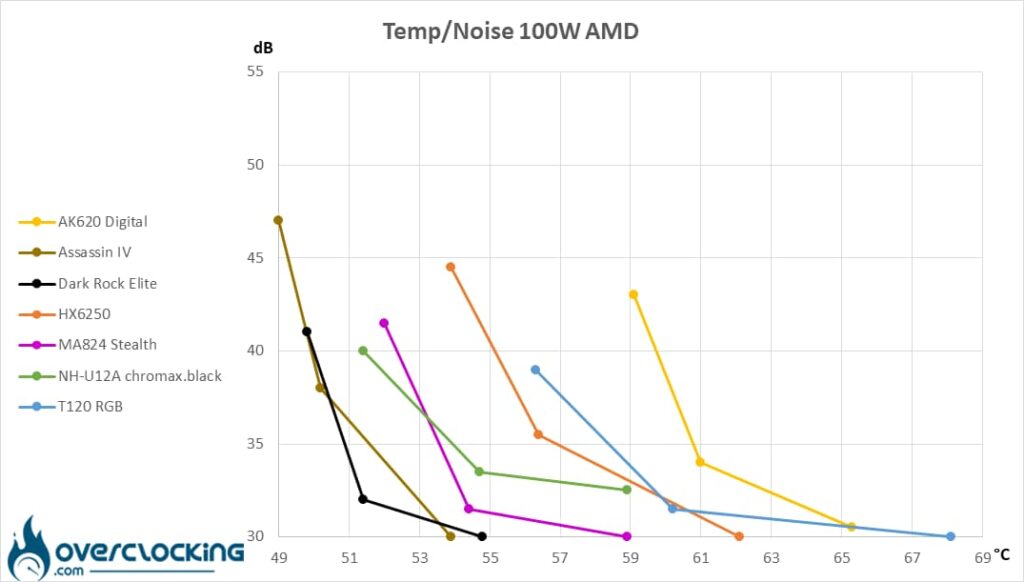
At 100W, things get a little more complicated with a very aggressive Assassin IV. Just behind, we notice that the MA824 Stealth and NH-U12A chromax. black are pulling at each other’s heels. Finally, we can’t help noticing a clear-cut differentiation between single- and double-turn models. The AK620 Digital being the exception!
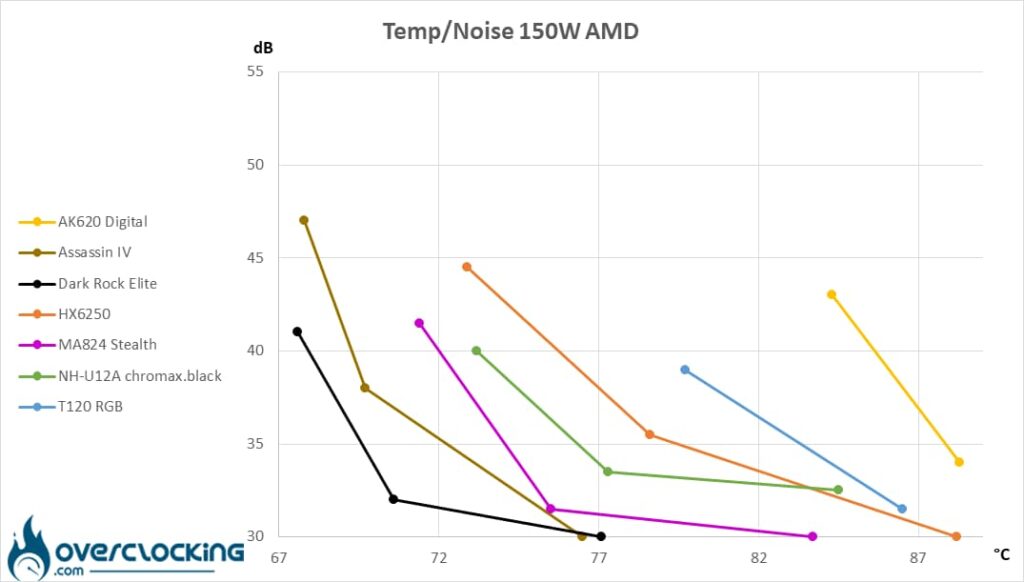
With a power consumption of 150W, the Dark Rock Elite is back in the lead, offering the most interesting temperature-to-noise ratio here. As you can see, it outshines all its rivals!
[nextpage title=”Intel CPU temperatures”]
Processor at 65W:
We’ll start with the 65W profile, a rather low power consumption, especially when you consider the base consumption of this 13600K. We’re here to simulate the power consumption of small processors with few cores or low power consumption. In theory, everyone should do well!
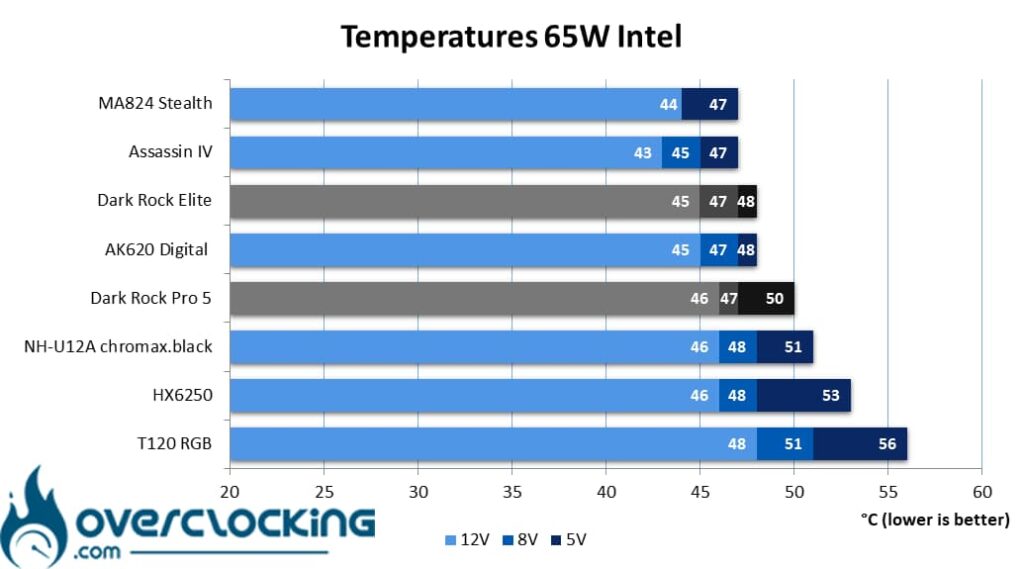
On our Intel Core i5 13600K processor, Dark Rock Elite performs rather well, titillating DeepCool’s AK620 Digital. However, against the Assassin IV and MA824 Stealth, we notice that it lags slightly behind.
As for Dark Rock Pro 5, it lags behind at low speeds. Overall, it’s a better match for Noctua’s NH-U12A chromax.black.
95W processor:
Here, we’re taking our readings on a Core i5 13600K, whose power consumption reaches 95W. For this, both the P-Core and E-Core operate at 3.5 GHz, while the VCore is set at 1.210V!
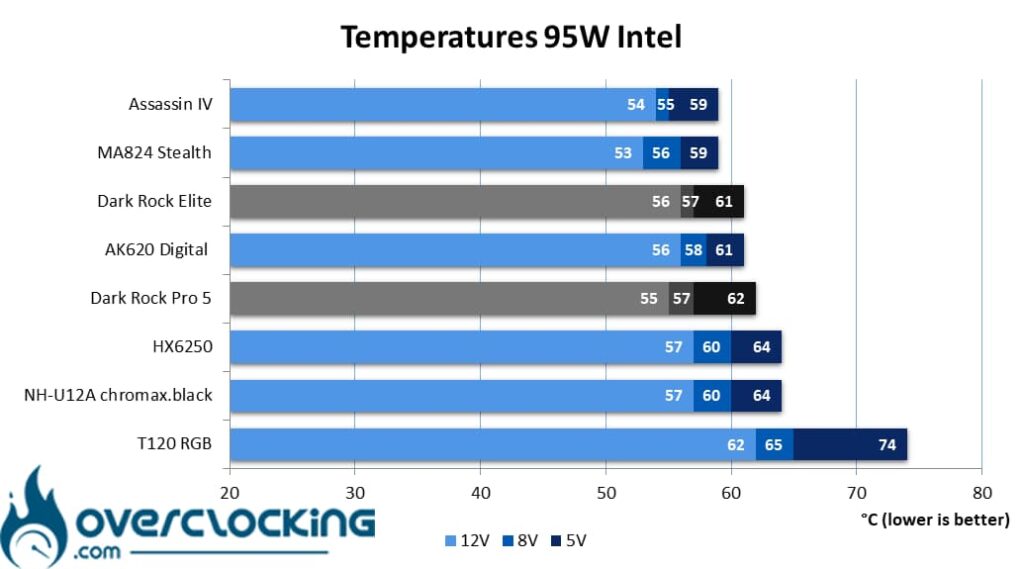
Overall, at 95W, the Dark Rock Elite doesn’t come close to separating itself from the AK620 Digital, while the Dark Rock Pro 5 is one degree less powerful. Incidentally, speaking of the latter, it stands out more from Jonsbo’s NH-U12A chromax.black and HX6250.
130W processor:
Finally, we conclude our series of readings with our Core i5 13600K, which consumes 130W. To achieve this, we push the frequencies a little further, as well as the VCore, which now rises to 1.270V!
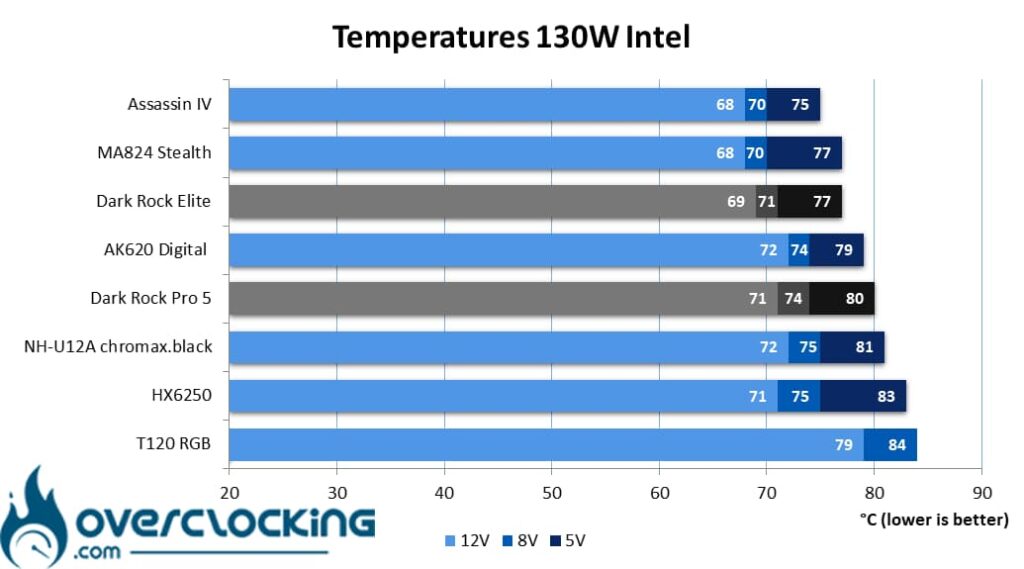
We finish with a consumption of 130W on our Intel processor. Clearly, high power consumption isn’t too bad for our be quiet! cooler. The Dark Rock Elite is more clearly ahead of the AK620 Digital, while the Pro 5 comes in on the heels of the DeepCool heatsink.
Summary :
On our Intel CPU, the be quiet! heatsinks blend in a little more. However, the hierarchy remains quite clear: the Dark Rock Elite is ahead of the Dark Rock Pro 5. In all cases, we’re dealing with heatsinks that are pretty solid on their feet.
[nextpage title=”Intel temperature-to-noise ratio”]
On these perf/noise ratio graphs, we remind you that it’s best to be positioned as far to the bottom left of the graph as possible. For ease of reading, the leftmost point symbolizes 12V ventilation, the central one 8V, and the rightmost 5V.
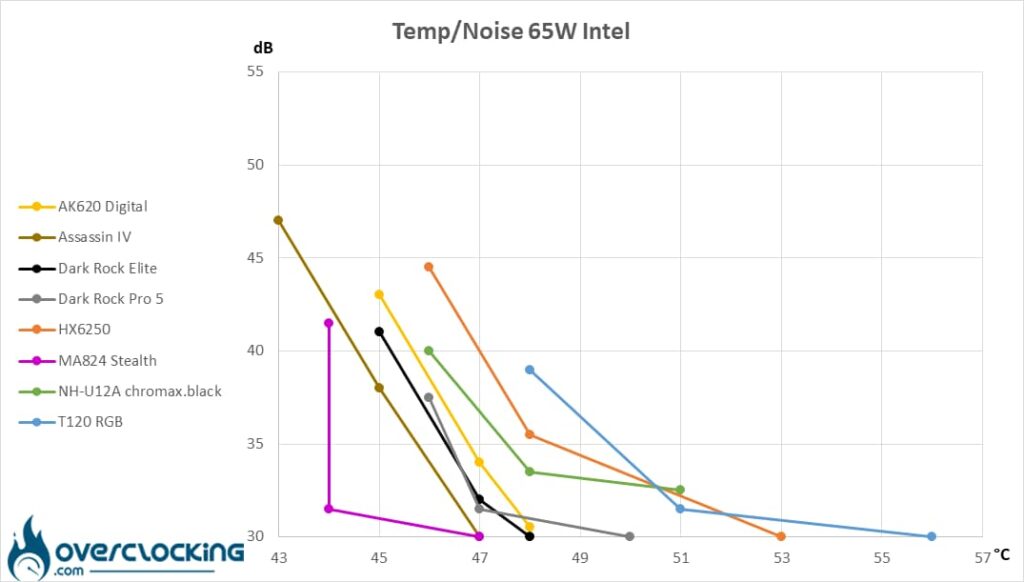
On this first profile, the two Dark Rocks are closely linked, with the Pro 5 model dragging its feet at low revs, while the Elite goes for higher speeds. In terms of competitors, they’re positioned right between the Assassin IV and AK620 Digital.
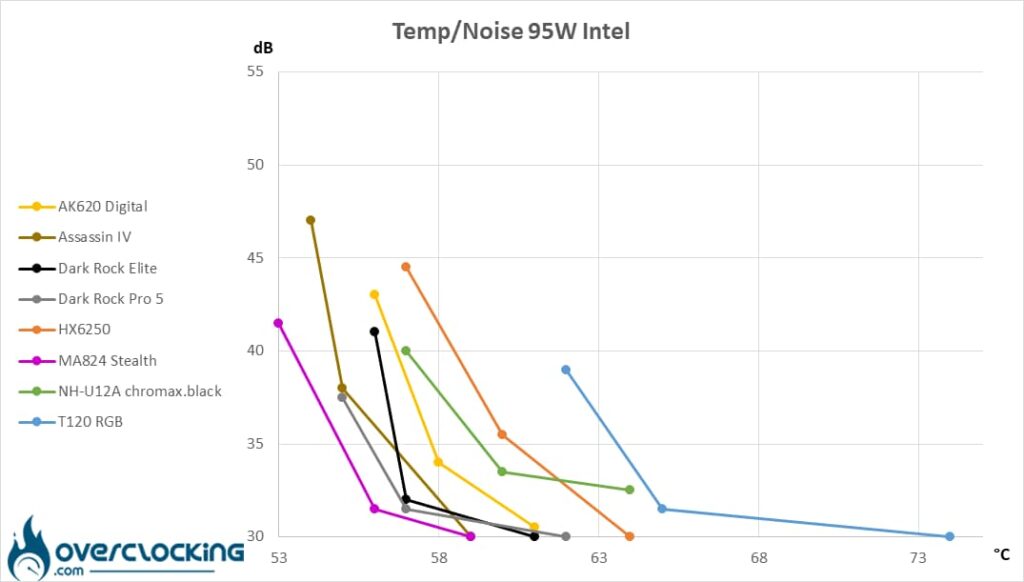
In 95W, we have a Dark Rock Pro 5 that’s clearly over-vitalized, as it’s positioned ahead of the Elite overall. This is helped by its higher temperatures at high speed. In fact, it’s right on the heels of Cooler Master’s cooler!
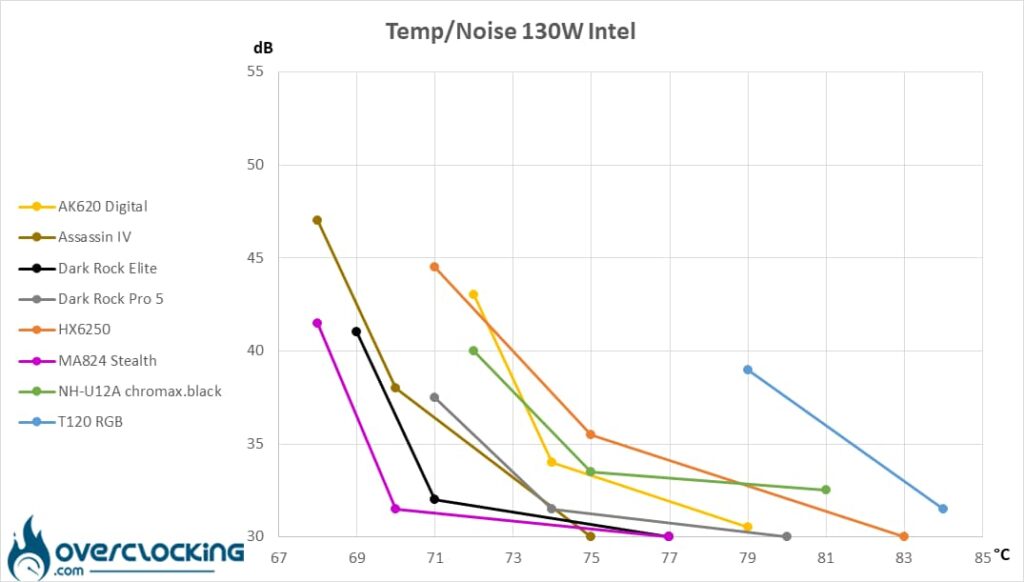
Finally, at 130W, Dark Rock Elite clearly takes the lead over Dark Rock Pro 5. What’s more, it offers a better temperature-to-noise ratio than the Assassin IV. However, on our Core i5 13600K, the king of the hill remains the MA824 Stealth.
[nextpage title=”Conclusion”]
This concludes our review of the Dark Rock Pro 5 and Dark Rock Elite from be quiet! Are we dealing with a successful product? Let’s take a closer look!
Impressive heatsinks!
Clearly, if you’re looking for compactness, you’ll have to look elsewhere. Indeed, these double-tower models are imposing, exceeding 160 mm in height. Depending on the case, you’ll have to look twice – wouldn’t it be a shame to end up with a configuration whose side panel you can’t close?
Worse still, the Elite version has two 135 mm fans, so depending on the profile of your RAM, you may have to raise the first fan, increasing the height even further! Fortunately, in this case, you won’t have to play with steel claws, but the adjustment rail is really hard.
Aside from this, the finish is meticulous, and the fans are entirely black. The upper part is also interesting, with a clever mix of aluminum and mesh grille, and a be quiet! logo in the right direction.
As for the accessory section, we’re delighted to find everything you need to assemble the heatsinks, along with the necessary tools. From one model to the next, there are no changes to the bundle.
Simple assembly, but you have to take everything apart..

With these models, be quiet! has greatly simplified the assembly system compared to its earlier fans, and so much the better. Assembly is simple and takes just a few minutes. However, as with many double-tower fans, you’ll need to dismantle the top part and the central fan to access the mounting tab.
However, given the nature and connectivity of the central fan, in the event of a problem, you’ll have to turn to be quiet! again. Unfortunately, we won’t be able to buy another fan at a later date, as this one is screwed onto a frame directly integrated into the top part. Not great.
Excellent on AMD, very good on Intel too!
In terms of performance, as we’ve seen, the Dark Rock Elite performs well on Intel processors, and even better on AMD. As we’ve seen, it buries all competition on our Ryzen 9 7900X, especially at high power consumption where it shows its full potential.
As for Dark Rock Pro 5, we’re frustrated not to have been able to test it on our AMD CPU . However, we’d like to point out that it ranks up there with the best-performing single-tower heatsinks. When power consumption rises, its imposing size sets it apart from its rivals!
Last but not least, noise levels are well under control, and the Dark Rock Pro 5 is the quieter of the two. In any case, all you need to do is regulate them, and you’ll no longer be bothered by the price of fans. From mid-range, they become inaudible, or almost!
A premium price:
Once again, we’re dealing with the crème de la crème from be quiet! so prices are high. As a reminder, the official price for the Dark Rock Pro 5 is €99.90, compared with €119.90 for the Elite version. Unfortunately, these prices are high, but they remain in line with market standards, since the Assassin IV is priced at €105~110, compared with €110 for the MA824 Stealth. Of the lot, the AK620 Digital remains the most affordable at just €85.
be quiet! Dark Rock Pro 5 :
We like :
- Excellent design and finish
- Good RAM compatibility
- Screwdriver included
- Easy to install
- The quieter of the two..
- … and its controlled noise levels!
We didn’t like :
- The impossibility of changing fans in case of failure!
- The considerable height (168 mm)
 At the end of this test, we have decided to award gold to the Dark Rock Pro 5. This heatsink offers solid performance and controlled noise levels. Assembly is straightforward, and all tools are supplied in the box. Unfortunately, in the event of failure, you won’t be able to change the fans due to their particular connectors and format, and beware of the 168 mm height, which can be a hindrance!
be quiet! Dark Rock Elite :
We like:
- Excellent design and finish
- Rail-mounted central fan for easy adjustment
- Screwdriver included
- Easy assembly
- The most powerful of the two
- Very good on a Core i5 13600K…
- … and even better on our Ryzen 9 7900X
- Noise levels under control!
We liked it less :
- The considerable height (168 mm)..
- … Even more so when you have to raise the front fan
- The very hard front fan adjustment rail!
- The impossibility of changing the fan in case of failure!
 If the Dark Rock Elite wins silver, it’s simply because of its size. Yes, 168 mm in height is substantial, even more so when you have to raise the front fan because the RAM is too high. However, despite rising noise levels at full speed, performance is solid, even more so than the Pro 5, and it really shines on our AMD processor… At least, against the competition!
Many thanks to be quiet!

