

Yesterday, Lisuan Tech launched its very first consumer graphics card, the LX 7G100. We’ve talked about it at length, but this model was to be a little nugget in terms of performance, as it was to rival NVIDIA’s RTX 4060. It’s a daring gamble, but if it holds up, the company has a formidable GPU for the mass market. In reality, we’re not there yet. However, beware of this initial conclusion, as not everything is so simple.
Lisuan Tech: a rather encouraging LX 7G100!
On a par with an RTX 3060 in synthetic tests!
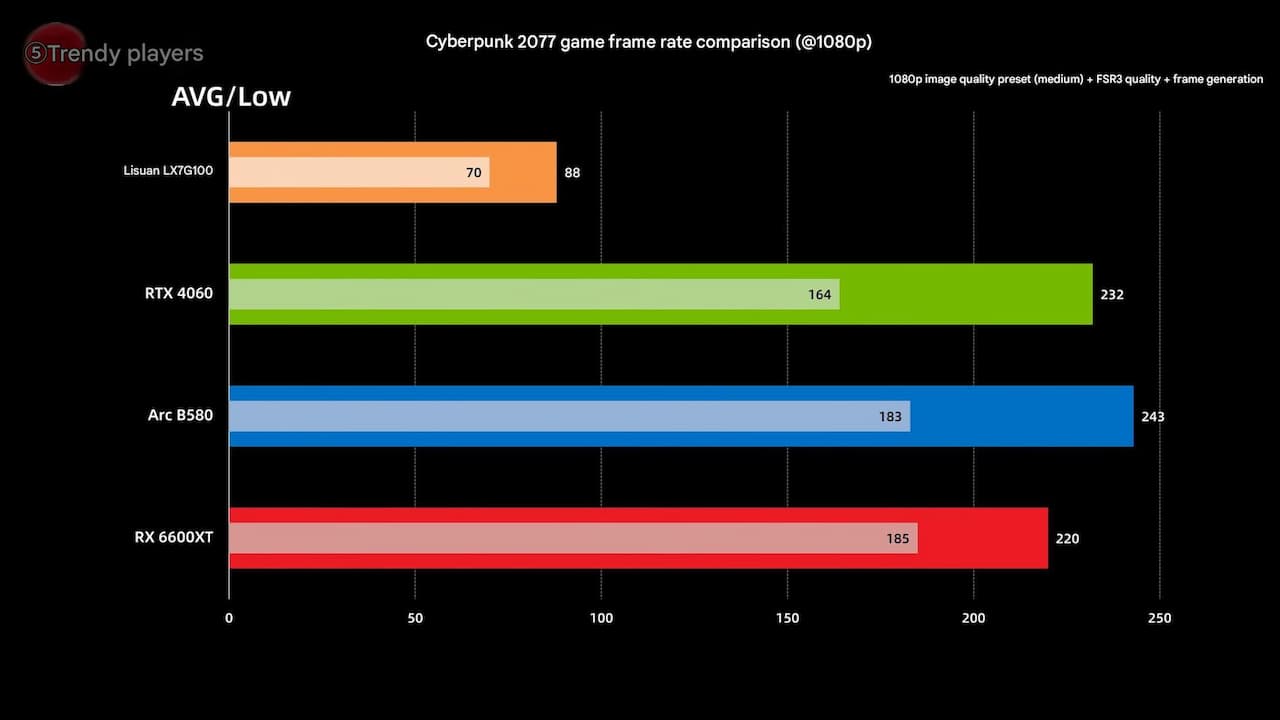
With this card, we find a model which, unfortunately, won’t be able to compete with an RTX 3060, a mid-range graphics card due for release in 2021. Indeed, if we look at the in-game figures, on Cyberpunk 2077 in 1080p with FSR3, the card runs at 88 FPS versus 232 FPS for the RTX 4060 and 243 for the Arc B580. On Wukong, the Chinese GPU reaches 56 FPS versus 115 FPS for the RTX 4060, and the worst is on Forza Horizon 5: 48 FPS versus 240 for the RTX 4060.
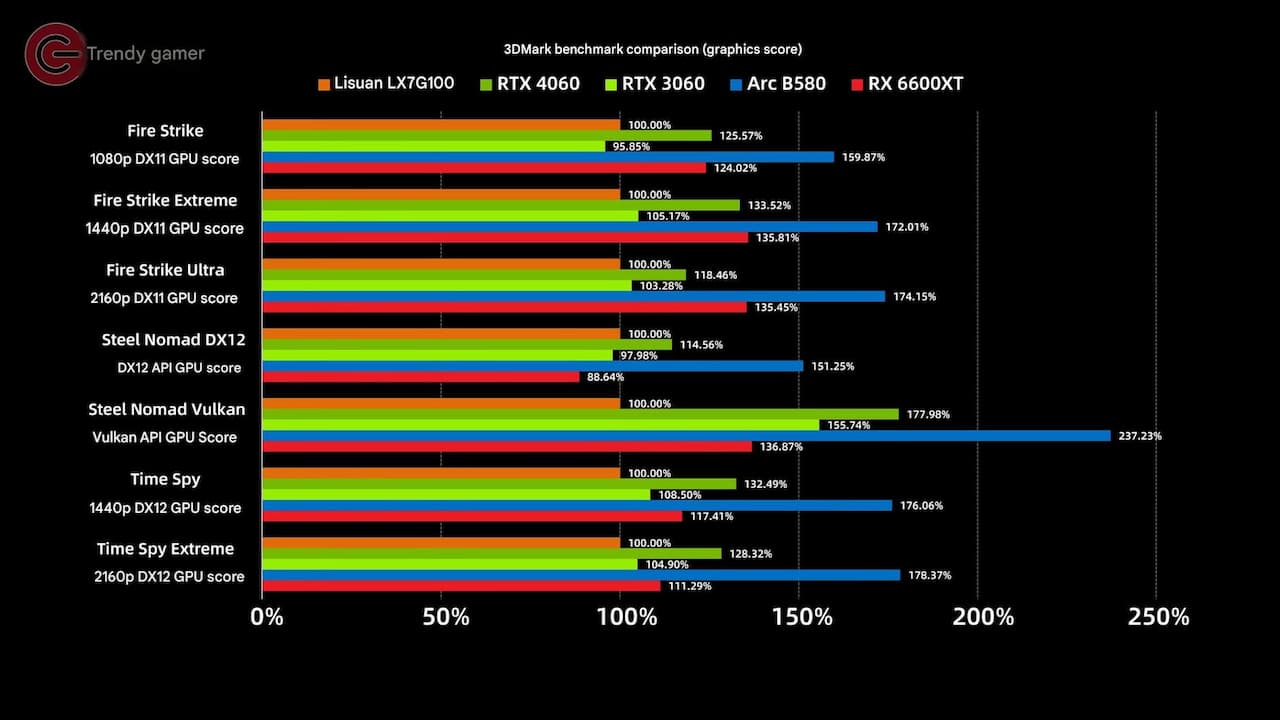
In terms of synthetic tests, 3DMark in short, the card is more in line with the RTX 3060 than the RTX 4060. Indeed, on FireStrike, Lisuan Tech’s card came out on top of the 3060, as it did on Steel Nomad DX12. In contrast, the little 3060 spanks it on Steel Nomad Vulkan, where it dominates with a superior score of 55.74%. Otherwise, the typical difference in favor of the RTX 3060 is between 5% and 6%.
In short, as you can see, the card still has a long way to go before it can match the performance of an RTX 4060.
But it’s not all doom and gloom!
But clearly, we’re dealing with the best GPU launch a Chinese company has given us. Indeed, unlike Moore Threads whose cards were a calamity to run (at launch), here, it runs pretty well on the one hand. On the other hand, the card is running quite a few games for its launch, including Cyberpunk 2077, GTA V Enhanced, Red Dead Redemption 2 and more. What’s more, Direct12 support is already present, so there’s no need for a new driver update in x years to take advantage of it, etc., while the card remains stable overall and there were few crashes during testing, it seems. As for ray tracing, this feature is reserved for a future generation of cards.
There’s also still some serious work to be done on the software side. The driver needs further optimization to take full advantage of the card’s architecture, but it also needs a polish. In fact, the overclocking parameters jump on every reboot, while Afterburner offers basic monitoring of GPU/memory usage. As is often the case, the problem lies in the software… And the price tag in this case, as the card is still priced at around $480… yes, that’s a bit steep…