

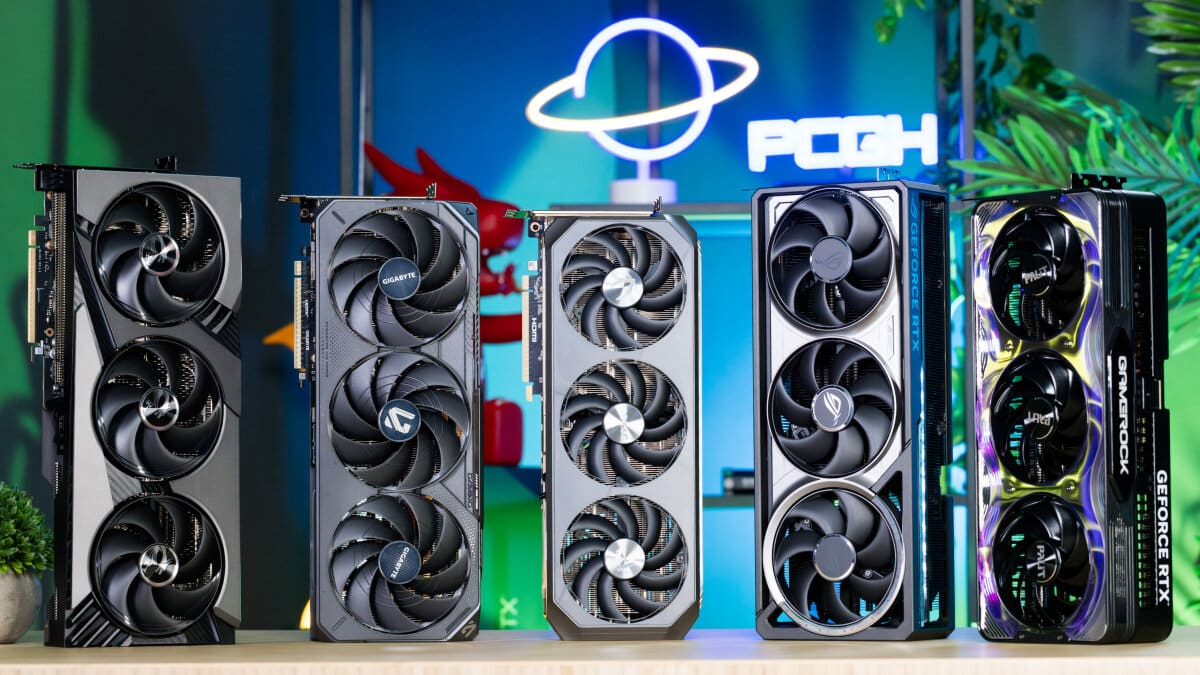
PC Games Hardware conducted a detailed evaluation of five custom models of the GeForce RTX 5080 graphics card. The goal was to assess their thermal performance, noise levels, and clock speeds under a standardized “stress test.” Models from Asus, MSI, Gigabyte, Zotac, and Palit were subjected to rigorous testing to determine which offers the best user experience. This in-depth test aims to directly compare the cooling solutions and acoustic performance of these high-end graphics cards.
The Test Methodology
The test is based on a relatively simple protocol. To isolate the noise emitted by the graphics card, a passive CPU cooler and a semi-passive power supply were installed. The entire setup is placed on a test bench in an open configuration. Under maximum load, the Metro Exodus Enhanced Edition benchmark, with ray tracing enabled, pushes each card to its limits. After a stabilization phase, the noise level is measured at a distance of 50 cm using a Cortex Analyzer NC10. GPU and video memory temperatures are recorded via HWInfo, while fan speeds and frequencies are noted.
This approach allows for a direct and accurate comparison between the different models. Manufacturers take various approaches to managing heat dissipation and noise. MSI and Asus appear to have struck an optimal balance, while Gigabyte, Zotac, and Palit have room for improvement in delivering a quieter and more efficient cooling experience. The measurements also include an analysis of the electrical buzzing phenomenon sometimes present on certain cards.
Comparison Results: MSI Vanguard and Asus Astral Lead the Pack
Two models clearly stand out in this full-load test: the MSI Vanguard and the Asus Astral. The MSI card offers the lowest temperatures, while the Asus model excels in terms of minimal noise, particularly in silent BIOS mode. The Gigabyte Gaming OC model consistently ranks between the two leaders. However, it remains slightly noisier than MSI’s Vanguard in BIOS P mode and louder than Asus’s Astral in BIOS S mode.
The Palit and Zotac cards fail to compete with the top performers. They post lower results in terms of both temperature and noise.
In conclusion, while the raw performance of these cards is very close, this benchmark highlights significant differences in thermal efficiency and noise levels. Users seeking the absolute best thermal performance will find an advantage with MSI, while those prioritizing quiet operation will be better served by Asus. The other models, while functional, fail to reach the same level of excellence in these two areas critical to the high-definition gaming experience.
Technical Details of the Tested Models
The models examined include the MSI GeForce RTX 5080 Vanguard SOC, the Gigabyte GeForce RTX 5080 Gaming OC, the Asus ROG Astral GeForce RTX 5080, the Zotac Gaming GeForce RTX 5080 AMP Extreme Infinity, and the Palit GeForce RTX 5080 GameRock OC. Each model underwent rigorous testing to verify its ability to maintain stable clock speeds under prolonged load. The results show that the quality of the thermal design directly influences the system’s lifespan and stability.