

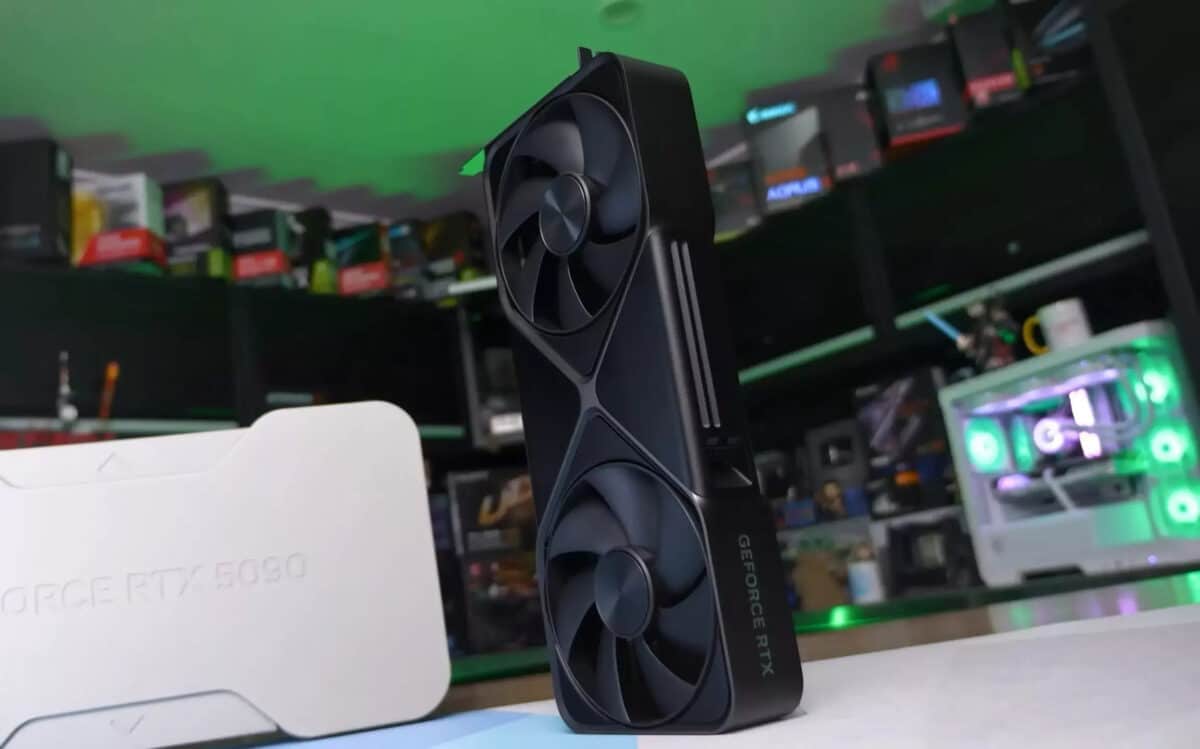
A new reality is setting in for demanding gamers: the GeForce RTX 5090, which currently retails for nearly €5,000, is no longer sufficient to deliver the ultimate gaming experience on 6K displays. As this segment begins to emerge with monitors like the Samsung Odyssey G80HS, capable of native 165 Hz, Nvidia’s most powerful graphics card must sacrifice key settings to remain usable at this resolution.
The Challenge of the First 6K 165 Hz Monitor
The Samsung Odyssey G80HS marks a technological breakthrough. Unlike professional 8K displays limited to 60 Hz, this model is aimed directly at gamers with a high refresh rate and comprehensive features such as G-Sync support. However, running this monitor requires a Blackwell architecture with DisplayPort 2.1, which immediately rules out the RTX 4090 despite its computing power, as it cannot drive the display beyond 60 Hz.
The 6K resolution (6,144 × 3,456) represents a 2.6-fold increase over 4K, totaling 21.2 million pixels. This pixel density places a heavy load on the graphics processor and video memory. Our colleague therefore compared the RTX 5090 to the RTX 5070 Ti on demanding titles like Cyberpunk 2077 and Crimson Desert.
Performance Plummets at Native Resolution
The results are clear-cut. In Cyberpunk 2077, the RTX 5090 achieves about 85 FPS in 4K with the Ray Tracing Overdrive preset and DLSS Performance enabled. At 6K, this configuration causes performance to drop to 42 FPS—half the previous value. To restore reasonable frame rates, you have to disable ray tracing, which brings the FPS back up to 72.
Crimson Desert confirms this trend. With the Cinematic preset and Ray Reconstruction enabled, the graphics card averages 63 FPS at 4K. At 6K, the game drops below 30 FPS. The only viable solution is to disable Ray Reconstruction and switch to DLSS Balanced mode, which yields 66 FPS but at the expense of shadow and texture quality.
The RTX 5070 Ti, on the other hand, is vastly outclassed. It struggles to even reach 40 FPS in 4K with high settings. In 6K, it’s practically unusable without drastically lowering graphics settings to Medium or using DLSS Ultra Performance mode, which results in a compromised visual experience.
The Inevitable Trade-off
In titles like Doom: The Dark Ages or Forza Horizon 6, the RTX 5090 maintains decent performance at 4K (around 85–100 FPS). At 6K, the same settings cause the FPS to drop to 43 or 56. To play comfortably, you must either disable ray tracing or settle for lower settings (High or Medium) and a frame rate around 60 FPS—a far cry from the high-frame-rate experience you’re looking for.
The test concludes that the RTX 5090 isn’t really suited for native 6K gaming at the highest settings. It requires significant compromises, such as disabling ray tracing or using aggressive upscaling modes that reduce the perceived effective resolution. Of course, for now, 6K gaming remains a niche within a niche, and users who prioritize this resolution aren’t exactly a common sight.