






2160p rasterisation gaming performance:
Let’s get on with the gaming tests. We’ve used all the graphics cards we thought would be interesting to compare with this NVIDIA RTX 5090 Founders Edition in 2160p definition. In the coming weeks, we’ll be offering a new type of article, retesting graphics cards from previous generations to find out what they’re still worth in 2025. Our games panel currently consists of 11 titles, and will be growing over the coming weeks.
We have chosen to use the benchmarks built into these different games.
Why have we done this? Quite simply to allow you to compare your results with ours if you also have a copy of one of these games. It’s a thought-provoking idea that will allow you to compare your results with ours. The number and titles selected have changed slightly, and will increase again over the coming weeks as we get our hands on new games.
What is rasterisation?
Before we start, a quick word about ‘rasterisation’, which is currently the subject of much discussion. Rasterisation is the evaluation of the performance of our graphics cards without using upscaling technologies . We choose a graphics quality, often the highest, and test it. The advantage of these tests is that we can quantify the gains made by the architecture between different generations. In our case, to be able to judge the gains obtained between the architecture of the RTX 4090 (ADA Lovelace) and that of the new RTX 5090 (Blackwell).
Borderlands 3 :
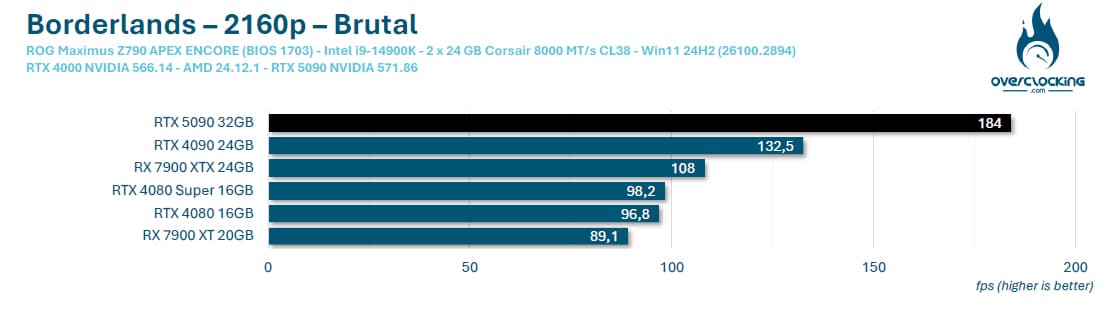
Let’s get on with the gaming part, starting with Borderlands 3. It’s an instant hit, with an average of 184 FPS and therefore a 38.9% gain over the RTX 4090.
Cyberpunk 2077:
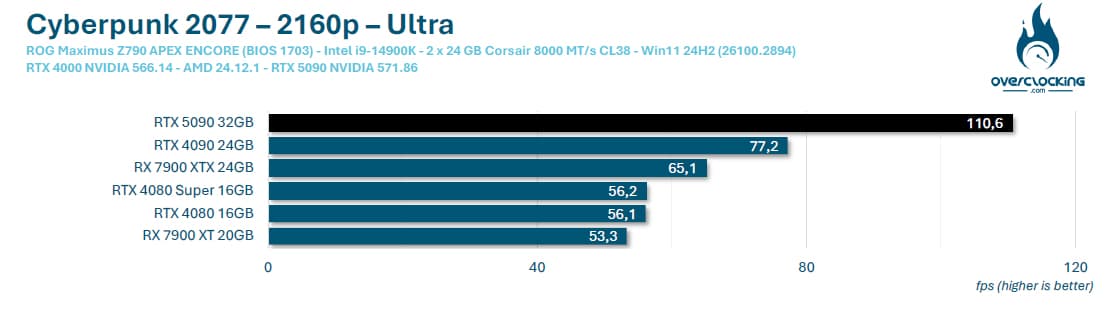
New game and same observation with Cyberpunk 2077. The 100 FPS mark is easily passed, with an average of 110.6 FPS.
COD Modern Warfare III:
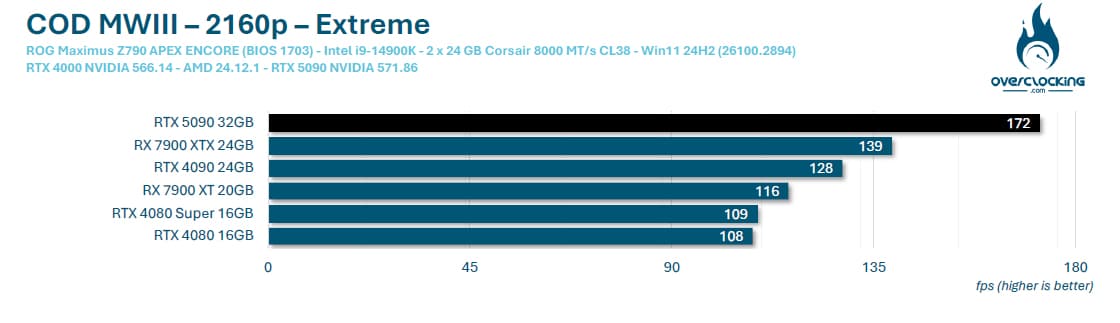
You don’t change a winning team, and our sample of the day is still well ahead. The gap is once again quite colossal against the RTX 4090, which is only in third place in this benchmark.
Forspoken :
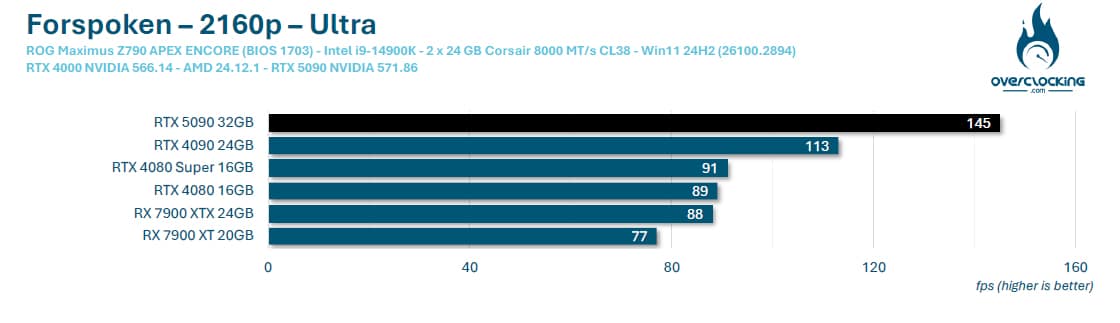
Forspoken is a fairly demanding game, and the RTX 4090 and RTX 5090 are the only two cards capable of breaking the 100 FPS barrier.
Horizon Zeron Dawn Remastered:
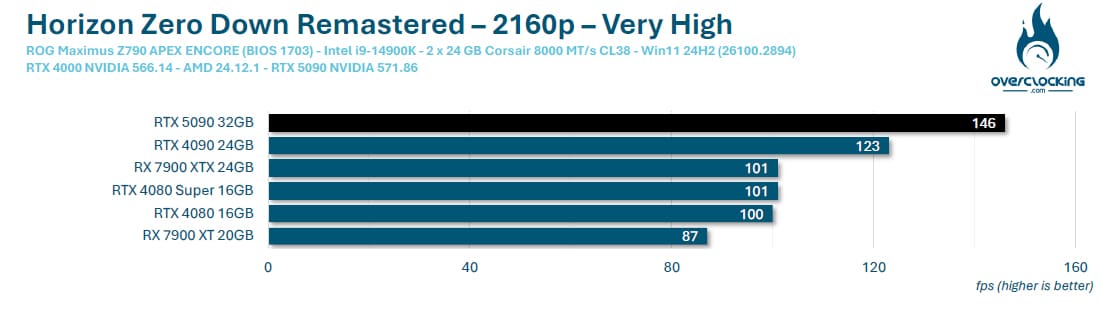
One of the new games we’ve added to our comparison, and one where the differences are smaller than usual. Here, there’s an 18.7% gain over the RTX 4090.
Shadow Of The Tomb Raider:
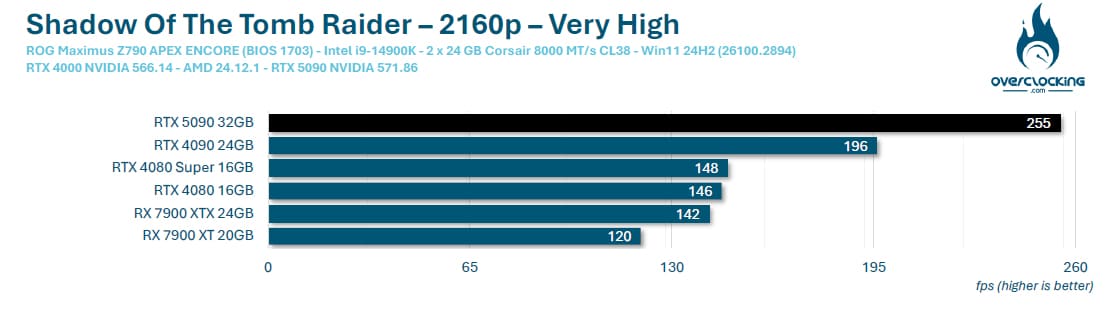
Shadow Of The Tomb Raider passes the 200 FPS mark with flying colours on our NVIDIA RTX 5090 Founders Edition.
Black Myth: Wukong Benchmark Tool :
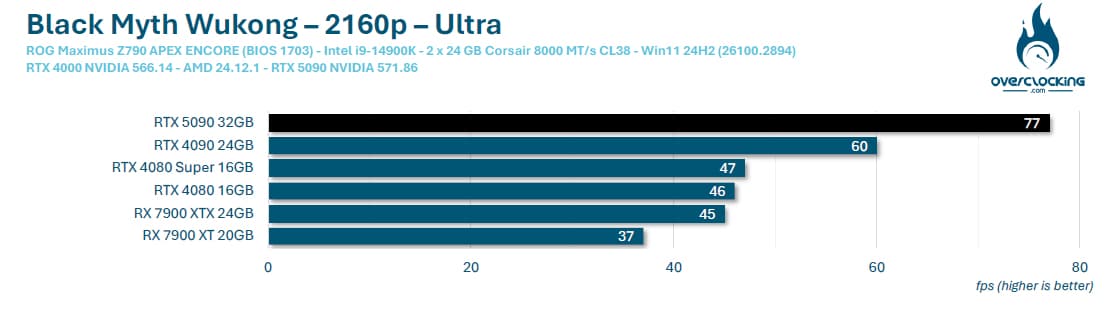
This new game also seems to be very greedy, and doesn’t do NVIDIA graphics cards any favours.
Far Cry 6:
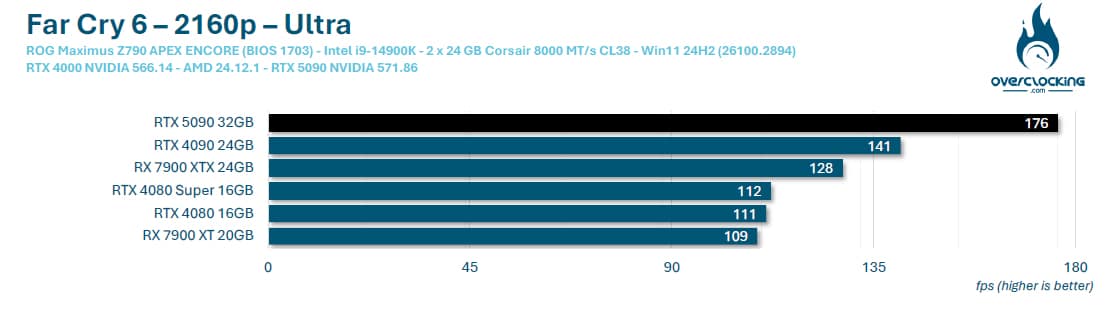 Performance is the same as ever for Far Cry 6, with the RTX 4090 and RTX 5090 topping the charts.
Assassin’s Creed Mirage:
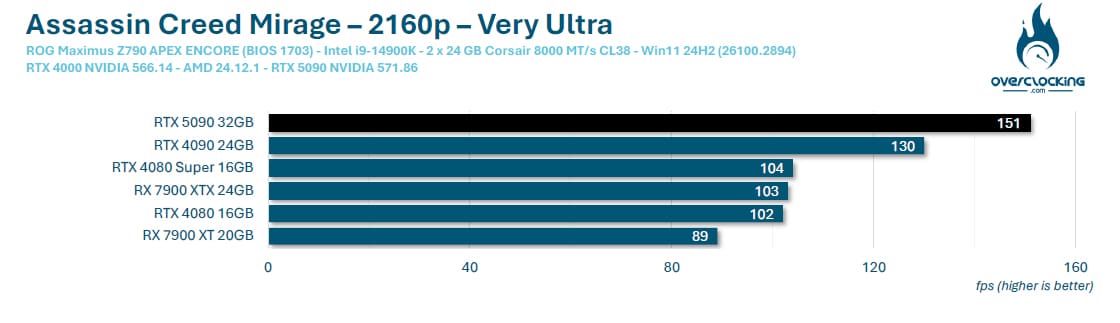
Here, it’s lower performance, but still first place for the RTX 5090.
Red Dead Redemption II:
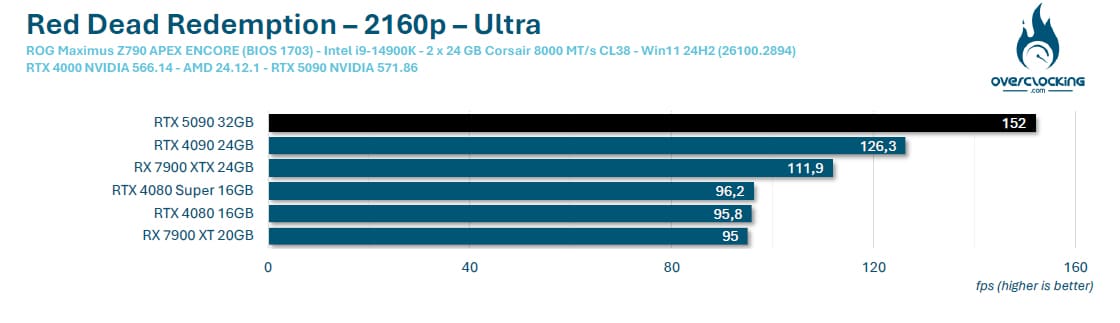
In Red Dead Redemption II, nothing changes and our RTX 5090 Founders Editions is ahead with an average of 152 FPS.
F1 2024 :
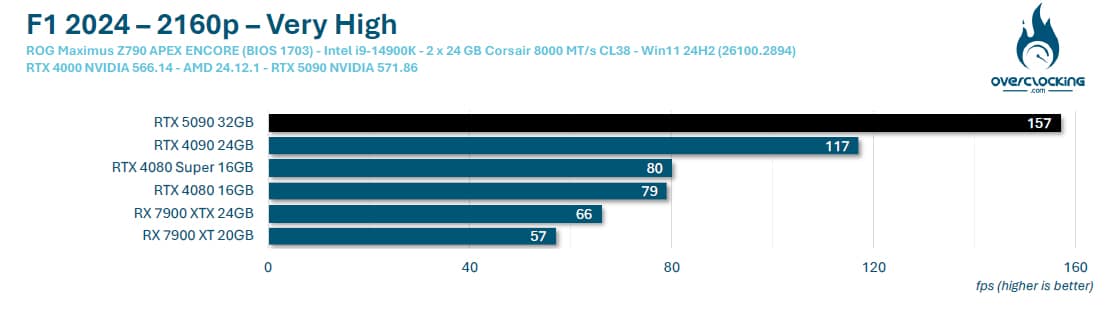
Last game and nothing will have changed during this series of 11 games, with an RTX 5090 logically dominating the older generation. Let’s calculate the average gains to get an idea of the difference between the two architectures.
Average for games in 2160p rasterisation :
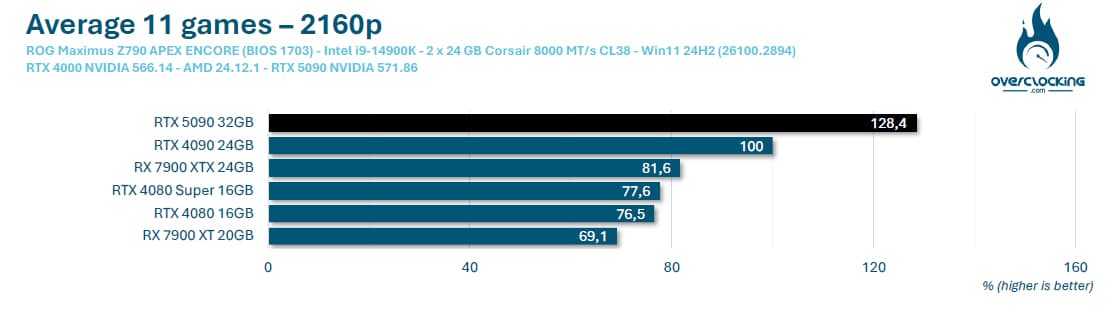
Let’s start with a logical observation: yes, our RTX 5090 logically performs better than the RTX 4090, and we come up with an average 28.4% gain over the previous architecture. There are two ways of looking at this, either to say that nearly 30% isn’t bad at all, or to say that it’s not enough given the gains, for example, that we noted between ADA Lovelace and Ampere. Well, yes, but… You mustn’t forget that between ADA Lovelace and Ampere, the engraving finesse improved (8nm to 4nm), the number of Cuda Cores was increased, the Tensor Cores and RT Cores evolved and increased in number, and it benefited from a much higher boost frequency.
Here, we’re using the same engraving finesse, which explains the lower gain, and unless the engraving finesse changes for the next architecture, we should end up with the same gain proportions. Is this a bad thing? Not really, and it would have been difficult to propose a greater gain in rasterisation in this situation, given that the TDP is already 575 watts. We’ll be keeping a close eye on how the rest of the RTX 5000 range performs against the previous generation.
NVIDIA has been working on AI for years, particularly with its upscaling, and continues to develop it, as we’ll see in the rest of our tests.