




Technical specifications:
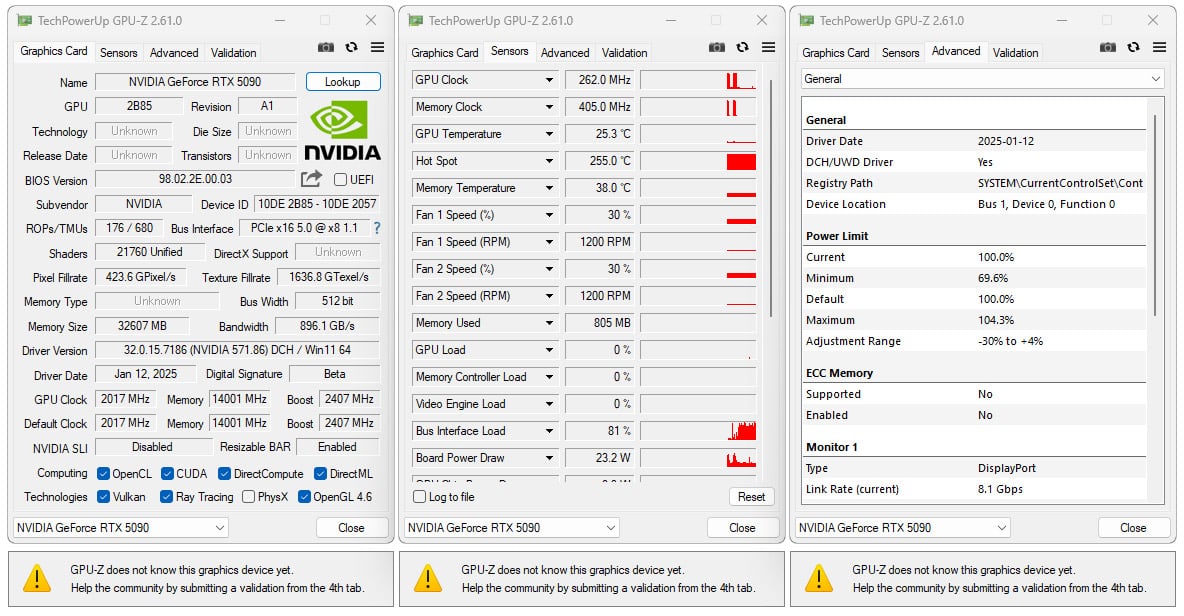
A quick trip to GPU-Z to check that the information read is correct. As you can see, this is not yet entirely the case. A new version of GPU-Z will almost certainly be posted on January 30, the day the RTX 5090 and RTX 5080 are launched. In the meantime, we can still learn a few things from our copy of the Founders Edition.
In terms of frequency, NVIDIA has announced a base frequency of 2017 MHz and a boost frequency of 2407 MHz for the RTX 5090 Founders Edition. The card has 32 GB of GDDR7 memory (1792 GB/s) on a 512-bit bus. This model features the base frequencies proposed by NVIDIA. Partners offering custom models will no doubt be offering factory overclocking on certain models.
Don’t forget that the GPU frequency could be higher in benchmarks, depending on the quality of your chip and the cooling system used.
In fact, we ran a test under 3DMark Time Spy to observe the GPU boost frequency. We can see that it reaches the maximum frequency of 2872 MHz at certain times. The memory frequency remains unchanged, which is perfectly normal.

As far as temperatures are concerned, it climbs to 66.2°C and the memory to 78°C. At the time of this first test, it was 18°C in the lab. We’ll have to check the temperatures during our more in-depth tests. The fans are far from running at maximum speed and the card is fairly silent. As a reminder, we’re on a bench and not inside a case. Let’s get testing!