

For some time now, the Chinese company Moore Threads has been making thunderous statements about its products, its progress and its determination to compete with the big names in GPUs. Still regarded with a certain disdain some time ago, the company is now making real progress, even though the international situation is clearly not making things any easier for it. Driven by China’s ambition to have its own independent tech companies, More Threads raised $1.1 billion in its IPO on the Shanghai Stock Exchange at the beginning of December.
Moore Threads credible in 2026 in Gaming?
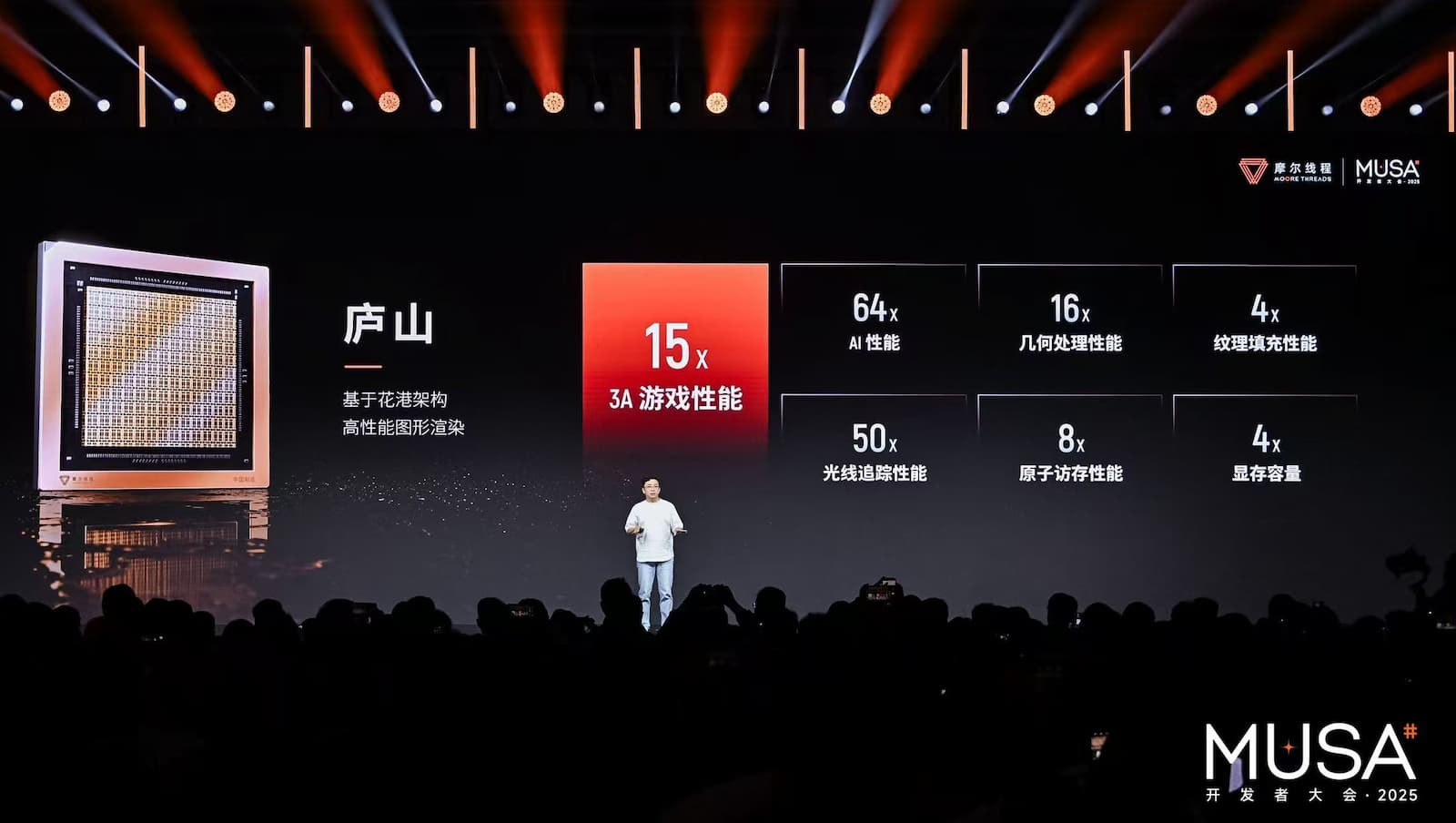
In the last few hours, the company has announced new GPUs based on its next-generation Flower Harbor (Huagang) architecture. These will equip the Lushan and Huashan graphics chips designed for gaming and AI respectively. And here again, the announcements were thunderous. Zhang Jianzhong, founder and CEO of Moore Threads, presented the future gaming chip, due to arrive in 2026. The progress announced would multiply AAA game performance by 15, ray tracing performance by 50, AI calculation by x64, geometric processing by x16, texturing throughput by x4 compared with the previous generation… On the software side, there were also some big announcements. First of all, with regard to the compatibility of these next GPUs, the objective is clear: to catch up with the software backlog. From the outset, full support for DirectX 12 Ultimate is announced, opening the door for these future chips to Windows gaming PCs. Obviously, if all these promises are confirmed, Moore Threads will change scale, while AMD, Intel and Nvidia will have to partially abandon production of their gaming cards in favor of AI chips.
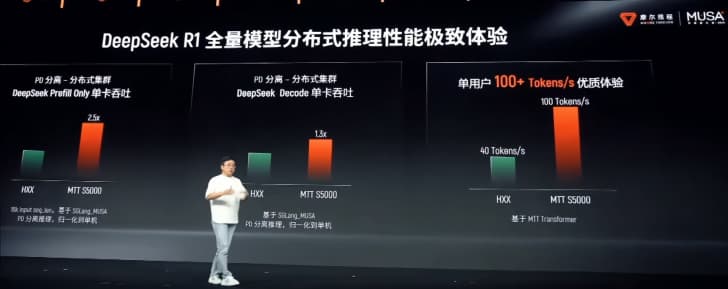
As for AI chips, here too the announcements are spectacular. The Huashan generation is said to feature a chiplet design with eight HBM slots. Some versions are compared to recent Nvidia GPUs, although no full details have been published in terms of frequencies or power consumption. A few slides were shown of the MTT S5000 GPU, designed to compete with the NVIDIA Hopper range in performance tests under DeepSeek V3.