

CXMT is a Chinese company that’s been making quite a splash lately. In addition to motherboard manufacturers optimizing their BIOS for this producer, the company is now making headlines for the price of its memory. In fact, its 64 GB modules for servers now sell for more than Samsung’s. Nope, just because it’s Chinese doesn’t mean it’s necessarily cheaper.RAM is scarce, and the company is entering the market at a time when the industry is seeking new sources of supply: naturally, that comes at a price.
Is CXMT charging more for its RAM than Samsung?
Over $1,240 for a 64 GB module!
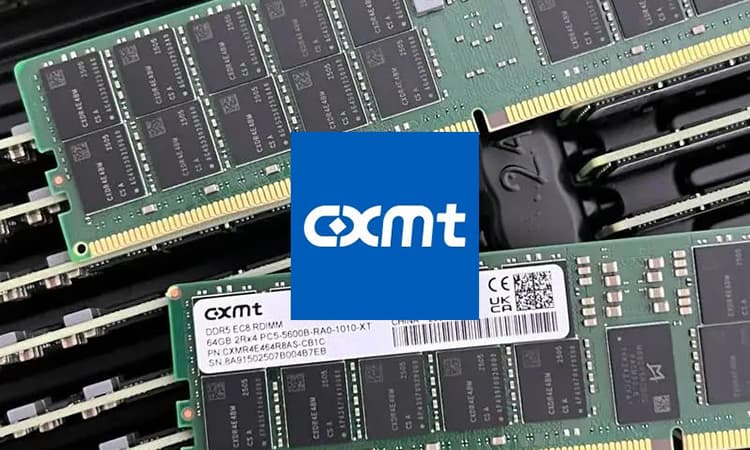
To put it simply, Samsung currently offers its 64 GB server memory modules for $1,240, but CXMT’s prices are reportedly even higher. However, it remains difficult to say exactly how much the Chinese giant charges for its modules. This may come as a surprise at first glance, since we’re used to assuming that, because it’s Chinese, prices will necessarily be low. Not so: the memory market remains subject to strong demand, while supply is in short supply. And as noted: “The Chinese manufacturer’s advantage lies not in its prices, but rather in its ability to supply memory at a time when demand was absorbing the entire output of SK Hynix and Samsung.”
A rising giant:
All these factors are turning CXMT into a true powerhouse in the memory sector. Admittedly, the company does not yet rival American and Korean manufacturers, but it accounts for between 8% and 10% of the global DRAM market (Micron: 24%, SK Hynix: 29%, Samsung: 36%). Furthermore, massive investments are being made to increase its production capacity. There are reports of two new factories under construction—one in Shanghai and the other in Hefei—while discussions are underway regarding the construction of a third factory. Ultimately, production is expected to exceed 600,000wafers per month, which should allow the company to catch up with Micron this year and even surpass it by 2030.
On the financial front, the company is highly profitable, with revenue reaching $7.5 billion—a 719% increase—while its profit surged 1,200% in the first quarter of 2026 compared to the first quarter of 2025. Overall, in the first half of 2026, revenue is expected to range between $16 billion and $17.7 billion, representing a 600% increase compared to the first half of 2025. In short, these figures should pave the way for a successful initial public offering (IPO).