

Here’s a little story to get us off the monotonous train of today’s graphics card market. Because let’s face it, the arrival of a newcomer to the already highly competitive GPU market is a real surprise in 2025. How can a company, virtually out of nowhere, even think of existing? Bolt Graphics thinks it can make its mark with a revolutionary approach to GPU design. The basic principle of the company founded in 2020? Solve the performance problems of heavy-duty tasks such as simulations and 3D graphics, while reducing energy consumption. Bolt Graphic promises that, with its Zeus GPU, it will bring to market a card around 10 times faster than the RTX 5090 in terms of rendering and up to 12 times faster than the latter in terms of FP64 HPC performance. A promise that seems too good to be true, given that the company has not yet put any cards into circulation. All the more so as the design of the card itself is something of a GPU fan’s dream. The GPU is based on a chiplet design, with 1, 2 and 4-chip models. The Zeus board itself will benefit from a modular design, with soldered LPDDR5X memory expandable via two SODIMM DDR5 modules to bring VRAM up to 384 GB.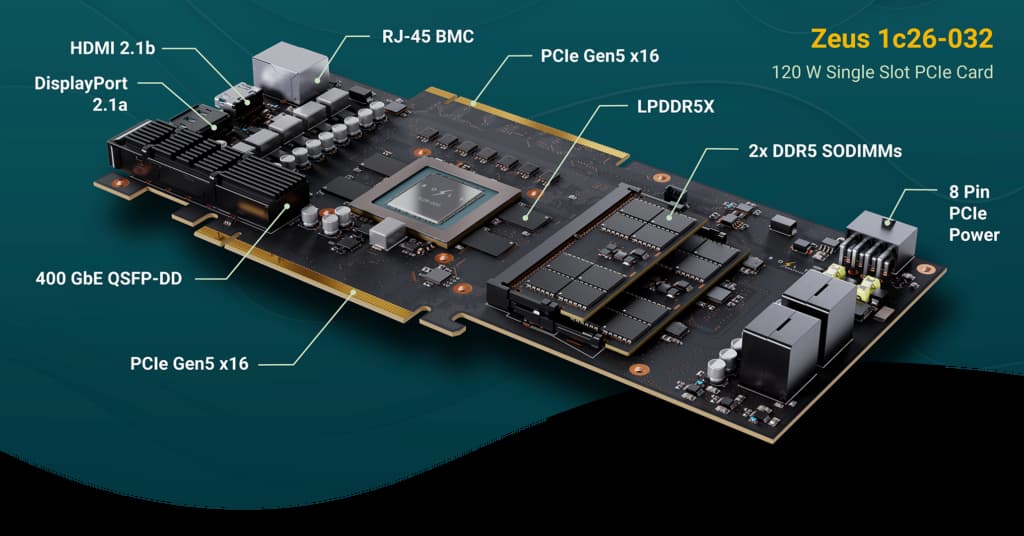
The Zeus board also natively integrates high-speed 400 GbE and 800 GbE Ethernet interfaces. On paper, users can connect GPUs directly to each other on a large scale to boost rendering or computing performance. The company plans to deploy its GPU in several formats, including PCIe cards, servers and even in the cloud. While the product’s target market seems to be the audiovisual industry, production studios and research centers, Bolt Graphics also promises to be present in the gaming sector. Again in its communication, the company claims that its solution is capable of running games in 4K / 120FPS with Ray Tracing enabled, without loss of quality and without any upscaling or AI solution. Does this mean we’ll be able to get a Windows card?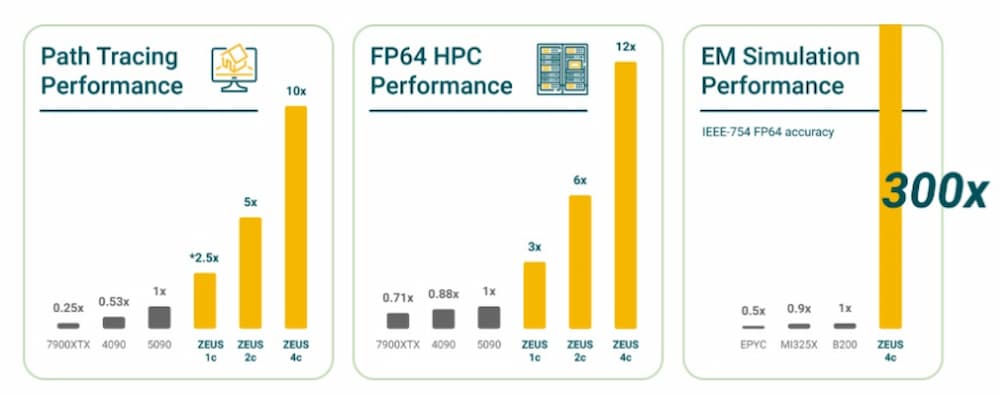
All this is obviously very exciting, but all the figures put forward by the company are based on virtual calculations or “pre-Silicon benchmarks in emulation”. To put it simply, these figures do not come from a real chip in operation. Last but not least, the GPU announced for 2025 will only be in the hands of developers in 2026…and in commercial production in 2027. Too good to be true? In fact, we’d like this company to prove us wrong.