

With this new model, NVIDIA is offering the least expensive card in its ADA Lovelace architecture. We had the opportunity to receive a copy of the Gigabyte RTX 4060 WindForce OC 8G. Announced for July, this RTX 4060 finally arrives a few days ahead of schedule.
This model will be in direct competition with AMD’s RX 7600, launched at the end of May. The MSRP for the AMD version is 299 euros in France. But this entry-level board for NVIDIA will also be up against the Intel ARC A750, currently selling for 260 euros. So we can look forward to some exciting competition between the three graphics card manufacturers.

Many thanks to Gigabyte for the availability of this sample.
[nextpage title=”Gigabyte RTX 4060 WindForce OC 8G:”]
Architecture:
As a reminder, the cards in the “Founders Edition” series are unique models offered by NVIDIA. For the RTX 4060 version, NVIDIA will not be offering any, leaving the entire offer to its partners. NVIDIA’s partners will also be offering their own models, either at NVIDIA’s MSRP of 329 euros, or at a higher price. We’ll be testing a second card tomorrow.
This Gigabyte RTX 4060 WindForce OC 8 GB features an AD107-400 GPU with 3072 CUDA cores, i.e. 1280 cores less than the RTX 4060 Ti. It features TSMC’s 4nm manufacturing process, rather than Samsung’s 8nm, bringing the TGP down to just 115 watts.

Memory: 8 GB of 128-bit GDDR6 memory, which translates into a bandwidth of 272 GB/s. The RTX 3060 Ti had 12 GB of memory and a 256-bit bus (448 GB/s), while the RTX 2060 Super had 8 GB with a 192-bit bus (448 GB/s). So we end up with a virtual RTX 4060 offering lower bandwidth. But NVIDIA assures us that bandwidth actually reaches 453 GB/s, thanks to the increase in L2 cache to 24 MB.

NVIDIA also emphasized the low power consumption of this RTX 4060 model, talking about the savings that can be made over 4 years for a person playing between 10 and 20 hours a week. The RTX 4060 is expected to consume around 2.2 kWh per week, less than an RTX 3060 170W at 3.5 kWh.
The Gigabyte RTX 4060 WindForce 8G bundle:
So what’s in the box? First of all, the box retains Gigabyte’s color code of orange, green and black. The box is fairly compact, which suggests that this is a card with reduced dimensions.
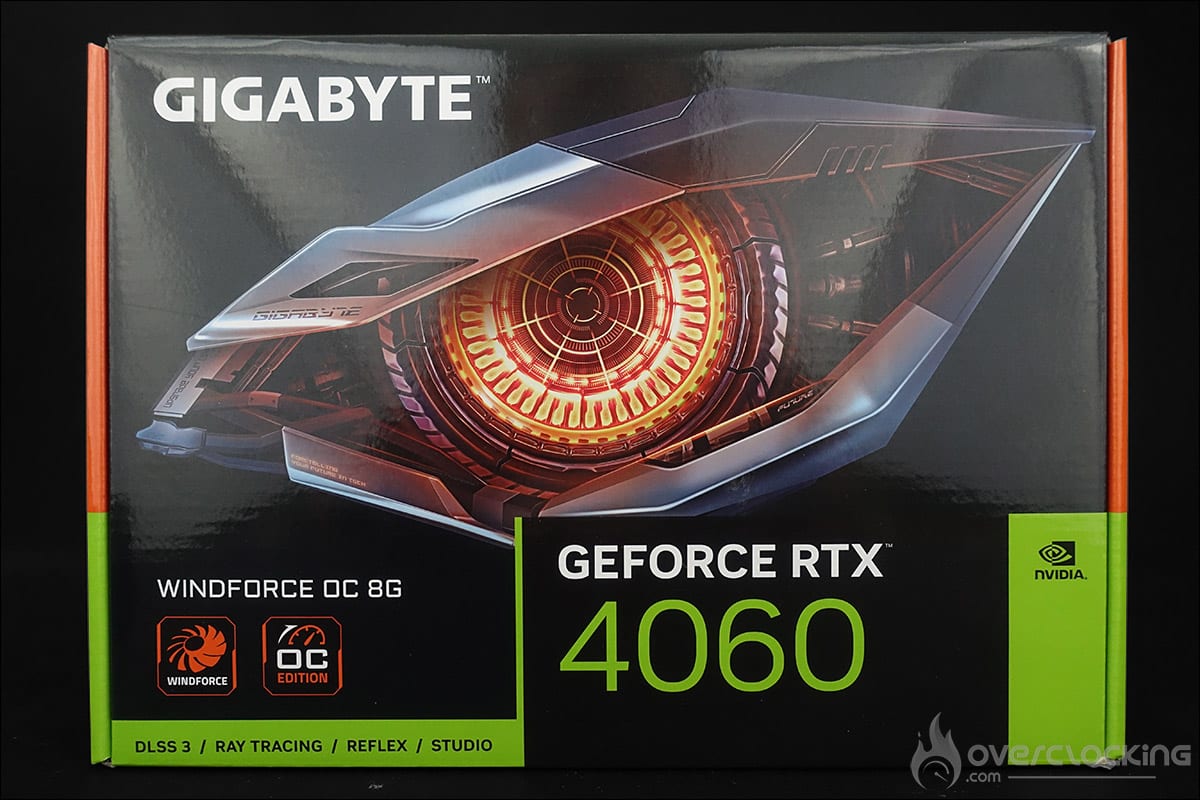

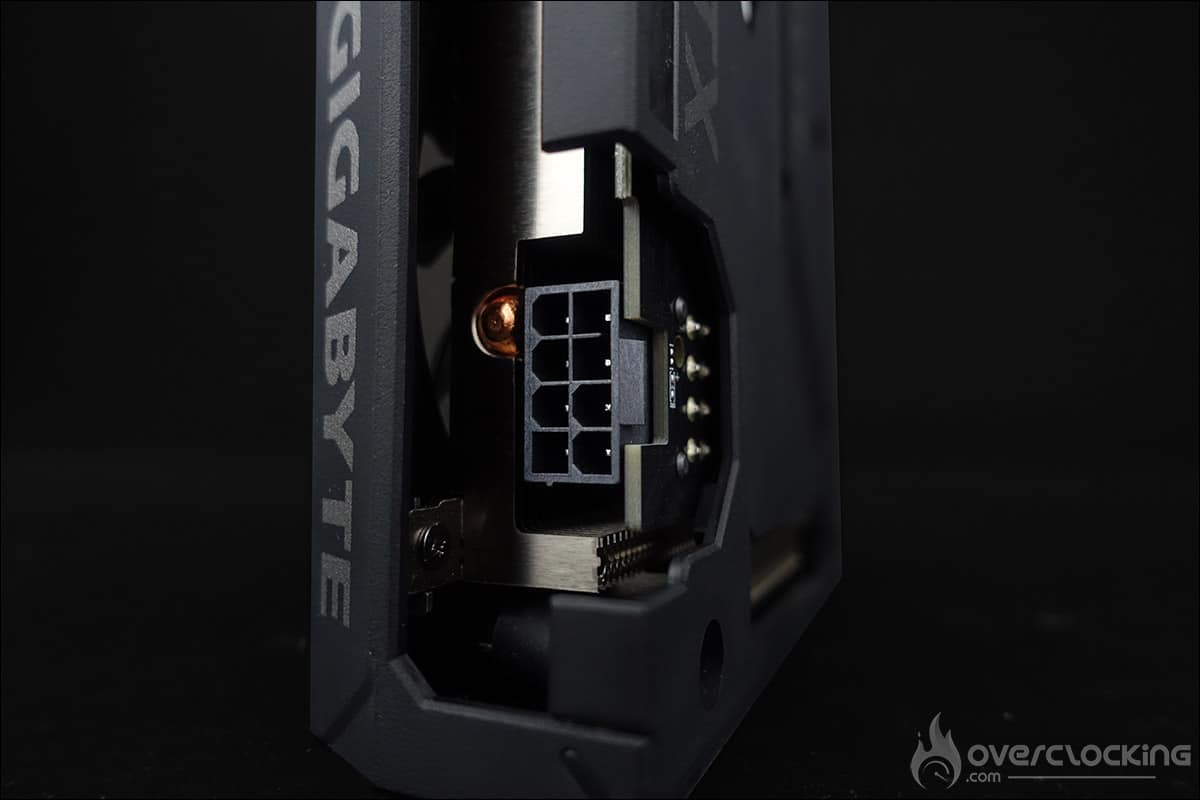
There’s nothing in the bundle other than a quick installation guide. The absence of a 12 4-pin adapter seems to confirm that Gigabyte has chosen to retain a “traditional” power connector.
Cooling:
The card benefits from a standard size for entry-level products, with dimensions of 192 x 120 x 41 mm and a width of 2 slots. A wise choice for owners of compact chassis.

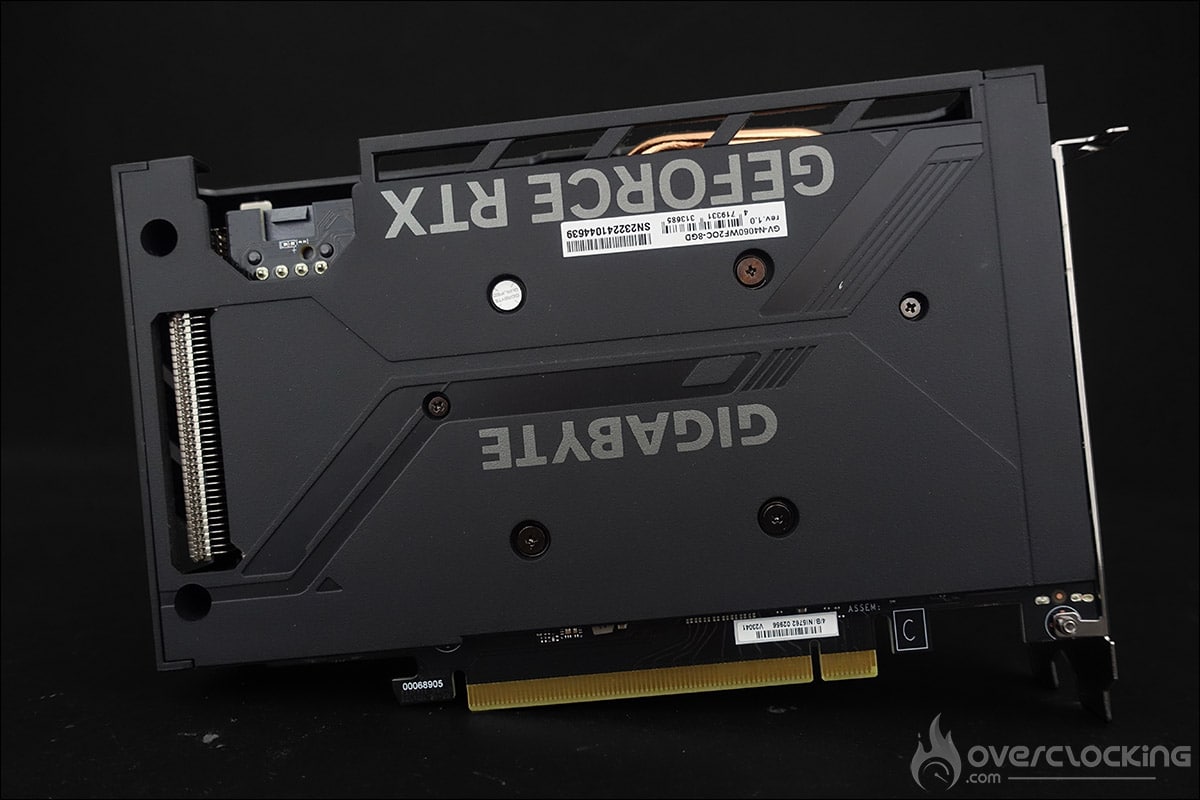
This isn’t the first time we’ve had a Gigabyte graphics card in our hands, so the design isn’t totally unfamiliar. This is a custom card, i.e. with its own cooling system. It is labelled “Windforce 2x” and features two 80 mm fans.
Gigabyte uses its patented Alternate Spinning technology on this board. The principle is quite simple, and involves the two fans rotating in opposite directions. The aim is to avoid turbulence between the two fans.


The eleven fan blades are slightly curved and raised to optimize airflow. Our sample is equipped with ” 3D Active Fan ” technology to leave the fans idle if the GPU temperature doesn’t require their operation.


The black plastic casing encloses the slightly shorter PCB, and bears the Gigabyte GeForce RTX lettering on the top edge. The finish of the plastic shell is quite good for an entry-level card, and the fairly neutral aesthetic should suit many users. Gigabyte, surely for financial reasons, does without RGB backlighting here.
The cooling system :
Let’s get down to disassembling the board’s cooling system. This is secured by six clamping points. The usual four around the graphics chip, but also two more around the power supply stages. This ensures optimum retention of the cooling system.


The aluminum radiator responsible for keeping the various PCB components cool is traversed by a single 6 mm heatpipe, which seems a little light to us all the same. This is in direct contact with the graphics chip. It’s a cooling system we’ve already encountered at Gigabyte on entry-level graphics cards. Memory chips, the power supply stage and certain PCB chips are covered with thermal pads to ensure heat dissipation.
Connectors :
The traditional 8-pin connector is used to power the board. Finally, the board’s video outputs include two DisplayPort 1.4a and two HDMI 2.1a ports.

Now that the owner’s tour is over, let’s move on to the technical specifications before beginning the full test of this Gigabyte RTX 4060 WindForce OC 8G.
[nextpage title=”Specifications and PCB:”]
Technical specifications:
In terms of frequency, the base frequency is announced at 1830 MHz, while the Boost peaks at 2475 MHz. The 8 GB of G-DDR6 memory run at 2125 MHz (272… 453 GB/s) on a 128-bit bus. As this is an “OC” marked board, we should be able to benefit from Gigabyte’s factory overclocking. The Boost frequency announced by NVIDIA is 2460 MHz, so here we’re entitled to a very slight overclocking of 15 MHz.
Let’s go to GPU-Z to check that the information read is correct. The GPU frequency is 1830 MHz, and the Boost frequency is 2475 MHz. Don’t forget that the latter will be higher in benchmarks, depending on the quality of your chip and determined by GPU Boost 4.0. Memory has a frequency of 2125 MHz.

Let’s take the PCB apart:
On the previous page, you’ll already have seen the rather ” light ” cooling system responsible for keeping the AD107-400 chip cool. The PCB contains 4 Hynix 2 GB memory chips, for a total of 8 GB.
The power controller for the GPU is a uP9512S chip, which will manage the various phases. The role of the VRMs is to convert direct current, because in the case of our GPU, it doesn’t operate on 12 V or 5 V, but on a lower voltage, such as 1 V. The chips that enable this are VRMs. VRMs can be divided into three areas. Firstly, the voltage controller (PWM), which supplies the GPU with the right voltage and current, the mosfets and the coils.

As far as the power supply stage is concerned, we believe it consists of a total of 5 1 phases. The number of phases is often determined by the current requirement of the graphics chip. The more current it needs, the more phases there are. Mosfets are the elements that need to be kept cool, and are often topped by a heat sink. This is Gigabyte’s own “in-house” PCB, as there are no reference boards available from NVIDIA.
[nextpage title=”New technological innovations: “]
A new generation automatically means a lot of technological innovations and this RTX 4070, like its big sisters, the RTX 4090, 4080 and 4070 Ti, is no exception to the rule. We will try to mention the most important ones in this page a little more theoretical.
New Ada Lovelace architecture:
On September 21 at 5pm, NVIDIA unveiled part of its future range of graphics cards architected around “ADA Lovelace”. Technically, this chip is out of the ordinary with its 76 billion transistors, its N4 engraving by TSMC, the Shader Execution Reordering, its 90 TFLOPS, its 200 RT TFLOPS, its 1400 Tensor TFLOPS and a maximum of 18432 CUDA Cores in a single GPU. This is quite impressive compared to the previous generation Ampere.


The chip is organized into 12 Graphics Processing Clusters (GPC) each containing 72 Texture Processing Clusters (TPC) with 144 Streaming Multiprocessors (SM). The Streaming Multiprocessors benefit from a new technology called Shader Execution Reordering (SER) which allows to multiply by two the Ray Tracing operations. We can also notice that the chip of the RTX 4090 is amputated allowing perhaps to see a future RTX 4090 Ti land.


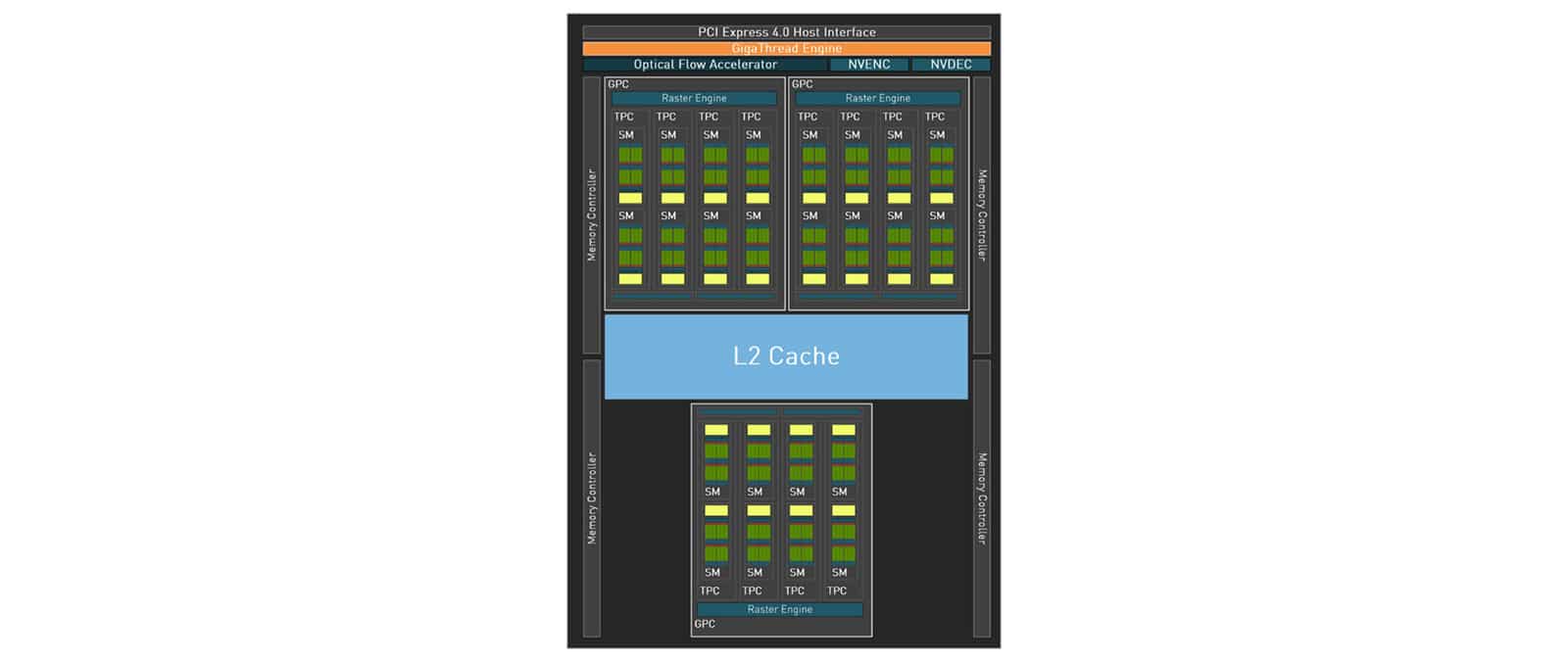
These new RTX also come with 4th generation Tensor Cores, which will be very useful for DLSS and DLSS 3 AI as well as 3rd generation RT Cores which will allow to double the performance of Ray Tracing. In addition to the evolution of generation, their number also increases compared to the previous generation depending on the model.


By the way, here is a comparison table to judge the differences between these cards.

DLSS 3 is now available and operational:
One of the announcements of NVIDIA during its conference is the arrival of DLSS 3. Be careful though, this one is only compatible with the RTX 4000. Owners of a previous generation card will be happy with the DLSS 2 that NVIDIA will continue to develop in the coming months.
As a reminder, until now, the principle of DLSS (Deep learning super sampling) was to allow a gain in terms of FPS by replacing the antialiasing TAA. The idea is to calculate the rendering in a lower definition than that chosen in the parameters and then to replay it in the definition said using an AI applied via the Tensor Core while maintaining an image quality as perfect as possible.


Today, with the arrival of DLSS 3, things are changing even if the fundamental principle of increasing the number of FPS is still the main reason. The novelty comes from the fact that DLSS 3 allows you to add whole intermediate images and no longer pixels. This increases the number of frames per second and consequently the fluidity. To achieve this, DLSS3 uses an optical flow gas pedal integrated into the new RTX 4000 architecture. This is why previous generations that do not have this will not be able to benefit from DLSS 3. We will have to be careful during our tests and compare what is comparable because yes, of course DLSS 3 will be more powerful but it is difficult to judge it on the Ampere generation which does not support it.
Even if the main function is to increase the number of FPS, NVIDIA also reminds the importance of latency. We had already dealt with this subject by talking about Nvidia Reflex. To summarize simply, the principle is to reduce the latency in games as much as possible, that is to say the time that elapses between the moment you click on the button of your mouse and its manifestation on the screen. In order to be able to perform all the readings, a compatible mouse will be necessary.


The latest advances from NVIDIA could turn the world of e-sports upside down, as we could see 1440p 27″ displays replacing the current 1080p 25″ displays. Finally, NVIDIA has already announced over 35 games that are compatible and ready to use DLSS 3. We will of course add games that support DLSS 3 to our tests. Of course DLSS 3 games are backwards compatible with DLSS 2 technology.
AV1 hardware compression:
NVIDIA is now integrating its 8th generation NVENC encoder with AV1 which is 40% more efficient than H.264. The arrival of AV1 will be very useful especially for streaming.
[nextpage title=”Test configuration: “]
As we said in the introduction, we’re (once again) busy updating all our graphics with the latest drivers from NVIDIA, AMD and now, of course, INTEL. We’ve also taken the opportunity to slightly modify our test configuration. So here we go again, with a new series of tests and graphics on this slightly modified configuration:
- Motherboard: ROG Maximus Z690 APEX
- Processor: Intel Alder Lake i9-12900K
- Memory : 32 GB Corsair Vengeance 5200 CL38 DDR5
- Graphics card: Gigabyte RTX 4060 WindForce OC 8G
- Cooling system : Asus ROG Ryujin II 360
- SSD: Western Digital Black SN750 2 TB EKWB radiator
- Power supply: Corsair AX1600i adapter 12VHPWR 600W
- Operating system: Windows 11 64-bit
For this test, we used a high-end configuration featuring an i9-12900K processor and DDR5. The use of a 144 Hz 4K display is also a sine qua non. For our tests, we’re using the ROG PG27UQ.
As we said in the introduction to this article, all our tests have been redone over the last few days with all our cards and with the latest drivers available!
The drivers used are the latest for each manufacturer, with NVIDIA 536.20, AMD Adrenalin-Edition-23.10.01.16 and Intel ARC 31.0.101.4369.
Our test protocol :
All cards are tested at stock frequencies and without any optimization. For the various benchmarks, whether synthetics or games, we’ll opt for 1080p, 1440p and 2160p resolutions, depending on the card’s performance. Here, with this model, we’ll be using 1080p and 1440p for Rasterization and 1080p for Ray Tracing.
As you can see, we’re now running Windows 11, and we’ve activated the ” ReSize BAR ” in the BIOS, which can be seen in GPU-Z. Now that you know everything about our test configuration, it’s time to get started!
[nextpage title=”Synthetic benchmarks: “]
Our first series of tests will be dedicated to synthetic benchmarks. These are often used for overclocking competitions, but are also very interesting for comparing different GPUs. We’ll be focusing on benchmarks from the 3DMark series.
We’ll be testing the following benchmarks:
- Fire Strike (1080p)
- Fire Strike Ultra (2160p)
- Time Spy (1440p)
- Time Spy Extreme (2160p)
- 3DMark Speed Way
- DirectX Raytracing
- Intel XeSS
- Mesh Shader
- 3DMark DLSS Feature Test (2160p)
3DMark Fire Strike and Fire Strike Ultra:
Let’s start with 3DMark Fire Strike, one of today’s most widely used benchmarks. It consists of two graphics tests, a CPU test and a fourth test that combines GPU and CPU. Don’t forget to deactivate the demo, which makes no contribution to the final score and prolongs the benchmark’s duration (unnecessarily). The version used for these tests is, of course, the latest.
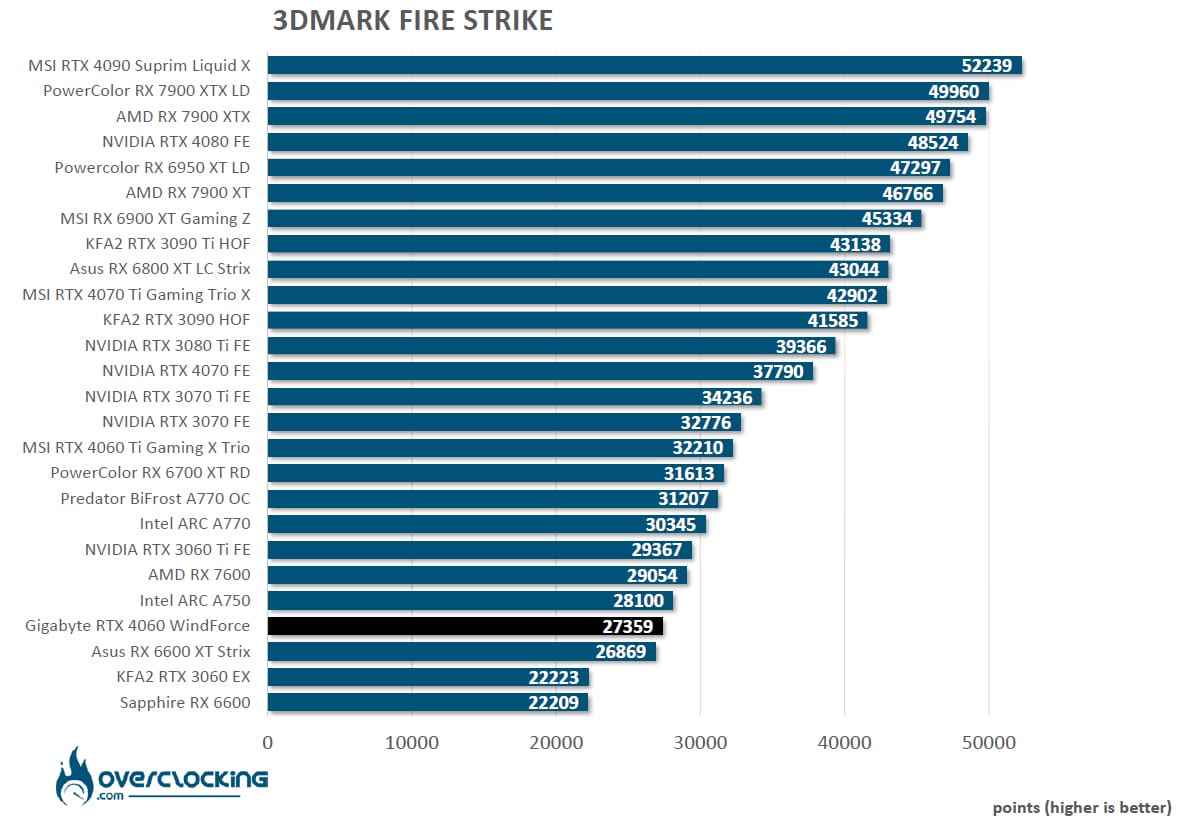
This is our first benchmark with this Gigabyte RTX 4060 WindForce OC 8G, and the least we can say is that we expected to see it a little higher up our ranking, even though we know that Fire Strike is more to the advantage of AMD cards.

Under Fire Strike Ultra, as was the case with the RTX 4060 Ti, the card struggles and even falls behind the RX 6600 XT.
3DMark Time Spy and Time Spy Extreme:
The second test is 3DMark Time Spy. Although this one is performed in 1440p, its main feature is that it uses DirectX 12. It consists of two graphics tests and a CPU test. As with Fire Strike, don’t forget to disable the demo. The first two benchmarks are provided by UL Benchmark.

The performance obtained in Time Spy is often representative of what we’ll get in games. Here, our sample of the day is on a par with the RX 7600, which should give us an indication of gaming performance close to that of the AMD model. The Intel A750 ARC can be seen to perform much better, but will it do the same in games?

Under 3DMark Time Spy Extreme, the RTX 4060 and the RX 7600 perform identically, and are both within striking distance of each other.
3DMark Speed Way
Ulbenchmark’s latest benchmark, and it’s nice to be able to say that we’re going to have a go at this Speed Way. It uses DirectX 12 and defaults to 1440p. We haven’t modified anything, so we’re using the original benchmark.

Here too, our Gigabyte RTX 4060 WindForce OC 8G scores 2554 points. We’ve also taken the opportunity to run the old cards through the benchmark again, to make it more complete.
3DMark DirectX Raytracing:
UL Benchmarks has added a new test to its series of benchmarks for measuring Ray Tracing performance. The idea is to use the 3DMark DirectX Ray Tracing test to compare the performance of Ray Tracing hardware dedicated to graphics cards from AMD and NVIDIA, and now also from Intel!
The 3DMark DirectX Ray Tracing test is designed to make Ray Tracing the limiting factor. Instead of relying on traditional rendering, the entire scene is traced and drawn in a single pass. The test result will depend entirely on Ray Tracing performance. This makes it easy to measure and compare the performance of different cards.
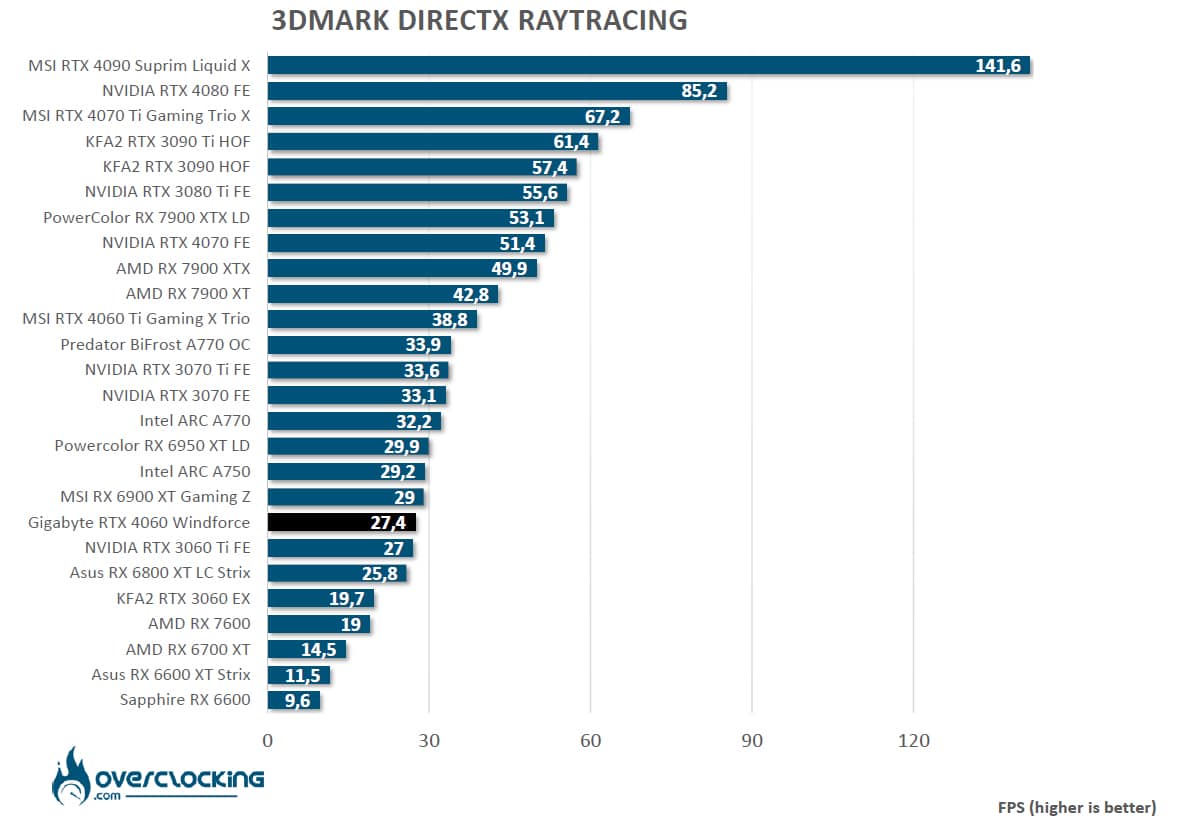
This benchmark has always been dominated by NVIDIA cards, and today’s sample is no exception, with a score of 27.4 FPS. It’s the addition of CUDA cores and higher frequencies that have a huge impact on the performance gain over the previous generation.
3DMark Intel XeSS
UL Benchmarks, in collaboration with Intel, will be adding this new benchmark to the 3DMark suite. We had early access to this new test for our tests. This Intel XeSS test is designed to evaluate and compare the performance and image quality of XeSS (Xe Super Sampling). There are four XeSS modes to choose from: Ultra Quality, Quality, Balanced and Performance. The 3DMark inspection tool helps you compare image quality with a side-by-side view of XeSS rendering and native resolution rendering. You need a graphics card that supports Intel XeSS to run this test.
So we’ll have two scores, a number of FPS with XeSS disabled and then, on the right, with XeSS enabled. The mode chosen is “Ultra Quality”, which is actually the benchmark’s default mode.


In this new benchmark, all graphics cards without exception benefit from XeSS, but it’s Intel that reaps the greatest gain. ARC models see a gain of 50
while NVIDIA and AMD models see gains of between 30% and 35%.
3DMark DLSS Feature Test:
We didn’t keep this benchmark, since it only concerns DLSS-compatible cards and was therefore not useful for our comparative tests. Here, we’ve retested it, since it officially supports DLSS 3 since the end of the NDA on the RTX 4090.
So we’re going to run a 2160p benchmark first with DLSS disabled, then with DLSS 2 performance and finally with DLSS 3 performance.

Our Gigabyte RTX 4060 WindForce OC 8G achieves a score of 12.4 FPS without DLSS, then 37.4 FPS (201%) with DLSS 2 enabled. DLSS 3 still delivers a 71% gain over DLSS 2, so we can see just how much the arrival of DLSS 3 has boosted gaming performance.
Well, to conclude this first series of synthetic tests, we’re right on target with our performance expectations. We’re well ahead of the RTX 3060 and very close to the performance of the RX 7600. We should have very good 1080p performance in rasterization.
[nextpage title=”Gaming performance 1080p and 1440p: “]
We’ve decided to select six games that we feel are sufficiently representative. We opted for DirectX12 and Vulkan with the following games:
- The Division 2 (DirectX 12)
- Borderlands 3 (DirectX 12)
- Red Dead Redemption II (Vulkan)
- Far Cry 6 (DirectX 12)
- Watch Dogs: Legion (DirectX 12)
- Cyberpunk 2077 (DirectX12)
We’ve chosen to use the built-in benchmarks for these games.
Why do we do this? Quite simply to enable you to compare your results with ours if you also own a copy of one of these games. It’s a thought-provoking idea that will enable you to compare your results with ours.
As we mentioned on page 4 of this article, we have activated the Resizable Bar in the BIOS, which is now supported by all (recent) GPUs. Last but not least, we’ve opted for 1080p and 1440p resolution only, which is what you’d expect from these cards.
The Division 2:
The Division 2 will be tested under DirectX 12. As far as graphics parameters are concerned, they will be set to ” ultra ” mode, with vertical synchronization deactivated.


First game, and the trend seen in the synthetic benchmarks is confirmed: our Gigabyte RTX 4060 WindForce OC 8G is well ahead of the RTX 3060, and even ahead of the RX 7600. Note that this is one of the least power-hungry games in our panel. No difference in 1440p definition, where positions are still identical. It’s worth noting, however, that Intel ARCs are lagging behind.
Borderlands 3:
For the second game, we switch to Borderlands 3. Graphics options are set to ” Brutal “. It’s worth noting that Borderlands 3 is quite greedy and that this choice of settings has a fairly strong impact on FPS. It’s a game that’s often praised in announcements of new graphics cards, and precisely in this Brutal mode.


Performance here takes a back seat, and although our Gigabyte RTX 4060 WindForce OC 8G performs 15% better than the RTX 3060, AMD’s RX 7600 is far ahead. The ARX A750 rivals and scores almost exactly the same as our sample of the day.
Red Dead Redemption 2:
The third and by no means least important game is Red Dead Redemption II on PC. The advantage of this opus is the possibility of testing the integrated Vulkan benchmark. We opt for the ” ultra ” graphics options.


Third and by no means least, RDR2 offers the possibility of testing the integrated Vulkan benchmark. Our three challengers of the day come within a whisker of each other in 1080p, which leaves some suspense for the other games.
Far Cry 6:
The latest game we’re adding to this section is Far Cry 6, since it supports DXR as well as AMD’s SFR. We’ll also look at it on the next page. For our benchmarks, we opted for ” ultra” graphics quality.


Even though our report on this game showed an advantage for the RX 6000 cards, our sample of the day performs just as well. In 1080p, it’s a number of FPS almost equivalent to the RTX 3060 Ti, and in 1440p, our RTX 4060 places between the two Intel cards and ahead of the RX 7600.
Watch Dogs Legion:
Last but not least, Watch Dogs Legion will also be used for our Ray Tracing tests. For our benchmarks, we’ve opted for ” very high” graphics quality.


In the Watch Dogs Legion benchmark, we are obliged to set the graphics quality to “very high” rather than “ultra”, as the benchmark then tells us that the 8 GB of memory is not enough. Once again, our RTX 4060 performs very well, even if this benchmark is more to the advantage of the reds.
Cyberpunk 2077:
Here’s a game we’ve been wanting to add for a while, and now we’ve done it, with an integrated benchmark. We’ll also be using this game for our Ray Tracing tests. For our benchmarks, we’ve opted for “ultra” graphics quality.


New and final benchmark for this panel of games. The 80 FPS mark is reached at 1080p, and 55 FPS at 1440p with ultra graphics quality. For the rest of the graphics, we’re perfectly consistent with our previous results.
Game average:
For the gaming average, the RTX 3060 is the reference card in 1080p, and the RTX 3070 in 1440p definition. Other cards score either higher or lower, depending on their performance against this model.


In 1080p, our RTX 4060 outperforms the previous-generation RTX 3060 by 20 ace overall. Against its AMD rival, the RX 7600, it lags slightly behind. As we’ve seen, depending on the game, it’s either the NVIDIA or AMD card that takes the lead. Intel ARC cards lag behind in 1080p, but are more efficient in 1440p.
[nextpage title=”Ray tracing and DLSS/FSR performance:”]
Let’s take a look at the seven games we’ve selected that support Ray Tracing and DLSS, and in some cases AMD’s FSR, as well as Intel’s new XeSS technology, which is supported by Shadow Tomb Raider and Hitman 3. As we’ve already reminded you, while DLSS remains the property of NVIDIA, FSR and XeSS can be used with all cards from AMD, Intel and even NVIDIA.
The seven DirectX 12 games we’ll be testing with Ray Tracing and DLSS, FSR or XeSS are :
- Shadow of the Tomb Raider (DLSS)
- Watch Dogs: Legion (DLSS)
- Metro Exodus PC Enhanced Edition (DLSS)
- Far Cry 6 (DLSS – FSR)
- Cyberpunk 2077 (DLSS 3 – FSR)
- Hitman 3 (DLSS 3 – XeSS)
- Forza Horizon 5 (DLSS 3)
No change for this new series of games, as we’re sticking with 1080p definition. Depending on the card, we’ll be using DLSS for NVIDIA and either FSR or XeSS for AMD models. If FSR isn’t available in a game, then we’ll give our AMD card the benefit of XeSS technology.
DLSS 3: watch out for our results!
As you know, NVIDIA unveiled DLSS 3 with the arrival of the RTX 4000 graphics cards, and in particular with the launch of the RTX 4090 version. So why the warning? Because NVIDIA now offers DLSS3 support on many games, but this is only supported by RTX 4000s. To put it simply, if we test a game that benefits from DLSS 3, our RTX 4060 Ti will take advantage of it, but an RTX 30xx will make do with DLSS 2, resulting in even greater discrepancies.
We currently have three games that support DLSS 3, and we’ll be increasing this number over the coming weeks. Updating all our graphics to 1080p and 1440p has taken us a long time. You can find the list of compatible games here.
Shadow of the Tomb Raider:
The first game we’ve added to this comparison supports Ray Tracing and DLSS 2.0. The game features three Ray Tracing levels (medium – high – ultra) and four DLSS levels (performance – quality – balanced – ultra performance).
For our benchmarks, we opted for ” very high ” graphics quality, ” ultra ” Ray Tracing and ” balanced ” DLSS.

With Ray Tracing activated in ultra, an average of 99 FPS is already achieved. The addition of DLSS 2.3 raises our average to 139 FPS, so there’s no difficulty in enjoying 1080p with Ray Tracing activated. In this first game, our Gigabyte RTX 4060 WindForce OC 8G leaves all its rivals behind.
One small note: Shadow Of The Tomb Raider has been equipped with XeSS, enabling AMD cards to benefit from this technology. You can still judge the difference in performance between the two technologies.
Watch Dogs Legion:
The second game, Watch Dogs Legion supports Ray Tracing and DLSS 2.0. It proves to be one of the most demanding games of the moment. The game features three Ray Tracing levels (medium – high – ultra) and four DLSS levels (performance – quality – balanced – ultra performance).
For our benchmarks, we opted for very high graphics quality, ” high ” Ray Tracing and ” balanced ” DLSS.

The Ray Tracing in Watch Dogs Legion is beginning to take its toll on the cards, but our sample of the day fares rather well, achieving an average of 62 FPS. Activating DLSS 2 will boost FPS to an average of 97 frames per second. Our RTX 4060 takes on the scalp of the RX 6700 XT.
Metro Exodus PC Enhanced Edition:
Third game to support DLSS 2.0. The game offers three levels of Ray Tracing and four levels of DLSS (performance – quality – balanced – ultra performance).
For our benchmarks, we opted for ultra graphics quality, ” ultra ” Ray Tracing and DLSS in ” balanced ” mode.

We continue with greedy games and here, our Gigabyte RTX 4060 WindForce OC 8G allows itself to do as well as the RTX 3060 Ti.
Far Cry 6:
Far Cry 6 supports DXR as well as AMD’s FSR, but not DLSS.
For our benchmarks, we opted for Ultra graphics quality, activated both DRX options and FSR in ” balanced ” mode.

In Far Cry 6, FSR is the only choice available to boost FPS after enabling Ray Tracing. So all our cards can benefit, regardless of manufacturer. Nothing really changes in the hierarchy, with the RTX 4060 still well ahead of the RX 7600.
Cyberpunk 2077:
A new game that we’ve added to our line-up, and which features DLSS and FSR activation in its settings. Note that this is the first game to enable DLSS3 for RTX 40xx graphics cards.
For our benchmarks, we opted for “high” graphics quality, “medium” Ray Tracing and ” balanced ” DLSS/FSR.

This is the most demanding game, where our cards have great difficulty keeping up. Here, an average of 44.8 FPS is achieved. DLSS 3, which we mentioned at the start of this page, offers a very significant gain, as you can see from our graph. From 44.8 FPS to 120.6 FPS!
Hitman 3:
Hitman 3 is now compatible with DLSS, FSR and XeSS technology. Depending on the model of card tested, we opt for one of these three technologies.
For our benchmarks, we opted for “high” graphics quality, ” enabled ” Ray Tracing and ” balanced ” DLSS/Xess.

Although we support DLSS 3, we were unable to judge a greater difference when using our RTX 4060 Ti, since the DLSS3 option remains grayed out, even though our game is perfectly up to date. Let’s find out why.
Forza Horizon 5:
The latest game to be added to our panel, this one now supports DLSS 3 technology. For our benchmarks, we opted for ” extreme ” graphics quality, ” extreme ” Ray Tracing and ” balanced ” DLSS/Xess/FSR.

This new game, which also supports DLSS 3, clearly demonstrates its potential. With Ray Tracing activated, our RTX 4060 is ahead of the RTX 3060 Ti, and with DLSS 3 active, the advantage is even more obvious.
So Ray Tracing with the RTX 4060:
On our seven games tested, our RTX 4060 had no problems whatsoever, and apart from Cyberpunk 2077, the average was always very close to or above 60 FPS. The good news is that when we use Ray Tracing, the RTX 4060 often performs as well as the RTX 3060 Ti. We were also able to judge the undeniable benefits of DLSS3. Once the hardware launches have calmed down a little, we’ll come back to DLSS3 in detail, with comparative videos and photos.
[nextpage title=”Temperature, power consumption and nuisances: “]
Temperature:
To take temperature readings, we opted for the Superposition stress test in Extreme mode. We opted for three 5-minute runs with 10-minute intervals between each test. We took advantage of this benchmark to record the graphics card’s power consumption for the table above.
To find out the Idle temperature, after completing the three stress test loops, we let the card rest for 20 minutes before taking the temperature reading. Bear in mind that most boards benefit from “0 dBa” technology, so the fans cut out below a certain temperature, often between 50 and 55°C. It therefore takes longer to dissipate heat after a period of stress testing or gaming. A card that does not benefit from this technology will be noisier than others at rest. A quick reminder: our temperature readings are taken in Open-Air. In a closed case, the cards will inevitably be warmer.

As we expected, temperatures are at the high end of our ranking, with a maximum of 69.6°C. The heatsink is quite light in its design, which explains the rise in temperature. Now, there’s nothing catastrophic about it, and it’s perfectly within the norms for a model of this size.
Power consumption (full configuration):
We use a wattmeter to measure power consumption at the output of our power supply. Our modular power supply is a CORSAIR AX1600i. The result is the average total power consumption of our configuration. Only the graphics card changes between each reading. This makes it easy to calculate the difference between each graphics card.

As we suspected, the overall power consumption of our configuration equipped with our Gigabyte RTX 4060 WindForce OC 8G was another excellent surprise, with an average of 206 watts. Please note that the benchmark used only applies to the GPU. For gaming use, the overall power consumption of our configuration will be higher, but this applies to all our graphics cards.
This result confirms the work carried out by NVIDIA on the ADA Lovelace architecture, in conjunction with the new finesse engraving. Our RTX 4060 is now the queen of these graphics, and therefore the graphics card with the lowest power consumption in 2023. As soon as we get our hands on the PCAT tool or the new version of the ElmorLabs PMD Power Measurement Device supporting 12 4 pins, we’ll update this chart, isolating only the graphics card.
[nextpage title=”The last word: “]
We’ll conclude by comparing NVIDIA’s current offering with this Gigabyte RTX 4060 WindForce OC 8G against its direct competitors, the RX 7600 and ARC A750. Indeed, if you think that in 2023, an entry-level card costing around 300 euros is too high, look no further. Our aim is to give you our impressions of the current offer, whether you’re for or against. We’ve already had the opportunity to share our impressions on the current price debate, and like everyone else, we’d like to see hardware prices pulled down.
We’d also like to stress that we don’t see the latest entry-level cards from NVIDIA or AMD as a replacement for the previous generation, but rather as an upgrade for a 4 or 5 year-old system. As we’ve seen, the NVIDIA RTX 30xx and AMD RX 6xxx cards still do the job perfectly.
This RTX 4060 versus AMD’s RX 7600?
With an MSRP of 299 euros, which could fall even further in the coming weeks, the RX 7600 has the edge over the RTX 4060 in 1080p rasterization. Admittedly, the advantage is only a few percent, but the difference is also in terms of price, since the MSRP of the NVIDIA RTX 4060 is 329 euros.
But the RTX 4060 has a number of assets not to be overlooked, starting with its first-place ranking in our power consumption graphs, making it the best card we’ve had in our hands for years. The performance provided by the DLSS3 is certainly not to be overlooked either, and our sample of the day performs very well against the RX 7600 in this little game. We don’t think anyone will be deprived of a few extra FPS, especially on an entry-level model that can make your games run more smoothly. So it’s availability and any changes in MSRP prices that will make either model the most attractive.
This RTX 4060 versus Intel’s ARC A750?
Currently priced at 260 euros, the Intel ARC A750 could be just the thing for 1080p gaming. Yes, it’s a very interesting card, but it consumes far more power than the RTX 4060 and RX 7600. In terms of rasterization performance, it’s 14% less efficient than the RTX 4060 and 18% less efficient than the RX 7600. If we apply a rule of three to the price/performance ratio, Intel’s offer holds up well.
Gigabyte RTX 4060 WindForce OC 8G :
As for our model of the day, the Gigabyte RTX 4060 WindForce OC 8G, we have very little to reproach it with. The only downside concerns the cooling system, which we feel is a little too light, although fortunately the RTX 4060 doesn’t consume much power. Otherwise, it’s an excellent choice for a card priced at 329.99 euros MSRP.
A word about overclocking, too, which is ultra-limited, since the card has no margin for power limit, and remains at 100%. The final gain is barely 4t, which is a real shame. We’ll see if the overclocking capability is better on a “higher-end” model. See you tomorrow.
We liked :
- A card for full 1080p enjoyment, and why not 1440p in rasterization?
- 20ace higher performance than the RTX 3060
- Quality of design and finish for an entry-level card
- Very low noise levels
- Power consumption that makes it the number 1 card in our comparison
- A coherent price compared to the previous generation (RTX 3060)
- DLSS 3 support and the arrival of more and more compatible games
- NVIDIA software suite
- Availability of 8th generation NVENC encoder with AV1
We would have liked :
- A more efficient cooling system design
- Higher overclocking potential, no margin for power limit
 With this RTX 4060, the most affordable card in the ADA Lovelace architecture, NVIDIA offers us the best power consumption chip in years. In terms of performance, it’s 20 ace more efficient than the previous generation and supports DLSS3, which will help you gain FPS and make your game smoother. Now the competition is on the lookout, and this bodes well for future buyers who will opt for the card that best matches their expectations. Thanks to Gigabyte France for making this sample available.