

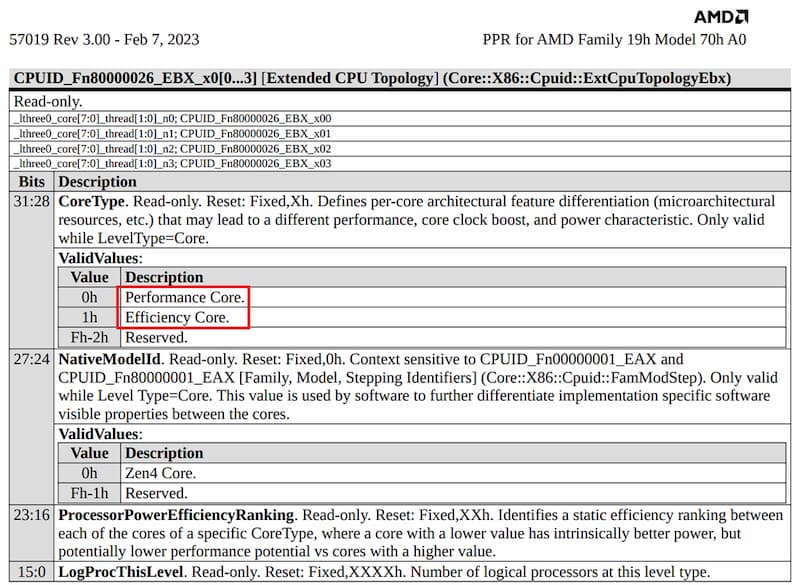
With the upcoming Phoenix 2 APU, AMD is reportedly preparing to launch its first hybrid processor this year. The chipmaker’s latest “Processor Programming Reference” mentions the use of “Performance” and “Efficiency” cores in the same way as its competitor Intel has been doing for 2 generations now. The main question concerns the architecture of the “Efficiency” cores. It seems unlikely that AMD will come up with really different P and E cores. There is indeed a good chance that for the Phoenix 2 APU we will be dealing with a central cluster that is limited in frequency to act as an E core. But this solution would only be a first step towards a wider adoption of this architecture by the Reds. Using the hybrid architecture would allow AMD to offer more efficient designs for lightweight, battery-powered products such as low-power game consoles and ultra-laptops.
AMD Phoenix 2: an APU to stay competitive in mobility
However, we shouldn’t be too quick to conclude that AMD is simply following Intel. The Reds are already using the hybrid “big.LITTLE” architecture with Zen4c. A new EPYC series codenamed “Bergamo” is also in the pipeline. However, Intel has a significant lead on the subject and should try to widen the gap with its competitor this year in the field of mobility with Meteor Lake dedicated solely to laptops.