

People don’t talk about it enough, but cameras get pretty hot… Especially when they have to record video while generating cryptographic proof of the authenticity of the captured images. Without proper cooling, there can be some issues during recording, which is why Josh Cowell is installing an NF-A4x10 fan in the housing of his CAIM1.
CAIM1: a camera cooled with a Noctua fan!
A camera that needs cooling!
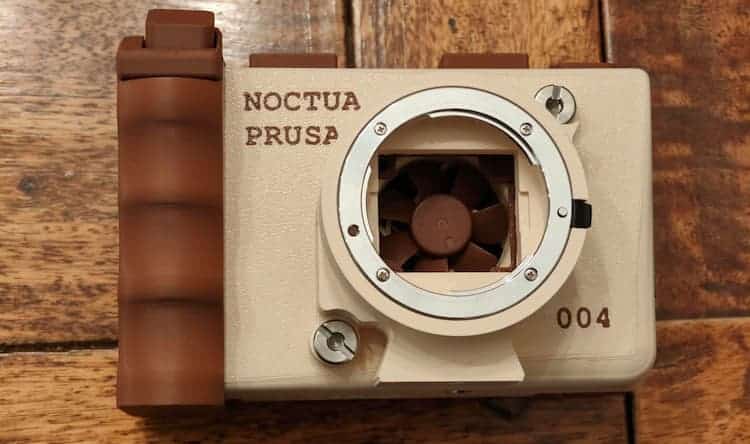
Simply put, the CAIM1 is a camera that records 4K video at 60 FPS while simultaneously producing cryptographic proof of the images’ authenticity. In fact, the acronym CAIM1 stands for Counter Artificial Intelligence Machine 1. In short, during image processing and certification, the hardware can start to heat up, which can lead to some issues. This results in a drop in the number of frames recorded during capture.
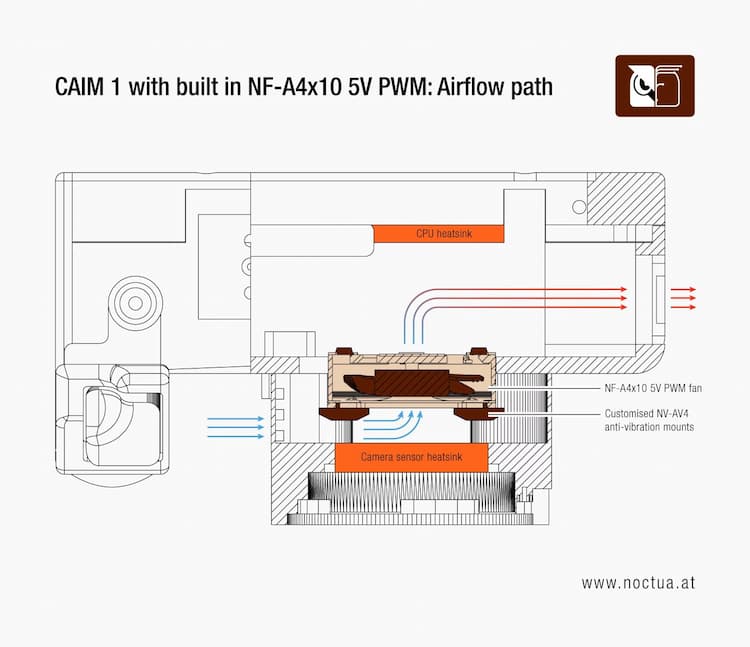
Of course, one might think that simply attaching a fan would solve the problem… But if you use just any fan, you run the risk of the audio being disrupted by the noise generated by the fan. Similarly, the sensor may also be affected by the fan’s vibrations if the build quality or assembly leaves something to be desired.
The NF-A4x10: The Perfect Solution?
Ultimately, for content creators, the NF-A4x10 5V PWM proves to be the perfect solution, since it effectively cools the camera without making too much noise, thereby preserving the audio recordings. On the other hand, the fan’s stable operation doesn’t interfere with the photo/video sensor or the resulting images. In short, it’s a fan that seems to fit anywhere; in fact, it’s even included in the Pulsar Feinmann F01 Noctua Edition that we tested here:
In any case, the camera housing was recreated using 3D printing with filaments in the Austrian brand’s colors. The fan is mounted on a small frame that is also 3D-printed and held in place using the brand’s silicone grippers.
For now, it’s a prototype, but it’s expected to be showcased at the Ethereum Tokyo Week and Pragma Tokyo 2026 trade shows, with the first batch set to launch in the first quarter of 2027.