

The second kit we are going to review is labeled “EXPO”. It is a kit from GSKill, the Trident Z5 NEO 6000 MT/s CL30 EXPO that we will test today on the ROG Crosshair X670E Gene. Last week we tested the Corsair Dominator Platinum RGB 6000 MT/s CL30 EXPO.
“EXPO”, but what is that? These are DDR5 memory kits that are intended for motherboards built around the X670E and B650E chipset. They have two profiles with a second more optimized profile, but is this really the case? We would also like to take this opportunity to thank GSKill for giving us the opportunity to review this $229,99 kit.

So, a little comment on the choice of unit for memory frequency. For several months, manufacturers and many of our colleagues have not used MHz to talk about the frequency of the memory. Either some use MT/s or Mbps. On our side, we will pass on MT/s at the moment while waiting to see what will become the new standard.
Don’t hesitate to ask us your questions if you have any problems with the settings either in comments or on our social networks. You can also join our community on the discord.
[nextpage title=”Packaging description: “]
Packaging Description:
The GSKill kit is delivered in a cardboard box with the usual color code in the spirit of the brand. One of the two black bars can be seen on the front of the box thanks to the cut-out. We can see that they are enclosed and protected in a transparent plastic protection. On the back of the box, there is also a label that informs the future buyer of the characteristics of his memory kit. Two cut-outs, at the level of the labels, allow to have the confirmation of this information.
Once the box is opened, we find our two modules perfectly protected in a transparent plastic shell. This series ” Trident Z5 NEO ” is mainly intended for AMD motherboards. It is the reference “NEO” which indicates it to us since GSKill has already used it to propose kits optimized for AMD platforms.


There are five different versions at the moment. The Trident Z5 NEO kit is available in either grey or black. In addition, you will have the choice to choose a version with or without RGB backlighting.


Our sample of the day is black and without RGB. The range goes from 5200, 5600 to 6000 MT/s. As for the timings, they also differ according to the kit, but we have the kit with the highest frequency and the tightest timings.
Features and cooling:
Our kit is clocked at 6000 MT/s, has timings of 30-38-38-96 and requires a voltage of 1.35 volts to operate. It is composed of two 16 GB modules for a total of 32 GB. We are here on full black.
The Heatspreaders are in aluminum and here of black color. They are responsible for dissipating the heat generated by the PCB composed of eight layers and the memory chips. If you have already had a G.SKill Trident kit in your hands, you will quickly notice that G.KSill has kept the same spirit in the design of the heat sink.

On both sides, we find the name of the series. A label includes some of the characteristics of our kit. Regarding the price, this kit is currently available for 454.95 euros at LDLC. It is possible to find it cheaper especially in this period of Black Friday.


On the upper part, no RGB but just the inscription G.Skill. To finish this presentation, please note that the kit is compatible with the new EXPO profiles. So do not forget to activate the profile directly via the BIOS of your motherboard.
[nextpage title=”What’s new in DDR5: “]
The arrival of the Z670E chipset coincides with the arrival of new DDR5 memory modules. The main change is an increase in frequency and a higher capacity. Be careful, let’s make things clear straight away, it is not possible to use DDR5 modules on a DDR4 motherboard and vice versa. Even though DDR5 also has 288 pins, the notches do not match and this is voluntary in order not to have disasters.
The arrival of the PMIC module:
The great novelty of DDR5 is the presence of a PMIC module(Power Manager Integrated Circuit). Its role is to regulate the power supply of the memory stick. There is therefore one per strip. This one will use the 5 volts of your motherboard and convert it to provide the necessary voltage to your kit. For example, if your kit needs 1.1 volts, each chip will receive 1.1 volts.  Previously, it was the motherboard that was in charge of doing this. In reality, this has an advantage but also a disadvantage. The advantage is that manufacturers no longer have to provide this control on the motherboard PCB. So, a financial gain. But unfortunately, there are two types of PMIC. One is locked and will only accept the default values of your kit, this is called secure mode. The other type of PMIC is modifiable and will therefore allow you to increase the voltage beyond 2 volts. Fortunately, Asus on its Z690 APEX, has already begun to circumvent the restriction of the secure mode to reach 1.435 volts. We talked about this in detail in the article dedicated to the APEX.


The other question is about the heat release of this chip as well as the additional cost for a DDR5 kit. Personally, we didn’t notice any extra heat release during our testing. As far as pricing is concerned, it will be higher and it will also depend on availability.
Higher frequencies and lower voltage:
So what’s changing? First of all, manufacturers seem to favor 16 GB strips and therefore dual channel kits in 2 x 16 or 2 x 32 GB whereas we are used to 2 x 8 GB for DDR4. The frequencies are also on the rise with kits that start at 4800 MT/s while the standard seems to be at 3200 MHz in DDR4 and which can currently reach 6600 MT/s. Finally, who says high frequencies says (much) more relaxed timings.


The voltage is also improved since it will be able to decrease to 1.1 volt for DDR5 against 1.2 volt for DDR4. We are talking about a voltage of 1.1 volt for DDR5 kits at 4800 MT/s. The voltage will be higher if the frequency increases as you will see below.
ECC (Error Correcting Code) compatible with DDR5
The DDR5 boards will be able to integrate the ECC(Error Correcting Code). Uh, yes? The idea of this module is to detect possible errors and analyze them before sending them to the CPU. Now, this module won’t be available on all boards since it will increase the price of the kit. As long as we are talking about the price, it should be unfortunately (much) higher.


XMP 2.0 (DDR4) and XMP 3.0 (DDR5), the changes:
We go from XMP 2.0 for DDR4 to XMP 3.0 for DDR5. What changes at first is the possibility for a manufacturer to offer three different XMP for its memory kit. These must be enabled in the BIOS.

[nextpage title=”How to identify your memory kit: “]
The basic features:
You’ll tell me that it’s quite easy since you just have to look at the references announced by the manufacturer. Yes, but this is not enough, especially if you plan to overclock it! Some information is given by the manufacturer, but you’ll have to dig or even remove the heat sinks to find out the others.
On one side of the heatsink, we find the inscription “GSKill Trident Z5” and on the other, a label with the technical specifications of our copy. This is what we will look at in detail. For example, in the case of our example of the day, this is the information we know.
- The brand: GSKill
- Model: Trident Z5 NEO
- Capacity: 2 x 16 GB
- Frequency: 6000 MT/s
- Timings: 30-38-38-96
- Voltage: 1 .35 volts
- Review: –
In order to get an idea of the overclocking potential of your kit, this information is insufficient and we will have to go further. Indeed, it is also very important to know the revision of the PCB as well as the model of the chips that equip your memory kit. Depending on this information, the overclocking performance of the kit will be very different.

To find this information, there is currently only one solution, dismantle the heat sinks. The Taiphoon Burner software does not currently support DDR5 kits.
CPU-Z still present:
Fortunately, our trusty CPU-Z software is still there and allows us to check this information, especially on the type of chips that equip our kit. Currently, there are three types of chips: Samsung, Hynix and Micron. Be careful, since from now on on the DDR5 kits, we can have either Hynix M-die or Hynix A-die.

Our kit is perfectly recognized under Windows 10 and the different timings perfectly read. The memory chips that equip our kit are Hynix M-die. They are chips with a very good potential in overclocking.
The PCB of our memory kit:
We will dismantle the heatsinks in order to observe the PCB and identify the chips. Be careful not to accidentally detach any chips from the PCB! The best technique is to heat the heatsink with a hair dryer before gently prying it off and being patient.

As a reminder, the design of DDR5 modules will also be different from DDR4 with the presence of a PMIC (power management integrated circuit) chip on board. The idea is to allow a better management of the power supply and therefore the stability of the system.
Our kit therefore benefits from the Hynix M-die chips, of which there are 8. We are on a kit known as “SR” for single rank, meaning that all the chips are on a single side. On the other hand, we can find “DR” kits for dual rank with chips on both sides of the PCB. The Hynix chips have the reference “HY5CG48MEB0” and are 2GB versions.
[nextpage title=”The importance of the XMP profile: “]
Setup within BIOS:
We can’t say it enough, but the settings of your memory kit are not automatically set after you install it. If it is the case for your processor, it is not the case for your memory kit and a passage through the BIOS will be mandatory! You will be able to configure it manually, by choosing the right frequency, timings and voltage for your kit. For more ease, we advise you to activate the EXPO 2 mode in “AI Overclock Tuner” in order to set it up automatically.
There is also an EXPO 1 profile but personally we have tested both profiles and they give identical performances.
Without activating the profile, your performance will be impacted in all areas and you will end up with a kit that does not exceed 4800 MHz in CL40. We will therefore activate our EXPO profile directly in the BIOS as shown in the screenshots below with our ROG Crosshair X670E Gene.


The Asus BIOSes, whether on the APEX or the Crosshair models, benefit from memory profiles. They are good bases to overclock your memory kit. We will first use them in our overclocking tests. Our kit is now set up in the BIOS and will work with the manufacturer’s specifications.


As you have seen in the above captures, once the EXPO profile is activated, the settings are automatically detected. The frequency goes up to 6000 MT/s, the timings are activated and the voltage goes up to 1.35 volt.
[nextpage title=”Test on AMD configuration: “]
Of course, this kit will only be tested on an AMD platform since currently only AMD motherboards support EXPO profiles. We should however see these profiles being taken into account in the next BIOS of motherboards with an Intel chipset:
- Motherboard: ROG Crosshair X670E Gene (BIOS 0805)
- Processor: Ryzen 9 7950X
- Memory : 32 GB GSKill Trident Z5 NEO 6000 MT/s CL32 EXPO
- Graphics Card: MSI GT 710
- Cooling system : Optimus Foundation + 480 mm EK radiator
- SSD : Western Digital SN850 NVMe SSD M.2
- Power supply : be quiet! Dark Power PRO 12 1500w
- Operating system : Windows 10 64 bits
For our tests, since this is the second kit we are going to test with AMD EXPO technology, we have added the performance of the Corsair Vengeance 5600 MT/s CL36 memory kit. But don’t worry, there will be more AMD EXPO kits to test in the coming weeks.
Please note! All non-AMD EXPO compatible DDR5 kits below 6000 MT/s should be compatible without any problem but from 6000 MT/s onwards, opt for AMD EXPO. Our Corsair Dominator Platinum RGB 6600 MT/s CL32 kit is not recognized and it is impossible to activate the DOCP. In fact, it is quite complicated to be stable beyond 6400 MT/s on the new AMD chipset.
Aida 64 :
 It is a software able to provide you with a lot of information about your configuration but it has the particularity to have a memory benchmark. It will calculate the speed of reading, writing, copying and the latency of your memory kit. It is very often used to compare memory kits between them. It is an excellent tool if you want to compare the performance of your memory kit with those we have already had the opportunity to test.
The version used for testing is the latest beta version and we are just starting to test this type of memory kits, so it will take time for our graphs to grow. Please note that we do not recommend the purchase of a non-EXPO kit with a frequency higher than 6000 MT/s as it may not be compatible.

The performance of this first test seems perfectly logical to us, even if at the same frequency and on an Intel platform, the performance will be better. Our GSKill Trident Z5 NEO 6000 MT/s CL30 kit scores 79126 MB/s. Our sample of the day has slightly more relaxed timings than the Corsair kit. However, we should have roughly the same scores.

In writing, same observation but here our sample of the day reaches a flow of 79573 MB/s thus allowing him to pass in front.

The findings are identical in copy with here a second place for our Trident Z5 NEO with a speed of 69513 MB/s.

Finally, the latency. This is the value that all eyes are on because DDR5 is a bit behind. Here we get 62.1 ns for our GSKill Trident Z5 NEO 6000 MT/s CL30. As a reminder, AMD announced a latency lower than about 63 nanoseconds which is perfectly the case here.
Geekbench 3.4.4 :
 It is a benchmark available in several revisions, version 5 having just been released a few weeks ago. It allows you to obtain two scores: one in single and the other in multi. Using this benchmark, we will focus on the performance obtained on the ” Memory Multi-Core ” score which allows to differentiate the memory performance.
The version used for the tests is 3.4.4.

For the Geekbench 3 benchmark, despite the fact that in single core the frequency of our Ryzen 9 7950X is 5.8 GHz, there is a difference in score between the different memory kits. Our kit of the day takes the first place with 9072 points.

In multi core, the gap between our kits is less important since it is 430 points.

As soon as we isolate the memory score, real differences are visible between our two kits. Our kit of the day gets a score of 11265 points! Not always easy to compare with three kits, but as we said in the introduction, other kits will arrive later and will be AMD EXPO compatible.
Geekbench 5.2.5 :
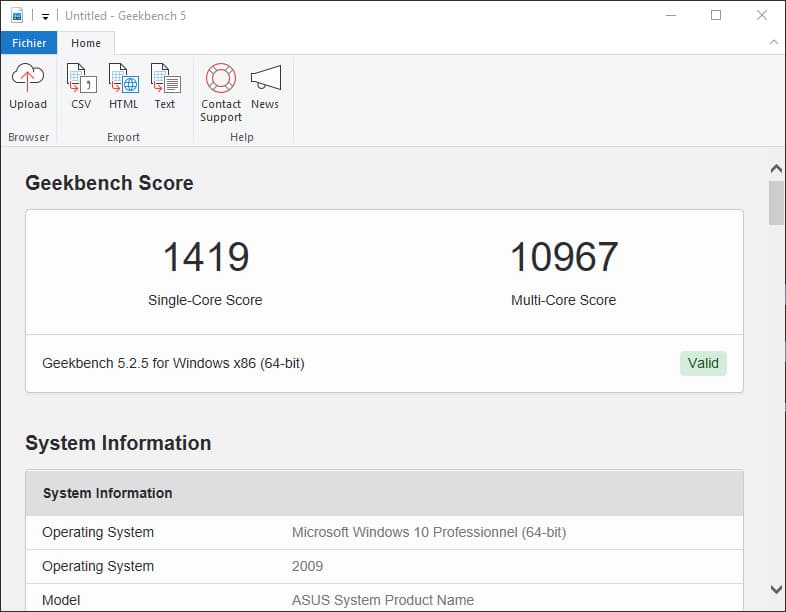 We decided to add this extra benchmark but why? The CPU benchmark uses new tests that more closely simulate the tasks that processors face in recent applications. Geekbench 5 also increases the memory used in the benchmark to better reflect the impact of this parameter in the CPU results. For now, we will keep both since version 3 is still widely used.

While in Geekbench 3 we had a difference in single core, here in version 5 the performance is pretty much the same and it’s still our kit of the day that takes second place with a total of 2345 points.

Finally, the last score of our benchmark series with a total of 24164 points for our sample. So, don’t stop this article here because overclocking is full of surprises!
[nextpage title=”Overclocking on our X670E Gene: “]
Choosing your DDR5 kit based on memory chips :
As it was already the case for DDR4, if you want to clock your memory, some brands will have a better potential. Currently, the EXPO kits announced by the various brands are only equipped with Hynix M-die chips. These chips have a good overclocking potential on Intel platforms. Attention, since a few weeks, there are also Hynix A-die chips which allow to go up in frequency more easily but no EXPO kit currently has them.
DDR5 EXPO “key” voltages:
This is really different from what happens with Intel. Here, four voltages seem to impact overclocking. The two main ones are the DRAM VVD Voltage and the DRAM VVDQ Voltage . During our overclocking tests, we also became aware that two other voltages could have an impact, these are VDDP and VDDIO.
We are just discovering overclocking on the AMD platform and it is quite different from what we have on an Intel platform. We’ll talk about it again in the overclockingsection.
Step 1: A little theory to get started
Well, let’s start with a theoretical reminder since there are some changes with the arrival of the ZEN 4 architecture as far as memory is concerned. While for the Ryzen 5000, the standard was to keep a 1:1:1 ratio between mclk:uclk:fclk, this will change with the Ryzen 7000. Indeed, they adopt the DDR5 memory. This one sees its frequency increasing, which implies changes in these ratios. AMD now recommends for AM5 motherboards in DDR5 a 1:1 ratio for the mclk:uclk and to finally leave the fclk in AUTO which will automatically set it to 2000 MHz. Theoretically, this is how it will behave:
- DDR5-4800 will give with the new 2400:2400:2000 MHz ratios (mclk:uclk:fclk)
- DDR5-5200 will give with the new ratios 2600:2600:2000 MHz (mclk:uclk:fclk)
- DDR5-6000 will give with the new ratios 3000:3000:2000 MHz (mclk:uclk:fclk)
Well, it may seem a bit complicated like that, but we’ll explain it all to you. First of all, don’t panic, if you activate your DOCP or EXPO profile in the BIOS, everything will be set up automatically. The explanations we give you here are for those who want to overclock their memory kit.
Step 2: fclk, uclk and mclk
The fclk is the frequency of theInfiny Fabric which can be, since the previous generation, controlled independently via the BIOS parameters. By default, this value is set to AUTO mode and it is the motherboard that will manage its frequency to ensure the stability of the system. Its maximum frequency is around 2100/2200 MHz but it also depends on the quality of your processor, but that’s the lottery that will decide. The mclk also sometimes called ” memclk ” is the frequency of your memory kit and the uclk is the frequency of the memory controller.


You should also know that if you exceed the frequency of 6000 MT/s with your memory kit, automatically the frequency of the memory controller (uclk) should switch to a ratio of 1:2 always in order to ensure system stability. AMD indicates that the best performing frequency and ratios are 3000:3000:2000(mclk:uclk:fclk). This is the reason why all DDR5 EXPO kits are 6000 MT/s.
We tested our DDR5 kits with a frequency higher than 6400 MT/s and none of them agreed to work.
Step 3: overclocking via profiles in the GENE BIOS
The ROG Crosshair X670E motherboard has three memory overclocking profiles compatible with Hynix kits in 2 x 16 GB. To do this, go to the BIOS in the “Extreme Tweaker” section and choose “Memory Presets”. There you will find a whole series of memory profiles.

We’re going to test each of these profiles to see the impact they have on the performance obtained with our original kit and you’ll see that it’s well worth overclocking!
Step 4: 6200, 6400 and maybe more?
To load the profiles, nothing could be easier, just click on them and validate. Be careful though, if the timings and the voltage are set automatically, you will have to change the frequency of the kit manually. For the first profile, we had to change the frequency in the BIOS from 6000 to 6200 MHz.
The profile 6200 1.4 volt and 6400 1.4 volt pass without problem. The second profile at 6400 MT/s uses a voltage of 1.5 volt. If our Corsair kit refused to boot with a voltage higher than 1.435 volt, it is not the case for our GSKill kit. The profiles present in the BIOS tighten up the subtimings very strongly which should bring a real gain in our benchmarks.

Here is a table that shows the different scores we got at these different frequencies under AIDA64 and Geekbench 3.4.4 comparing to the stock frequencies. We also added a new profile based on the 6400 MT/s profile where we went from CL32 to CL30 for the tCL.

The overclocking potential of this kit is excellent and thanks to the profiles, the performance gain is very interesting. We are surprised that manufacturers do not opt for tighter subtimings. Here are our two best scores under AIDA64 and Geekbench 3.4.4 with FCLK frequency increased to 2200 MHz, further optimized subtimings and a VDD/VDDQ voltage of 1.53 volt.


We continue our exploration of overclocking on this type of kit with the goal of passing the 100000 MB/s mark in reading.
[nextpage title=”The last word: “]
GSKill offers us with this Trident Z5 NEO kit a very interesting kit for the new AMD platforms based on the X670 and B650 chipsets. Priced at $229,99 or 454,95 euros, it is finally as expensive as the Corsair kit we reviewed last week. Our sample of the day has a perfect finish and above all an ultra sober design. It’s black, no RGB and this kit will fit on any motherboard design. The performance out of the box and with the EXPO profile is good. On the other hand, this GSKill Trident Z5 NEO kit shows its full potential when the subtimings are tightened, especially with the profiles available on our ROG Crosshair X670E Gene. The good news is that this GSKill kit does not have its voltage locked and unlike the Corsair kit, we can use voltages above 1.435 volts.
DDR5 performance is starting to improve on our X670E platform and hopefully we will see GSKill release an even more optimized kit with a frequency above 6000 MT/s before too long. Now some of the work is in the hands of AMD and it’s hard to see high frequency kits coming out with the limitations of the platform especially because of the ratio imposed by mclk, uclk and fclk.
GSKill Trident Z5 NEO 6000 MT/s CL30 EXPO:
We liked:
- The look of the heatsinks and especially their sobriety that will fit any motherboard
- The quality of finish of the memory modules
- The excellent overclocking potential of the Hynix M-die chips and the BIOS of our Crosshair
- Unlocked VDD/VDDQ voltages
- Lifetime warranty
- Performance with the EXPO profile
We would have liked:
- A lower price in Europe even if some versions are cheaper while keeping good performances
 Just like the Corsair kit, the out of the box performance is good but it is really the overclocking that allows to boost the performance and have results close to what we get on an Intel platform. The big advantage of this GSKill Trident Z5 NEO kit is that it doesn’t have its VDD/VDDQ voltages locked, which allows it to take full advantage of its overclocking potential. If you want to gain performance, this kit is a great choice!
Thanks to GSKill for making this sample available.