

Finally, that’s the first word that sums up the beginning of this test because yes, we’ve been waiting for Intel GPUs for quite a while. Now, let’s not forget that between the rumors of stopping production and the delays, this is a first generation of graphics cards for Intel. And as Raja has repeatedly reminded us, the number of obstacles for this first launch has been substantial. But now we are happy to say that we have a copy of the Intel ARC A770 16GB and the Intel ARC A750 8GB in the lab.
As a reminder, Intel launched its first entry-level model, the ARC A380 version, back in June. Here, with these two cards A770 and A750, we are on the two high-end models of the brand that we hope to see compete with AMD and NVIDIA in the definitions 1080p and 1440p. Finally, you should know that an Intel A580 is also on the program, but certainly not immediately.  Intel has summarized it well, it humbly lands with a first generation while not forgetting where they come from and where they want to go. Let’s not forget that personally, it is a real satisfaction to see a third brand land in the world of GPU with certainly the means to redistribute the cards.
On our side, our will is always to offer you the most relevant results, which forces us to regularly update our charts. And this is once again the case with the “re-run” of all our GPUs on our test platform with the latest drivers available to date. As you know, this takes time and therefore not all GPUs will be reintroduced to our graphics yet, but it will happen in the coming days. Unfortunately, we lost almost 36 hours due to a hardware failure of our main SSD containing all our games. Having only a VDSL connection, the time to re-download them all caused us a lot of delay.
But no worries, the main challengers of these ARC A770 and ARC A750 are well present and our graphics will focus on 1080p and 1440p definitions. [nextpage title=”ARC A770 and ARC A750:”] If you are a regular visitor to our site, you will have seen the first photos of the Intel press kit we received last Friday, which contained the two ARC A770 and ARC A750 graphics cards.
Architecture:
Our two ARC A770 and ARC A750 graphics cards are equipped with the ARC Alchemist architecture. This is the first generation of GPU launched by Intel. The goal of the brand is to continue to offer other cards in the future but it is currently difficult to know at what rate.
The ARC A770 Limited Edition card benefits from an ACM-G10 graphics chip with a 6nm manufacturing process by TSMC. The chip hosts 32 Xe Cores, 32 Ray Tracing units and 512 XMX Engines. It has 16 GB of GDDR6 in 256-bit, which translates into a bandwidth of 560 GB/s. Note that an 8 GB version will also be available. The average TDP is announced at 225 watts.


The ARC A750 Limited Edition has a chip that hosts 28 Xe Cores, 28 Ray Tracing units and 448 XMX Engines. It has 8 GB of GDDR6 in 256-bit, which translates into a bandwidth of 512 GB/s. The average TDP is also 225 watts.


As we said in our unboxing of the press kit, the two boxes are almost identical and it’s only the reference on the front panel that distinguishes them.
Bundle:
This one is non-existent except for some information leaflets and a thank you for the purchase of an ARC graphics card. Intel is cutting costs and can thus afford to keep its competitive pricing logic.


There is however a USB cable present in the box of the A770 version that will allow you to synchronize the RGB with the other components benefiting from an RGB backlight in your configuration. On the other hand, we received a very nice press bundle that you can discover here.
The cooling :
The two graphics cards we received are ” Limited Edition ” models. We will come back later on the difference between these versions and the others. The two boxes containing the GPU are perfectly identical except for the model number.


So we will limit ourselves to a series of photos of either one or the other to illustrate the features of these models. The card has two 85mm fans with 15 blades each. In terms of length, the card measures 267 mm and will occupy a width of two slots on your motherboard via a USB port.


To power this GPU, you will need an 8-pin and a 6-pin connector. Intel keeps traditional power connectors and that’s good. We can see on the right picture below the small USB connector that should allow the synchronization of the RGB with your other components when connected to your motherboard.


Design wise , it’s sober but very efficient. The card plays on black and anthracite colors. We have no doubt that modders will have a great time customizing these models. On the front panel, there are no inscriptions or logos, even on the central part of the fans. It is only on the top edge that it says “Intel ARC” and on the backplate where it says the model of the card.


The build quality is excellent and we really like the wrap around finish on the back of the card. This allows to make the connection between the front panel and the backplate. There are four outputs, three DisplayPort 2.0 and one HDMI 2.1. As for the prices that have already been revealed, we are talking about an ARC A770 16 GB starting at $ 329 and an ARC A750 at $289. With European taxes, we should be around 400/425 euros for the A770 but nothing is confirmed yet.
Radiator:
At the time of posting this article, we have not yet disassembled our samples for the simple reason that we did not know where to start this operation. Since then, we have seen our colleagues from Mydrivers who have stripped down their ARC A750 and ARC 770 samples. So we will use the pictures from their site.


We can discover the cooling system which is actually a vapor chamber that will be in charge of dissipating the heat of the different components. The copper part is in contact with the GPU chip via thermal paste and via thermal pads for the memory chips and the power stage.


This vapor chamber is associated with four copper heat pipes and connected to the radiator to optimize heat dissipation. The radiator is integrated into the vapor chamber. We will judge the performance of this cooling system which uses only 2 slots of thickness.
Yes, some backlighting:
But only on the ARC A770 version, the A750 does not have RGB backlighting and sees it replaced by a metallic border. The ARC A770 Limited Edition has four areas with RGB: around the two fans, on the top edge of the card as well as the “Intel ARC” logo and finally on part of the backplate.


Personally, but it’s a matter of taste, I find it much prettier without backlighting, it’s a bit too much or just in white.
The connectors:
To power the card, there is an 8-pin and a 6-pin connector. These are traditional connectors found on most power supplies. The card has three DisplayPort video outputs and an HDMI 2.1 port.
The bracket is perforated to let the heat escape under the pressure of the two fans. Now that we’ve had a good look at it, let’s move on to the insides of the card. [nextpage title=”Specifications and PCB:”]
The technical specifications:
In terms of frequency, let’s start with the ARC A750 Limited Edition, the GPU frequency is announced at 2400 but without having any information about the Boost frequency. The 8 GB of G-DDR6 memory runs at 2000 MHz (512 GB/s) on a 256 bit bus As for the ARC A770 Limited Edition, the GPU is announced at 2400 but without having any information on the Boost frequency either. The 16 GB of G-DDR6 memory runs at 2187 MHz (560 GB/s) on a 256 bit bus.


A small passage through GPU-Z to check that the information read is correct. No problem, the announced frequencies correspond to what is announced. On the other hand, currently there are still problems with the ” sensors ” tab, especially with the reading of the GPU frequency which is not active. Intel is working with GPU-Z to solve this problem.
Let’s unpack the PCB:
As we explained to you, we have not yet dismantled the cooling system. It is therefore impossible for us to reveal the PCB but thanks to our colleagues from Mydrivers, here are two pictures of it. The PCB has a chip size of 406 mm². It is an “in-house” PCB from Intel. Our Intel ARC A750 and A770 has 6 + 2 phases (GPU + memory). The number of phases is often determined by the current requirement of the graphics chip. The more current it needs, the more phases there are.


The memory chips are 8 in number and 1 GB on the A750 version and 2 GB on the A770 version. In addition to sharing the same cooling system, they share almost the same PCB. [nextpage title=”Intel Xe Super Sampling:”] Intel also launches in parallel with its new graphics cards, the Xe Super Sampling technology more commonly known as XeSS. This is a new graphics technology proposed by Intel that uses AI-optimized scaling to improve performance while maintaining faithful image quality. XeSS renders each image at a lower resolution to first improve performance (FPS) and then uses AI scaling to generate images at the desired resolution.
So, as you can see, XeSS, like FSR, can be used with any graphics card, whether it is an AMD, NVIDIA or Intel model. Only the DLSS technology remains the property of NVIDIA and is only compatible with the Chameleon cards. The advantage of DLSS over FSR and XeSS is the amount of games that support it. In the coming months we should also see a growing number of games that are compatible with FSR and XeSS technologies.
Hitman 3: one of the first games to support XeSS
Hitman 3, for example, is one of the first games to support XeSS. We have received access to download the beta version which gives us access to the new settings. This is a game that we will now add to our graphics tests for the Ray Tracing part. We will use it here as an example to illustrate the XeSS but you will find all the results on page 8. Here are the parameters we used during our tests.


Like DLSS and FSR, there are several modes for XeSS. If we refer to the Hitman 3 game, we can discover the 4 different modes: Performance, Balanced, Quality and Ultra Quality. These will be found in all future games that support XeSS.  These different modes have an impact on the number of FPS. As you can imagine, the Performance mode will increase the number of FPS but more to the detriment of the graphic quality unlike the Ultra Quality mode. To see for yourself, we tested our Intel ARC A750 under Hitman 3 with these 4 modes and here are our readings.
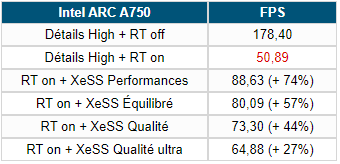
As you can see, the different XeSS modes allow you to gain from 27 to 74% depending on the one you have selected. We will come back later with a file containing screenshots to judge the visual quality.
You should also know that Intel has announced that Call of Duty: Modern Warfare II will support XeSS when it is released on October 28. Speaking of games, Intel should provide a substantial bundle with the purchase of an Intel ARC A750/A770 Call of Duty : Modern Warfare II, Ghostbusters: Spirits Unleashed, Gotham Knights and The Settlers. [nextpage title=”The test configuration:”] As we said in the introduction, we are (again) busy updating all our graphics using the latest drivers from NVIDIA, AMD and of course Intel. We also took the opportunity to slightly modify our test configuration. So here we go again for a new series of tests and therefore of graphics on this slightly modified configuration:
- Motherboard: ROG Maximus Z690 APEX
- Processor: Intel Alder Lake i9-12900K
- Memory : 32 GB Corsair Vengeance 5600 CL38 DDR5
- Graphics Card: Intel ARC A770, ARC A750, KFA2 RTX 3060 EX, NVIDIA RTX 3060 Ti FE, NVIDIA RTX 3070 FE, Sapphire RX 6000 Pulse, Asus RX 6600XT Strix and Powercolor RX 6700 XT RD.
- Cooling system: ROG Ryujin II 360
- SSD : Western Digital Black SN750 2 TB + EKWB radiator
- Power supply : Corsair AX1600i
- Operating system: Windows 11 64 bits
 The drivers used are NVIDIA 517.48, AMD 22.9.2 and Intel 101.3435. Note that the Intel drivers weigh a little more than 1.3 GB.
Our test protocol:
All cards are tested at stock frequencies and without any optimization. For the various benchmarks, whether synthetic or gaming, we will opt for 1080p, 1440p and 2160p resolutions depending on the card’s performance. Here, with this mid-range model, we will only use 1080p and 1440p definitions. As you can see, we have switched to Windows 11 and we have enabled the “ReSize BAR” in the BIOS, which is visible in GPU-Z. Now that you know everything about our test configuration, it’s time to start! [nextpage title=”Synthetic benchmarks: “] Our first series of tests will be dedicated to synthetic benchmarks. These are often used for overclocking competitions but are also very interesting to compare different GPUs. So we will focus on the 3DMark benchmarks. We will test the following benchmarks:
- Fire Strike (1080p)
- Fire Strike Ultra (2160p)
- Time Spy (1440p)
- Time Spy Extreme (2160p)
- DirectX Raytracing
- Intel XeSS
- Mesh Shader
3DMark Fire Strike and Fire Strike Ultra :
Let’s start with 3DMark Fire Strike, which is one of the most used benchmarks today. It consists of two graphics tests, a CPU test and a fourth test that combines GPU and CPU. Don’t forget to deactivate the demo which doesn’t bring anything in the final score and prolongs the benchmark duration (unnecessarily). The version used for these tests is of course the latest one  The first benchmark we have done with these Intel ARC graphics cards and it is rather a good start since the A770 version is in third place just behind the RX 6700 XT. The A750 version also does very well and leaves the RTX 3060 EX far behind.
 The same is true under Fire Strike Ultra, even if our A770 falls back one place to a few points behind the RTX 3060 Ti. These two first benchmarks are very encouraging for the future.
3DMark Time Spy and Time Spy Extreme:
The second test is 3DMark Time Spy. Although this one is done in 1440p, it has the particularity of using DirectX 12. It consists of two graphical tests and a CPU test. As for Fire Strike, don’t forget to disable the demo. These two first benchmarks are proposed by UL Benchmark.
 The performance obtained in Time Spy is often representative of what we will get in games. Here, we can see that our A770 is almost on the verge of taking first place, which is very surprising! The A750 version is also doing very well. Should we expect the same results in gaming, it seems unlikely to me in view of Intel’s announcements that very often oppose it to the RTX 3060.
 Under 3DMark Time Spy Extreme, our two samples of the day came in second and third place. We can’t wait to find out the overclocking potential of these two cards because they seem very interesting for 3D.
3DMark DirectX Raytracing:
UL Benchmarks has added a new test to its series of benchmarks to measure Ray Tracing performance. The idea will be to use the 3DMark DirectX Raytracing test to compare the performance of Ray Tracing hardware dedicated to AMD and NVIDIA graphics cards but now also to Intel!
The 3DMark DirectX Raytracing test is designed to make Ray Tracing the limiting factor. Instead of relying on traditional rendering, the entire scene is traced and drawn in one pass. The test result will depend entirely on the performance of the Ray Tracing. It will be easy to measure and compare the performance of the different cards between them.
 This benchmark has always been dominated by NVIDIA cards and we continue to surprise with our two Intel cards that, once again, are on the podium.
3DMark Intel XeSS
UL Benchmarks in collaboration with Intel will add this new benchmark to the 3DMark suite. We had early access to this new test for our testing. This Intel XeSS test is designed to evaluate and compare the performance and image quality of XeSS (Xe Super Sampling). There are four XeSS modes to choose from: Ultra Quality, Quality, Balanced and Performance. The 3DMark inspection tool helps you compare image quality with a side-by-side view of XeSS rendering and native resolution rendering. You need a graphics card that supports Intel XeSS to run this test.
So we’ll have two scores, a FPS number with XeSS disabled and then on the right with XeSS enabled. The mode chosen is “Ultra Quality” which is actually the default mode for the benchmark.

 In this new benchmark, all graphics cards without exception benefit from XeSS, but it is Intel that has the best gain. ARC models see a gain of 50% while NVIDIA and AMD models see a gain of about 35%.
3DMark Mesh Shader:
Here is the new test we added to the synthetic benchmarks: Mesh Shader. We added it because it is managed by the RDNA 2 architecture of AMD and therefore our RX 6000. It allows us to analyze the performance level of GPUs concerning this feature. As a reminder, it allows to exploit more complex calculations at the geometry level, in a more flexible way, for each meshlet . The displayed result is the one with the Mesh Shaders active.
 Well, as we conclude this first series of synthetic tests, we are bluffed by the performance of our ARC A750 and our ARC A770. These results put us in doubt about the gaming performance. What if Intel had bluffed us by offering cards that were much more powerful than expected? [nextpage title=”Gaming performance 1080p and 1440p: “] We decided to choose six games because they seem to be representative enough. We chose to use DirectX12 and Vulkan with the following games:
- The Division 2 (DirectX 12)
- Borderlands 3 (DirectX 12)
- Red Dead Redemption II (Vulkan)
- Far Cry 6 (DirectX 12)
- Watch Dogs: Legion (DirectX 12)
- Cyberpunk 2077 (DirectX12)
We have chosen to use the benchmarks integrated in these different games. Why did we do this? Simply to allow you to compare your results with ours if you also have a copy of one of these games. It’s a thought that seemed relevant to us and that will allow you to compare your results with ours.
As we mentioned on page 4 of this article, we have activated the Resizable Bar in the BIOS, which is now supported by all (recent) GPUs. Finally, we have chosen only 1080p and 1440p resolutions, which is what you should expect from these cards.
The Division 2:
The Division 2 will be tested under DirectX 12. As for the graphics settings, they will be set to ” ultra ” mode with vertical synchronization disabled.

 First game and the trend noted for the synthetic benchmarks is not confirmed as our two Intel ARCs come in on either side of the RTX 3060. Finally, after Intel’s official announcements, this is where we expected to see them.
Note that this is one of the least demanding games in our panel. Good surprise in 1440p, where both our cards jump one place and the A770 version even manages to break away from its pursuers. Is this a trend that will continue?
Borderlands 3:
For the second game, we switch to Borderlands 3. The graphic options are set to ” Brutal “. It is important to know that Borderlands 3 is quite greedy and that this choice of parameters has a strong impact on the FPS. It is a game that is often praised in the announcements of new graphics cards and precisely in this Brutal mode.

 The performance here is better and the gap with the RTX 3060 EX and the RX 6600 is widening. The A770 version even allows itself to get close to the RTX 3060 Ti. In 1440p, the Intel ARC A770 seems to be more comfortable against the competition and is closer to an RTX 3060 Ti than the RTX 3060.
Red Dead Redemption 2:
Third game and not the least, Red Dead Redemption II on PC. The advantage of this opus is to offer the possibility to test the integrated benchmark under Vulkan. We opt for the graphics options in ” ultra “. 
 Third game and not the least, RDR2 offers the possibility to test the integrated benchmark under Vulkan. The rise in power of the two Intel ARCs is confirmed as they leave behind an additional card, the RX 6600 XT. Here, in 1440p, the observation is the same as for 1080p definition.
Far Cry 6:
The latest game we are adding to this section is Far Cry 6, since it supports DXR as well as the SFR proposed by AMD. We will also find it on the next page. For our benchmarks, we opted for an ” ultra” graphic quality. 
 Even though our report on this game showed an advantage for the RX 6000 cards, we were hoping for more from our two samples of the day. Here they find a place they have already met, that is, on either side of the RTX 3060. We still find this observation that gives our two ARCs better performance in 1440p than against their competitors in 1080p.
Watch Dogs Legion:
Last but not least, Watch Dogs Legion which will also be used for our tests with Ray Tracing. For our benchmarks, we have opted for a graphic quality in ” very high”. 
 In the Watch Dogs Legion benchmark, the A770 model passes the symbolic 100 FPS mark ahead of the RX 6000. The A750 is 6 FPS ahead of the RTX 3060. In 1440p it is now becoming obvious, our ARCs are much more comfortable.
Cyberpunk 2077:
This is a game that we have been wanting to add for a while and it is now done since it now has an integrated benchmark. We will also use this game for our tests with Ray Tracing. For our benchmarks, we have opted for a “high” graphic quality. 
 New and last benchmark of this gaming panel. It is going to be a bit of a downer for the performance of our two Intel ARCs, as both of them are at the back of the pack and quite far behind the other cards and especially the RTX 3060. This is quite surprising and despite several rounds of testing, these results are confirmed. In 1440p, our two samples move up one place in the ranking.
Average Game:
For the gaming average, the RTX 3060 is the reference card in 1080p while the RTX 3070 is the reference card in 1440p. The other cards score either higher or lower depending on their performance against this model. 
 In the end we are on two different views. In 1080p, our Intel ARC A750 does as well as the NVIDIA RTX 3060. The performance is relatively similar and one sometimes takes the lead over the other depending on the game chosen. The ARC A780 does better and takes a bigger advantage over the RTX 3060. But it is finally in 1440p that the differences are more important with an ARC 770 that shows itself very interesting! [nextpage title=”Ray tracing and DLSS/FSR performances:”]
Let’s now take a look at the six games we’ve selected that support Ray Tracing and DLSS as well as, for some, AMD’s FSR and Intel’s new XeSS technology, which is supported by Shadow Tomb Raider and Hitman 3. As we have already reminded you, if the DLSS remains the property of NVIDIA, the FSR and the XeSS can be used with all cards from AMD, Intel and even NVIDIA.
The six DirectX 12 games that we will test with Ray Tracing or DirectX Ray Tracing and DLSS, FSR or XeSS are :
- Shadow of the Tomb Raider (DLSS – XeSS)
- Watch Dogs: Legion (DLSS)
- Metro Exodus PC Enhanced Edition (DLSS)
- Far Cry 6 (DLSS – FSR)
- Cyberpunk 2077 (DLSS – FSR)
- Hitman 3 (DLSS – XeSS)
Of course, we had to make a choice and as we started with Ray Tracing rather heavy, we settled for 1080p definition. So yes, some games will also go to 1440p, but for the most part, the number of FPS does not reach 60 FPS. Remember that the Intel ARC does not support DLSS. We assume that there is a balance between image quality and technologies like DLSS, FSR and now XeSS.
Shadow of the Tomb Raider:
The first one we add to this comparison supports Ray Tracing and DLSS 1.0. Three levels of Ray Tracing are offered in the game (medium – high – ultra) and only one level of DLSS. For our benchmarks, we chose Ultra graphics quality, ” ultra ” Ray Tracing and DLSS enabled. The good news is that this game is now XeSS compatible and we were able to use it in “Balanced” mode for our Intel and AMD GPUs.  Even with Ray Tracing enabled, our two ARC copies are doing just fine since the average is 60 FPS or higher. Enabling XeSS offers a gain in FPS for a smoother rendering.
Watch Dogs Legion:
Second game, Watch Dogs Legion supports Ray Tracing and DLSS 2.0. It is one of the most demanding games of the moment. Three levels of Ray Tracing are offered in the game (medium – high – ultra) and four levels of DLSS (performance – quality – balanced – ultra performance). For our benchmarks, we opted for Ultra graphics quality, ” high ” Ray Tracing and ” balanced ” DLSS.  The Ray Tracing in Watch Dogs Legion makes all cards suffer and therefore automatically our two samples of the day. Finally, the ARC A770 does the best and almost manages to reach 60 FPS. As this game only offers DLSS, it is impossible to achieve a gain in FPS like on the three NVIDIA cards.
Metro Exodus PC Enhanced Edition:
Third game and which supports DLSS 2.0. We have dedicated a file to it. Three levels of Ray Tracing are offered in the game and four levels of DLSS (performance – quality – balanced – ultra performance). For our benchmarks, we opted for Ultra graphics quality, ” high ” Ray Tracing and ” quality ” DLSS.  We continue with the demanding games but both our cards manage to reach the symbolic 60 FPS mark. We notice that the Intel ARC A770 does as well as the RTX 3060 which benefits from DLSS.
Far Cry 6:
The latest game we add to this section since it supports DXR as well as SFR proposed by AMD. For our benchmarks, we opted for Ultra graphics quality, we enabled both DRX options as well as FSR in ” quality ” mode for the three definitions: 1080p, 1440p and 2160p.  In Far Cry 6, FSR is the only choice available to boost FPS after enabling Ray Tracing. All of our cards can benefit from this, regardless of the manufacturer. Once again, our A750 and A770 are perfectly at ease.
Cyberpunk 2077:
We have just added a new game which proposes in its parameters the activation of DLSS but also FSR. For our benchmarks, we have opted for “high” graphics quality, ” ultra” Ray Tracing and ” balanced ” DLSS/FSR.  This is the most demanding game where our cards have a hard time keeping up. We will most likely set the Ray Tracing back to “high” for our next update. We did not post our scores with the two AMD cards because for some reason we had a performance bug in each of our attempts.
Hitman 3:
New game also added since this one is now XeSS compatible in addition to DLSS. We have received access to a beta version which should be officially released soon. We talked to you more about this game on page four of our article. For our benchmarks, we opted for “high” graphics quality, ” enabled ” Ray Tracing and ” balanced ” DLSS/Xess.  As soon as the game is more optimized and takes advantage of the XeSS technology specific to Intel cards, our two copies can take full advantage of the gain brought by the XeSS. So you’ll be perfectly comfortable in 1080p to enjoy the combination of Ray Tracing and XeSS.
No Ray Tracing in 1440p with ARCs?
We decided that as long as our six games didn’t pass at least 60 FPS, we didn’t think it was necessary to post the performance in 1440p. So yes, Ray Tracing is possible in 1440p with the A770 but only in certain games like Far Cry 6, Shadow of Tomb Raider and Hitman 3. We can just say that if the game is XeSS compatible, then yes, you can imagine playing in 1440p with Ray Tracing enabled and combined with XeSS. [nextpage title=”Temperature, consumption and nuisance: “]
Temperature:
In order to measure temperatures, we opted for the Superposition stress test in Extreme mode. We opted for three 5 minutes runs with 10 minutes interval between each test. We took advantage of this benchmark in order to measure the power consumption of the graphics card for the table above.
In order to know the temperature in Idle, after having finished the three loops of the stress test, we let the card rest for 20 minutes before reading the temperature. It should be taken into account that most of the cards have the “0 dBa” technology and therefore, the fans turn off below a certain temperature, often between 50 and 55°C. This means that it takes longer to dissipate the heat after a period of stress testing or gaming. A card without this technology will be noisier than others at rest. Small reminder: our temperature readings are taken in Open-Air. In a closed case, the cards will necessarily be hotter.
 Our two samples of the day benefit from a good cooling system that allows them to handle the load quite well, especially when you contrast these temperatures with the consumption of the cards. The cards that do best are the custom models from Asus, Powercolor and KFA2.
Noise Levels:
No readings for the moment. As we mentioned at the beginning of this article, we have just retested all our maps and unfortunately our test room close to the road, distorts our results. We are looking for a new solution to be perfectly efficient.
Power consumption (full configuration):
We use a wattmeter by reading the consumption on the output of our power supply. Our modular power supply is a CORSAIR AX1600i. The result we propose is the average of the total consumption of our configuration. Only the graphics card changes between each reading. It is therefore easy to calculate the difference between each graphics card.  Surprise, but not really in a good way, since the ARC A750 and ARC A770 consume the most power, just before the RTX 3070 Founders Edition. Even if we would have preferred a better power consumption, we are on a first generation so we will be a bit more indulgent. [nextpage title=”Overclocking:”] Due to a lack of time, we didn’t have the opportunity to do some overclocking with our Intel ARC. Don’t worry, it’s planned for this weekend so that we can propose you a dedicated article on the results obtained. We think this card still has a lot left in the tank and we can’t wait to push it to the limit.
We hope to have a GPUZ update soon so we can track the GPU frequency live but in the meantime, you can use the Intel ARC Control software. This is Intel’s in-house software that will allow you to monitor your graphics card. You will also have the opportunity to overclock it since a series of parameters are available within this application.


See you by the end of the week for the update of this section with hopefully good surprises on the overclocking potential of our two copies. [nextpage title=”The last word:”]
Too late arrival?
When we know that NVIDIA and AMD have just or will announce the arrival of their next generation of GPUs, we can naturally wonder if Intel has missed the boat by entering the GPU market only now. Well for us the answer is obvious, it’s NO, but with two conditions.
First, the price. Intel has used this argument throughout its announcements, notably by opposing the price/performance ratio to the RTX 3060. The prices will have to follow in front of NVIDIA’s and when we know the green strategy, we can surely expect a reaction and why not a slight decrease in the price of the RTX 3060 in the days to come. The first battle will be on the prices that will be applied in France and that we still do not know at the time of posting this article.
Secondly, the availability. First of all for all those who participated in the contest organized by Intel and who have been waiting to receive their GPU for several weeks (300 cards in total, 100 A770 and 200 A750). We are starting to feel a certain impatience from the winners, especially on our Discord where there are several of them. But we’ll also have to satisfy the demand of gamers who might be tempted by a GPU at 350/425 euros to take full advantage of 1080p with Ray Tracing but also 1440p with or without Ray Tracing for the A770 version. We know for sure that at least one store has stocked up on ARC cards in order to be able to meet the demand on the day of the launch, scheduled for October 12th.
Price + availability = bingo ?
If these two conditions are finally met, we are ready to bet that the Intel ARC A750 and A770 cards will be a great success in the weeks to come. Indeed, even if they have been a long time coming, the Intel ARC cards are well on their way! Let’s not forget that this is the first generation of GPUs for Intel and that things can only get better and better as the weeks go by. We are thinking in particular of the excellent performance in synthetic benchmarks which should be even more reflected in the gaming part. The drivers are still young and will mature.
Personally, in all of our benchmarks we did not encounter any problems except when we changed the definition, a lapse of a few seconds. Moreover, these ARC A770 and A750 manage Ray Tracing in a nice way and this in particular thanks to the XeSS technology. The update of our graphics with the latest drivers also allowed us to realize the improvement of performance at NVIDIA but also and especially at AMD.
The arrival of XeSS technology is also a real plus and we hope to see it used more and more by game designers. Intel surely has the assets and the necessary weight to convince them. Remember that XeSS will be present in the next Call of Duty: Modern Warfare II.
A three-way market from now on :
This is perhaps the most important thing, the arrival of a third contender in the graphics card market. It is the buyer who should be the first to benefit from Intel’s arrival, knowing that their objective seems to be to (re)offer “correct” prices when buying a graphics card. We can only look to the future and hope to find more coherent prices than those that the majority of components are undergoing.