

MindFactory is a real gem when it comes to sales figures. In fact, for each product, the retailer displays the number of sales rounded to the nearest 10 units. But if we look a little closer, on the product page, just above the reviews, we see the after-sales return rate. This isn’t the return rate that includes customer cancellations, etc., but rather the percentage of requests due to malfunctions or failures. And in this context, the RX 9070 XT Reaper—which seems like a good deal—turns out to be the least reliable card!
RX 9070 XT Reaper: The Least Reliable?
A 3.28% return rate out of 2,350 sales:

In this context, we’re relying on figures compiled by our colleagues at Hardwareand.co. They highlight that PowerColor’s Reaper version is the least reliable model, as it has a high return rate exceeding 3% out of more than 2,350 cards sold. In contrast, the most reliable model appears to be the Prime version from ASUS, with a return rate of just 0.17% out of more than 590 cards sold.
Second place for cards with the highest return rate goes to the Red Devil Spectral White version, also from PowerColor, with a return rate of 1.87% out of 270 sales. Finally, in third place is ASRock’s Taichi, with a return rate of 1.34% out of 390 sales.
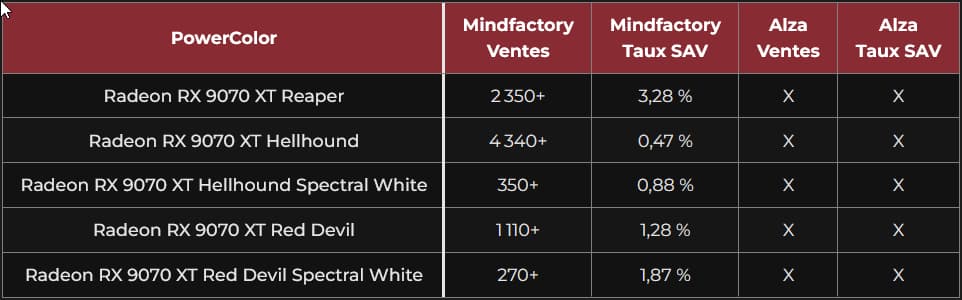
However, these figures vary by retailer. At Alza, for example, the ASUS RX 9070 XT Prime has a return rate of 1.07% based on over 1,000 sales. Similarly, while XFX’s QuickSilver White version has a return rate of 1.28% (490 sales) at MindFactory, that percentage rises to 2.84% at Alza with 200 sales. The same applies to Sapphire cards:
- Pulse: 0.66% based on 2,000 sales at MindFactory, 2.14% based on 2,000 sales at Alza
- Nitro+: 0.99% out of 1,760 sales at MindFactory, 2.02% out of 2,000 sales at Alza
These figures are for reference only:
These figures provide only a rough indication of the cards’ reliability. As can be seen, the percentages vary from one retailer to another, especially since retailers do not necessarily sell the same cards or in the same proportions. Similarly, it’s also important to consider how after-sales returns are handled, since the two stores likely don’t have the same protocols or the same methods for accounting for them.