

Gamers’ expectations regarding graphics card upgrades are fading in the face of new, conflicting reports. While recent leaks, notably those from MLID, had placed the arrival of NVIDIA’s RTX 60 series and AMD’s RDNA 5 generation in the first half of 2027, a different source is casting doubt on that timeline. Kepler_L2, a well-known tech insider, now claims that nearly all of these products won’t be released until 2028.
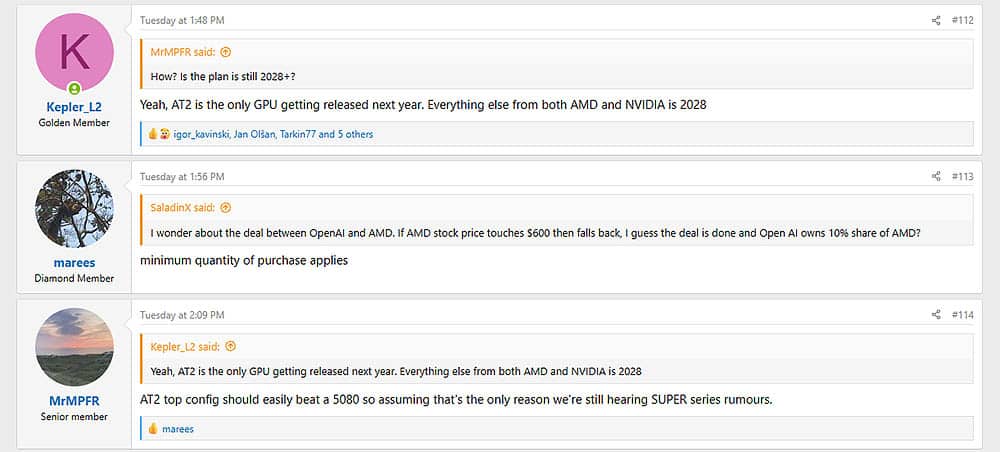
This discrepancy has created confusion within the hardware community. While MLID claimed that the launch was scheduled for 2027 and had received internal approval several months ago, Kepler_L2 has stepped in to challenge this claim. In a thread on the AnandTech forums, he specifies that only one specific product will be released next year, while the rest of the lineup from the two giants will have to wait until the following year.
A Single Exception for AMD in 2027
The leak does, however, point to one notable exception for the American manufacturer. According to Kepler_L2, AMD’s AT2 chip will be the only next-generation component to go on sale in 2027. This chip, based on the RDNA 5 architecture, is designed to compete with NVIDIA’s high-end offerings, such as the RTX 5080.
Some technical details about this AT2 chip are already known. It is said to feature 40 compute units, which would position it as a mid-range card capable of competing with current models like the RX 9070 XT. This strategy would allow AMD to enter the market next year, while more powerful models—such as the flagship AT0 series product and the entire NVIDIA Rubin lineup—would be delayed.
Possible Reasons for the Delay
While Kepler_L2 does not provide an explicit reason for this massive delay, the market context offers some insights. The GDDR7 memory shortage—due to the reallocation of production capacity toward HBM chips for artificial intelligence data centers—could be a key factor. Since the manufacture of graphics cards requires large amounts of video memory, production costs may have become prohibitive for a widespread release in 2027.
Furthermore, the RTX 50 SUPER series, initially planned to refresh the Blackwell lineup with more memory, appears to have been canceled or postponed, according to other sources. This suggests that NVIDIA may have decided to move directly to the Rubin family to maximize the impact of the new architecture, at the expense of a faster release cycle.
Until official confirmation, gamers will likely have to wait even longer for a complete hardware refresh. The difference between a 2027 launch and a delay to 2028 amounts to a full year of waiting—a significant amount of time in a market where prices remain high. Only time will tell whether Kepler_L2 or MLID will prevail regarding the exact timeline for these future generations.