

The consumer graphics card market is experiencing unprecedented strain since the launch of the RTX 50 series. As consumers scramble to get their hands on a card for their PCs, statistics show that, despite sky-high prices, sales continue to rise. But new information sheds light on one of the structural causes of this shortage: the massive purchase of these chips by companies involved in artificial intelligence.
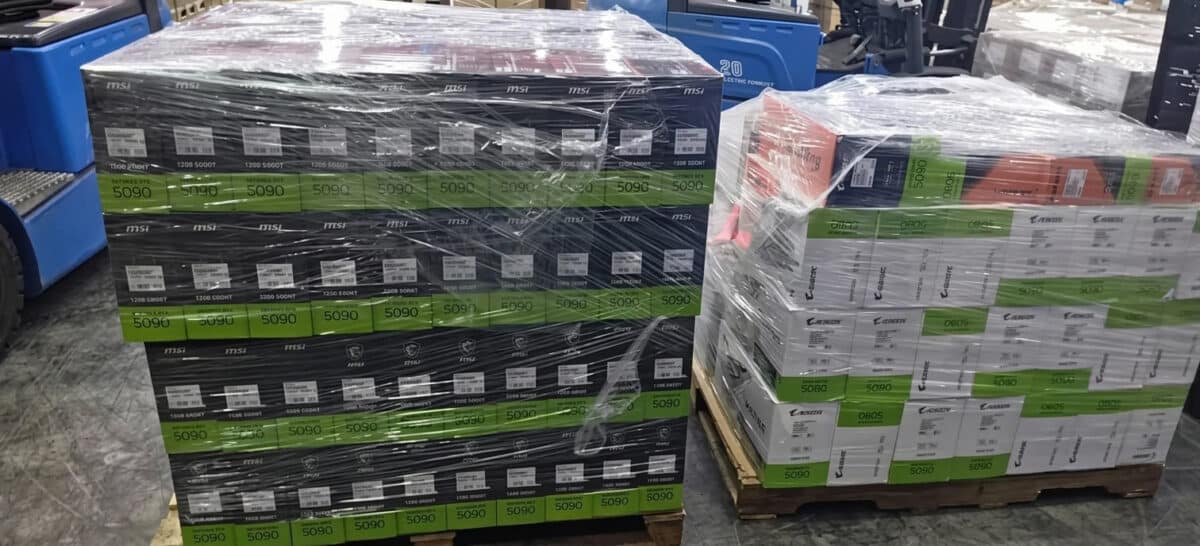
Recently shared images show entire pallets of RTX 5090 cards, still sealed in their original packaging, being unpacked at server assembly sites. What’s particularly telling is the absence of dedicated professional-grade cards. These are neither the RTX PRO 6000 models nor the specific data center accelerators that NVIDIA typically markets for this type of work. The cards in question are standard RTX 5090s—the very ones gamers are struggling to find at the launch price.
Similarities to the Cryptocurrency Crisis
The current situation is strangely reminiscent of what was observed during the cryptocurrency boom. At that time, miners had bought GeForce cards in bulk, stifling the supply available to gamers. NVIDIA responded at the time with Lite Hash Rate (LHR) models that reduced mining performance without affecting gaming specifications. Although this restriction was circumvented about a year later, it had temporarily curbed large-scale mining operations.
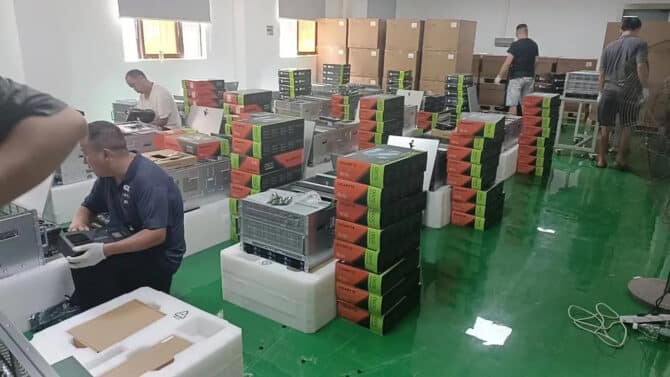
Today, the workload has shifted: it’s no longer about Bitcoin mining, but about training artificial intelligence models. Yet the consequence for gamers remains all too familiar. Retail prices for the RTX 5090 have exceeded $5,000 on some websites—more than double its launch price of $1,999. This price spike did not happen by chance; industry analysts had actually warned of this possibility several months earlier.
The Lack of Restrictions on the Global Market
One important technical detail is worth noting: the cards shown in the photos are not RTX 5090D or v2 variants. These specific versions, reserved for the Chinese market, had already been downgraded by NVIDIA to limit their AI performance while complying with export regulations. The standard version of the RTX 5090 has 3,352 AI TOPS, compared to 2,375 for the Chinese version.
This finding indicates that NVIDIA has mastered the technique for limiting a GeForce card’s AI capabilities while preserving its gaming performance. However, the company has not applied this same restriction to the RTX 5090 sold in the rest of the world. Given that AI has become central to NVIDIA’s business model, it seems unlikely that the company will intervene to limit the use of these cards in multi-GPU setups, even though AIB partners could theoretically exercise greater control over wholesale sales.
At present, the RTX 5090 appears to have lost its exclusive status as a gaming card and has instead become a strategic resource for the AI industry, leaving mainstream consumers facing prices that bear no relation to initial market conditions.