

The launch of DLSS 5 marked a turning point in the history of graphics rendering, promising greater realism thanks to its Neural Rendering. However, this technology proved to be extremely resource-intensive, causing drastic performance drops even on the most powerful graphics cards. Faced with this situation, the modding community reacted quickly, developing solutions to reorganize the rendering pipeline and preserve gameplay.
The first official tests, conducted by Digital Foundry on NBA 2K27, highlighted the scale of the problem. On an RTX 5090, enabling DLSS 5 resulted in a performance loss of over 50%, causing the frame rate to drop from 128 FPS to 62 FPS. On cards like the RTX 5080 or RTX 5070, the situation was even more critical, making the game virtually unplayable at high resolutions. This bottleneck is due to the fact that Neural Rendering traditionally runs after image upscaling (Super Resolution), forcing the graphics card to process millions of additional pixels.
Reversing the pipeline to improve smoothness
The solution developed by modders involves a fundamental change in the order of operations. The Neural Upstream mod, now integrated into the DLSS 5 Autopilot tool, allows Neural Rendering to run before image upscaling. Instead of processing a final 4K image, the neural model works on a much lower internal resolution, similar to that used by the Performance or Quality modes in classic DLSS.
The results are impressive. On an RTX 4080 running Assassin’s Creed Shadows at 4K resolution, enabling DLSS 5 using the standard method caused the frame rate to drop to 31 FPS. With the Neural Upstream approach, performance climbs back to around 50 FPS—an improvement of about 61% over the conventional method. Similar gains were observed in demanding titles such as STALKER 2, Cyberpunk 2077, and GTA V Enhanced.
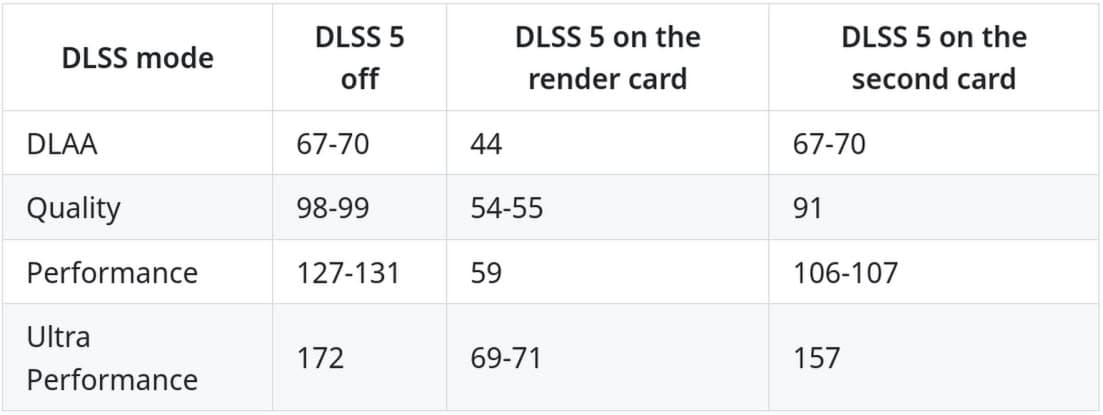
Another approach, developed by Marcelo Guibout under the name MGPU Bridge, proposes offloading Neural Rendering to a second dedicated graphics card. Tests conducted with two RTX 5060 Ti cards show that this method reduces the load on the main rendering card by 35% to 60%, while maintaining smooth frame rates. Although this solution requires two cards, it demonstrates that Neural Rendering can be isolated without affecting the rest of the graphics pipeline.
Wider compatibility and visual trade-offs
In addition to optimizing performance, DLSS 5 Autopilot makes it easier to implement the technology in games that do not officially support it. The tool automatically analyzes the game and the graphics card to select the most appropriate method, whether via Neural Upstream, OptiScaler, or other injections. This brings Neural Rendering to RTX 20, 30, and 40 series graphics cards, as well as to Vulkan and DirectX 11/12 architectures.
However, this reversal of the pipeline is not without consequences. Since Neural Rendering operates on a lower-resolution image, visual fidelity may be slightly lower than that of NVIDIA’s official method. Some users have noticed changes in color gradation or a loss of subtle details. Furthermore, using mods carries risks related to stability and incompatibility with anti-cheat systems, as the tool’s developers point out.
Despite these trade-offs, these modifications offer a new option for players who want to try out DLSS 5 without experiencing its side effects. The community continues to refine these solutions, while NVIDIA is still working on optimizing its technology for the RTX 50 series cards before considering broader support for previous generations.