

The revelation of the computational requirements behind OpenAI’s latest model, dubbed GPT-6 Astra, has highlighted the industrial scale required for the next generation of artificial intelligence. Jensen Huang, CEO of Nvidia, confirmed on September 6 that training this model requires approximately 100,000 Grace Blackwell-series GPUs. He also announced the deployment of an additional 400,000 units for future phases. This information, released prior to any official statement from OpenAI, sheds direct light on the current supply constraints in the consumer hardware market.

It is important to note that Jensen Huang’s initial statement raised questions about the unit of measurement. Some interpreted these figures as the number of complete server racks, which would have implied 7.2 million GPUs. However, Greg Brockman, president of OpenAI, clarified the situation by specifying that the figure indeed referred to 100,000 individual accelerators. This would correspond to approximately 1,390 NVL72-type racks, a configuration deployed at the Abilene campus in Texas.
Colossal power consumption for the infrastructure
The impact of this infrastructure on the power grid is considerable. An NVL72 rack, consisting of 72 Blackwell GPUs and 36 Grace processors, consumes approximately 135 kW during continuous operation, reaching up to 155 kW at peak. For the 1,390 racks required, the total power consumption of the training cluster amounts to approximately 187 megawatts. If we include the expansion phase announced by Nvidia, energy demand could reach nearly 750 megawatts—and that’s without even accounting for cooling and data storage requirements.
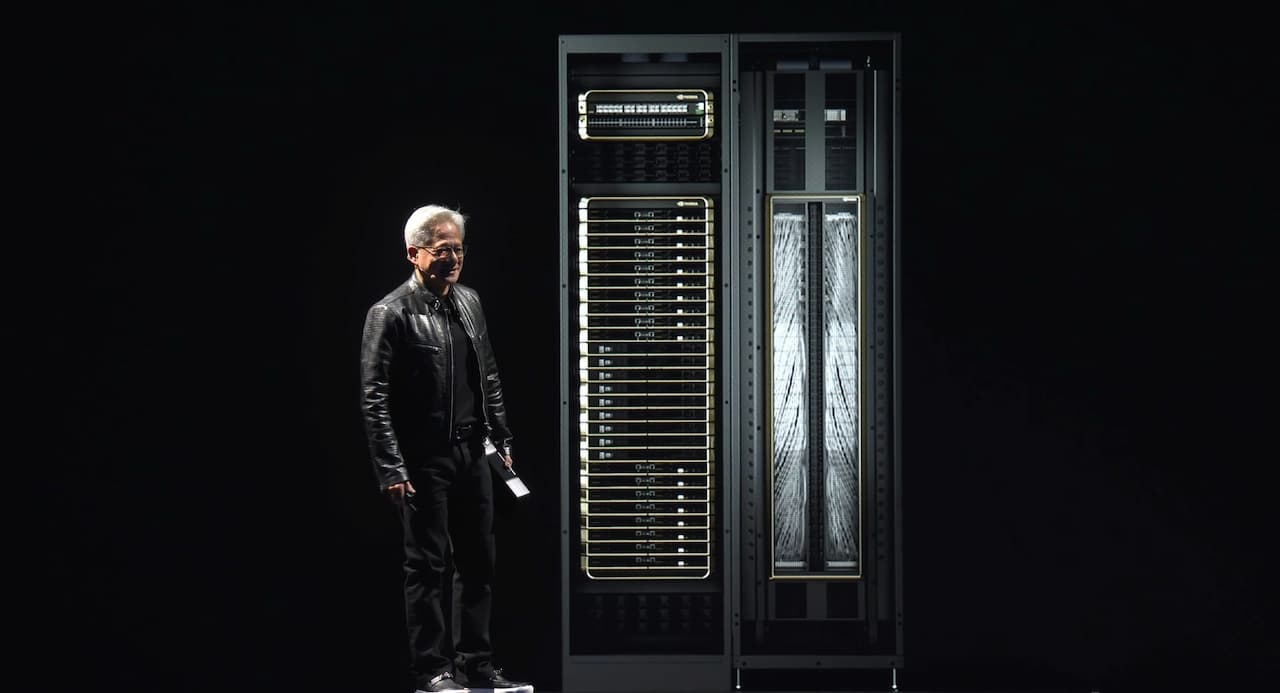
The physical and energy-related constraints are therefore significant. A rack like this weighs approximately 1,580 kg and dissipates 90% of its heat through a liquid cooling system. The Uptime Institute reports that a standard rack in a data center consumes an average of 9 kW, making the management of these thermal and electrical flows a major technical challenge for operators such as Oracle, which had initially planned to install 400,000 GB200 GPUs at this site.
Competition for HBM3E memory chips
The real impact on consumers lies in the memory supply chain. Each Blackwell GPU incorporates between 186 and 288 GB of HBM3E memory, depending on the version. For a cluster of this scale, the demand for memory reaches volumes of several petabytes. Samsung, SK Hynix, and Micron produce this HBM3E memory on the same production lines as the DDR5 modules intended for consumer PCs.
These three manufacturers control more than 90% of global DRAM production. Since 2025, they have redirected a significant portion of their capacity toward HBM production to meet data center demand, as profit margins are higher. This direct shift in production capacity largely explains the shortages and price increases observed in the market for RAM for personal computers.
Market data confirms this trend. In mid-August 2026, prices for DDR5 and DDR4 RAM, as well as SSDs, reached record highs compared to the pre-crisis period. Trendforce forecasts a further increase in DRAM contract prices of 13 to 18 percent for the third quarter of 2026. Experts estimate that prices are unlikely to begin falling again until 2028 at the earliest.
Finally, the performance of GPT-6 Astra demonstrates remarkable efficiency. On the ARC-AGI-3 benchmark, the model outperforms the human baseline on 96% of the levels. Although terms like “AGI” are used with caution by OpenAI, the technical results are tangible. Nvidia, which generated $89 billion in its most recent quarter thanks to its data center divisions, is using this announcement to highlight the adoption of its technologies, while production costs continue to weigh on the components available to consumers.