

FSR 4.1 is now supported by RX 7000 graphics cards following the driver update to version 26.6.2. To achieve this, AMD had to adjust its technology to support the RX 7000 series’ INT8 instructions rather than the FP8 used by default on the RX 9000 series. But since support is now official and no workarounds are needed to run FSR 4.1 on the RX 7000 series, a colleague ran some tests to measure the impact on performance. Yes, there are performance drops compared to the RX 9000 series.
FSR 4.1: Lower Performance Compared to the RX 9000 Series!
The RX 7900 XTX is up to 9% slower than the RX 9070 XT:
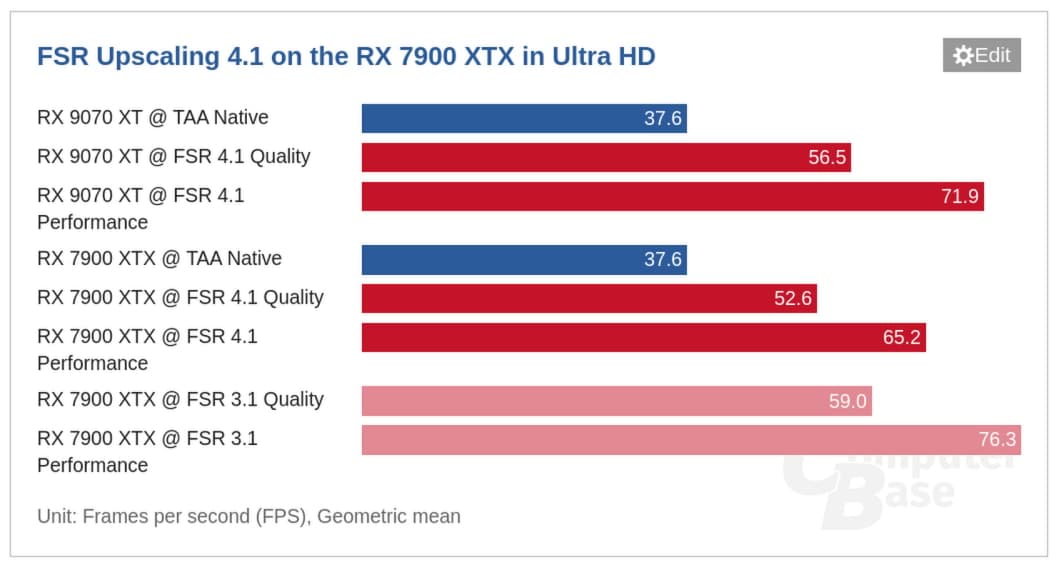 Broadly speaking, the German media outlet ran tests and compared the results based on an average of nine games running in UHD. At native resolution, the RX 9070 XT and RX 7900 XTX deliver the same performance. However, when FSR 4.1 is enabled, it’s a different story. In Quality mode, the previous-generation card averages 52.6 FPS, compared to 56.5 FPS for the current-generation card. The 7900 XTX is therefore 7% slower under these conditions. But if we switch FSR to Performance mode, the gap widens further, and the 7900 XTX falls 9% behind the RX 9070 XT, with 65.2 FPS compared to 71.9 FPS.
A technology that’s more resource-intensive on older cards!
Originally, FSR 4 and 4.1 weren’t supposed to run on the RX 7000 series, but AMD was able to adapt its technology to the RX 7000 architecture. To do so, it had to leverage the cards’ INT8 AI accelerators, whereas the RX 9000 series uses FP8. The calculations are therefore more demanding for the RX 7000 series, which explains this difference in performance. In fact, when comparing the results obtained with versions 3.1 and 4.1 of the technology, there are significant performance differences:
- FSR 4.1 Quality: up to 11% slower than FSR 3.1 Quality
- FSR 4.1 Performance: up to 14.5% slower than FSR 3.1 Performance
What about the RX 6000 series:
The case of the RX 6000 series promises to be an interesting challenge to solve, since these cards simply do not have AI acceleration like the RX 7000 and RX 9000 series. As a result, calculations will have to be performed on the GPU itself, which is likely to have a greater impact on performance. Expect significant performance gaps compared to FSR 3.1, for example. It remains to be seen whether AMD will be able to tweak things enough to achieve decent performance.
A happy medium on the RX 7000 series:
In reality, on the RX 7000 series, FSR 4.1 strikes a balance on these cards. It does offer a definite visual improvement over FSR 3.1, but performance doesn’t reach quite as high. Obviously, to get the most out of the game’s visual quality, it’s best to play at native resolution, but that also means you’re stuck with native performance levels.