

An unusual situation recently arose in the hardware world. The Australian media outlet Hardware Unboxed published one of the first independent reviews of the Radeon RX 9050 8 GB, but the testing process was subject to severe restrictions. According to reports, AMD did not provide a sample to the publication and explicitly prohibited its partners from sending one to it. The card was ultimately obtained through what the reviewers call “secondary channels,” with one source insisting that their identity and the exact model remain undisclosed. This situation reminds us of similar practices at Nvidia.
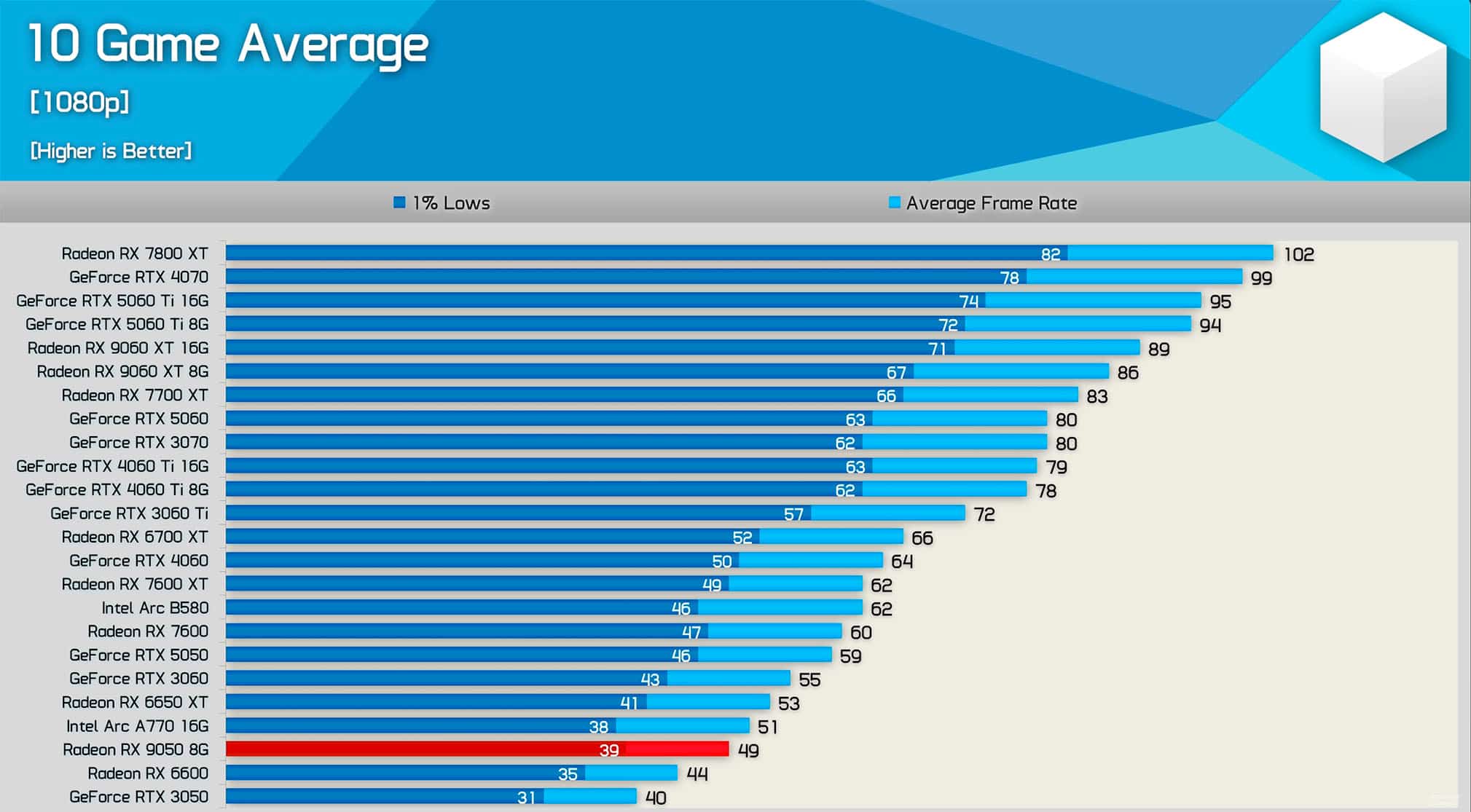
The RX 9050 8 GB is struggling…
This forced secrecy suggests a product with modest performance. The Radeon RX 9050 represents the most basic configuration in the RDNA 4 lineup for desktop PCs to date. It features 16 compute units and 1,024 stream processors—exactly half the number of active shaders found on a Radeon RX 9060 XT. Although both cards are based on the same silicon, the RX 9050 features 18 Gbps GDDR6 memory on a 128-bit interface, with a typical power draw of 92 W. Hardware Unboxed suggests that this card could serve as a lower-tier variant for Navi 44 silicon that fails to meet the specifications of the higher-end lineup, although AMD has not confirmed this explanation.
The performance results offer little justification for the price. Across ten tested games, the card averaged 49 FPS at 1080p and only 33 FPS at 1440p. At 1080p, the GeForce RTX 5050 is 20% faster, while the Radeon RX 7600, released in 2023, is 22% faster. At 1440p, the RX 9050 drops to the same 33 FPS as the RTX 5050, while the RX 7600 reaches 35 FPS. The gap with the RX 9060 XT is even wider: the latter achieves 86 FPS, representing a 76% performance boost.
The value for money is problematic. Hardware Unboxed tested the card against a suggested price of around $280 and concluded that it should cost no more than $200 to make sense. Reviewers instead recommend looking for used hardware, the Intel Arc B580, or saving up for the Radeon RX 9060 XT. Their conclusion is clear: the RX 9050 8GB offers too little performance for its current price.
There is also a 4GB variant, but it is not a standard retail AIB model. AMD previously confirmed that this card was developed specifically for an OEM partner’s system and has no plans to sell it separately. The known system is a CyberPowerPC Gamer Master sold through Best Buy. This 4GB configuration also reduces the memory bus width from 128-bit to 64-bit, dropping the bandwidth from 288 GB/s to 144 GB/s. The 8 GB version is intended for standalone sale, with designs announced by ASRock and SAPPHIRE. Availability is limited to Latin America, the Asia-Pacific region, and Japan, excluding Australia and Korea, which has prevented the Australian channel from obtaining a sample through normal channels.