

Here’s a curiosity that could perhaps do quite a few things for the world of electronics in general and the PC in particular. Work carried out by scientists in Hong Kong has made a heat dissipation process using salt water work. The solution tested is 33% more efficient than traditional passive heat sinks using metal conductivity alone. The system is also totally passive, containing no moving parts and relying almost entirely on chemical processes.
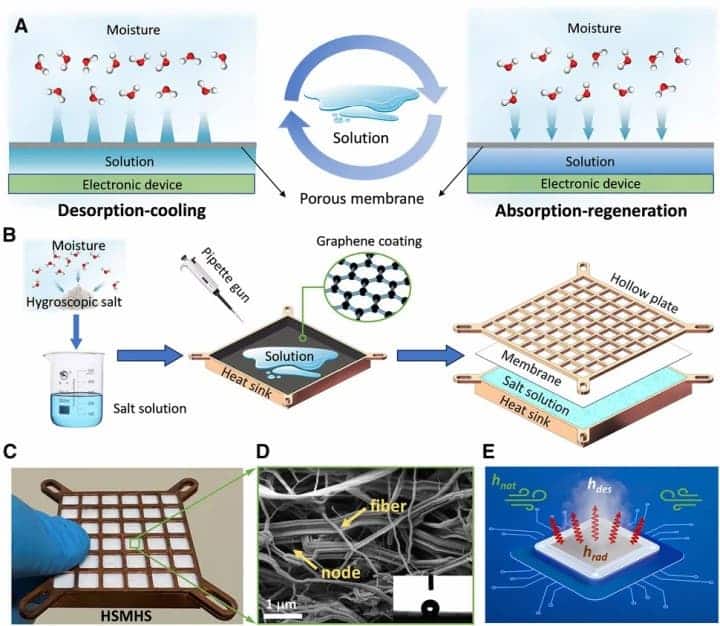
The process has been dubbed HSMHS (Hygroscopic Salt-loaded Membrane-encapsulated Heat Sink). It is based on the use of lithium bromide salt, filtered with a porous membrane that allows water to evaporate. This membrane provides a two-in-one effect. It desorbs moisture from the saline solution to extract heat and prevent the cooled element (a CPU, for example) from overheating. And it can autonomously absorb humidity from the ambient air during “off-peak hours” to recover its cooling capacity.
The advantage of this is that it can evacuate heat constantly, unlike passive metal heat dissipation, which simply stores heat. Its effectiveness diminishes over time as the metal block gradually heats up. The obvious consequence is a reduction in the performance of the element being cooled (the CPU in our example). During tests of this new process, it was found that the system was capable of running for over 6 hours while maintaining CPU temperature at a constant level. By comparison, this is almost 10 times better than passive devices using metal conductivity alone. Last but not least, the design is particularly economical and would hold its own against a totally metallic solution (copper, for example).