

[nextpage title=”Origins and first steps”]
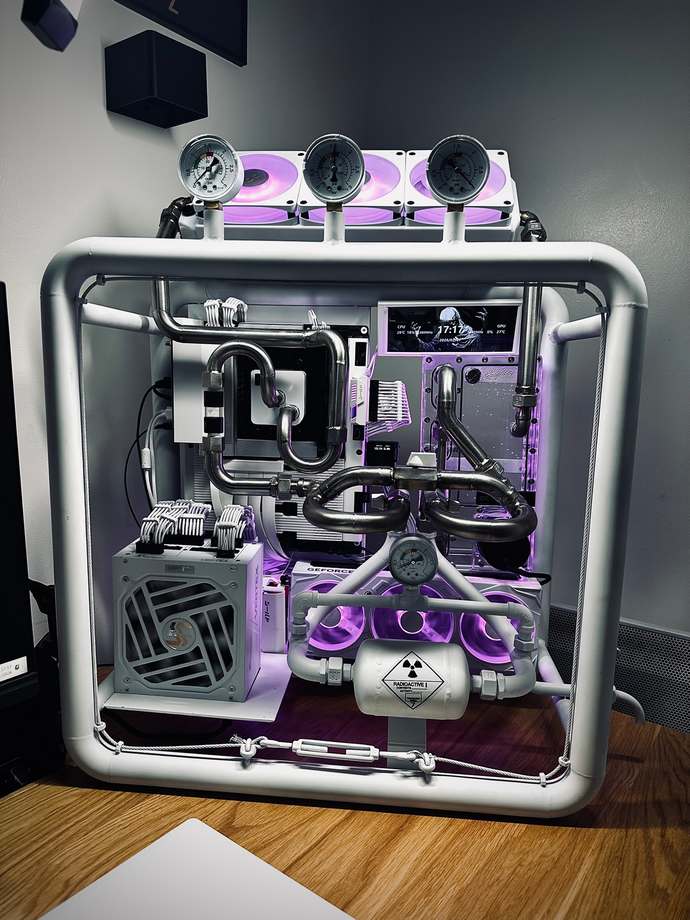
He built one of the most interesting computers of recent months. And he designed and assembled it entirely by hand, from the chassis to the stainless steel watercooling tubes. We had the chance to talk to EZY, a talented French modder who is committed to the community.
Between TIG welding, archival colorization, and future projects, meet a maverick whose first project has already made a lasting impression.
Origins and first steps

OCC: Let’s start at the beginning: what was your first contact with hardware ?
EZY: I discovered hardware about ten years ago. I bought a colleague’s setup, which was equipped with a GTX 980 Ti HOF. Over the years, I tried to maintain and improve it, without ever really deciding to replace it, because it was enough for me at the time.
OCC: When you say “improve,” did you upgrade the components or make other modifications ?
EZY: Mainly CPU and GPU overclocking. Nothing particularly innovative: I followed tutorials and experimented with the goal of gaining a few FPS. And I often took the components apart to clean them.

OCC: So you kept that configuration for almost ten years ?
EZY: Yes. Until recently, it was still running very well. It had become a little slow for recent games, but it still suited me.
OCC: What were your main uses ? Video games ?
EZY: Yes. I’ve always been a big fan of games, I grew up with consoles at home. Even so, I always kept a little time to play.
OCC: Did you prefer single-player or competitive games ?
EZY: Competitive: Call of Duty, Counter-Strike, Assetto Corsa, Overwatch. I’ve been playing with the same people for about fifteen years, and we’ve played quite a few online games together.
We understand that the Stealth ICE project is actually EZY’s very first build. That’s hard to believe for anyone who has seen the final result. We want to know more and understand the origin of this name.
[nextpage title=”Birth of the Stealth ICE project”]
Birth of the Stealth ICE project

OCC: If I understand correctly, we’re going straight from this 980 Ti HOF-based configuration to the Stealth ICE project ?
EZY: Exactly. “All or nothing.” But the process was more complicated than that. After the 980 Ti broke, I hesitated to replace it and continue. Except that starting over with a new-generation card while keeping older components wasn’t necessarily ideal.
OCC: So what triggered the Stealth ICE project ?
EZY: When I opened Instagram, I came across the Gigabyte Stealth ICE contest, which allowed selected influencers to win an almost complete configuration. That’s when the Stealth ICE project was born. I started drawing a prototype, thinking about it, and doing a lot of research on the components, hoping to be selected.
OCC: You already had a significant audience on social media, right? But not enough ?
EZY: I already had quite a few followers because I was coloring archival images on social media. I hoped that the project — which was entirely handmade — would stand out. But I got the impression that, on the marketing side, the main objective was to attract big streamers.
OCC: Do we know what the selection criteria were ?
EZY: I have no idea. I tried to contact them several times, but I never got a response.
Faced with this disappointment, it would have been easy to abandon the project. But Julien “EZY” decided to turn it into an opportunity to push himself without any creative limits. Before going into the details of the project itself, we wanted to discuss his unusual passion for archives.
Colorization of archival images

OCC: Colorizing archival images is not common. Was it a hobby ? Can you tell us more about the process and the community that is interested in it ?
EZY: Yes. I’ve always been passionate about history, and I became interested in colorization thanks to an acquaintance who was already doing it. It’s a very long process, because you first have to obtain the rights to use the images from the museums or collectors who own them. Once you’ve obtained the rights, you work on the raw image: cleaning, removing artifacts, improving the quality, etc. Then you can start colorizing with AI, which simulates colors based on the intensities and values in the image. After colorization, we can further improve the rendering with other software, such as DaVinci. Some renderings take several days.
OCC: What AI do you use for this process ? Specialized models ? Local ?
EZY: Some software, such as HitPaw, makes it fairly easy to do. And some groups are working on their own AI to achieve a more natural rendering.
OCC: Do you still do this today ? And do you have a favorite era ?
EZY: No, unfortunately, I stopped : many videos were penalized by the platform algorithms. And I’ve always loved the 1920s.
Julien designed and drew a custom frame and chose the materials. But he couldn’t stop there. His creative passion drove him to continue despite this initial setback and the doubts that creators inevitably encounter. In the end, support from the community and a few brands revived the project. Stealth Ice quickly met enthusiastic and almost unanimous acclaim on the platforms.
[nextpage title=”Independence and community”]
Independence and community

OCC: When you realized that Gigabyte wasn’t going to follow through, what happened ?
EZY: I continued with the project. I was already very involved, and a certain Nico CPK started to take an interest in it. I decided that I was going to see it through, contact other brands, and finish this UFO. At the time, it was a blow: when you open the workshop at 5 a.m. on the weekend, alone with the project, you sometimes ask yourself, “What’s the point ?” But in those moments, the best thing to do is to do things for yourself.
OCC: What was the decisive starting point ? The chassis itself ?
EZY: Yes. The chassis is the basis of everything, the heart of the project. And it was the chassis that allowed the project to get a second start.

OCC: How is this new start going: a clear break or a gradual evolution ?
EZY: It’s pretty clear. From there, I’m not dependent on any deadlines. I do things the way I want to, and those who like it can follow me.
OCC: So there’s been a shift towards the community: are you getting encouraging feedback quickly ?
EZY: Exactly. The community has started to understand where I wanted to go. Some very technical people have taken an interest in the project, and then brands too. That clearly gave me the feeling that others might like it.
OCC: Is that important to you ?
EZY: For this project, yes. Sharing things — especially when it comes to know-how — and then being encouraged about it is galvanizing. Socials can be tough sometimes, but I’ve been pretty much spared from the cynics and trolls.
Support, configuration, and industrial constraints

OCC: Can you tell us more about the brands involved ? What did they bring to the project, and at what stages ? This will also be an opportunity to talk about the configuration.
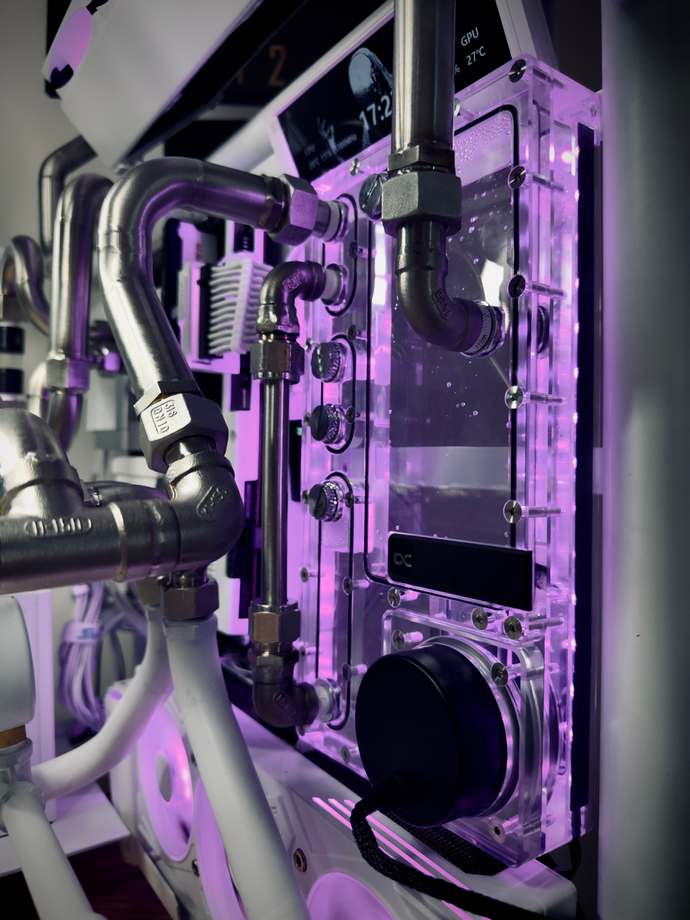
EZY: The first to join the adventure was Seasonic, who sent me a Vertex 1000 W. Then Thermal Grizzly provided me with thermal paste, a contact frame, and three WireView Pros ! EZDIY-FAB provided me with a GPU shield, which allowed me to position the graphics card exactly as I wanted in the build, as well as a 90° adapter for the 24-pin. Then Alphacool really helped me bring the concept to fruition: they sent me a Distroplate 240, three Apex fans, a Core 1 CPU waterblock, a filter, and a NexXxoS 360 mm radiator. Finally, Ergohide sent me a sit-stand desk for the project presentation.
OCC: Support that matched the ambition of the project. Your workshop is linked to your work and your approach to customization, isn’t it ?
EZY: Yes, definitely: without the brands, the project wouldn’t be what it is. Today, I’m a production manager in the industrial piping sector. I spent almost ten years as a welder and industrial pipe fitter, and that’s where the industrial DNA of the project comes from. I wanted to incorporate accessories that I use on a daily basis, particularly stainless steel : a noble but complex material.
Stainless steel at the heart of the process

OCC: Would you say that the choice of this material dictated the creative process ?
EZY: Absolutely. I chose stainless steel knowing some of the technical constraints, and others that I was not yet aware of. Some accessories already had their place in the loop before I even started.
OCC: So there were discoveries and lessons learned along the way ?
EZY: A lot. I started from scratch, and some processes were completely foreign to me. But I was able to count on a few people who helped me a lot. The most delicate part was the loop : industrial fittings are designed to withstand 30 to 40 bar, so they require a higher tightening torque than on a conventional loop. I really gritted my teeth when connecting to the distroplate and Core 1.

OCC: Are you satisfied with how it works ?
EZY: Yes, very happy: everything works perfectly. But I also feel a kind of melancholy : I love the process as much as the result.
OCC: Before we talk about what’s next, what will you take away from this Stealth ICE project ?
EZY: I’ll take away that you have to see your ideas through to the end. And that the hardware community is extraordinary : people much more skilled than me took me under their wing without hesitation.
[nextpage title=”Next steps, ambitions, and sharing”]
Next steps, ambitions, and sharing
OCC: Stealth ICE : how are you going to use it ? Can we expect to see you streaming with this machine, for example ?
EZY: Streaming is quite unlikely at the moment, due to lack of time. I’m going to take the time to discover it first, and maybe upgrade some of the components. What’s certain is that it’s likely to be with me for the next few years.
OCC: The call of a new project is still there : are you thinking of building another PC ? Something different ? Will we stick with an industrial and stainless steel theme ?
EZY: That’s for sure. I have lots of ideas, with completely different materials : maybe titanium, Inconel, or maybe I’ll stick with stainless steel. But one thing is certain, the industrial aspect will remain at the heart of everything I do.
For the moment, I’m likely to be quite busy with work. But I already have plans in my head. I’m thinking of a titanium frame, large quick-connect fittings, and a pump integrated into the frame. The frame would be an integral part of the loop.
An upgradeable machine ?
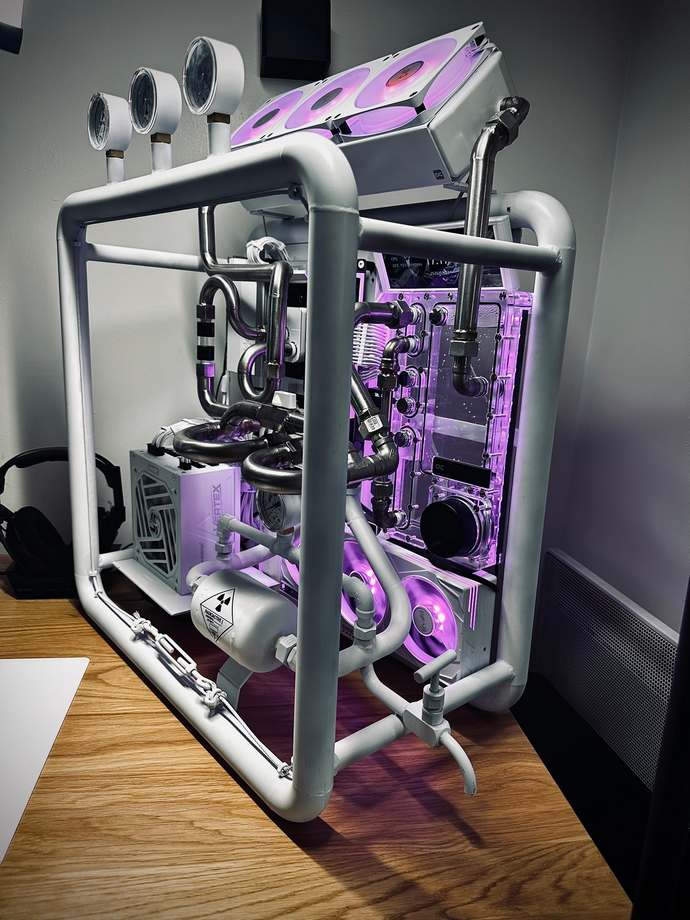
OCC: Could you add the GPU to the Stealth project loop at a later date ? Isn’t that too complex ?
EZY: It’s a possibility, but I don’t think this build will see any major improvements on the loop side: there’s very little room for additional tubes. I’d especially like to do that on a future build.
OCC: Looking back, would you do anything differently ?
EZY: I did what I could with the financial and time resources I had. I would have liked to have been able to film and photograph in better conditions, and devote more time to the video and photo part of the project. But that will come later.
OCC: Are you planning to offer tutorials ? Your skills could be a great asset to the community.
EZY: Why not ? I don’t consider my knowledge sufficient to give advice on PC assembly. However, when it comes to welding and hydraulics, I’m open to helping those who want to venture into that area. TIG welding requires a significant financial investment and solid technical skills, especially on small diameters.
OCC: Where can we talk to you if we want to know more ?
EZY: On Instagram, where I’m very active, on TikTok, or on Discord. I often visit OCC’s Discord, even though I’m fairly discreet.
OCC: Thank you very much. Would you like to add anything else ?
EZY: I would like to thank Nico and overclocking.com, who supported me throughout the project.
Thank you to Julien for taking the time to talk to us and share the behind-the-scenes story of this superb project. We met a passionate, humble, and talented creator. We can’t wait to discover his next adventure, as he is undoubtedly a rising star in the French modding scene.