

Nova Lake is eagerly awaited by all those who think Intel can still make a splash on the desktop PC market. But for the past few days, it’s been the Nova Lake-AX version that’s been the talk of the town. It could potentially be the Blue’s answer to AMD’s Strix Halo APUs. Raichu, one of Intel’s most reliable leakers, has confirmed a number of elements to give us an idea of what future Nova Lake-AX chips might look like. But, as with all things blue at the moment, nothing is simple and, beyond the configuration of these chips, it’s their arrival that is still very hypothetical, as he also mentioned.
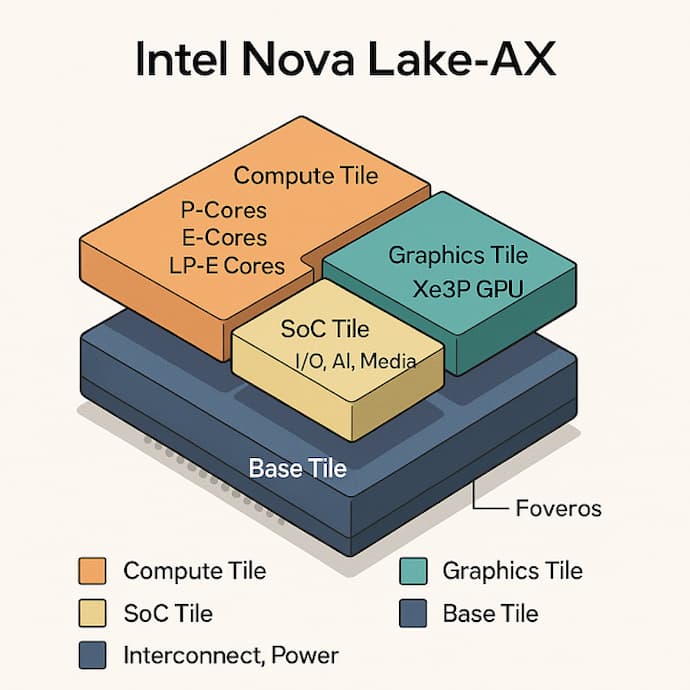
Nova Lake-AX: a monstrously theoretical APU…
But let’s get back to the configuration of this Nova Lake-AX chip. In order to have a graphics part that holds its own, Intel has removed one CPU tile, retaining only one compute tile equipped with eight “Coyote Cove” P cores and sixteen “Arctic Wolf” E cores. In addition, the SoC includes a low-power island with four cores, giving the APU a total of 28 CPU cores. For graphics, Arrow Lake-AX is expected to be based on the forthcoming Xe3 “Celestial” architecture, with 384 execution units (EUs).
If we consider an organization close to that of previous Intel GPUs, this would be equivalent to 48 Xe cores. To give a point of comparison, this exceeds the number of graphics cores present in some of Intel’s Arc dedicated graphics cards currently offered for desktop computers. To ensure the smooth operation of this iGPU, Intel plans to combine it with a 256-bit wide memory bus. As far as the memory subsystem is concerned, these APUs would be compatible with LPDDR5X memory, offering speeds of up to 10,667 MT/s.
Obviously, we’re still working on rumours. But if they prove to be true, we’d have a chip with simply spectacular asset specifications, capable of competing with AMD as well as Apple Silicon SoCs in configurations such as notebooks and mini PCs. While it’s quite likely that this chip is in Intel’s cartons, its arrival will be subject to estimates of its theoretical profitability. This seems to be the strategy that now governs all the new CEO’s decisions: focus on projects that pay off and avoid unnecessary risks for the time being. Finally, if by chance this project were to see the light of day, it’s the timing that would be crucial. Wouldn’t a release in the second half of 2026, like the desktop versions, already be too late?