

ASRock is also announcing a large number of motherboards at CES. The company is unveiling an astronomical number of boards: sixteen AMD, 20 Intel! Clearly, the brand is pulling out all the stops, and once again, there’s something for everyone. Of course, it goes without saying that most of the ranges are present. Let’s take a look at what the brand has cooked up for us.
Intel B860:
Steel Legend series:

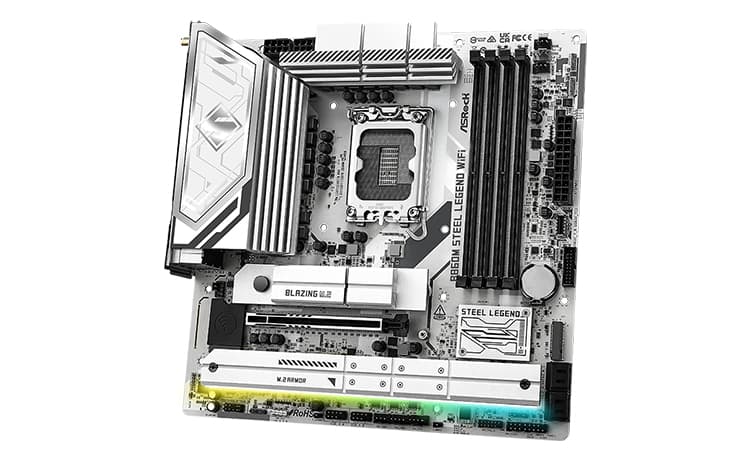
Let’s start with the brand’s Steel Legend series, with two models, the B860 and B860M Steel Legend. The program features motherboards in ATX and micro-ATX formats. Each model features a PCIe x16 5.0 slot and an M.2 slot, also interfaced with PCIe 5.0.
Apart from the format, the two boards are very similar in terms of features and functionality. In both cases, the boards feature four 8666 MT/s DDR5 memory slots or a power supply stage with 12+1+1+1+1 phases. Connectivity features 2.5 GbE Ethernet and 6E WiFi. Audio is provided by a Realtek ALC1220 chip.
Phantom Gaming Series:
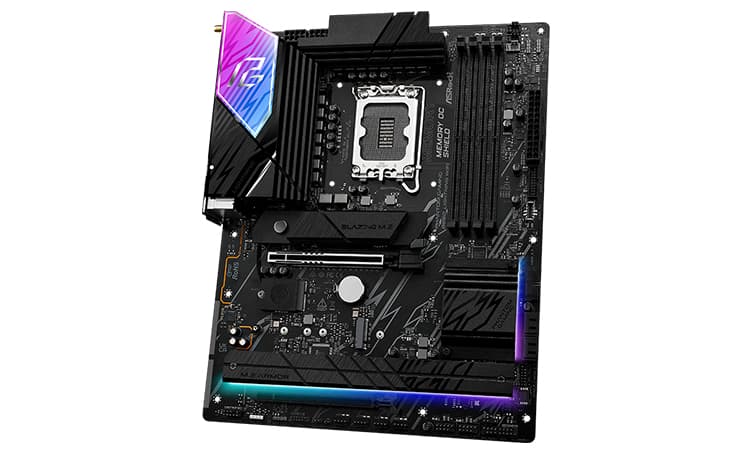
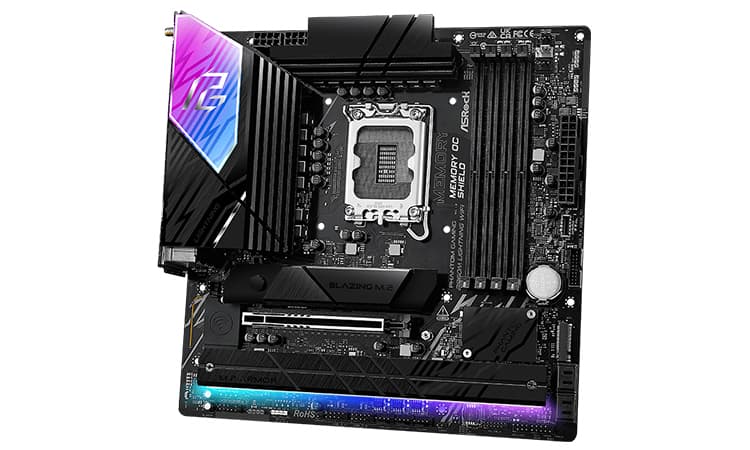
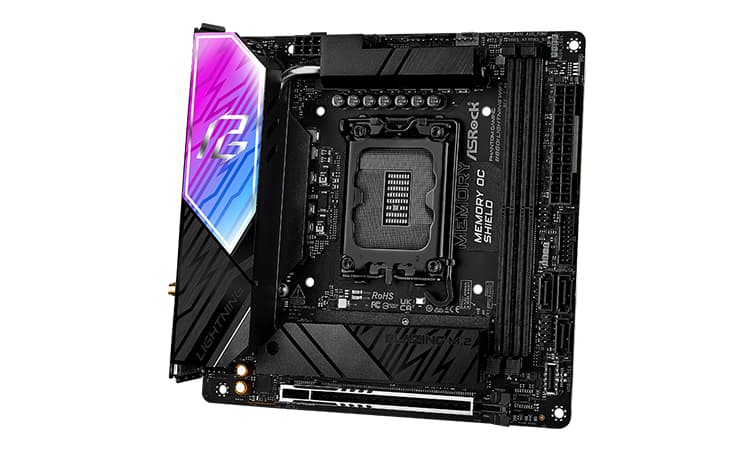
The Phantom Gaming series corresponds to the range of cards designed for gamers. The series comes in three models: the B860 Lightning WiFi, B860M Lightning WiFi and B860i Lightning WiFi. The range covers the three most common board formats: ATX, micro-ATX and mini-ITX respectively.
Broadly speaking, the ATX and micro-ATX models share the same layout as their Steel Legend counterparts. We find the same connectors positioned in the same places. However, there are a few differences, notably in terms of memory, with support for DDR5 at 8933 MT/s. Otherwise, the network part swaps the Dragon RTL8125BG for the Killer E3100G in 2.5 GbE… Except for the little B860I, which remains in Dragon.
The Pro range, 8 references!
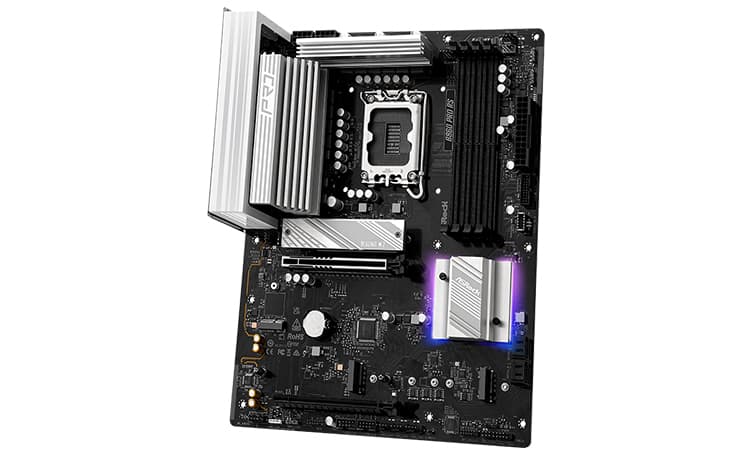
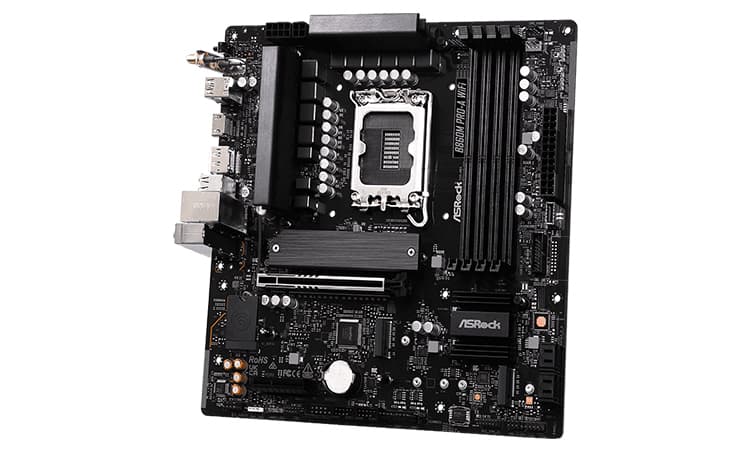
It’s in the Pro range that we find the most references: eight in all. Each model has its WiFi-free equivalent, all in ATX and micro-ATX formats. In short, there’s plenty to do.
Broadly speaking, these are rather affordable boards, with the RS versions a little more sophisticated, notably in terms of the VRM heatsink (10+1+1+1+1 phases), which includes an I/O cache. Otherwise, we find the same RAM support (8666 MT/s), the same network interface with a Dragon RTL8125BG and the same ALC897 audio.
LiveMixer, the series for content creators!
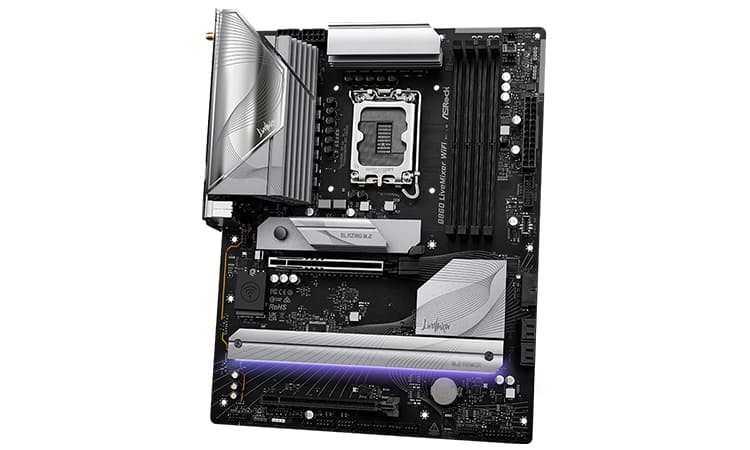
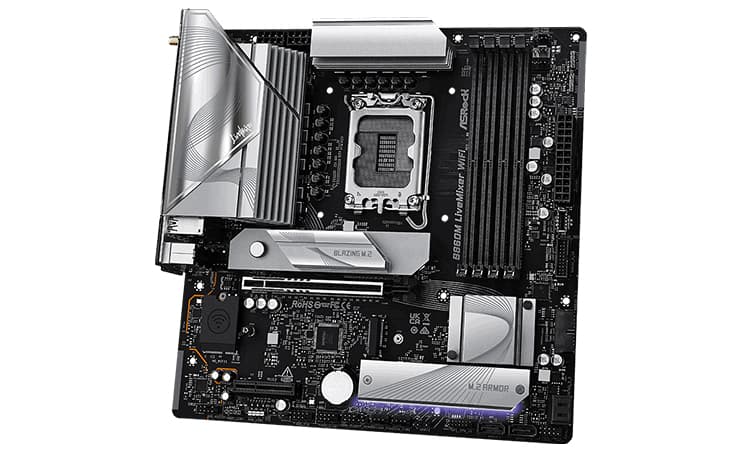
With its LiveMixer range, ASRock has set its sights on content creators with boards offering a wide range ofUSB options. On the I/O side of the ATX model, there are a total of 13 USBs, compared with ten for the other series. Otherwise, we have a stage comprising 12+1+1+1+1 phases for the B860 LiverMixer and 10+1+1+1+1 phases for the B860M of the same name, while RAM support is in 8666 MT/s. For audio, we’re using ALC1220 on both models, while networking is again entrusted to a 2.5 GbE Dragon RTL8125BG chip.
The regular series: four entry-level boards!
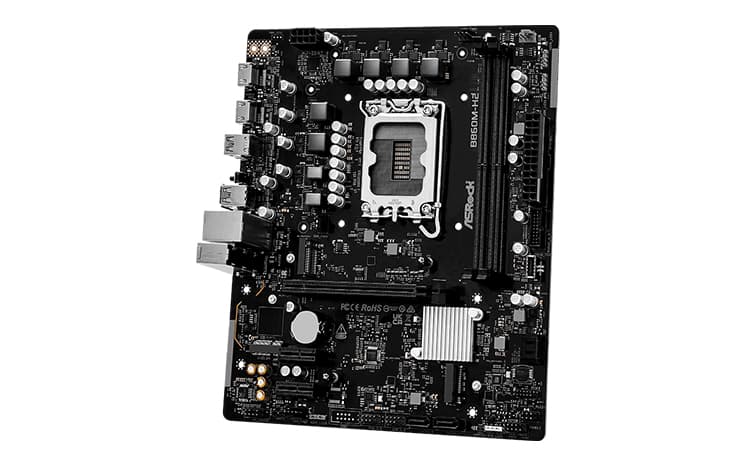
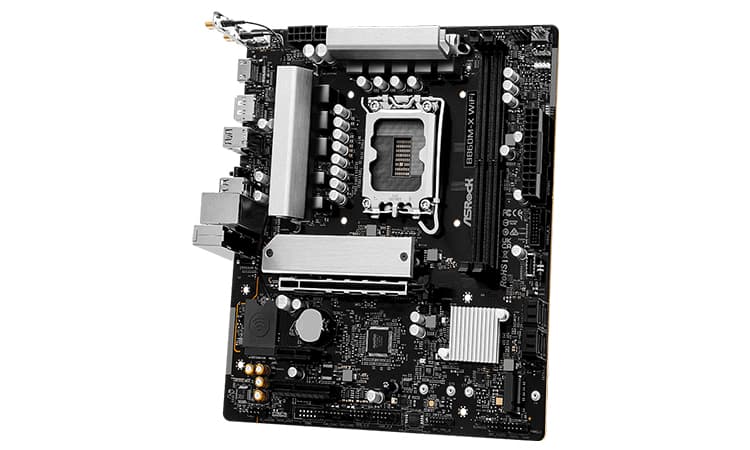
The following four cards are basic models with no great pretensions, but are also likely to be more affordable. The program includes :
- B860M-X WiFi
- B860M-X
- B860M-H2
- B860I WiFi
Clearly, the ITX model stands apart from the rest, as it features the largest power supply stage (8+1+1+1 phases), PCIe 5.0 for the SSD and graphics card. Networking is in Dragon RTL8125BG, while audio is in ALC897. RAM support includes DDR5 8933 MT/s.
The M-Xs share the same base, with WiFi being the only differentiating factor between the two boards. Here, we switch to a 7+1+1+1 phase power stage, while memory support increases to 9066 MT/s. On the network side, the RTL8125 BG is still present, while for audio, we’re faced with ALC897. However, PCIe 5.0 is lost for the graphics card, and is retained for one of the SSD‘s M.2 slots.
Finally, the little ASRock M-H2 is even more basic. VRMs are reduced to 5+1+1+1+1 phases, 2.5 GbE Ethernet is lost in favor of a 1 GbE port (8111H), and audio is in ALC897. RAM support drops to 8333 MT/s, but PCIe 5.0 is retained for the main M.2 slot!
Intel H810:
Two small micro-ATX boards:

ASRock is preparing two Intel H810 boards… One actually with a non-WiFi version. This model features 6+1+1+1 power supply phases and supports 6400 MT/s DDR5. As the H810 chipset is mandatory, PCIe 5.0 has disappeared altogether, and even the SSD won’t benefit from it. Otherwise, the brand is generous and integrates a 2.5 GbE Ethernet chip (RTL8125BG), while audio remains in ALC897.