

[nextpage title=”Introduction: “] Finally, we were lucky enough to get our hands on a Teamgroup Delta RGB 6400 CL40 DDR5 kit with Hynix memory chips. Like you, we are experiencing DDR5 availability problems and that’s why we had to buy this memory kit personally. It’s a real chance to have been able to buy one as the availability is so limited in Europe and globally. I might as well tell you straight away that the price stings because we bought it in England. We therefore had to go through the VAT and customs taxes. In the end, this kit (unobtainable) cost us the sum of 703.21 (purchase excluding VAT) + 156.74 (VAT/customs), i.e. a total of 859.95 euros. Now we really wanted to get our hands on a copy of this kit to test the potential of the Hynix chips in overclocking. You can find our test of the Kingston Fury Beast 5200 MHz CL40 DDR5 (Micron chips) and the G.SKill Trident Z5 5600 MHz CL36 DDR5 (Samsung chips).

We take a look at the kits available to us:
Since this is an article where we are going to do comparative tests, we thought it would be interesting to review the different kits in our possession. You will thus be able to know in detail the characteristics of each of them. You can also take a look at the section where our latest memory kit tests are available and find the one that interests you.

 So, a little comment on the choice of unit for the memory frequency. For several months now, manufacturers and many of our colleagues no longer use MHz to talk about the frequency of the memory. Either some use MT/s or Mbps. For our part, we are going to use MT/s for the time being while waiting to see what the new standard will be. Don’t hesitate to ask us your questions if you encounter any problems with the settings, either in comments or on our social networks. You can also join our community on the discord. [nextpage title=”Packaging description:”]
Description of the packaging :
The Teamgroup kit is delivered in a cardboard box with a sober colour code. The brand emphasizes the RGB of its kits, with a black and a white backlit module on the front. The labels of our two black modules can be seen on the back of the box thanks to a cut-out. The labels are enclosed and protected in a transparent plastic cover. On the back of the box there is also a label that informs the future buyer of the characteristics of the memory kit. Once the box is opened, we find our two modules perfectly protected in a transparent plastic shell.


There are currently three different versions. The range has kits from DDR5 6000, 6200 to DDR5 6400. All the current range benefits from Hynix chips.


Features and cooling:
Our kit is clocked at 6400 MT/s with timings of 40-40-40-84 requiring 1.35 volts to operate. It is made up of two 16GB arrays for a total of 32GB. We are here on full black at the level of the radiators. A white version is also available on the Teamgroup site but seems to be even rarer.


In terms of dimensions, we are looking at modules measuring 46.1(H) x 144.2(W) x 7(E) mm. The heatspreaders are made of aluminium and are black in colour. They are responsible for dissipating the heat generated by the ten-layer PCB and the memory chips. On the top of the module is the RGB backlight area, into which the addressable LEDs are inserted. The shape resembles the American stealth fighter aircraft. Our modules are of course compatible with RGB software from Asus, Gigabyte, MSI, Biostar and ASRock.


On the first side, there are several inscriptions, the name of the series as well as DDR5 and RGB. A cutout in the heatsink features the letter “R”. On the other side, a label shows some of the characteristics of our kit. As far as the price is concerned, it should be around 500 euros. The small number of kits available has pushed this kit up to over 800 euros.

To conclude this presentation, you should know that the kit is XMP 3.0(Extreme Memory Profile) compatible. So don’t forget to activate the profile directly via the bios of our motherboards. [nextpage title=”What’s new in DDR5: “]
The arrival of the Z690 chipset coincides with the arrival of new DDR5 memory modules. The main change is an increase in frequency and a higher capacity. Let’s be clear, it is not possible to use DDR5 modules on a DDR4 motherboard and vice versa. Even though DDR5 also has 288 pins, the notches do not match and this is deliberate so that no disasters occur.
The arrival of the PMIC module:
The big novelty of DDR5 is the presence of a PMIC(Power Manager Integrated Circuit) module. Its role is to regulate the power supply to the memory stick. There is therefore one per strip. It will use the 5 volts of your motherboard and convert it to provide the necessary voltage to your kit. For example, if your kit needs 1.1 volts, each chip will receive 1.1 volts.

Previously, the motherboard was responsible for doing this. In reality, this has both an advantage and a disadvantage. The advantage is that manufacturers no longer have to provide this control on the motherboard PCB. So, a financial gain. But unfortunately, there are two types of PMIC. One is locked and will only accept the default values of your kit, called secure mode. The other type of PMIC is modifiable and will therefore allow the voltage to be raised above 2 volts. Fortunately, Asus on its Z690 APEX, has already started to bypass the restriction of the secure mode in order to reach 1.435 volts. We talked about this in detail in the article on the APEX.


The other issue is the heat release of this chip and the additional cost for a DDR5 kit. Personally, we did not notice any additional heat release during our tests. As far as pricing is concerned, it will be higher and will also depend on availability.
Higher frequencies and lower voltage:
So what’s changing? Firstly, manufacturers seem to be favouring 16GB arrays and therefore dual channel kits in 2 x 16 or 2 x 32GB whereas we are used to 2 x 8GB for DDR4. The frequencies are also on the rise with kits that start at 4800 MT/s whereas the standard seems to be 3200 MHz in DDR4 and which can currently reach 7000 MT/s at G.SKill. Finally, high frequencies mean (much) more relaxed timings.

The voltage is also improved as it can be reduced to 1.1 volts for DDR5 compared to 1.2 volts for DDR4. We are talking about a voltage of 1.1 volts for DDR5 kits at 4800 MT/s. The voltage will be higher if the frequency increases as you will see below.
ECC (Error Correcting Code) compatible with DDR5
DDR5 arrays will be able to incorporate ECC(Error Correcting Code). Uh, yes? The idea of this module is to detect possible errors and analyze them before sending them to the CPU. Now, this module won’t be available on all chipsets as this will increase the price of the kit. While we’re on the subject of price, these should unfortunately be (much) higher.


XMP 2.0 (DDR4) and XMP 3.0 (DDR5) changes:
We are moving from XMP 2.0 for DDR4 to XMP 3.0 for DDR5. What changes initially is the possibility for a manufacturer to offer three different XMPs for its memory kit. These must be enabled in the BIOS.

The other big development is the ability to register your own XMP. To put it simply, you can optimize timings and tensions and then write your own XMP. Once “burned” on your memory stick, you will be able to choose this XMP within the BIOS. This is of course a feature that we will come back to in detail in a dedicated article. [nextpage title=”How to identify your memory kit: “]
The basic features :
You’ll tell me that it’s quite easy since you just have to look at the references announced by the manufacturer. Yes, but that’s not enough, especially if you plan to overclock it! Some information is given by the manufacturer, but you’ll have to dig or even remove the heat sinks to find out the others. On one side of the heatsink you will find the inscription “DDR5 RGB – T-Force – Delta” and on the other, a label with the technical specifications of our example. This is what we will look at in detail. For example, in the case of our example today, this is the information we know.
- The brand: Teamgroup
- Model: Delta RGB
- Capacity: 2 x 16 GB
- Frequency: 6400 MT/s
- Timings: 40-40-40-84
- Voltage : 1.35 volts
- Review: –
In order to get an idea of the overclocking potential of your kit, this information is insufficient and we will have to go further. Indeed, it is also very important to know the revision of the PCB as well as the model of the chips that equip your memory kit. Depending on this information, the overclocking performance of the kit will be very different.

To find this information, there is currently only one solution, dismantle the heat sinks. The Taiphoon Burner software does not currently support DDR5 kits. Moreover, there is no indication that this will be the case in the coming weeks.
CPU-Z still present :
Fortunately, our trusty CPU-Z software is always on hand to verify this information, including the type of chips in our kit. Currently, there are three types of chips: Samsung, Hynix and Micron.

CPU-Z confirms the manufacturer’s information with some additional information such as the type of memory chips, “SK Hynix”. We can also know the date of production of our kit which is here the week 44 of the year 2021 between November 1 and 7.
The PCB of our memory kit:
So, although I’m not shy about this sort of thing, for once I’m going to wait before removing the heatsinks so I can look at the PCB. Although I’ve never had any trouble during this operation, this kit is so rare nowadays that I’m not going to risk damaging it. As a reminder, the best technique is to heat the heatsink with a hair dryer before gently prying it off. We are well aware that the design of DDR5 modules is different from DDR4 with the presence of an on-board PMIC (power management integrated circuit) chip. The idea is to allow for better power management and therefore system stability.

Our kit benefits from the 8 Hynix chips. We are on a kit called “SR” for single rank, which means that all the chips are on one side. On the other hand, we can find “DR” kits for dual rank with chips on both sides of the PCB. [nextpage title=”The importance of the XMP profile: “]
Setup within the bios:
It can’t be said enough, but the settings of your memory kit are not automatically set after you install it. If it is the case for your processor, it is not the case for your memory kit and a passage through the BIOS will be mandatory! You will be able to configure it manually, by choosing the right frequency, timings and voltage for your kit. For more convenience, we advise you to activate the XMP (Intel) or DOCP (AMD) mode in “AI Overclock Tuner” in order to set it up automatically. Without this, your performance will be impacted in all areas and you will end up with a kit that does not exceed 4800 MHz in CL40. So we will enable our XMP profile directly in the BIOS.


As we can see, the specifications of our kit are well respected with the XMP profile. We are at 6400 MT/s with timings of 40-40-40-84. As for the voltage, it is indeed 1.35 volts.


The Asus BIOSes, both on the APEX and the Crosshair models, benefit from RAMS profiles. They are a good basis for overclocking your memory kit. We will first use them in our overclocking tests. Our kit is now set up in the BIOS and will work with the manufacturer’s specifications.
[nextpage title=”Intel configuration test: “] Of course, this kit will only be tested on an Intel platform as AMD does not currently have any motherboards supporting DDR5.
- Motherboard: ROG Maximus Z690 APEX (BIOS 0053)
- Processor: Intel i9-12900K Alder Lake
- Memory : 32 GB Teamgroup Delta RGB 6400 MT/s 40-40-40-84
- Graphics Card: NVIDIA RTX 3070 Founders Edition
- Cooling system : Optimus Foundation + 480 mm EK radiator
- SSD: Western Digital SN850 NVMe SSD M.2
- Power supply: be quiet! Dark Power PRO 12 1500w
- Operating system: Windows 10 64-bit


Aida 64 :
 This is a software capable of providing you with a lot of information about your configuration but which has the particularity of having a memory benchmark. It will calculate the speed of reading, writing, copying and the latency of your memory kit. It is very often used to compare memory kits between them. It is an excellent tool if you want to compare the performance of your memory kit with those we have already had the opportunity to test. The version used for the tests is 6.50.2812 beta and we have used the performance of the previously tested kits.

Boom, well the least we can say is that it starts very strong and it is logical. The “reading” score under AIDA64 is mainly influenced by the frequency. Here, our sample of the day with its 6400 MT/s is logically far ahead with a score of 101343 MB/s. As a reminder, our best score in DDR4 was 61325 MB/s with the Corsair Dominator Platinum at 4800 MT/s CL19. As usual with an Intel platform, you should therefore favour frequency and tight timings.

In writing, the same is true with speeds soaring to 87331 MB/s. For information, the Corsair Dominator Platinum 4800 MT/s CL19 in DDR4 obtained 67251 MB/s. Once again, we note a gap between the different frequencies.

As a copy, our Teamgroup Delta RGB 6400 MT/s kit sees its speed rise to 88832 MB/s, which is an excellent score considering our kit is still with its original settings. The findings are identical in copy. The Corsair Dominator Platinum 4800 MT/s CL19 in DDR4 had a copy speed of 57330 MB/s. As you can see, it is in reading and copying that DDR5 has a very large advantage over DDR4.

Finally, latency. This is where all eyes are on this value as DDR5 lags a bit behind although our kit once again manages to take the lead with 64.3 ns. Our best DDR4 kit in this game was the G.SKill Trident Z Royal Elite 4000 MT/S CL14 which achieved 41.4 ns. You will notice that the higher the DDR5 frequency the smaller this gap becomes. Note that a 3200 MT/S CL16 DDR4 kit has a latency of 50.3 ns.
Geekbench 3.4.4 :
 It is a benchmark available in several revisions, version 5 having just been released a few weeks ago. It allows you to obtain two scores: one in single and the other in multi. Using this benchmark, we are going to focus on the performance obtained on the ” Memory Multi-Core ” score, which allows us to differentiate memory performance. The version used for the tests is 3.4.4.

For the Geekbench 3 benchmark, despite the fact that our i9-12900K has a single core frequency of 5.2 GHz, there is a difference in score between the four memory kits. The difference between the 4800 MT/s kit and our 6400 MT/s is 280 points. For your information, in DDR4, our best kit was the G.SKill Trident Z Royal 4400 MT/S CL16 with 5617 points.

In multi-core, the gap between our kits is less important but it does not change our top three. We’ll be sure to share with you the results obtained on an MSI Z690 platform coupled with DDR4 very soon so that you can judge the differences.

As soon as we isolate the memory score, real differences are visible between the kits. Our kit of the day gets a score of 10662 points! This is the first DDR5 kit that manages to break the 10K barrier out of the box.
Geekbench 5.2.5 :
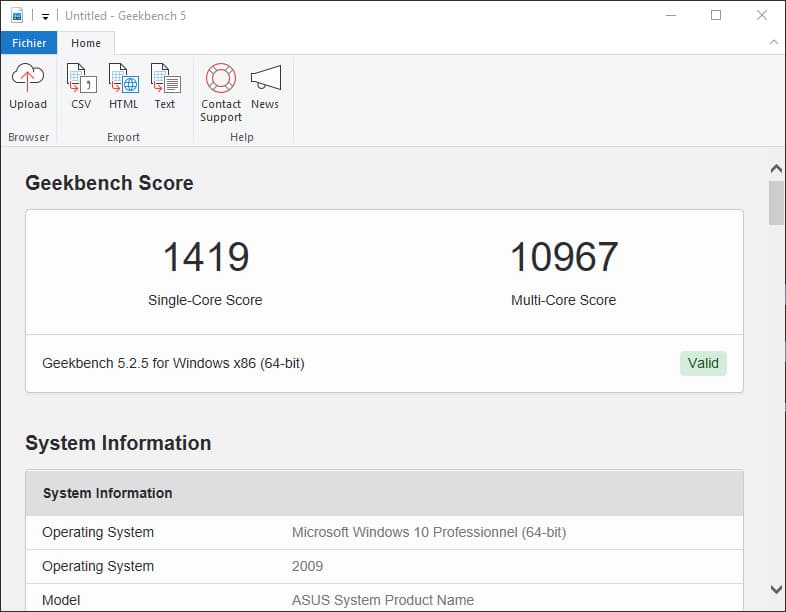 We decided to add this extra benchmark but why? The CPU benchmark uses new tests that more closely simulate the tasks that processors face in recent applications. Geekbench 5 also increases the memory used in the benchmark to better reflect the impact of this parameter on the CPU results. For now, we will keep both as version 3 is still widely used.

While in Geekbench 3 we had a difference in single core, here in version 5 the performance is almost identical and it’s still our sample of the day that takes the top spot.

Finally, the last score of our benchmark series with a total of 19259 points for our Teamgroup Delta RGB 6400 MT/S kit in 40-40-40-84. In short, as you can see, our sample of the day has simply achieved a flawless performance by taking first place in all our benchmarks. [nextpage title=”Overclocking on our Z690 APEX: “]
Choosing your DDR5 kit based on memory chips :
As was already the case with DDR4, if you want to clock your memory, some brands will have a better potential. Currently, the kits announced by the various brands benefit from either Micron, Hynix or Samsung chips. The latter two brands will be the most interesting. Our Teamgroup Delta 6400 MT/S CL40 kit is of course equipped with Hynix chips.
The “key” voltages of DDR5:
For memory overclocking, there are 4 key voltages. These are the voltages that will have an impact on the overclocking and therefore on the frequency rise or the tightening of the timings. These are the CPU System Agent Voltage (SA), DRAM VVD Voltage, DRAM VVDQ Voltage, Memory Controller Voltage and IVR Transmitter VVDQ Voltage. Here is where these voltages are located in the BIOS of our ROG Maximus Z690 APEX.


Beware, depending on the type of memory chips (Micron, Hynix and Samsung), the balance between these different voltages is different. Don’t panic, we’ll come back to this in detail in our guide on overclocking Alder Lake and DDR5. If your PMIC module is not locked, enabling ” High DRAM Voltage Mode ” will give you access to voltages up to 2 volts. Let’s go for overclocking this DDR5 from Teamgroup.
Step 1: The profiles of our APEX 6200 MT/s 36-35-35-52 1T
The first step is to go to the BIOS of our ROG Maximus Z690 APEX and more specifically to the timings section where profiles are waiting for us for the three current chip types: Micron, Samsung and Hynix.  Here, as you will have understood, we will opt for the highest profile for Hynix, namely the 6200 MT/s at 1.435 volts with timings of 36-35-35-52 1T. This profile launches without any difficulty and is perfectly stable to pass our three benchmarks: AIDA64, Geekbench 3 and Geekbench 5.
Step 2: personal profile 6400 MT/s 30-37-37-51 2T
This first profile is based on the screens that I could see on the internet and the information that I could collect during the last days. It is also important to know that thanks to the ROG team and Shamino in particular, we received several BIOS patches in a few hours. We also used version 0053 for our tests.


Step 3: best personal profile 6600 MT/s 30-38-38-52 2T
Thanks to Safedisk’s advice, I set out to build my own profile since it was impossible to boot from the BIOS at 6600 MT/s. I was able to optimise a 6600 MT/s profile with timings of 30-38-38-50. Please note that the impact of subtimings is also very important. In order to push the whole thing to the maximum, I opted for 5300 MHz on all the P cores and I was even able to raise the BCLK to 101 or 101.5 MHz to reach 6666 MT/s Geekbench 3 and 6700 MT/s AIDA64.


I hope to improve these scores in the coming days by continuing to optimize the subtimings.
Overclocking performance summary :
Here are our updated test charts so you can see the gains from overclocking in the different benchmarks we use. We’ve added the benchmark scores as well as those obtained with the three profiles above. Let’s start with AIDA64 to see the impact of overclocking our kit on throughput.


As you can see, the basic performance was already excellent and our different profiles still allow us to significantly improve our scores. Under AIDA64 in reading, we exceeded 106K. But it is especially the “writing” and “copying” scores that are exploding! Let’s go to Geekbench 3 to observe the memory performance score which is often the one that climbs the most. And it is indeed the case, since for the first time, we managed to exceed 13K.


Finally, let’s finish with Geekbench 5 in version 5.2.5. The same observation, even if it is less obvious on our two graphs, the scores are still improving even if here, the GSKill kit and its Samsung chips compete much better.


Now that our various tests are over, it’s time to conclude.
[nextpage title=”The final word: “] I had a lot of fun with these Hynix chips on these Teamgroup Delta RGB 6400 MT/s CL40 modules. Now, let’s be honest, this is DDR5 memory we are discovering. I have spent dozens of hours testing the modules but more importantly I have mastered the overclocking of DDR5. And what I can tell you is that I am far from having acquired all the subtleties. As you can see, the performance is there with a kit that dominates all those we have previously tested. The frequency is of course a big part of it, but the overclocking potential of the Hynix chips allows you to go even further in terms of performance. We’re far from finished with these modules as we’re still working on subtimings to get them past the 14K barrier under memory in Geekbench 3. We also intend to stick our DOD on them to see how they behave under cold conditions before a possible switch to LN2.
The price, if availability returns to “normal” should also be very interesting and make this kit the one to buy. We know that Teamgroup will soon be offering modules with Samsung chips.
Teamgroup Delta RGB 6400 MT/s 40-40-40-84
We liked :
- The look of the heatsinks with an aesthetically pleasing RGB
- The quality of finish of the memory modules
- The low height of the heatsinks allows great compatibility with the fans
- The general performance of DDR5
- The excellent overclocking potential of the Hynix chips and the BIOS of our APEX
- Lifetime warranty
- The fact that it is fun to clock the Hynix chips
We would have liked :
- A less precarious availability which results in excessive prices
 A real favourite, this Teamgroup Delta RGB 6400 MT/s CL40 kit has given us many hours of research to optimize our overclocking profiles knowing that it is not yet finished. Let’s hope that DDR5 production will improve in the coming weeks so that we can more easily find this Teamgroup Delta RGB kit. Special thanks to the ROG team for the King Shamino BIOS and the advice of Safedisk and Kevin Wu from Teamgroup!