

Once again, the Core i7 14700K is the subject of a leak, as the processor is featured in a number of tests. This time, the results are obtained from an ” ES ” model. It can be seen in particular on Cinebench R23, as well as on a number of games.
i7 14700K gains are on the agenda, some of them significant!
As a reminder, this processor arrives as a refresh of the previous generation. However, it brings a number of improvements, notably in terms of the number of cores. This i7 will feature 8 P-Cores and 12 E-Cores, whereas the 13700K has 8 P-Cores and 8 E-Cores. There’s also an increase in the total amount of L3 cache memory, up to 33 MB from 30 MB for the 13700K. But this goes hand in hand with the increase in the number of E-Cores. Last but not least, the frequency is also increased: up to 5.6 GHz vs. 5.4 GHz for the current CPU.
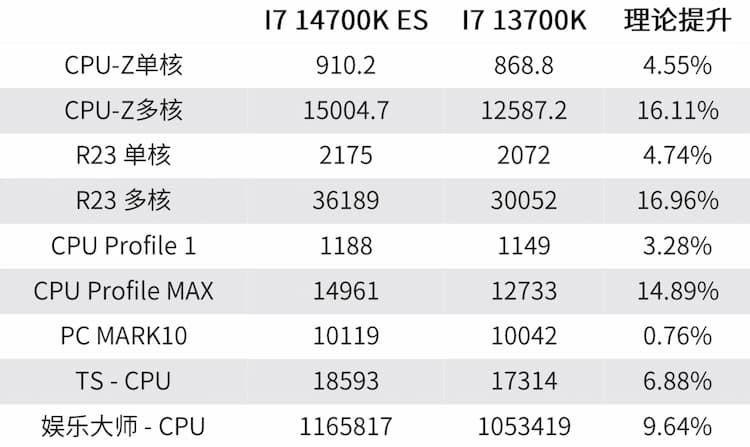
In terms of performance, this ES model already boasts performance gains that can be massive in multi-threaded mode. These include 16.96%, ~17% on Cinebench R23 and 16.11% on CPU-Z multi-threaded. The other big percentage is on CPU Profile MAX, with scores up 14.89% on the i7 13700K. Otherwise, in mono-threaded mode, we can expect gains of around 5%, mainly due to higher frequencies.
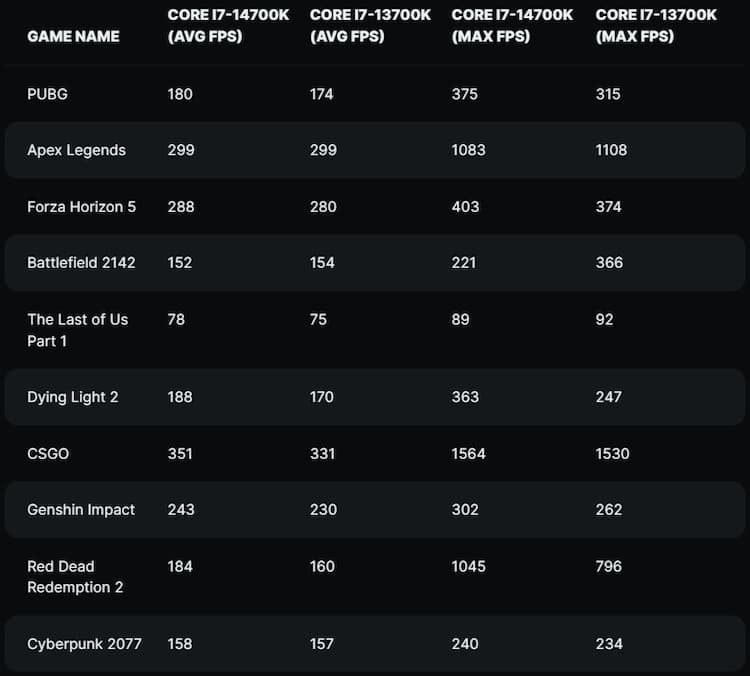
Now in games, results are better overall, sometimes quite significantly so. CS:GO comes to mind, where the average framerate rises from 331 FPS to 351 FPS with this 14700K. On Battlefield 2042, this Engineering Sample does slightly less well, while average framerates don’t budge much on Apex Legends or Cyberpunk 2077. But this can be explained by the lack of optimization of microcode or frequencies linked to the fact that this is an ES copy. It wouldn’t make sense to have a worse CPU than the previous one when it shares the same architecture and offers higher frequencies and a higher number of cores.
Finally, 20 cores in one CPU is starting to make itself felt, especially in terms of power consumption. In fact, the first readings indicate 300W of consumption at stock with a VCore of 1.35V. Apparently, this can be reduced to 260W at 1.30V VCore. As for temperature, you’ll need to arm yourself with a heatsink. We’re talking about 90°C exceeded in AIDA stress tests.