

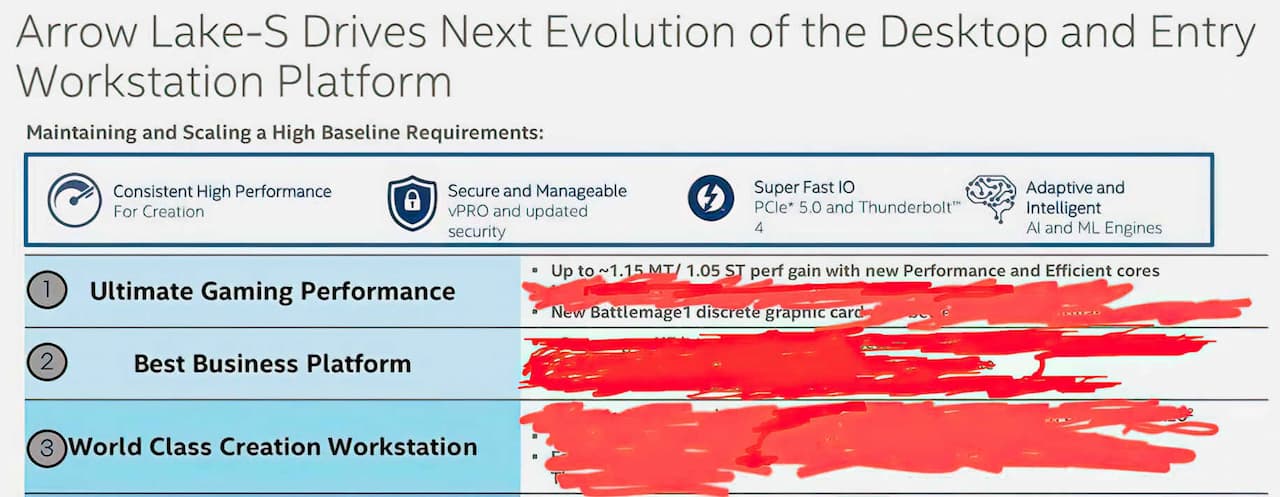
In a slide shared by uzzi38, we learn that Arrow Lake-S performance targets are pretty low after all. Indeed, the slide shows gains of 5% in single-core versus 15% in multi-core.
Arrow Lake-S: measured performance gains?
 Let’s take another look at the situation. We’re currently awaiting the Raptor Lake Refresh processors, Intel’s fourteenth-generation chipset. However, we shouldn’t expect anything new, since these CPUs are based on the same architecture as the current one. Only frequency gains are to be expected here. This is the result of the cancellation of Meteor Lake-S, which was originally intended to take its place.
With ARL-S, however, we’ll have the real novelty for the desktop segment. This generation would offer new P-Cores, the Lion Cove on the one hand. On the other, for the E-Core segment, we’ll find Skymont.
For the time being, we expect the largest model to feature a configuration equivalent to a Core i9 13900K… At least in terms of core count. If the crystal balls aren’t made of glass, we’re likely to see CPUs offering a maximum of 8P16E. As for cache memory, it should reach 3 MB of L3 per core. Last but not least, all this should benefit from engraving using the Intel 20A process in 5 nm, which Intel opposes to the 2 nm of its competitors.
As for performance, this is where the slide comes in, as it reveals the projected performance for this generation. We learn that Intel is forecasting around 5% performance improvement in single-core, versus 15% in multi-core. What we don’t know, however, is how old this slide is.