

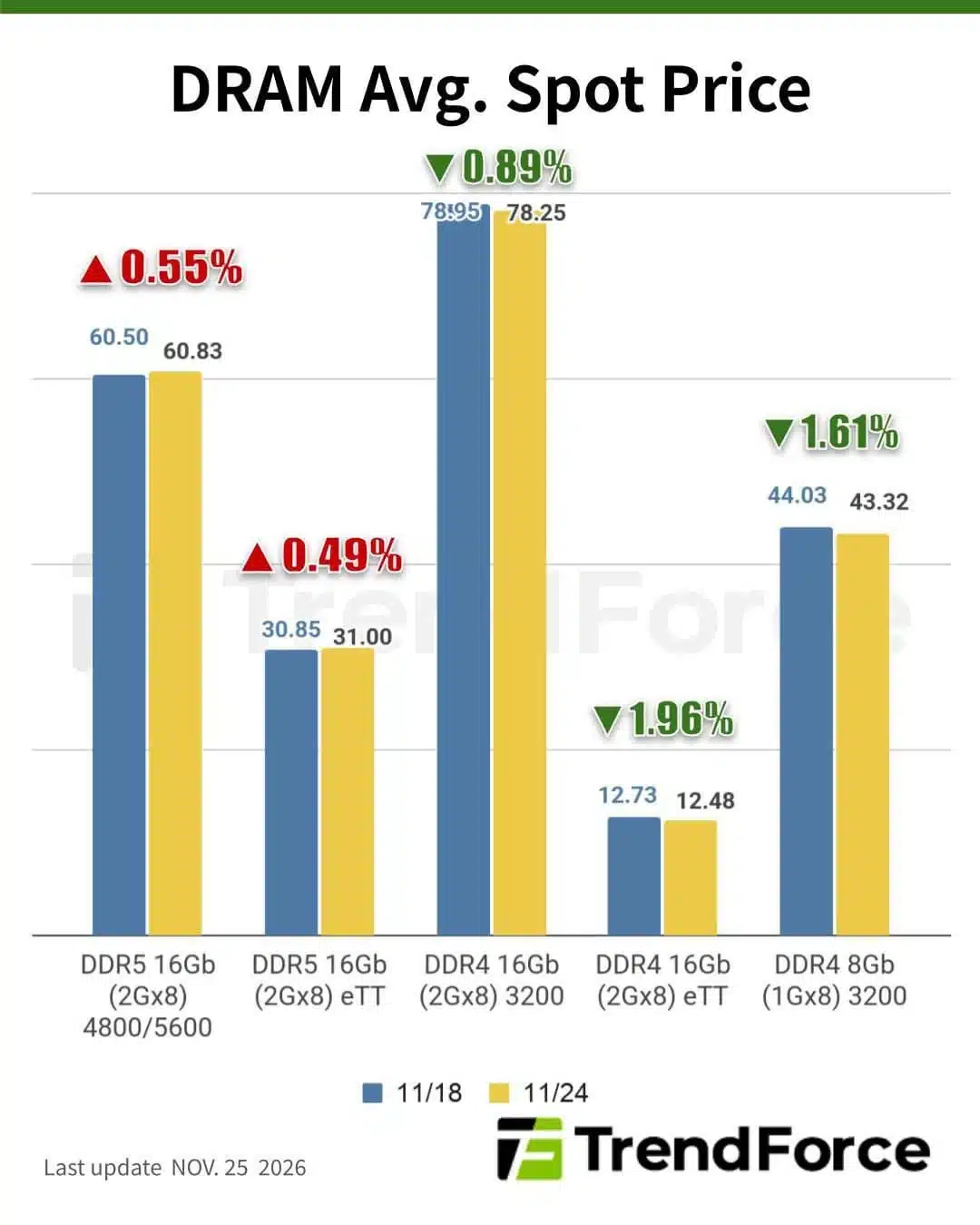
The RAM market, which has seen rapid price increases in recent months, appears to be entering a cooling-off phase. According to analyses by TrendForce, spot prices for DDR4 and DDR3 are now falling, while forecasts for contract DRAM price increases in 2027 have been revised downward.
Sluggish demand and geopolitical uncertainties
This slowdown is primarily due to increased caution among buyers. TrendForce notes that U.S. policies regarding data centers, as well as the current geopolitical landscape, are making demand harder to predict. At the same time, Chinese cloud service providers have reduced their demand for server DRAM, fueling fears of weaker-than-expected growth.
The consumer segment is following a similar trend. Very high prices have dampened consumer spending, prompting distributors and retailers to cut back on orders to focus on clearing their current inventory. As a result, demand for consumer DRAM could turn out to be weaker than expected in 2027.
Production Trends and Outlook for DDR5
On the supply side, the situation is changing. Major manufacturers such as Samsung, Micron, and SK hynix have massively shifted their production capacity toward high-bandwidth memory (HBM) for AI accelerators, which has reduced the availability of conventional DRAM. However, TrendForce notes that smaller manufacturers, such as Nanya and Winbond, are now helping to fill this gap in the consumer market.
Significant growth in consumer DRAM production is expected in 2027. Although volumes will remain below 2024 levels, this increase—combined with weaker demand and inventory liquidation—could rebalance the market.
However, this return to stability does not mean an immediate return to low prices. Contract prices for DDR5 are expected to continue rising next year, although the anticipated increase is now considered less significant than in previous forecasts. Prices are likely to remain well above the levels seen in 2024 and early 2025. As long as there is strong growth in the AI sector, the situation will remain tight.